Review
Volume 39; Suppl. 1
22 min
The changing epidemiology of multidrug-resistant bacteria in hospitals: from high-risk clones to clinical impact
Epidemiología cambiante de las bacterias multirresistentes en el ámbito hospitalario: de los clones de alto riesgo al impacto clínico
Desirèe Gijón-Cordero1 , Patricia Ruiz-Garbajosa1,2, Rafael Cantón1,2*
1Servicio de Microbiología, Hospital Universitario Ramón y Cajal and Instituto Ramón y Cajal de Investigación Sanitaria (IRYCIS), Madrid. Spain
2CIBER de Enfermedades Infecciosas (CIBERINFEC), Instituto de Salud Carlos III, Madrid, Spain
*Correspondence:
*Rafael Cantón. rafael.canton@salud.madrid.org
Publication:
09/11/2026
Metrics
268
Views
34
Downloads
Share
Share
Abstract (EN)
Multidrug-resistant bacteria (MDRB) have become a major challenge for healthcare systems, representing a leading cause of healthcare-associated infections worldwide. The hospital environment provides ideal conditions for the emergence and dissemination of these microorganisms due to intensive antimicrobial use, the concentration of vulnerable patients, frequent invasive procedures, and opportunities for cross-transmission. The epidemiology of MDRB is dynamic and varies according to geographic region, healthcare practices, and local antimicrobial selective pressure. This review briefly summarizes the current epidemiology of MDRB in hospital settings, focusing on the ESKAPE pathogens. Special attention is given to the emergence and international dissemination of the so-called high-risk clones, which have played a central role in the global spread of antimicrobial resistance. The review also addresses the principal epidemiological risk factors, transmission routes, the role of environmental reservoirs and colonized patients, and the contribution of intensive care units as major amplification points for MDRB transmission and maintenance. Moreover, infections caused by MDRB are associated with increased mortality, prolonged hospitalization, and higher healthcare costs. Continuous surveillance, rapid microbiological diagnosis, infection prevention and control measures, and antimicrobial stewardship programs remain essential to limit their spread and clinical impact. New genomic surveillance approaches are improving our understanding of transmission dynamics and supporting more potentially effective control strategies.
Keywords (EN):
Antimicrobial resistance
ESKAPE pathogens
Carbapenem-resistant enterobacterales
High-risk clones
Infection prevention and control
Abstract (ES)
Las bacterias multirresistentes (BMR) se han convertido en un reto para los sistemas sanitarios, ya que constituyen una de las principales causas de infecciones relacionadas con la asistencia sanitaria en todo el mundo. El entorno hospitalario ofrece condiciones ideales para su aparición y diseminación debido al amplio uso de antimicrobianos, la concentración de pacientes vulnerables, la frecuencia de procedimientos invasivos y las posibilidades de transmisión cruzada. La epidemiología de las BMR es dinámica y varía en función de la región geográfica, las prácticas sanitarias y la presión selectiva local ejercida por los antimicrobianos. Esta revisión resume brevemente la epidemiología actual de las BMR en entornos hospitalarios, centrándose en los patógenos del grupo ESKAPE. Se presta especial atención a la aparición y la diseminación internacional de los denominados clones de alto riesgo, que han desempeñado un papel fundamental en la diseminación mundial de la resistencia a los antimicrobianos. También se abordan los principales factores de riesgo epidemiológicos, las vías de transmisión, el papel de los reservorios ambientales y de los pacientes colonizados, así como la contribución de las unidades de cuidados intensivos en la amplificación, transmisión y mantenimiento de las BMR. Además, las infecciones causadas por BMR se asocian con mayor mortalidad, hospitalización prolongada y costes sanitarios más elevados. La vigilancia continua, el diagnóstico microbiológico rápido, las medidas de prevención y control y los programas de optimización de antimicrobianos siguen siendo esenciales para limitar su propagación e impacto clínico. Los nuevos enfoques de vigilancia genómica están mejorando nuestra comprensión de su dinámica de transmisión y de las potenciales estrategias de control.
Keywords (ES):
Resistancia a los antimicrobianos
Patógenos ESKAPE
Enterobacterales resistentes a carbapenems
Clones de alto riesgo
Prevención y control de infecciones
Introduction
Antimicrobial resistance (AMR) is recognized by the World Health Organization (WHO) as one of the top ten threats to global public health. In the hospital setting, AMR acquires critical relevance due to the concentration of vulnerable patients, the extensive use of antimicrobials, and the high probability of crosstransmission [1,2]. The term multidrug-resistant bacteria (MDRB) is applied to microorganisms that demonstrate resistance to three or more antimicrobial groups used in the treatment of patients infected by these microorganisms, provided that this resistance is of clinical relevance [3]. In recent decades, the sustained increase in these bacteria has transformed the epidemiological profile of healthcareassociated infections (HAIs), compromising medical procedures such as surgeries, transplants, mechanical ventilation, and chemotherapy [4].
Multidrug resistance arises from genetic determinants of resistance encoded at the chromosomal level or located in mobile genetic elements, facilitating horizontal gene transfer (HGT). The expression of these determinants results in the absence of the inhibitory or lethal effect of antimicrobials and increases the risk of clinical failure. HGT elements can increase the severity of the problem. They disseminate to susceptible bacteria, or even to those already possessing resistance, expanding the multidrug resistance profile and favoring the emergence of epidemic outbreaks, particularly in environments with high selection density such as hospitals. This process is associated with the so-called high-risk clones. They are defined as genetically related bacterial lineages characterized by enhanced biological fitness, successful transmission across healthcare and community settings, and the ability to acquire, maintain, and disseminate antimicrobial resistance determinants, often together with virulence traits, resulting in their widespread international distribution and major contribution to multi-drug resistant (MDR) infections [5]. These high-risk clones have emerged as a consequence of the “genetic capitalism” of the bacteria, for which those that are resistant to one antimicrobial agent or antimicrobial class are able to acquire more resistant traits [6].
The costs associated with AMR are substantial. Infections caused by these microorganisms lead to poorer clinical outcomes, prolonged hospital stays, and significantly higher mortality rates compared to infections caused by susceptible microorganisms.
Epidemiological burden of nosocomial infections due to multidrug-resistant bacteria
At a global level, it is estimated that infections caused by resistant bacteria contribute to more than 4.7 million deaths annually, of which approximately 1.14 million are directly attributable to AMR [2]. Hospitals are the primary setting for the emergence and spread of these infections [2]. Moreover, the WHO’s GLASS system integrates data on more than 23 million confirmed bacterial infections, with participants from 104 countries in 2023. This surveillance system has documented that between 2018 and 2023, one in six infections was antimicrobial-resistant, and 5-15% of pathogen/antibiotic combinations showed increasing annual resistance [1].
In the European Union and the European Economic Area (EU/EEA), more than 3.5 million HAIs occur annually, resulting in approximately 90,000 deaths. It is estimated that 71% of these infections are caused by antibiotic-resistant bacteria, including resistance to last-resort antimicrobials such as carbapenems [7]. Prevalence studies from the European Center for Disease Control and Prevention (ECDC) (2022–2023) show that 32% of microorganisms isolated in HAIs are resistant, with the highest burden found in Intensive Care Units (ICUs), hematology departments, and major burn units. EARS Net, the ECDC surveillance system, reported in 2024-2025 that the incidence of methicillin-resistant Staphylococcus aureus (MRSA) bacteremias continued to decline, while carbapenem-resistant K. pneumoniae infections increased by >60% compared to 2019, exceeding Europe’s 2030 targets [8]. Nevertheless, the US integrated community and hospital surveillance systems showed an overall 24% decline in carbapenem-resistant Enterobacterales between 2016 and 2020, although hospital-acquired cases remained stable [9]. These differences illustrate the relevance of local epidemiology and the need for continuous surveillance.
Primary multidrug-resistant bacteria in the hospital setting
The ESKAPE group encompasses six bacterial pathogens (Enterococcus faecium, Staphylococcus aureus, Klebsiella pneumoniae, Acinetobacter baumannii, Pseudomonas aeruginosa, and Enterobacter spp.) responsible for MDR nosocomial infections and for “evading” the action of available antimicrobials. These microorganisms are notable for their high capacity to adapt to the hospital environment, their association with high-risk clones, and their leading role in serious infections such as bacteremia, ventilatorassociated pneumonia, surgical site infections, and device-associated urinary tract infections (Table 1). Collectively, the ESKAPE group is responsible for 70–80% of nosocomial MDRB infections in highcomplexity hospitals [10]. Vancomycin-resistant Enterococcus faecium (VRE) is typically hospitalendemic and is rarely acquired in the community. Its epidemiology is characterized by a) predominance among patients with prolonged hospitalization, b) high prevalence in ICUs and hematology units, and c) the ability to persist in the environment for extended periods. In Europe, the incidence of VRE has been steadily increasing over the past decade, especially in tertiary care hospitals, where it can account for up to 25–30% of enterococcal isolates in nosocomial bacteremia [11,12]. Alongside VRE, MRSA remains one of the most important Gram-positive MDRB in healthcare settings and continues to represent a major clinical challenge. Although the incidence of MRSA has declined in some countries in northern and western Europe thanks to infection prevention and control (IPC) programs, it remains a key pathogen in hospital epidemiology, particularly in catheter-related bacteremia, surgical infections, and ventilator-associated pneumonia. Hospital-acquired MRSA is associated with clones well-adapted to the healthcare environment, distinct from community clones, and continues to serve as a marker for care pressure and failures in cross-transmission [11,12].
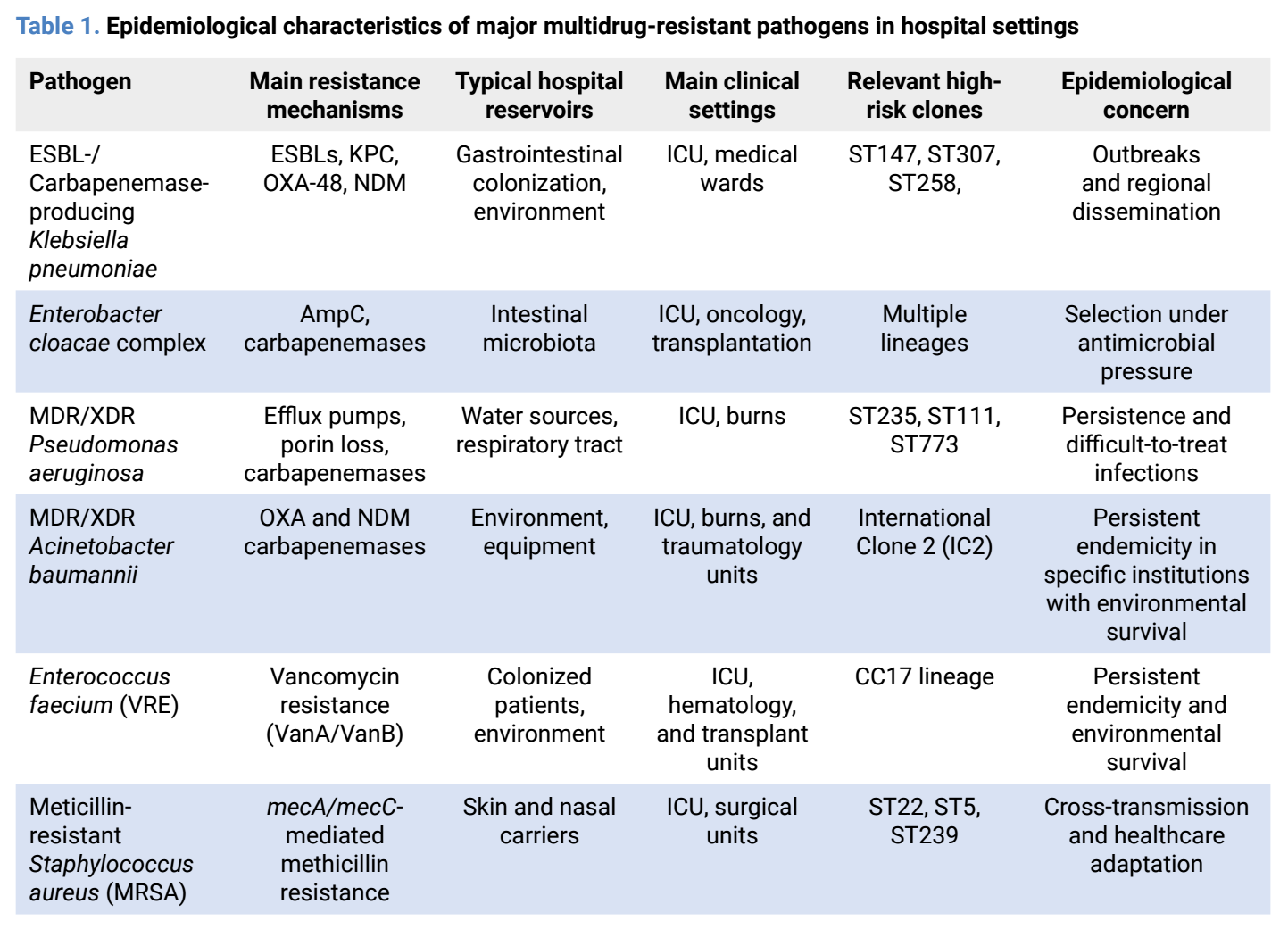
Among the Gram-negative pathogens, K. pneumoniae is currently one of the main contributors to the ESKAPE problem in hospitals, playing a central role in the epidemiology of Enterobacterales that produce extended-spectrum beta-lactamases (ESBLs) and/or carbapenemases (mainly KPC, OXA-48, NDM, and VIM variants). The main epidemiological characteristics are a) high capacity for clonal spread, b) persistent gastrointestinal colonization, and c) recurrent nosocomial outbreaks. In Southern and Eastern Europe, more than 50% of invasive K. pneumoniae isolates show resistance to third-generation cephalosporins, and carbapenem-resistant strains have increased dramatically in large hospitals, particularly in Italy and Greece [12,13]. Again, MDR is associated with high-risk clones such as ST307, which has increased worldwide and has even developed resistance to ceftazidime-avibactam or cefiderocol [14-16]. Moreover, species of the Enterobacter cloacae complex and other Enterobacterales exhibit inducible resistance to cephalosporins (AmpC) and the ability to acquire carbapenemases. Epidemiologically, they are commonly found in tertiary care hospitals and are associated with outbreaks linked to antimicrobial pressure [12,13]. In Spain, corresistance is a frequent feature with increasing prevalence, as well in K. pneumoniae, with the simultaneous production of two or three carbapenemases [17].
P. aeruginosa combines intrinsic and acquired resistance mechanisms with the ability to persist in biofilms. From an epidemiological standpoint, it is particularly common in ICUs, is associated with ventilator-associated pneumonia, and exhibits MDR, extremely-drug-resistant (XDR), and difficult-to-treat (DTR) phenotypes. Recent studies show an overall stabilization or slight decline of antimicrobial resistance, but with an increase in carbapenemaseproducing strains within the XDR subgroup [12,13]. This has been particularly observed in Spain and in other European countries [18]. These carbapenemases are mainly metallo-beta-lactamases of the VIM class and, more recently, of NDM associated with high-risk clones spread due to geopolitical situations [19].
Finally, Acinetobacter baumannii is the paradigm of an extreme hospital-acquired pathogen, almost exclusively restricted to healthcare settings. Its epidemiology is characterized by high endemicity in ICUs, prolonged survival on environmental surfaces, and a high frequency of MDR, XDR, and pan-drug-resistant (PDR) strains. In some Mediterranean countries, carbapenem resistance rates exceed 70–80%, making it one of the greatest current therapeutic challenges in hospital epidemiology [12,13]. Overall, the spread of A. baumannii has been associated with international clone 2 (IC2) worldwide, with the exception of Latin America, associated with IC5. In both clonal lineages, carbapenem resistance is high, associated with the production of OXA-23, OXA-40-like, and more recently, NDM carbapenemases [20]. Genomic sequencing in Chinese hospitals indicated that endemic strains of A. baumannii (ST2) dominate in ICUs, with transmission between wards and hospitals, confirming persistent hospital outbreaks [11,21].
Distribution by hospital areas and epidemiological risk factors
The ICUs present the highest incidence rates of MDRB, associated with invasive device use, broad-spectrum antibiotic therapy, and high colonizing pressure. Multicenter studies indicate incidences up to five times higher in the ICU compared to other services. Other areas with high prevalence include transplant units, hematology and oncology departments, dialysis units, and hospital-linked socio-sanitary centers. These areas function as epidemiological reservoirs and amplifiers within the healthcare network [22,23].
In the ICU, the environment has been recognized as a relevant reservoir for MDR microorganisms, which might persist over time in this compartment, given an opportunity for the acquisition of resistance determinants. This has been demonstrated in the follow-up of environmental isolates recovered on abiotic surfaces and when the latter are compared with isolates recovered from colonized or infected patients in the same ICU [24,25]. Again, high-risk clones play a relevant role in this scenario.
Overall, the main risk factors associated with MDRB infection or colonization include recent previous hospitalization, use of antibiotics within the last 3 months, stay in the ICU, presence of central venous catheters or other invasive devices, mechanical ventilation, immunosuppression, and severe comorbidity. From a demographic point of view, elderly patients and critically ill children present a higher relative risk [22,23].
Transmission mechanisms and epidemiological dynamics
The transmission of MDRB in the hospital setting is the central focus of the epidemiology of HAIs. Unlike the community, the hospital functions as a highly selective ecosystem where vulnerable patients, intensive use of antimicrobials, and a high density of healthcare contacts converge, promoting the emergence, persistence, and spread of resistant microorganisms. Understanding the transmission mechanisms and epidemiological dynamics of MDRB is essential for designing effective IPC strategies.
Main transmission pathways in the hospital
The most important mechanism of transmission of MDRB in hospitals is direct contact, primarily via the hands of healthcare workers (contact with colonized or infected patients, consecutive patient care without proper hand hygiene, and/or the handling of invasive devices). This mechanism explains the rapid spread of pathogens such as MRSA, VRE, and ESBL or carbapenemase-producing Enterobacterales. Suboptimal adherence to hand hygiene remains one of the factors most consistently associated with nosocomial MDRB outbreaks [26,27].
Many MDR bacteria have a high ability to survive in the environment, making the hospital setting a significant epidemiological reservoir (high-touch surfaces such as handrails, infusion pumps, and beds; shared medical equipment; rooms previously occupied by colonized patients; etc.). This mechanism is particularly relevant for carbapenem-resistant A. baumannii and VRE, which are capable of surviving for weeks or months on dry surfaces, facilitating hospital-acquired endemicity and prolonged outbreaks. This feature has also been demonstrated with K. pneumoniae and other Enterobacterales [24,25]. Moreover, in recent years, water systems, sinks, and drainage networks have emerged as important ecological niches for the persistence and dissemination of resistant bacteria, especially in high-risk settings such as ICUs. Several studies have documented the presence of identical environmental and clinical clones, supporting the role of these reservoirs in the acquisition and transmission of MDRB among hospitalized patients [25].
From an epidemiological perspective, colonization plays a major role in transmission dynamics (intestinal colonization [enterobacteria, VRE], skin or nasal colonization [MRSA], and/or respiratory colonization in ventilated patients [P. aeruginosa and A. baumannii]). Most nosocomial infections caused by MDRB are preceded by a colonization phase, which can persist for weeks or months. Colonized patients act as silent reservoirs, facilitating horizontal transmission without apparent clinical signs. Associated with this situation is the concept of colonization pressure that describes the presence of patients carrying MDRB and serving as a reservoir for cross-transmission to non-colonized patients. Colonization pressure has long been recognized as an important risk factor for the spread of these pathogens, including high-risk clones [28].
Central venous catheters, urinary catheters, endotracheal tubes, and implantable devices play a central role in the transmission of MDRB, as they breach the host’s natural barriers, facilitate biofilm formation, and allow bacteria to persist despite antibiotic therapy. This mechanism is critical in the epidemiology of mechanical ventilation-associated bacteremia and pneumonia caused by ESKAPE pathogens [29].
The movement of patients between hospitals, ICUs, long-term care facilities, and nursing homes contributes to the introduction and regional spread of MDRB (interhospital transfers, frequent readmissions, institutionalized chronic patients, etc.). This phenomenon explains the regional and international spread of high-risk clones, such as carbapenemase-producing K. pneumoniae ST11, ST147, ST258, or ST307, among others [30].
Epidemiological dynamics
The intensive use of broad-spectrum antibiotics creates selective pressure that promotes elimination of susceptible microbiota, spread of resistant strains, and colonization with high-risk lineages [31]. Units with the highest antibiotic consumption, such as ICUs, have significantly higher rates of MDRB, reinforcing the relationship between antimicrobial use and hospital epidemiology. The epidemiological dynamics of MDRB combine two patterns: a) clonal spread, predominant in K. pneumoniae, A. baumannii, and MRSA; and b) independent acquisition of resistance, common in P. aeruginosa [32]. The identification of high epidemic clones is essential for determining whether an increase in resistance is due to a true outbreak or a sporadic rise.
In addition to clonal spread, the HGT via plasmids or transposons plays a decisive role [33,34]. This phenomenon allows different bacterial species to share resistance mechanisms, accelerating the spread of resistance traits (e.g., carbapenem resistance and carbapenemases) and other critical resistance determinants within the hospital. MDRB can establish themselves in hospitals in the form of endemicity (constant circulation at low levels) [35] or epidemic outbreaks (sudden increases associated with control failures) [36]. Many hospitals experience both scenarios, with outbreaks occurring on top of a pre-existing endemic situation, particularly for resistant Enterobacterales and A. baumannii [37].
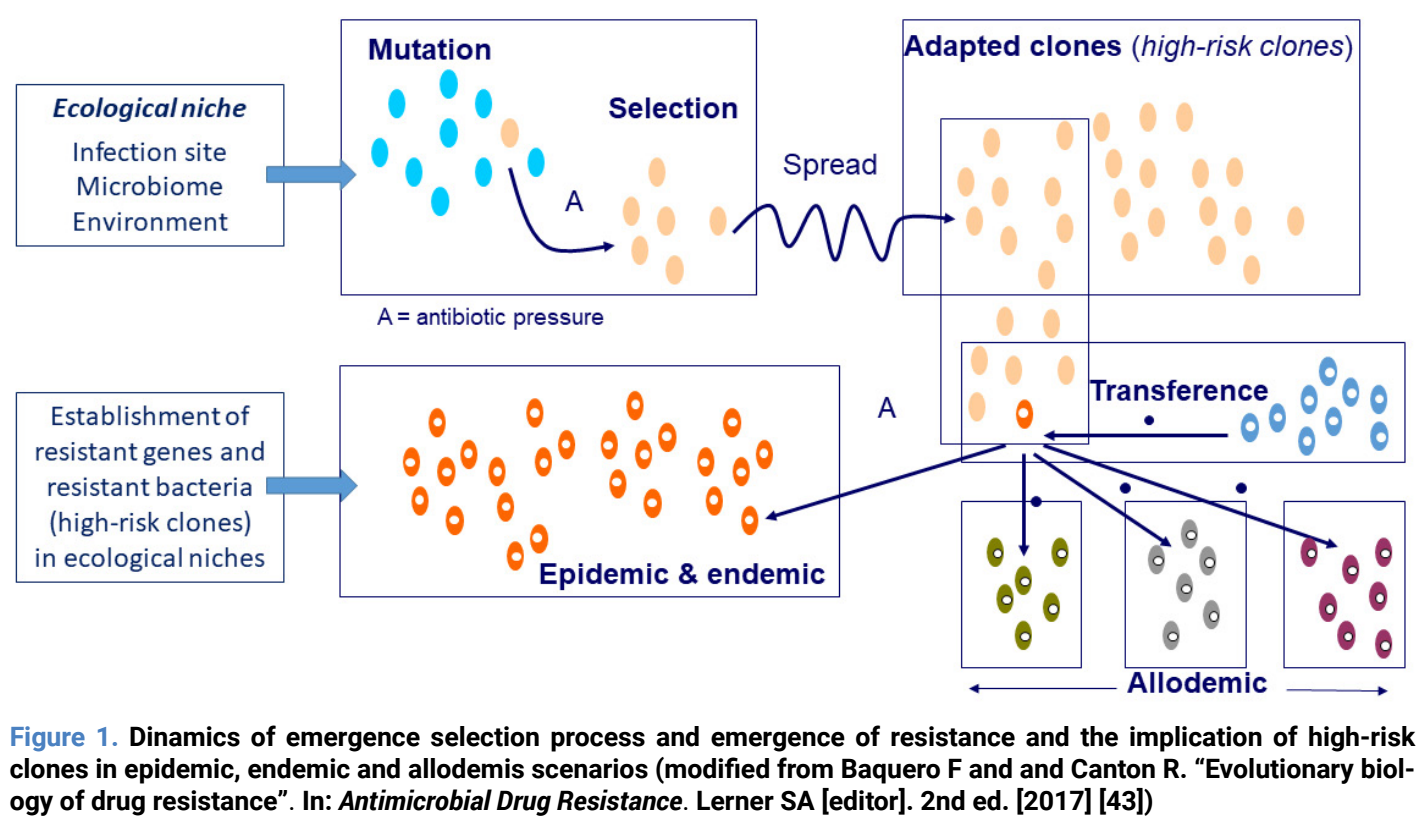
Another situation is that defined as “allodemics” by Baquero et al. [38], which describes an epidemiological spread of an antimicrobial resistance determinant across multiple bacteria within unrelated clones of the same bacteria or different species within an ecosystem, reflecting the dissemination of a resistance phenotype or genetic element rather than the expansion of a single epidemic clone (Figure 1). This scenario has been described with ESBL-producing Enterobacterales but might also be present in carbapenemase producers.
Epidemiological and control implications
Understanding transmission mechanisms and epidemiological dynamics has direct implications for IPC programs, colonization screening strategies, isolation and cohorting measures, and antimicrobial stewardship programs. Effective control of MDRB requires a multidimensional and sustained approach, based on active epidemiological surveillance, structural measures, and rapid diagnosis.
Clinical and economic impact
HAIs caused by MDR bacteria are associated with mortality and economical costs. A significant increase in mortality compared with infections caused by susceptible microorganisms has been demonstrated. A meta-analysis including more than 80 observational studies showed that antimicrobial resistance is associated with a 60% increased risk of death in HAIs [39]. Consistent with this, the Global Burden of Disease study estimated that in 2021, bacterial resistance was directly responsible for 1.14 million deaths, many of them related to serious HAIs such as bacteremia and pneumonia [2].
In most of the studies, economical cost is monitored with length of stay. HAIs caused by MDRB significantly prolong hospital stays. A recent meta-analysis estimated an average increase of 7 to 21 additional days of hospitalization, particularly in cases of infections caused by carbapenemase-producing Enterobacterales and A. baumannii [40]. This extended stay is accompanied by a greater need for invasive procedures, hospital readmissions, and clinical complications, which increases the burden on healthcare resources and the risk of new adverse events [28]. Moreover, antimicrobial resistance is associated with increased morbidity and healthcare resource utilization. Patients with MDRB infections experience higher mortality, higher rates of readmission (OR 2.17), and increased use of healthcare services, including emergency department visits [41]. Significant economic consequences have also been documented. Attributable costs have been estimated at up to approximately US$29,000 per episode in systematic reviews, while P. aeruginosa infections are among the most expensive nosocomial infections, with several studies reporting additional hospital costs ranging from approximately €15,000 to €28,000 per admission [42].
These data underscore the need to invest in IPC programs, epidemiological surveillance, and the prudent use of antimicrobials as cost-effective strategies to combat bacterial resistance [4,7].
Conclusions
Epidemiological surveillance remains a cornerstone for the control of MDRB in healthcare settings. National and international surveillance networks, including GLASS, EARS-Net, and CDC programs, are essential for identifying resistance trends, detecting outbreaks, and quantifying the burden of healthcare-associated infections. Current epidemiological patterns are heterogeneous. While some pathogens such as MRSA have declined in several regions, MDR Gramnegative bacteria, particularly carbapenem-resistant K. pneumoniae and A. baumannii, continue to emerge as major threats.
ICUs remain the epicenter of MDRB transmission because of the concentration of critically ill patients, extensive antimicrobial exposure, and frequent use of invasive devices. Colonized patients constitute the main reservoir for transmission, highlighting the importance of targeted screening and active surveillance strategies in high-risk populations. In addition, the persistence of pathogens such as A. baumannii and VRE in the hospital environment contributes to sustained transmission and complicates eradication efforts.
The clinical and economic consequences of MDRB infections are substantial, including increased mortality, prolonged hospitalization, and higher healthcare costs. Consequently, surveillance should be a component of a broader strategy integrating IPC measures and antimicrobial stewardship programs. Evidence consistently shows that sustained, multidisciplinary interventions are more effective than isolated control measures.
Emerging technologies, including whole-genome sequencing, automated surveillance platforms, and large-scale data analytics, are transforming the field by enabling earlier outbreak detection and improved understanding of transmission dynamics. Their integration into routine surveillance systems offers opportunities for more precise and proactive interventions.
Overall, the epidemiology of MDRB in hospitals reflects a complex and evolving challenge. Strengthening surveillance systems while integrating them with stewardship and IPC programs will be critical to reducing the clinical and economic burden of these infections and limiting the impact of antimicrobial resistance on modern healthcare.
Funding
The research conducted by RC, PRG, and DG is funded by CIBERINFEC (CB21/13/00084) and the Instituto de Salud Carlos III (PI2026/00135 and PI22/1283), Madrid, Spain.
Author contributions
Conceptualisation: D.G., P.R.-G., R.C.; Methodology: D.G., P.R.-G., R.C.; Investigation: D.G., P.R.-G., R.C.; Formal analysis: D.G., P.R.-G., R.C.; Writing – original draft: D.G., P.R.-G., R.C.; Writing – review & editing: D.G., P.R.-G., R.C. All authors have read and approved the final version of the manuscript.
Conflicts of interest
No commercial, financial, or personal conflicts of interest were identified in relation to the research, authorship, and/or publication of this article.
AI statement
No artificial intelligence tools were used in the writing, analysis, interpretation, or review of this article.
References
- World Health Organization. Global antibiotic resistance surveillance report 2025. Geneva: World Health Organization; 2025. Available from: https://www.who.int/publications/i/item/9789240116337 [Accessed 30 Jun 2026].
- Naghavi M, Vollset SE, Ikuta KS, Swetschinski LR, Gray AP, Wool EE, et al. Global burden of bacterial antimicrobial resistance 1990-2021: a systematic analysis with forecasts to 2050. Lancet. 2024;404(10459):1199-226. Available from: https://doi.org/10.1016/S0140-6736(24)01867-1
- Magiorakos AP, Srinivasan A, Carey RB, Carmeli Y, Falagas ME, Giske CG, et al. Multidrug-resistant, extensively drug-resistant and pandrug-resistant bacteria: an international expert proposal for interim standard definitions for acquired resistance. Clin Microbiol Infect. 2012;18(3):268-81. Available from: https://doi.org/10.1111/j.1469-0691.2011.03570.x
- Coque TM, Cantón R, Pérez-Cobas AE, Fernández-de-Bobadilla MD, Baquero F. Antimicrobial resistance in the global health network: known unknowns and challenges for efficient responses in the 21st century. Microorganisms. 2023;11(4):1050. Available from: https://doi.org/10.3390/microorganisms11041050
- Woodford N, Turton JF, Livermore DM. Multiresistant Gram-negative bacteria: the role of high-risk clones in the dissemination of antibiotic resistance. FEMS Microbiol Rev. 2011;35(5):736-55. Available from: https://doi.org/10.1111/j.1574-6976.2011.00268.x
- Cantón R, Ruiz-Garbajosa P. Co-resistance: an opportunity for the bacteria and resistance genes. Curr Opin Pharmacol. 2011;11(5):477-85. Available from: https://doi.org/10.1016/j.coph.2011.07.007
- European Centre for Disease Prevention and Control. Healthcare-associated infections: surgical site infections. In: ECDC. Annual epidemiological report for 2023. Stockholm: ECDC; 2026. Available from: https://www.ecdc.europa.eu/sites/default/files/documents/AER-20251013-SSI.pdf [Accessed 30 Jun 2026].
- Council of the European Union. Council recommendation on stepping up EU actions to combat antimicrobial resistance in a One Health approach (2023/C 220/01). Off J Eur Union. 2023;C220:1-20. Available from: https://eur-lex.europa.eu/legal-content/EN/ALL/?uri=CELEX:32023H0622(01) [Accessed 30 Jun 2026].
- Duffy N, Li R, Czaja CA, Johnston H, Janelle SJ, Jacob JT, et al. Trends in incidence of carbapenemresistant Enterobacterales in 7 US sites, 2016-2020. Open Forum Infect Dis. 2023;10(12). Available from: https://doi.org/10.1093/ofid/ofad609
- Morris S, Cerceo E. Trends, epidemiology, and management of multi-drug resistant Gram-negative bacterial infections in the hospitalized setting. Antibiotics (Basel). 2020;9(4):196. Available from: https://doi.org/10.3390/antibiotics9040196
- Low JA, Pang JS, Lim TCM, Parimannan S, Rajandas H, Chuah C. ESKAPE pathogens and antimicrobial resistance: emerging trends and therapeutic challenges. Future Microbiol. 2026;21(6):585-99. Available from: https://doi.org/10.1080/17460913.2026.2677420
- European Centre for Disease Prevention and Control. Antimicrobial resistance in the EU/EEA (EARS-Net) - Annual Epidemiological Report for 2024. Stockholm: ECDC; 2025. Available from: https://www.ecdc.europa.eu/en/publications-data/antimicrobial-resistance-eueea-ears-net-annual-epidemiological-report-2024 [Accessed 30 Jun 2026].
- European Centre for Disease Prevention and Control, World Health Organization Regional Office for Europe. Antimicrobial resistance surveillance in Europe 2023 - 2021 data. Stockholm: ECDC; 2023. Available from: https://www.who.int/europe/publications/i/item/9789289058537 [Accessed 30 Jun 2026].
- Huang X, Yao X, Hou Y, Zhang D, Xie R, Shi C, et al. Global trends of antimicrobial resistance and virulence of Klebsiella pneumoniae from different host sources. Commun Med (Lond). 2025;5(1):383. Available from: https://doi.org/10.1038/s43856-025-01112-1
- Budia-Silva M, Kostyanev T, Ayala-Montaño S, Bravo-Ferrer Acosta J, Garcia-Castillo M, Cantón R, et al. International and regional spread of carbapenem-resistant Klebsiella pneumoniae in Europe. Nat Commun. 2024;15(1):5092. Available from: https://doi.org/10.1038/s41467-024-49349-z
- Castillo-Polo JA, Hernández-García M, Morosini MI, Pérez-Viso B, Soriano C, De Pablo R, et al. Outbreak by KPC-62-producing ST307 Klebsiella pneumoniae isolates resistant to ceftazidime/avibactam and cefiderocol in a university hospital in Madrid, Spain. J Antimicrob Chemother. 2023;78(5):1259-64. Available from: https://doi.org/10.1093/jac/dkad086
- Cañada-García JE, Pérez-Vázquez M, Oteo-Iglesias J, editors. Vigilancia molecular de Klebsiella pneumoniae, Enterobacter cloacae complex y Escherichia coli productores de carbapenemasas en España. Informe anual RedLabRA 2023. Majadahonda (Madrid): Instituto de Salud Carlos III, Centro Nacional de Microbiología; 2025. Available from: https://cnm.isciii.es/redlabra [Accessed 30 Jun 2026].
- Sastre-Femenia MÀ, Fernández-Muñoz A, Gomis-Font MA, Taltavull B, López-Causapé C, Arca-Suárez J, et al. Spanish nationwide survey of Pseudomonas aeruginosa cefiderocol susceptibility and resistance mechanisms. Int J Antimicrob Agents. 2025;66(4):107563. Available from: https://doi.org/10.1016/j.ijantimicag.2025.107563
- Hernández-García M, Cabello M, Ponce-Alonso M, Herrador-Gómez PM, Gioia F, Cobo J, et al. First detection in Spain of NDM-1-producing Pseudomonas aeruginosa in two patients transferred from Ukraine to a university hospital. J Glob Antimicrob Resist. 2024;36:105-11. Available from: https://doi.org/10.1016/j.jgar.2023.12.022
- Müller C, Reuter S, Wille J, Xanthopoulou K, Stefanik D, Grundmann H, et al. A global view on carbapenemresistant Acinetobacter baumannii. mBio. 2023;14(6). Available from: https://doi.org/10.1128/mbio.02260-23
- Wang X, Xu T, Zhang Y, Qiu Y, Liang Y, Feng J, et al. Comparative genomic and resistance characterization of ST2 and ST164 carbapenem-resistant Acinetobacter baumannii from hospital environments and clinical specimens. Microb Genom. 2026;12(4):001679. Available from: https://doi.org/10.1099/mgen.0.001679
- Osman AH, Darkwah S, Kotey FCN, Odoom A, Hotor P, Dayie NTKD, et al. Reservoirs of nosocomial pathogens in intensive care units: a systematic review. Environ Health Insights. 2024;18:11786302241243239. Available from: https://doi.org/10.1177/11786302241243239
- Chea N, Li R, Eure T, Alkis Ramirez R, Nadle J, Lee JE, et al. Health care-associated infections in U.S. hospitals, 2023 versus 2015. N Engl J Med. 2026;395(3):255-66. Available from: https://doi.org/10.1056/NEJMoa2510881
- Aracil-Gisbert S, Fernández-De-Bobadilla MD, Guerra-Pinto N, Serrano-Calleja S, Pérez-Cobas AE, Soriano C, et al. The ICU environment contributes to the endemicity of the “Serratia marcescens complex” in the hospital setting. mBio. 2024;15(5). Available from: https://doi.org/10.1128/mbio.03054-23
- Hernández-García M, Nieto-Torres M, Guerra-Pinto N, Castillo-Polo JA, Saez de la Fuente J, Michelena M, et al. ICU environment asareservoir of KPC-ST307-Klebsiella pneumo niae high-risk clone resistant to ceftazidime-avibactam. Sci Rep. 2025;15(1):29486. Available from: https://doi.org/10.1038/s41598-025-14987-w
- Lotfinejad N, Peters A, Tartari E, Fankhauser-Rodriguez C, Pires D, Pittet D. Hand hygiene in health care: 20 years of ongoing advances and perspectives. Lancet Infect Dis. 2021;21(8). Available from: https://doi.org/10.1016/S1473-3099(21)00383-2
- Boyce JM. Hand and environmental hygiene: respective roles for MRSA, multi-resistant Gram-negatives, Clostridioides difficile, and Candida spp. Antimicrob Resist Infect Control. 2024;13(1):110. Available from: https://doi.org/10.1186/s13756-024-01461-x
- Bonten MJM. Colonization pressure: a critical parameter in the epidemiology of antibiotic-resistant bacteria. Crit Care. 2012;16(4):142. Available from: https://doi.org/10.1186/cc11417
- Bouhrour N, Nibbering PH, Bendali F. Medical deviceassociated biofilm infections and multidrug-resistant pathogens. Pathogens. 2024;13(5):393. Available from: https://doi.org/10.3390/pathogens13050393
- Cantón R, Gijón D, Ruiz-Garbajosa P. Antimicrobial resistance in ICUs: an update in the light of the COVID-19 pandemic. Curr Opin Crit Care. 2020;26(5):433-41. Available from: https://doi.org/10.1097/MCC.0000000000000755
- Fuzi M. The fitness connection of antibiotic resistance. Front Microbiol. 2025;16:1556656. Available from: https://doi.org/10.3389/fmicb.2025.1556656
- Miller WR, Arias CA. ESKAPE pathogens: antimicrobial resistance, epidemiology, clinical impact and therapeutics. Nat Rev Microbiol. 2024;22(10):598-616. Available from: https://doi.org/10.1038/s41579-024-01054-w
- Baquero F, Martínez JL, Lanza VF, Rodríguez-Beltrán J, Galán JC, San Millán A, et al. Evolutionary pathways and trajectories in antibiotic resistance. Clin Microbiol Rev. 2021;34(4). Available from: https://doi.org/10.1128/CMR.00050-19
- Evans DR, Griffith MP, Sundermann AJ, Shutt KA, Saul MI, Mustapha MM, et al. Systematic detection of horizontal gene transfer across genera among multidrug-resistant bacteria in a single hospital. eLife. 2020;9. Available from: https://doi.org/10.7554/eLife.53886
- Zahar JR, Lesprit P. Management of multidrug resistant bacterial endemic. Med Mal Infect. 2014;44(9):405-11. Available from: https://doi.org/10.1016/j.medmal.2014.07.006
- Cruz TPPS, Azevedo FKSF, Pepato MA, Rizzo PS, Souto FJD, Brenig B, et al. Whole-genome sequencing analysis of multidrug-resistant Serratia marcescens isolates in an intensive care unit in Brazil. J Infect Dev Ctries. 2024;18(5):726-31. Available from: https://doi.org/10.3855/jidc.18913
- Gijón D, Tedim AP, Valverde A, Rodríguez I, Morosini MI, Coque TM, et al. Early OXA-48-producing Enterobacterales isolates recovered in a Spanish hospital reveal a complex introduction dominated by sequence type 11 (ST11) and ST405 Klebsiella pneumoniae clones. mSphere. 2020;5(2). Available from: https://doi.org/10.1128/mSphere.00080-20
- Baquero F, Coque TM, Cantón R. Allodemics. Lancet Infect Dis. 2002;2(10):591-2. Available from: https://doi.org/10.1016/S1473-3099(02)00393-6
- Cassini A, Högberg LD, Plachouras D, Quattrocchi A, Hoxha A, Simonsen GS, et al. Attributable deaths and disability-adjusted life-years caused by infections with antibiotic-resistant bacteria in the EU and the European Economic Area in 2015: a population-level modelling analysis. Lancet Infect Dis. 2019;19(1):56-66. Available from: https://doi.org/10.1016/S1473-3099(18)30605-4
- Zhang L, Zhai W, Lin Q, Zhu X, Xiao Z, Yang R, et al. Carbapenem-resistant Enterobacteriaceae in hematological patients: outcome of patients with carbapenem-resistant Enterobacteriaceae infection and risk factors for progression to infection after rectal colonization. Int J Antimicrob Agents. 2019;54(4):527-9. Available from: https://doi.org/10.1016/j.ijantimicag.2019.06.023
- Barrasa-Villar JI, Aibar-Remón C, Prieto-Andrés P, Mareca-Doñate R, Moliner-Lahoz J. Impact on morbidity, mortality, and length of stay of hospital-acquired infections by resistant microorganisms. Clin Infect Dis. 2017;65(4):644-52. Available from: https://doi.org/10.1093/cid/cix411
- Poudel AN, Zhu S, Cooper N, Little P, Tarrant C, Hickman M, et al. The economic burden of antibiotic resistance: a systematic review and meta-analysis. PLoS One. 2023;18(5). Available from: https://doi.org/10.1371/journal.pone.0285170
- Baquero F, Cantón R. Evolutionary biology of drug resistance. In: Mayers DL, editor. Antimicrobial drug resistance: mechanisms of drug resistance. Vol. 1. Totowa (NJ): Humana Press; 2009. p. 9-32. Available from: https://doi.org/10.1007/978-1-59745-180-2_2
Explore
Articles
Volumes
About the journal
Most read
Recomendaciones para la prevención y el tratamiento de las infecciones respiratorias en adultos mayores institucionalizados
Revista Española de Quimioterapia
Características epidemiológicas de pacientes con aislamientos de Enterobacterales productores de carbapenemasas-NDM en un hospital de alta complejidad
Revista Española de Quimioterapia
Acute infectious gastroenteritis in childhood: the role of rapid multiplex molecular syndromic panels in diagnosis and clinical management
Revista Española de Quimioterapia
Review on the management of intra-abdominal candidiasis
Revista Española de Quimioterapia
Eravacycline: From broad-spectrum coverage to novel clinical applications
Revista Española de Quimioterapia