Review
Volume 39; Suppl. 1
9 min
Zoonoses and arboviruses: clinical impact of climate change
Zoonosis y arbovirus: impacto clínico del cambio climático
Francisco Javier Membrillo-de-Novales1* , Octavio Arce-García1, Wilmer Villamil-Gómez2, Amanda Guerrero3, Alfonso J. Rodríguez-Morales4
1CBRN and Infectious Diseases Department, Hospital Central de la Defensa “Gómez Ulla”, Madrid, Spain
2Life Sciences Research Center, Universidad Simón Bolívar, Barranquilla, Colombia; Committee on Tropical and Travel Medicine, Pan-American Association of Infectious Diseases
3Hospital Militar Central, Asunción, Paraguay
4Faculty of Health Sciences, Universidad Científica del Sur, Lima, Peru
*Correspondence:
*Francisco Javier Membrillo-de-Novales. javier@doctormembrillo.com
Publication:
09/11/2026
Metrics
300
Views
26
Downloads
Share
Share
Abstract (EN)
Climate change, global travel, and rapid urbanization are profoundly altering the epidemiology of infectious diseases. Rising global temperatures and the proliferation of ecotones have increased human-animal contact, driving the emergence of zoonoses and arboviruses. In Europe, the geographic expansion of vectors such as Aedes spp. and ticks has led to unprecedented outbreaks of Dengue, West Nile Virus, and Crimean-Congo Hemorrhagic Fever. This narrative review explores the clinical and public health impacts of these shifting paradigms, highlighting the urgent need to address Neglected Tropical Diseases and to adopt a global “One Health” approach to mitigate future health threats.
Keywords (EN):
Climate change
Zoonosis
Arbovirus
Neglected tropical diseases
Abstract (ES)
El cambio climático, los viajes globales y la rápida urbanización están alterando profundamente la epidemiología de las enfermedades infecciosas. El aumento de las temperaturas y la proliferación de ecotonos han incrementado el contacto humano-animal, lo que ha impulsado la aparición de zoonosis y arbovirosis. En Europa, la expansión de vectores como Aedes spp. y garrapatas ha provocado brotes sin precedentes de dengue, del virus del Nilo Occidental y de fiebre hemorrágica de Crimea-Congo. Esta revisión narrativa explora el impacto clínico y en salud pública de estos cambios, destacando la urgencia de abordar las enfermedades tropicales desatendidas y de adoptar un enfoque “One Health”.
Keywords (ES):
Cambio climático
Zoonosis
Arbovirus
Enfermedades tropicales desatendidas
Introduction
The global landscape of infectious diseases is undergoing a radical transformation. In recent decades, the frequency of emerging and re-emerging disease outbreaks has accelerated, largely driven by five major factors: global travel, urbanization, climate change, increased human-animal contact, and health worker shortages [1,2]. Rapidly changing ecosystems, particularly ecotones—places where distinct ecosystems converge—are serving as hotspots for novel interactions among wildlife, domestic animals, and human populations, significantly increasing the risk of pathogen spillover events [3].
An emerging concept within the One Health framework is the biogeography of infectious diseases, which integrates geography, ecology, biology, and medicine to understand the spatial and temporal distribution of pathogens, vectors, and hosts and to develop early warning systems for emerging infectious threats. This discipline examines how historical, ecological, climatic, geological, and evolutionary processes shape the distribution of organisms and influence the emergence and spread of infectious diseases [4].
Since 1900, global mean temperatures have increased by 1.1°C, with temperatures in the tropics approaching the thermal limits of organisms. These warming temperatures, combined with increased incidence of extreme weather events such as floods, are directly affecting the geographic range, intensity, and transmission dynamics of vectors and pathogens [5]. Floods alone result in severe health impacts ranging from injuries and communicable diseases (through contaminated water) to population displacement and interruption of critical healthcare systems. Furthermore, human migration patterns, shaped by both environmental disasters and socio-economic disparities, pose complex challenges to the prevention and control of infectious diseases across borders, as seen in transit areas such as the Darien Gap [6].
The enduring challenge of neglected tropical diseases (NTDs)
Neglected Tropical Diseases (NTDs) represent one of the most enduring contradictions in global health. The World Health Organization (WHO) recognizes 21 NTDs, caused by diverse viruses, bacteria, parasites, and fungi. These diseases burden over 1 billion people worldwide and require preventive or curative interventions for up to 1.5 billion individuals annually [7]
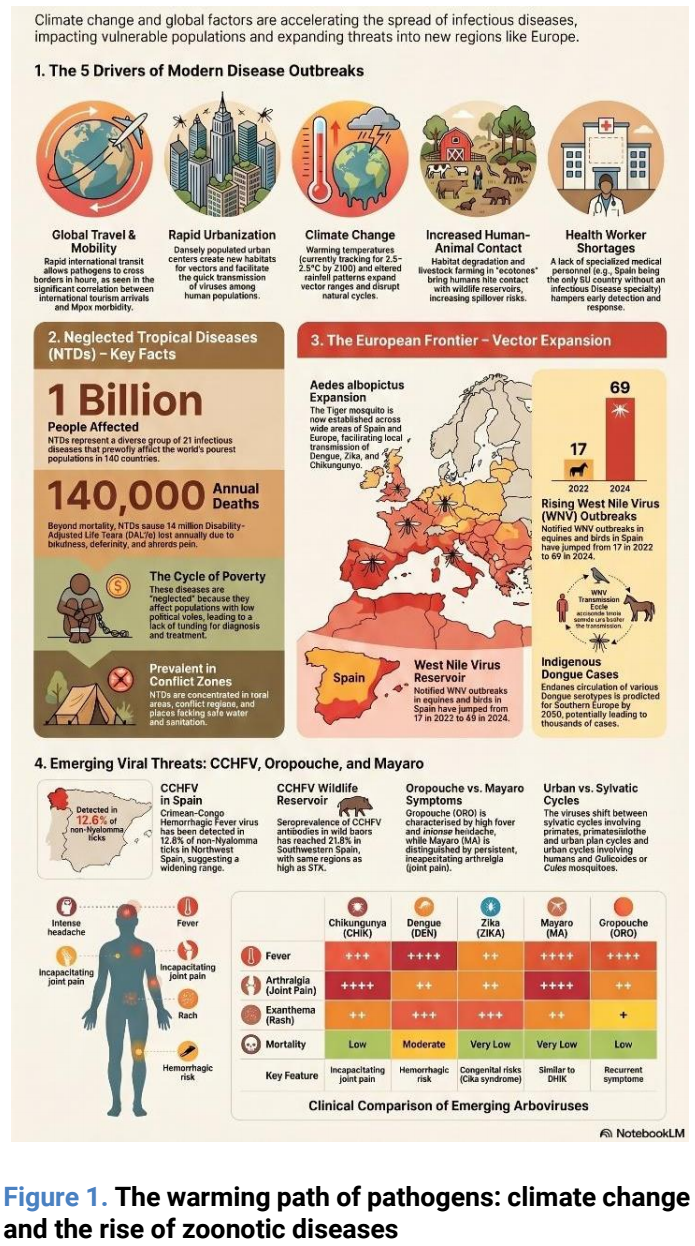
Despite their massive impact, NTDs are often misunderstood due to several pervasive misconceptions (Figure 1). NTDs cause massive economic losses, significant social stigma, and result in 120,000 to 140,000 deaths and the loss of over 14 million disability-adjusted life years (DALYs) annually. Breaking the cycle of poverty and disease requires integrating NTD interventions into national health systems and ensuring equitable access to diagnosis, treatment, and safe sanitation (Figure 1).
Arboviruses and zoonoses in a warming Europe
The thermal performance of vectors is shifting, allowing them to thrive at higher altitudes and latitudes and leading to longer transmission seasons. Consequently, diseases once confined to tropical regions are becoming a tangible threat in Europe. The projected spread of vectors such as Aedes aegypti and Aedes albopictus will significantly increase the global population at risk [8].
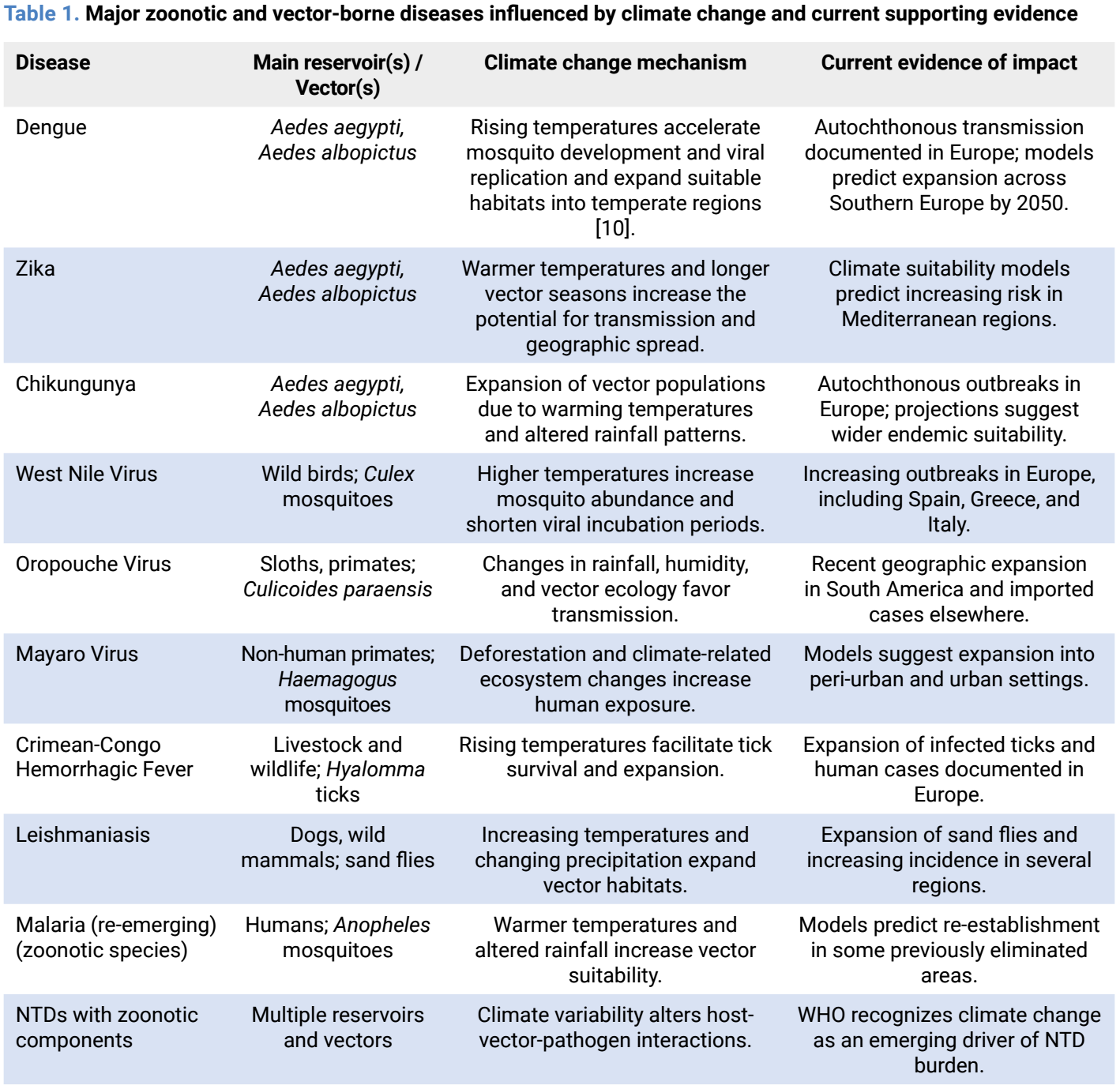
In Spain, the presence of Aedes albopictus is well-established, and autochthonous cases of Dengue have already been documented. Predictive models suggest a substantial increase in the risk of autochthonous transmission of dengue, chikungunya and Zika virus in southern and eastern Spain by 2050. The endemic persistence of these viruses could result in cases of hemorrhagic dengue, malformations in newborns (from Zika), increased West Nile virus encephalitis, and even the perilous reintroduction of malaria, which was eradicated in Spain in 1964. Outbreaks of West Nile Virus are already a public health reality, with numerous equine and avian foci reported in southwestern Spain between 2022 and 2024, facilitating spillover to accidental human hosts [9] (Table 1).
Similar associations between climatic and environmental changes and increased arboviral transmission have been reported in Latin America. In a municipality in Colombia, an unusual increase in dengue cases among adults older than 60 years was associated with changes in precipitation patterns, temperature, and vegetation dynamics identified through satellite-based environmental monitoring, highlighting the close relationship between ecosystem alterations and vector-borne disease risk [10].
Emerging viral threats: oropouche, mayaro and CCHFV
In addition to traditional arboviruses, pathogens like Oropouche (transmitted by midges such as Culicoides paraensis) and Mayaro are emerging as significant public health concerns [6]. Recent outbreaks of OROV have affected several countries in Latin America, leading to a growing number of imported cases in non-endemic regions. Although both infections often present as acute febrile illnesses characterized by fever, headache, myalgia, arthralgia, and maculopapular rash, their clinical recognition remains challenging because of their overlap with dengue, chikungunya, and other arboviral infections. The expansion of competent vectors, environmental changes, deforestation, urbanization, and increasing human mobility may facilitate the geographic spread of these viruses beyond their traditional endemic areas. Furthermore, OROV infection has been associated with neurological complications, while MAYV infection may cause prolonged and sometimes debilitating arthralgia, highlighting the importance of accurate diagnosis and surveillance. As international travel and climate-driven ecological changes continue to intensify, clinicians should increasingly consider these pathogens in the differential diagnosis of febrile returning travelers and unexplained arboviral syndromes [11].
Simultaneously, Crimean-Congo Hemorrhagic Fever (CCHFV) represents a severe zoonotic threat. Human infection may range from a non-specific febrile illness to severe haemorrhagic disease with multiorgan failure and high case-fatality rates. In Europe, the epidemiology is shifting, necessitating a robust One Health approach [12]. Spain represents one of the westernmost areas of endemic CCHFV circulation, with autochthonous human cases reported since 2016. In Spain, CCHFV expansion has been documented outside traditional endemic zones, with the virus detected in non-Hyalomma ticks in the northwest (El Bierzo). Furthermore, high seroprevalence has been observed in wild and domestic animals, including a 21.8% positivity rate among swine (mainly wild boars) in southwestern Spain, highlighting a massive silent enzootic cycle [13]. In addition to tick-borne transmission, person-to-person transmission through contact with blood or bodily fluids may occur, making early recognition and strict infection prevention measures essential. Confirmed cases require management in high-level isolation units with specialized multidisciplinary support. Recent clinical experience has highlighted the potential role of combined therapeutic approaches in selected severe cases, although further evidence is needed to establish their effectiveness [6].
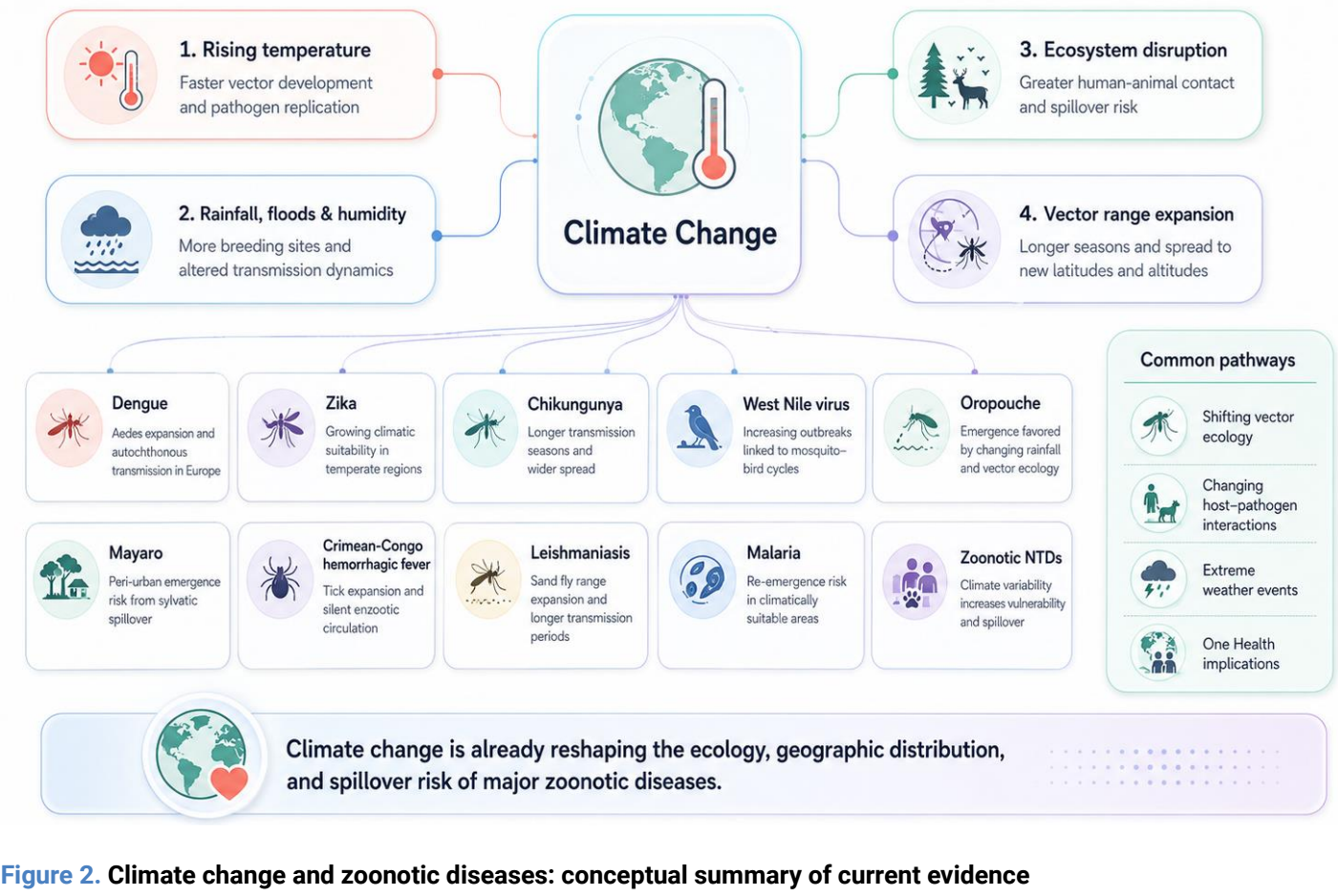
In summary, in Europe and abroad, there is growing evidence that climate change is significantly affecting, through multiple environmental variables, the epidemiology of zoonotic diseases (Figure 2).
Advances in prevention and therapeutics
The global response to these threats requires robust innovation in vaccines and therapeutics. The landscape of arboviral prevention is improving with the introduction of new vaccines. Qdenga® (TAK-003), a live-attenuated tetravalent dengue vaccine, has been approved in multiple countries and represents an important advance in dengue prevention. However, implementation strategies continue to evolve according to local epidemiology, population characteristics, and public health priorities. For Chikungunya, live vaccines such as Ixchiq® and recombinant alternatives like Vimkunya® are advancing preventative strategies.
On the therapeutic front, international collaborations are launching significant trials, such as the DENHOST trial, which investigates host-directed treatments, including baricitinib, dexamethasone, and N-acetylcysteine, to prevent disease progression in hospitalized patients with moderate-to-severe Dengue [14].
Conclusion
Climate change is not a distant threat but a present reality fundamentally altering the distribution of zoonotic and arboviral diseases. As the geographic boundaries of vectors expand, the distinction between “tropical” diseases and global health threats vanishes. Controlling this escalating crisis requires substancial investment in NTDs, deployment of new vaccines and therapeutics, and implementation of strong, multisectoral One Health approaches that monitor human, animal, and environmental health as a single, interconnected entity [15-17].
Funding
No funding was received for the research, authorship and/or publication of this article.
Author contributions
Conceptualization, F.J.M.N. and A.J.R.M.; methodology, F.J.M.N. and O.A.G.; investigation, F.J.M.N., O.A.G., W.V.G., A.G. and A.J.R.M.; writing – original O.A.G., W.V.G., A.G. and A.J.R.M.; writing – original draft preparation, F.J.M.N., O.A.G., W.V.G. and A.G.; writing – review and editing, F.J.M.N., O.A.G., W.V.G., A.G. and A.J.R.M.; supervision, F.J.M.N. and A.J.R.M. All authors have read and approved the final version of the manuscript and agree to be accountable for all aspects of the work.
Conflict of interests
The authors declare that there is no commercial or financial conflict of interest for this research.
AI statement
Artificial intelligence (AI) tools were used to assist in the design and creation of the figures included in this manuscript. Specifically, NotebookLM was used for Figure 1, and ChatGPT was used for Figure 2.
References
- Thomson MC, Stanberry LR. Climate change and vectorborne diseases. N Engl J Med. 2022;387(21):1969-78. Available from: https://doi.org/10.1056/NEJMra2200092
- Rodríguez-Morales AJ, Bonilla-Aldana DK, Cardona-Ospina JA, Sah R, Membrillo de Novales FJ. Relationships between morbidity from mpox and international tourism globally during 2022-2024 epidemics. J Glob Antimicrob Resist. 2024;39(Suppl):68-9. Available from: https://doi.org/10.1016/j.jgar.2024.10.220
- Smith KF, Goldberg M, Rosenthal S, Carlson L, Chen J, Chen C, et al. Global rise in human infectious disease outbreaks. J R Soc Interface. 2014;11(101):20140950. Available from: https://doi.org/10.1098/rsif.2014.0950
- Murray KA, Preston N, Allen T, Zambrana-Torrelio C, Hosseini PR, Daszak P. Global biogeography of human infectious diseases. Proc Natl Acad Sci U S A. 2015;112(41):12746-51. Available from: https://doi.org/10.1073/pnas.1507442112
- Wu Y, Wen B, Gasevic D, Patz JA, Haines A, Ebi KL, et al. Climate change, floods, and human health. N Engl J Med. 2024;391(20):1949-58. Available from: https://doi.org/10.1056/NEJMsr2402457
- Ramírez-Olivencia G, Estébanez M, Mata Forte T, Fernández Tomás M, Arce O, Sierra G, et al. Treatment of Crimean Congo hemorrhagic fever with supportive care, favipiravir, and avatrombopag. Clin Infect Dis. 2026;ciag415. Available from: https://doi.org/10.1093/cid/ciag415
- Membrillo FJ, Navarro JC, Pava-Garzón DM, Weatherhead J, Suárez JA, Rodriguez-Morales AJ. From local burden to global threat: neglected tropical diseases in an era of climate change and human mobility. Travel Med Infect Dis. 2026;70:102958. Available from: https://doi.org/10.1016/j.tmaid.2026.102958
- Kraemer MUG, Reiner RC Jr, Brady OJ, Messina JP, Gilbert M, Pigott DM, et al. Past and future spread of the arbovirus vectors Aedes aegypti and Aedes albopictus. Nat Microbiol. 2019;4(5):854-63. Available from: https://doi.org/10.1038/s41564-019-0376-y
- Membrillo de Novales FJ, Álvarez Martínez MJ. Malaria y otras enfermedades infecciosas transmitidas por artrópodos (dengue, West Nile...) y relacionadas con el cambio climático. In: Cisneros JM, coordinador. Las enfermedades infecciosas en 2050: cómo serán las enfermedades infecciosas en 30 años. SEIMC; 2022. Available from: https://www.animalshealth.es/fileuploads/user/PDF/2022/07/seimc-Enfermedades-Infecciosas-2050-one-health.pdf
- Villamil-Gómez WE, Herrera-Sierra FA, Mantilla-Meluk H, Ortiz M, Vargas-Arboleda AF. Biogeography of diseases: dengue in people over 60 years of age. ESCMID Global. 2026;Abstract P4406. Available from: https://online.escmid.org/media-922-biogeography-of-diseases-dengue-in-people-over-60-years-of-age
- Torres JR, Villamil-Gómez WV, Arce García O, Membrillo de Novales FJ. Epidemiology, diagnosis and treatment of Mayaro and Oropouche virus infections: implication for clinical practice and public health. Enferm Infecc Microbiol Clin (Engl Ed). 2026;44(4):503055. Available from: https://doi.org/10.1016/j.eimce.2025.503055
- Norman FF, Arce OA, Díaz-Menéndez M, Belhassen-García M, González-Sanz M. Changes in the epidemiology of Crimean-Congo hemorrhagic fever: impact of travel and a One Health approach in the European region. Travel Med Infect Dis. 2025;64:102806. Available from: https://doi.org/10.1016/j.tmaid.2025.102806
- Cuadrado-Matías R, Moraga-Fernández A, Peralbo-Moreno A, Negredo AI, Sánchez-Seco MP, Ruiz-Fons F. Crimean-Congo haemorrhagic fever virus in questing non-Hyalomma spp. ticks in Northwest Spain, 2021. Zoonoses Public Health. 2024;71(5):578-83. Available from: https://doi.org/10.1111/zph.13130
- Oxford University Clinical Research Unit, Vietnam. Therapeutics for moderate andseveredengue(DEN-HOST). ClinicalTrials.gov. 2026. NCT07543458. Available from: https://clinicaltrials.gov/study/NCT07543458
- Hudu SA, Jimoh AO, Adeshina KA, Otalike EG, Tahir A, Hegazy AA. An insight into the success, challenges, and future perspectives of eliminating neglected tropical disease. Sci Afr. 2024;24:e02165. Available from: https://doi.org/10.1016/j.sciaf.2024.e02165
- World Health Organization. Ending the neglect to attain the Sustainable Development Goals: a road map for neglected tropical diseases 2021-2030. Geneva: World Health Organization; 2021. Available from: https://www.who.int/publications/i/item/9789240010352
- Cardenas R, Sandoval CM, Rodríguez-Morales AJ, Franco-Paredes C. Impact of climate variability in the occurrence of leishmaniasis in northeastern Colombia. Am J Trop Med Hyg. 2006;75(2):273-7. Available from: https://pubmed.ncbi.nlm.nih.gov/16896132/
Explore
Articles
Volumes
About the journal
Most read
Recomendaciones para la prevención y el tratamiento de las infecciones respiratorias en adultos mayores institucionalizados
Revista Española de Quimioterapia
Características epidemiológicas de pacientes con aislamientos de Enterobacterales productores de carbapenemasas-NDM en un hospital de alta complejidad
Revista Española de Quimioterapia
Acute infectious gastroenteritis in childhood: the role of rapid multiplex molecular syndromic panels in diagnosis and clinical management
Revista Española de Quimioterapia
Review on the management of intra-abdominal candidiasis
Revista Española de Quimioterapia
Eravacycline: From broad-spectrum coverage to novel clinical applications
Revista Española de Quimioterapia