Brief report
October 2025, Volume 38, nº5
10 min
Analysis of Respiratory Syncytial Virus cases at Hospital Clínico San Carlos in Madrid during 2018-2025
Carlos González Corralejo1* , Esther Culebras López1, Mercedes Martínez Rodríguez1, Alberto Delgado-Iribarren García-Campero1
1Hospital Clínico San Carlos, Madrid, España
http://www.doi.org/10.37201/req/061.2025
Receipt Date:
02/07/2025
Acceptance Date:
20/08/2025
Publication Date:
14/09/2025
How to cite
González Corralejo C, Culebras López E, Martínez Rodríguez M, Delgado-Iribarren García-Campero A. Analysis of Respiratory Syncytial Virus cases at Hospital Clínico San Carlos in Madrid during 2018-2025. Rev Esp Quimioter. 2025; 38(5):426-430. Available from: http://www.doi.org/10.37201/req/061.2025
Metrics
311
Views
46
Downloads
Share
Share
Abstract (EN)
Respiratory syncytial virus (RSV) infection is one of the main causes of morbidity and mortality in infants under 6 months of age; however, it can cause respiratory infection at other stages of life. In the period 2018-2025, the number of cases has risen considerably, with positivity mainly concentrated in children under 24 months of age. The SARS-CoV2 pandemic caused modifications in affected population groups and seasonality. The percentage of RSV in children under 6 months of age in the period 2024-2025 was significantly lower than in the 2023-2024 season. In contrast, in the elderly population, especially those over 86 years of age, the percentage of positive cases has increased significantly. From 2022 onwards, the incidence of virus positivity shows a more stable and sustained pattern from October to April compared to previous years. The aim of this review is to assess the evolution of the type of patient diagnosed with RSV infection and to determine early whether the beginning of the vaccination campaign has reduced the incidence in the susceptible population. The availability of epidemiological information to guide decision-making is of great importance for evaluating the effectiveness of these measures and adopting changes in the use of vaccination in the general population.
Keywords (EN):
RSV
Epidemiology
Vaccination
Introduction
Human RSV, scientifically known as human Orthopneumovirus, is a lipid enveloped virus whose genome consists of a negative-sense single-stranded RNA molecule. It consists of two distinct serotypes (A and B) and transmission occurs via respiratory tract secretions. It is a major cause of morbidity and mortality in children under 6 months of age. The clinical manifestations most frequently are bronchiolitis and pneumonia, which may require admission to intensive care units and mechanical ventilation [1]. RSV has also been associated with a considerable burden of disease in the adult population, particularly in those over 65 years of age and in persons with severe lung disease and immunocompromised. RSV is a seasonal virus that in Europe produces peaks of incidence mainly during autumn and winter (mainly from October to April). Exposure to this virus does not produce lifelong immunity, and reinfections are frequent [2]. The growing interest in this virus in recent years has led to the development of new rapid diagnostic tests after SARS-CoV-2 pandemic, which has contributed to increased detection. In recent years, different strategies have developed against RSV infection, including the monoclonal antibody nirsevimab. In July 2023, the Vaccination Program and Registration Committee proposed some recommendations for Nirsevimab during the 2023-2024 period to promote passive immunization in newborns and infants [3]. The incipient increase in RSV diagnoses and the start of vaccination promoted this epidemiological study at the Hospital Clínico San Carlos in Madrid during 2018-2025. This study aimed to gain an overview of the virus evolution and the current and future impact of implementing immunization measures.Material and methods
The data analyzed in this retrospective study come from the Laboratory Information System (LIS) of the Microbiology Department of the Hospital Clínico San Carlos in Madrid. These data obtained by the techniques and equipment available at each time point during this period. These tests include antigen detection tests (STANDARD F RSV Ag FIA®, Triple virus SARS-CoV-2, influenza A/B and RSV GOLDSITE DIAGNOSTIC®) and multiplex Polymerase Chain Reaction (PCR) for respiratory viruses (Allplex Respiratory Panel-Seegene®, Xpert® Xpress CoV-2/Flu/RSV plus, Resp-4-Plex Alinity M Abbot®). The data covers the period from October 2018 to April 2025. For data analysis, information stratified according to age range, year, season, total number of samples tested, and number of positive results. Statistical analysis includes distribution plots with respect to the percentage of positivity and comparative analysis using the Chi-square statistical test (GraphPad Prism 8).Results
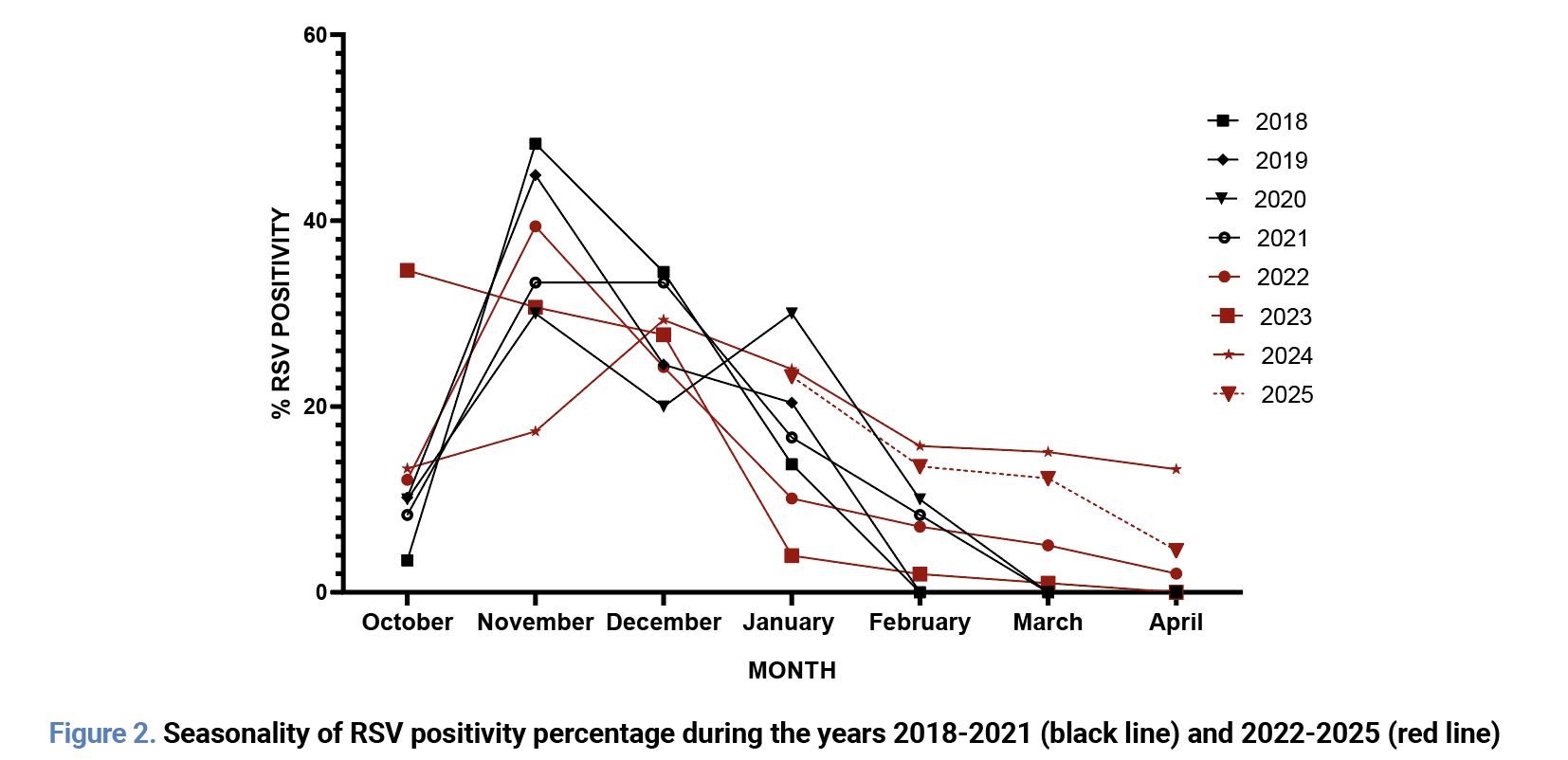
The epidemiological evolution of RSV detection in the period from October 2018 to April 2025 (Table 1) in patients with acute respiratory symptoms. A progressive increase in the total number of samples analyzed for RSV observed between 2018 and 2025. While between 2018-2021 the number of annual samples remained below 800 (with lows in 2020 during the pandemic), steady growth is evident from 2022 onwards. Most positive tests analyzed by PCR, since 2022, the number of positive antigen tests has also risen slightly.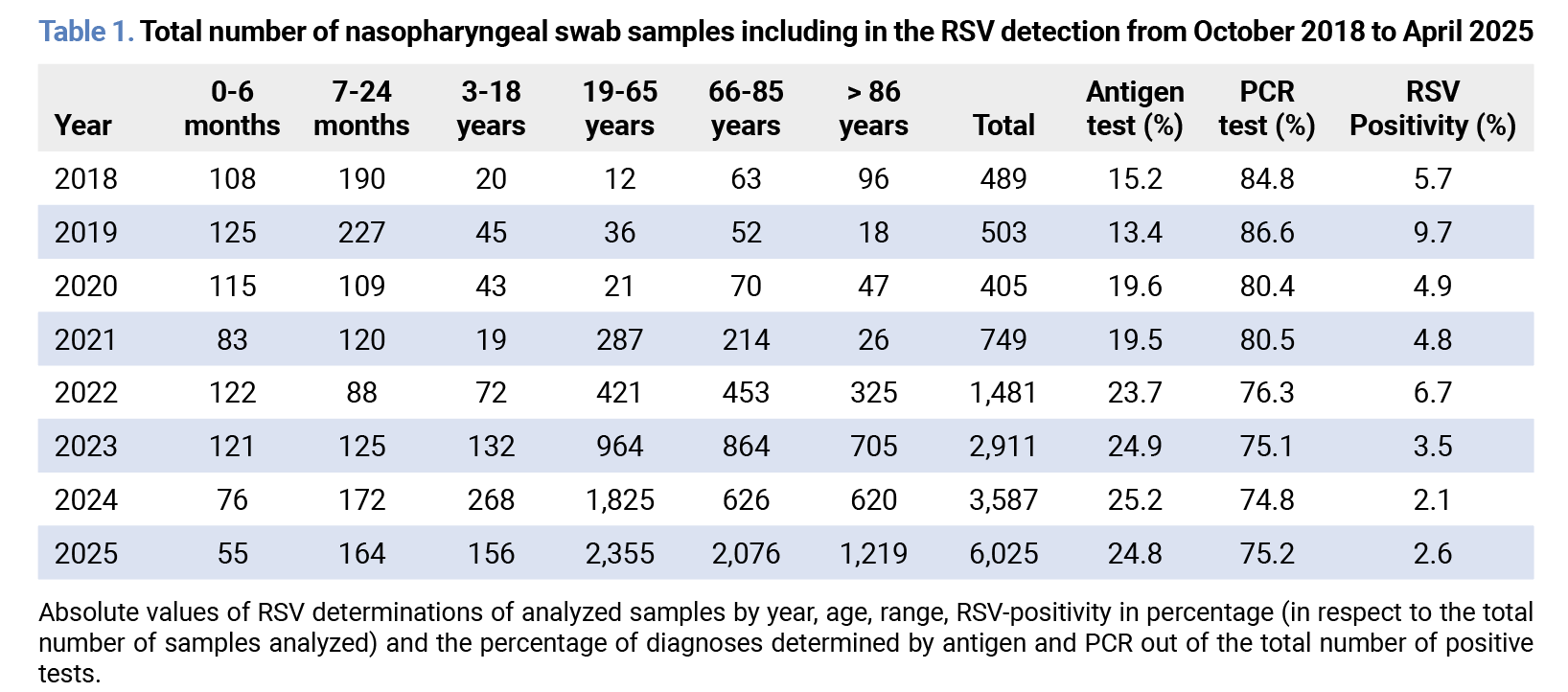 Regarding RSV positivity among the studied population groups, a differential evolution observed with turning point during the SARS-CoV-2 pandemic in 2020 (Figure 1). The percentage of positivity in all age groups during 2020-2021 was lower in comparison to previous and subsequent years. Until 2021, the highest burden of RSV positivity is concentrated in population groups under 24 months of age. All age groups studied experienced an increase in the number of positives test in 2022. A marked decrease in the total number of positive RSV determinations in patients under 6 months of age and between 7-24 months of age, compared to older ages. Positivity values increasing in 2022-2023 and being lower in 2024-2025. Figure 2 shows a dynamic evolution in RSV seasonality between 2018 and 2025, revealing significant changes before and after the SARS-CoV-2 pandemic. In the first four months of 2025, the data show lower values than previous years. The proportion of RSV-positive samples was analyzed in two seasons (October-April 2022-2023 vs. 2024-2025), stratified by age group. In the 0-6 months group, a significant decrease in positivity was observed (28.8% vs. 17.6%; χ² = 5.77, p = 0.0163). In the >86 years group, positivity increased significantly (1.8% vs. 3.2%; χ² = 4.33, p = 0.0374).
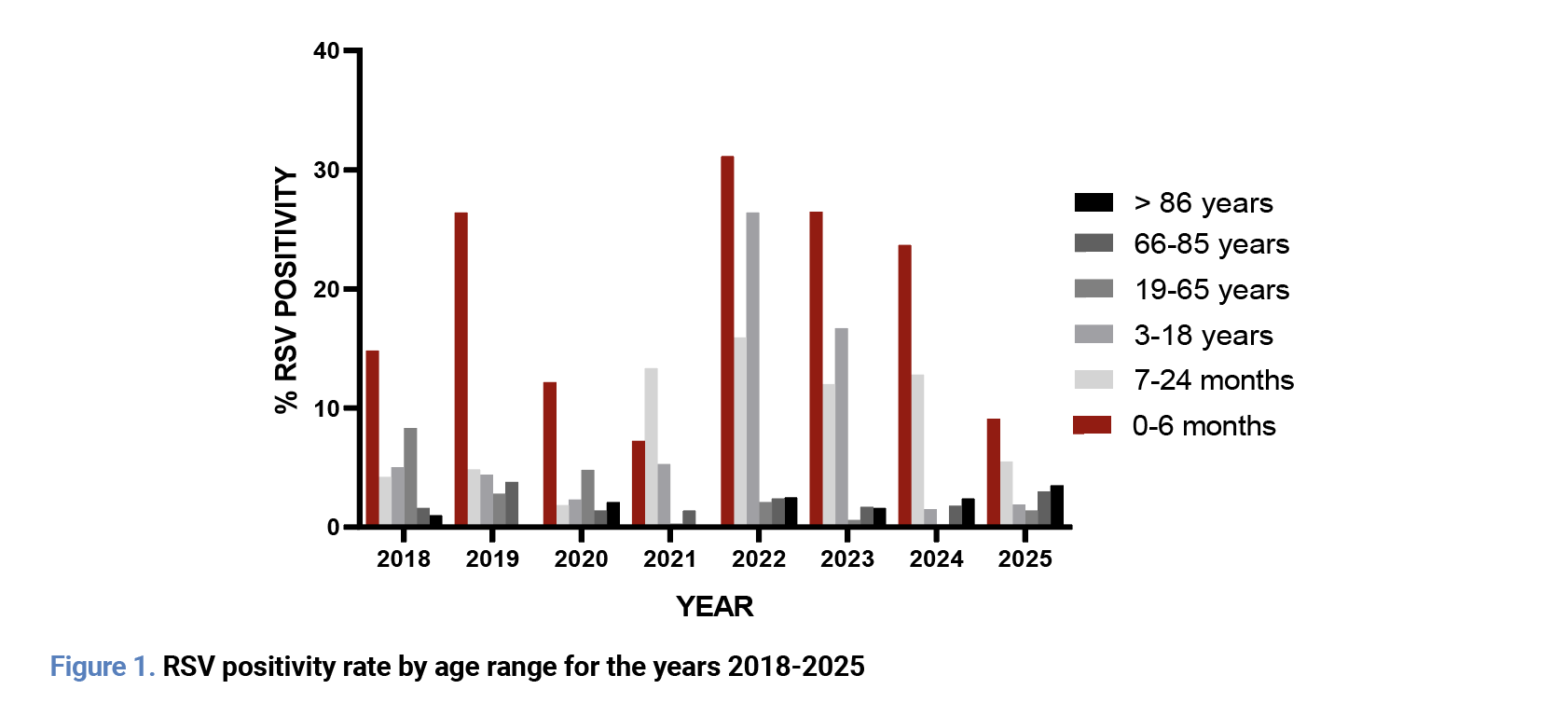
 No significant differences were found in the 7-24 months or 66–85-year-old groups. Thus, in infants aged 0-6 months a significant decrease in positivity from 28.8% in 2022-2023 to 17.6% in 2024-2025. This reduction was statistically significant (p = 0.0163). In the 7-24 months group, a decrease was also evident (from 13.6% to 9.2%), although it did not reach statistical significance. In older adults, the trend was the opposite: 66–85-year-old group showed a slight increase in positivity (2.0% to 2.7%), without statistical significance, while in those over than 86 years, the increase from 1.8% to 3.2% was statistically significant (p = 0.0374).
Between 2018-2019, positivity was concentrated mainly in winter (December to February), in line with classic RSV seasonality. From 2021 onwards, a progressive reappearance of RSV observed with low but increasing activity. The abrupt peak in December 2022 indicates a strong resurgence, with activity beginning early in October and November. This pattern repeated in 2023, with high positivity from October to January. In more recent years (2024-2025) virus behavior is less predictable and more extended in time, including significant positive cases as early as April does.
Discussion
A progressive increase in the total number of samples analyzed for RSV (Table I) observed during 2018-2019 to 2024-2025 with 77 and 232 positive samples, respectively. These data could reflect a change happened in the middle years in epidemiological surveillance, greater susceptibility in older adults, or an enhancement in the use of diagnostic tests. The gross number of determinations in the last four years has increased compared to 2021 in non-pediatric patients. This may be due to the implementation of rapid antigen detection diagnostic tests or multiplex PCR tests widely used in the diagnosis of respiratory infections after SARS-CoV-2 pandemic [4]. In 2022, the number of RSV tests doubled compared to 2018-2019. Regarding RSV positivity in the population groups studied, a differential evolution can be observed with turning point during the SARS-CoV-2 pandemic in 2020 (Figure 1). Until 2021, the greatest burden of RSV positivity is concentrated in population groups under 24 months of age. From 2023 onwards, samples from those aged 66 years and older (especially >86-year-old group) constitute the most significant proportion of the total. In contrast, the contribution of children under two years of age remains stable, although with less relative weight in recent years. The number of antigen tests has also increased slightly since 2020, however, PCR testing at the center remains above 70%. Despite the increase in sample volume in recent years, PCR diagnosis outperforms antigen testing. This may be because PCR is more sensitive than antigen testing, especially in the adult population [5,6]. Several factors could explain the increased RSV-positivity in older populations, such as loss of active immunization due to the use of masks and protective measures during the pandemic. The lack of exposure to RSV in pediatric children during the two years following the pandemic appears to be the main cause of the increase in positive cases in children under two years of age in 2022 [7]. A marked decrease in the total number of positive RSV determinations in patients younger than 6 months and between 7-24 months, compared to older ages, with positivity values increasing in the years 2022-2023 and being lower in the period 2024-2025 (Figure 1). This drop in positivity in this population group may directly be related to passive immunization with Nirsevimab starting in 2023 [8]. In this context, our data show a marked increase in the number of specimens tested and in RSV positivity in older adults, particularly those over 86 years of age, while a relative decrease in positivity in infants younger than 6 months. This may reflect a shift in the disease burden toward older populations and a change in the clinical and epidemiological approach to RSV following the pandemic [9]. Between 2018 and 2019, positivity is mainly concentrated in the winter months (December to February), in line with the classic RSV. During 2020, a year marked by COVID-19 control measures, positivity was practically zero in all months. From 2021 onwards, a progressive reappearance of RSV observed. The abrupt peak in December 2022 indicates a strong resurgence, with activity beginning early in October and November. This pattern repeated in 2023 with high positivity from October to January. In more recent years (2024 and 2025), although positivity continues to show an autumn–winter pattern, the behavior of the virus is less predictable and more extended in time, including significant positive cases even in April. This fact may mean that vaccination coverage also required other population groups in order to break the chain of transmission and achieve group immunity [10,11]. Taken together, these data reflect a modification in the post-pandemic seasonal dynamics of RSV, characterized by earlier onsets of activity (October-November), a higher peak positivity rate in certain years and a longer duration of viral circulation. These changes could be related to alterations in population immunity, increased susceptibility after the pandemic and variations in diagnostic surveillance. Author contributions Conceptualization, methodology, software and validation, González-Corralejo. Carlos; formal analysis, Martínez-Rodríguez. Mercedes; investigation, resources, data curation, Culebras-López. Esther; writing-original draft preparation, writing-review and editing, González-Corralejo. Carlos; visualization and supervision, Culebras-Lopez. Esther; project administration and funding acquisition, Delgado-Iribarren. Alberto. All authors have read and agreed to the published version of the manuscript. Funding Servicio de Microbiología Clínica. Instituto Medicina de Laboratorio (IML), Fundación para la Investigación Biomédica del Hospital Clínico San Carlos (IdISSC), Hospital Clínico San Carlos, Madrid, Spain. Conflict of interest The authors declare no conflict of interest.References
- Graham BS. The Journey to RSV Vaccines-Heralding an Era of Structure-Based Design. N Engl J Med. 2023; 388(7):579-81. Available from: https://doi.org/10.1056/NEJMp2216358
- Mazur NI, Löwensteyn YN, Willemsen JE, et al. Global Respiratory Syncytial Virus–Related Infant Community Deaths. Clin Infect Dis Off Publ Infect Dis Soc Am. 2021; 73(Suppl 3):S229-37. Available from: https://doi.org/10.1093/cid/ciab528
- Rodriguez-Fernandez R, Mejias A, Ramilo O. Monoclonal Antibodies for Prevention of Respiratory Syncytial Virus Infection. Pediatr Infect Dis J. 2021;40(5S):S35-S39. Available from: https://doi.org/10.1097/INF.0000000000003121
- Upadhyay P, Surur F, Singh V. Performance Assessment of a Multiplex Real-Time PCR Assay for Detection of Viruses Causing Respiratory Tract Infections. Diagnostics (Basel). 2024; 14(21):2350. Available from: https://doi.org/10.3390/diagnostics14212350
- Trigueros Montes JB, Montes D, Miele A, Baik-Han W, Gulati G, Lew LQ. The Impact of COVID-19 Pandemic on Respiratory Syncytial Virus Infection in Children. Pulm Med. 2024; 2024:2131098. Available from: https://doi.org/10.1155/2024/2131098
- Onwuchekwa C, Moreo LM, Menon S, Machado B, Curcio D, Kalina W, et al. Underascertainment of Respiratory Syncytial Virus Infection in Adults Due to Diagnostic Testing Limitations: A Systematic Literature Review and Meta-analysis. J Infect Dis. 2023; 228(2):173-184. Available from: https://doi.org/10.1093/infdis/jiad012
- Treggiari D, Pomari C, Zavarise G, Piubelli C, Formenti F, Perandin F. Characteristics of Respiratory Syncytial Virus Infections in Children in the Post-COVID Seasons: A Northern Italy Hospital Experience. Viruses. 2024; 16(1):126. Available from: https://doi.org/10.3390/v16010126
- Hammitt LL, Dagan R, Yuan Y, Baca Cots M, Bosheva M, Madhi SA, et al. Nirsevimab for Prevention of RSV in Healthy Late-Preterm and Term Infants. N Engl J Med. 2022; 386(9):837-846. Available from: https://doi.org/10.1056/NEJMoa2110275
- Alfano F, Bigoni T, Caggiano FP, Papi A. Respiratory Syncytial Virus Infection in Older Adults: An Update. Drugs Aging. 2024; 41(6):487-505. Available from: https://doi.org/10.1007/s40266-024-01118-9
- Caini S, Casalegno JS, Rodrigues AP, Lee V, Cohen C, Huang QS, et al. Change in Age profile of Respiratory Syncytial Virus disease over the course of annual epidemics: a multi-national study. J Infect. 2024; 88(5):106154. Available from: https://doi.org/10.1016/j.jinf.2024.106154
- Bähre J, Lange M, Salaschek P, Twardella D, Arens S, Eberhard F, et al. Distinct seasonality and increased respiratory failure in RSV patients < 2 years of age after emergence of SARS-CoV-2: data from the multicentric, prospective PAPI study. Eur J Pediatr. 2025; 184(4):246. Available from: https://doi.org/10.1007/s00431-025-06057-0
Explore
Articles
Volumes
About the journal
Most read
Recomendaciones para la prevención y el tratamiento de las infecciones respiratorias en adultos mayores institucionalizados
Revista Española de Quimioterapia
Acute infectious gastroenteritis in childhood: the role of rapid multiplex molecular syndromic panels in diagnosis and clinical management
Revista Española de Quimioterapia
Características epidemiológicas de pacientes con aislamientos de Enterobacterales productores de carbapenemasas-NDM en un hospital de alta complejidad
Revista Española de Quimioterapia
Review on the management of intra-abdominal candidiasis
Revista Española de Quimioterapia
Neoscytalidium dimidiatum: a rare locally acquired deep cutaneous infection in a renal transplant recipient
Revista Española de Quimioterapia