Case report
June 2025, Volume 38, nº 3
8 min
Anemia and lower limbs edemas in a patient with HIV infection
Francisco Arnaiz de las Revillas*,1, Javier Martín-López2, Milagros Heras-Vicario3 , Montserrat Briz del Blanco4 , Carlos Armiñanzas-Castillo1, Manuel Gutiérrez-Cuadra1, Paula Runza-Buznego 5, Raul Parra-Fariñas 5, María Carmen Fariñas-Álvarez1
1Infectious Diseases Service, Hospital Universitario Marqués de Valdecilla-IDIVAL, University of Cantabria, Santander, CIBERINFEC, Spain
2Pathological Anatomy Department, Hospital Universitario Puerta de Hierro, Madrid, Spain
3Nephrology Department, Hospital Universitario Marqués de Valdecilla-IDIVAL, Santander, Spain
4Hematology Department, Hospital Universitario Marqués de Valdecilla-IDIVAL, Santander, Spain
5Infectious Diseases Service, Hospital Universitario Marqués de Valdecilla-IDIVAL, Santander, Spain
http://www.doi.org/10.37201/req/124.2024
Receipt Date:
25/12/2024
Acceptance Date:
19/03/2025
Publication Date:
06/04/2025
How to cite
Arnaiz de las Revillas F, Martín-López J, Heras-Vicario M, Briz del Blanco M, Armiñanzas-Castillo C, Gutiérrez-Cuadra M, et al. Anemia and lower limbs edemas in a patient with HIV infection. Rev Esp Quimioter. 2025; 38(3): 244-8. Available from: http://www.doi.org/10.37201/req/124.2024
Metrics
541
Views
57
Downloads
Share
Share
Sir,
In the Mediterranean area, leishmaniasis is caused by Leishmania infantum. Visceral leishmaniasis (VL) is the most severe systemic form caused by this potentially fatal organism in the absence of treatment [1,2].
The classic clinical form is characterized by intermittent febrile episodes, hepatosplenomegaly, and pancytopenia secondary to bone marrow invasion, leading to anemia, hemorrhages and concurrent infections [3]. Atypical VL such as cases with renal involvement, occurs in human immunodeficiency virus (HIV) infection with low CD4+ T lymphocyte counts [1].
These patients may also be affected by other opportunistic infections, making diagnosis even more challenging [4]. We present this case because atypical forms in immunocompromised patients represent a major diagnostic challenge, and we have reviewed the few cases of membranoproliferative glomerulonephritis (MPGN) associated with this infection in the literature.
The patient was a 49-year-old man of Portuguese origin who had been living in northern Spain for two years, after previously residing on the Mediterranean coast. Notably, he had been diagnosed with HIV infection 25 years earlier and, at the time of hospital admission, was receiving treatment with tenofovir, emtricitabine, darunavir and ritonavir. His HIV viral load was suppressed, and his CD4+ T lymphocytes count was 519 cells/mm3. He also had a chronic liver disease secondary to hepatitis C virus infection, with undetectable RNA levels. Additionally, he had a history of giant condylomata acuminata in the anal region, requiring surgical resection in 2015. In June 2017, he was diagnosed with anal carcinoma, requiring colostomy. The patient had also undergone splenectomy following polytrauma 20 years ago.
The patient presented to the emergency department due to progressive edema of the lower limbs, refractory to diuretic treatment. Physical examination on admission revealed low-grade fever (37.8ºC) and edema with fovea of the lower limbs up to the knees. There were no abnormalities in cardiopulmonary auscultation or increment in jugular venous pressure. Laboratory tests revealed anemia of 7 g/dl and a thrombocytopenia of 41,000 platelets/ml. In addition, it highlighted an albumin of 2.3 mg/dl, with urea 41 mg/dl and creatinine 0.91 mg/dl and a 24-hour proteinuria of 3,024 mg. Bence-Jones proteinuria was negative, and no monoclonal gammopathies were observed in the proteinogram.
The patient was diagnosed with nephrotic syndrome, and tenofovir was discontinued. Combination therapy with lamivudine and darunavir / cobicistat was started. A complete immunological study, including antinuclear antibodies, antineutrophil cytoplasmic autoantibodies, and anti-glomerular basement membrane antibodies, was requested and returned negative results. Complement levels, rheumatoid factor, and cryocyte levels remained in the normal range. An abdominal computed tomography (CT) scan was performed and showed chronic liver disease and a polylobulated formation measuring approximately 8 cm, compatible with splenosis following splenectomy, as previously observed in imaging studies. This had previously been associated with portal hypertension.
A renal biopsy was performed and reported as follows: kidney cylinders with an MPGN pattern, identifying numerous intracellular parasitic forms at glomerular level (in tendocapillary cells) and at interstitial level associated with lymphohistiocytic inflammatory infiltrates. The morphological image was compatible with Leishmania infection. The immunofluorescence study showed diffuse and intense deposits of IgG, IgM, C1q at endocapillary level and weak and segmental deposits of IgA, C4 and C3. PCR for Leishmania in the renal biopsy was positive. The study was completed with bone marrow biopsy at sternal level, showing parasites compatible with intracellular Leishmania (Figure 1).
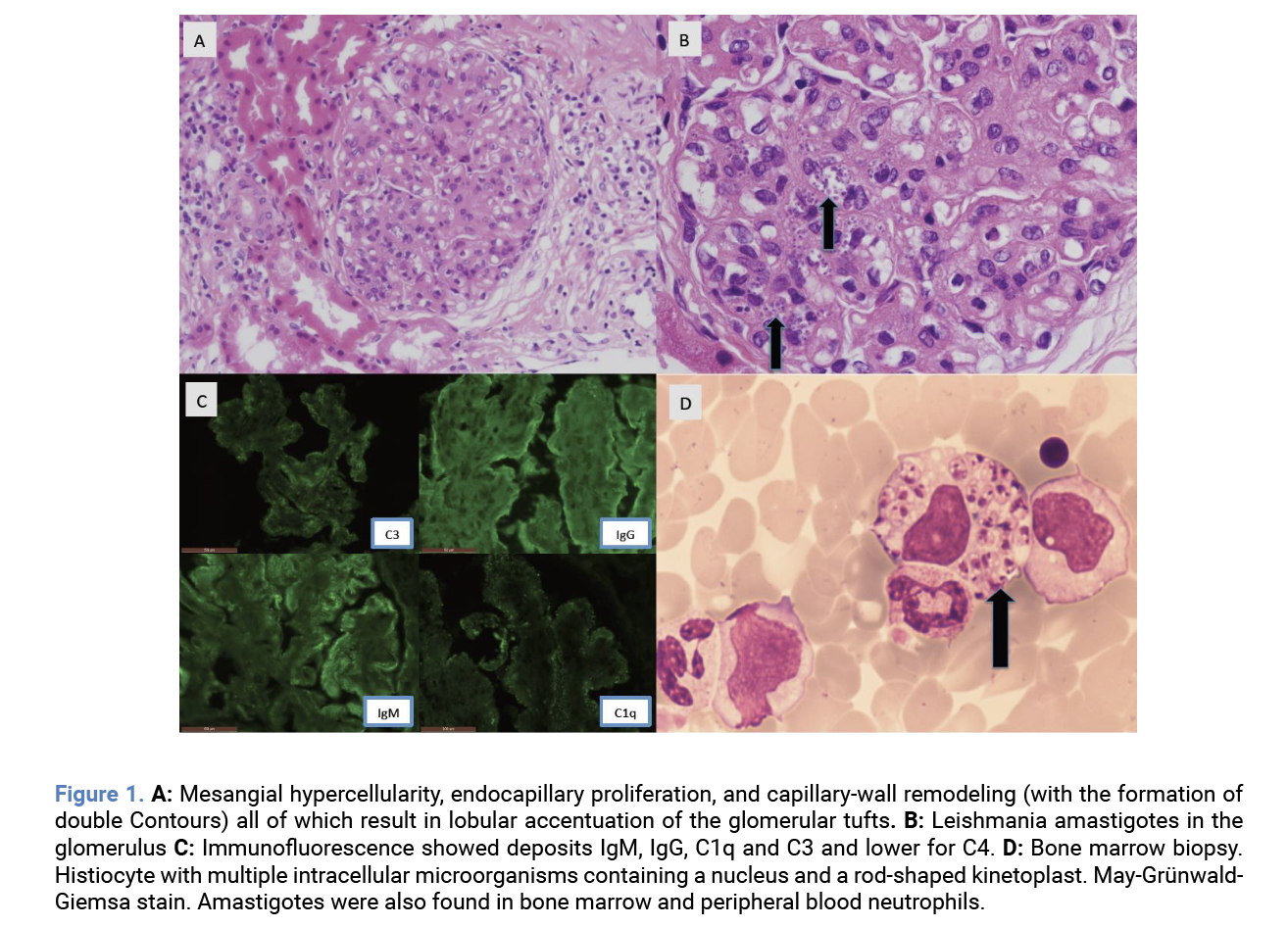 Treatment with liposomal amphotericin B was initiated at a dose of 3 mg/kg daily for the first 5 days, and then on days 10, 17, 24, 31 and 38. Subsequently, the patient received prophylaxis for 6 months with liposomal amphotericin B at a dose of 3mg/kg every 15 days, resulting in a progressive decrease in proteinuria, improved serum albumin levels with progressive increase in platelets and without requiring new transfusions of blood products.
HIV induces immunosuppression primarily through the destruction of CD4+ T lymphocytes, which facilitates the dissemination and progression of Leishmania, which is normally controlled by cellular immunity. In turn, Leishmania chronically activates macrophages and other immune cells, increasing HIV replication. Patients with HIV-Leishmania coinfection often present with more aggressive and disseminated forms of the disease, involving unusual organs such as the gastrointestinal tract or bone marrow.
Renal disease is a rare complication of VL that can manifest as acute renal failure, renal amyloidosis, different types of GMN nephritic and nephrotic syndrome [5].
In general, kidney disease associated with leishmaniasis occurs in the immunocompromised host, particularly in the context of HIV infection with low CD4 + T Lymphocyte count [4].
Patients with chronic VL can have mild proteinuria, microscopic hematuria and leukocyturia [5], but nephrotic syndrome can occur in the presence of AA amyloidosis or a MPGN associated with chronic Leishmania infection [7]. Glomerular involvement in VL has been associated with the deposit of immunocomplexes and complement due to polyclonal activation of B lymphocytes by the parasite.
Specifically in the kidney, the activation of macrophages and T cells by Leishmania can trigger a chronic inflammatory response with the release of proinflammatory cytokines such as TNF-α, IL-1, and IL-6. These cytokines promote endothelial dysfunction and damage to the glomerular basement membrane. The direct invasion of the parasite could induce glomerular damage through mechanisms such as cell apoptosis and oxidative stress [6].
Only a few cases of MPGN have been described in patients coinfected with VL and HIV [8-16]. In
the cases described in the literature, the biopsy findings are similar to those found in our case, except that in our patient, intracellular parasites were observed in the glomeruli in the endocapillary cells. (Table 1).
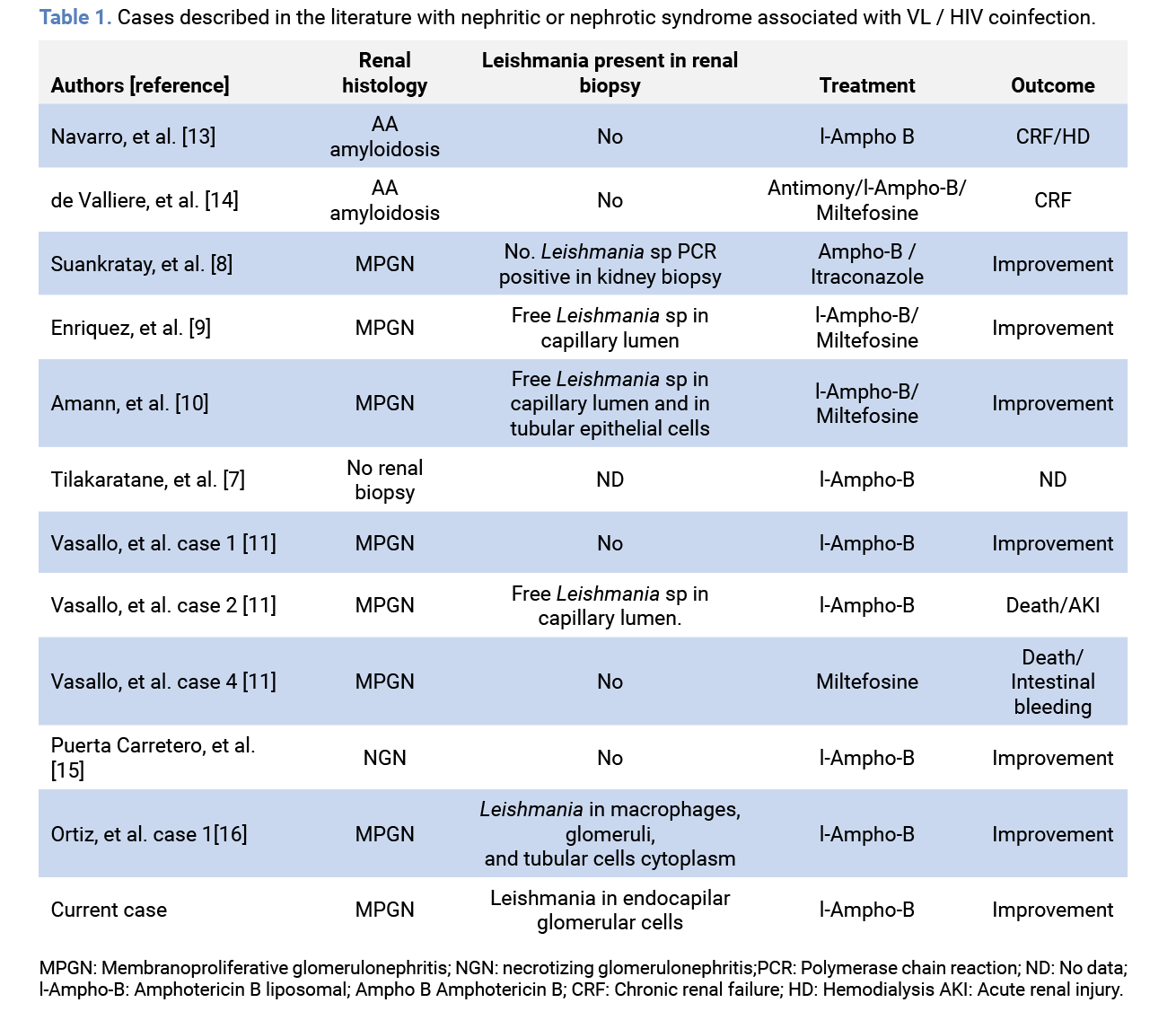 However, in the described biopsies, free parasites were occasionally found in the capillary lumen [9-11], and in macrophages present at the interstitial level [12], or in tubular cells [10] but within glomerular cells, they have only been observed in one of the cases reported by Ortiz M et al [16]. In other cases, the GMN was related to VL because of immunocomplexes and complement deposit in the glomeruli, while the parasite was identified in other locations, such as the bone marrow [11], or a positive Leishmania PCR result was obtained from the kidney biopsy [8].
In conclusion, nephritic and nephrotic syndromes caused by Leishmania in patients with HIV infection may not only be related to AA Amyloidosis or MPGN caused by the deposition of immune complexes secondary to systemic infection but may also result from direct glomerular infection by the parasite itself.
Funding
None to declare.
Conflict of interest
The authors declare no conflicts of interest.
Author contributions
Writing—original draft preparation, F.A.R, M.H.V, M.B.B., and R.P.F.; writing—review and editing, P.R.B.; supervision, M.C.F. All authors have read and agreed to the published version of the manuscript.
Treatment with liposomal amphotericin B was initiated at a dose of 3 mg/kg daily for the first 5 days, and then on days 10, 17, 24, 31 and 38. Subsequently, the patient received prophylaxis for 6 months with liposomal amphotericin B at a dose of 3mg/kg every 15 days, resulting in a progressive decrease in proteinuria, improved serum albumin levels with progressive increase in platelets and without requiring new transfusions of blood products.
HIV induces immunosuppression primarily through the destruction of CD4+ T lymphocytes, which facilitates the dissemination and progression of Leishmania, which is normally controlled by cellular immunity. In turn, Leishmania chronically activates macrophages and other immune cells, increasing HIV replication. Patients with HIV-Leishmania coinfection often present with more aggressive and disseminated forms of the disease, involving unusual organs such as the gastrointestinal tract or bone marrow.
Renal disease is a rare complication of VL that can manifest as acute renal failure, renal amyloidosis, different types of GMN nephritic and nephrotic syndrome [5].
In general, kidney disease associated with leishmaniasis occurs in the immunocompromised host, particularly in the context of HIV infection with low CD4 + T Lymphocyte count [4].
Patients with chronic VL can have mild proteinuria, microscopic hematuria and leukocyturia [5], but nephrotic syndrome can occur in the presence of AA amyloidosis or a MPGN associated with chronic Leishmania infection [7]. Glomerular involvement in VL has been associated with the deposit of immunocomplexes and complement due to polyclonal activation of B lymphocytes by the parasite.
Specifically in the kidney, the activation of macrophages and T cells by Leishmania can trigger a chronic inflammatory response with the release of proinflammatory cytokines such as TNF-α, IL-1, and IL-6. These cytokines promote endothelial dysfunction and damage to the glomerular basement membrane. The direct invasion of the parasite could induce glomerular damage through mechanisms such as cell apoptosis and oxidative stress [6].
Only a few cases of MPGN have been described in patients coinfected with VL and HIV [8-16]. In
the cases described in the literature, the biopsy findings are similar to those found in our case, except that in our patient, intracellular parasites were observed in the glomeruli in the endocapillary cells. (Table 1).
However, in the described biopsies, free parasites were occasionally found in the capillary lumen [9-11], and in macrophages present at the interstitial level [12], or in tubular cells [10] but within glomerular cells, they have only been observed in one of the cases reported by Ortiz M et al [16]. In other cases, the GMN was related to VL because of immunocomplexes and complement deposit in the glomeruli, while the parasite was identified in other locations, such as the bone marrow [11], or a positive Leishmania PCR result was obtained from the kidney biopsy [8].
In conclusion, nephritic and nephrotic syndromes caused by Leishmania in patients with HIV infection may not only be related to AA Amyloidosis or MPGN caused by the deposition of immune complexes secondary to systemic infection but may also result from direct glomerular infection by the parasite itself.
Funding
None to declare.
Conflict of interest
The authors declare no conflicts of interest.
Author contributions
Writing—original draft preparation, F.A.R, M.H.V, M.B.B., and R.P.F.; writing—review and editing, P.R.B.; supervision, M.C.F. All authors have read and agreed to the published version of the manuscript.
References
- Aronson N, Herwaldt BL, Libman M, Pearson R, Lopez-Velez R, Weina P, et al. Diagnosis and Treatment of Leishmaniasis: Clinical Practice Guidelines by the Infectious Diseases Society of America (IDSA) and the American Society of Tropical Medicine and Hygiene (ASTMH). Clin Infect Dis. 2016;63:e202-64. doi: 10.1093/cid/ciw670.
- Burza S, Croft SL, Boelaert M. Leishmaniasis. Lancet . 2018;392:951-70. doi: 10.1016/S0140-6736(18)31204-2.
- Lindoso JAL, Cunha MA, Queiroz IT, Moreira CH. Leishmaniasis–HIV coinfection: current challenges. HIVAIDS Research and Paliative Care. 2016;8:147-56. doi: 10.2147/HIV.S93789.
- Diro E, van Griensven J, Mohammed R, Colebunders R, Asefa M, Hailu A, et al. Atypical manifestations of visceral leishmaniasis in patients with HIV in north Ethiopia: a gap in guidelines for the management of opportunistic infections in resource poor settings. Lancet Infect Dis. 2015;15:122-9. doi: 10.1016/S1473-3099(14)70833-3.
- da Silva Junior GB, Guardão Barros EJ, De Francesco Daher E. Kidney involvement in leishmaniasis—a review. Braz J Infect Dis. 2014;18:434-40. doi: 10.1016/j.bjid.2013.11.013.
- Goto H, Prianti M das G. Immunoactivation and immunopathogeny during active visceral leishmaniasis. Rev Inst Med Trop Sao Paulo. 2009;51:241-246. doi: 10.1590/s0036-46652009000500002
- Tilakaratne T a. D, Malhasi IWG a. L, Rathnathilaka A. Nephrotic syndrome in a patient with visceral leishmaniasis: a case report. Ceylon Med J. 2018;63:31-2. doi: 10.4038/cmj.v63i1.8622.
- Suankratay C, Suwanpimolkul G, Wilde H, Siriyasatien P.. Autochthonous Visceral Leishmaniasis in a Human Immunodeficiency Virus (HIV)-Infected Patient: The First in Thailand and Review of the Literature. Am J Trop Med Hyg. 2010;82:4-8. doi: 10.4269/ajtmh.2010.09-0434.
- Enríquez R, Sirvent AE, Padilla S, Toro P, Sánchez M, Millán I. Membranoproliferative Glomerulonephritis due to Visceral Leishmaniasis in an HIV Patient. Am J Case Rep. 2015;16:8-11. doi: 10.12659/AJCR.892641.
- Amann K, Bogdan C, Harrer T, Rech J. Renal Leishmaniasis as Unusual Cause of Nephrotic Syndrome in an HIV Patient. J Am Soc Nephrol. 2012;23:586-90. doi: 10.1681/ASN.2011050472.
- Vassallo M, Moranne O, Ambrosetti D, Jeandel PY, Pomares C, Cassuto E, et al. Visceral leishmaniasis due to Leishmania infantum with renal involvement in HIV-infected patients. BMC Infect Dis. 2014;14:561. doi: 10.1186/s12879-014-0561-9.
- Sethi S, Fervenza FC, Siddiqui A, Quint PS, Pritt BS. Leish maniasis-Associated Membranoproliferative Glomerulonephritis With Massive Complement Deposition. Kidney Int Rep. 2016;1:125-30. doi: 10.1016/j.ekir.2016.06.003.
- Navarro M, Bonet J, Bonal J, Romero R. Secondary amyloidosis with irreversible acute renal failure caused by visceral leishmaniasis in a patient with AIDS. Nefrologia. 2006;26:745-6. PMID: 17227255.
- de Vallière S, Mary C, Joneberg JE, Rotman S, Bullani R, Greub G, et al. AA-amyloidosis caused by visceral leishmaniasis in a human immunodeficiency virus-infected patient. Am J Trop Med Hyg. 2009;81:209-12. PMID: 19635871.
- Puerta Carretero M, Ortega Díaz M, Corchete Prats E, Roldán Cortés D, Cuevas Tascón G, Martín Navarro JA, et al. Necrotizing glomerulonephritis in patients with HIV, HCV and visceral leishmaniasis. Nefrologia (Engl Ed). 2020 ;40:481-484. doi: 10.1016/j.nefro.2019.05.003.
- Ortiz M, Mon C, Herrero JC, Oliet A, Rodríguez I, Ortega O, et al. Glomerulonephritis and cryoglobulinemia: first manifestation of visceral leishmaniasis. Clin Nephrol. 2015;83:370-7. doi: 10.5414/CN108195.
Explore
Articles
Volumes
About the journal
Most read
Recomendaciones para la prevención y el tratamiento de las infecciones respiratorias en adultos mayores institucionalizados
Revista Española de Quimioterapia
Acute infectious gastroenteritis in childhood: the role of rapid multiplex molecular syndromic panels in diagnosis and clinical management
Revista Española de Quimioterapia
Características epidemiológicas de pacientes con aislamientos de Enterobacterales productores de carbapenemasas-NDM en un hospital de alta complejidad
Revista Española de Quimioterapia
Review on the management of intra-abdominal candidiasis
Revista Española de Quimioterapia
Neoscytalidium dimidiatum: a rare locally acquired deep cutaneous infection in a renal transplant recipient
Revista Española de Quimioterapia