Brief report
August 2026, Volume 39, nº 4
10 min
Associations between high-risk human papillomavirus genotypes: evidence of HPV16 predominance as a monoinfection and its no stronger link with high-grade lesions
Asociaciones entre genotipos del virus del papiloma humano de alto riesgo: evidencia del predominio del VPH16 como monoinfección y de su ausencia de asociación más fuerte con lesiones de alto grado
Julia González-Cantó1 , María Amparo Burgos-Isern2, Antonio Burgos-Teruel2
1Hospital Universitario de La Ribera, Alzira, España
2Universitat Autònoma de Barcelona, Barcelona, España
*Correspondence:
Julia González-Cantó. juliagonzalez1992@hotmail.com
Receipt Date:
29/03/2026
Acceptance Date:
29/05/2026
Publication Date:
16/06/2026
How to cite
González-Cantó J, Burgos-Isern MA, Burgos-Teruel A. Associations between high-risk human papillomavirus genotypes: evidence of HPV16 predominance as a monoinfection and its no stronger link with high-grade lesions. Rev Esp Quimioter 2026; 39(4):375-379. Available from: http://www.doi.org/10.37201/req/178.2026
Metrics
247
Views
28
Downloads
Share
Share
Abstract (EN)
Background: High-risk human papillomaviruses (HR-HPVs) are the main etiological agents of cervical cancer. Although coinfections with multiple HPV types are common, it remains unclear whether certain genotypes tend to associate preferentially or whether these associations occur randomly. In particular, HPV16 is considered the most oncogenic type, but its behavior in the context of mono- versus coinfection is less well defined.
Methods: We retrospectively analyzed cervical cytology and HPV genotyping results from 1,140 women aged 25–65 years. We calculated absolute and relative frequencies of individual HR-HPV types, examined between associations of two-type coinfections, and compared observed versus expected frequencies to assess whether genotype combinations occurred beyond chance. Special attention was given to HPV16, analyzing cytological outcomes in monoinfections versus coinfections.
Results: Most HR-HPV coinfections occurred at frequencies consistent with chance, suggesting no preferential interactions between genotypes. HPV16, however, was disproportionately present as a monoinfection. Importantly, no HPV16 monoinfections were significantly more associated with high-grade squamous intraepithelial lesions (HSIL) than HPV16 coinfections (p=0,365).
Conclusions: HPV16 was the most frequent genotype and was more commonly observed as a monoinfection than several other HR-HPV types. However, HPV16 monoinfections were not significantly associated with a higher frequency of HSIL compared with HPV16 coinfections. The observed genotype distribution patterns should be interpreted cautiously within the epidemiological context of opportunistic prevaccination screening.
Keywords (EN):
Coinfection
High-grade squamous intraepithelial lesion (HSIL)
HPV16
Genotype-specific risk
Cervical cancer screening
Human papillomavirus (HPV)
Abstract (ES)
Antecedentes: Los virus del papiloma humano de alto riesgo (VPH-AR) son los principales agentes etiológicos del cáncer de cuello uterino. Aunque las coinfecciones con múltiples tipos de VPH son frecuentes, aún no está claro si ciertos genotipos tienden a asociarse de forma preferencial o si estas asociaciones ocurren al azar. En particular, el VPH16 se considera el tipo más oncogénico, pero su comportamiento en el contexto de la monoinfección frente a la coinfección está menos definido.
Métodos: Analizamos retrospectivamente los resultados de citología cervical y genotipificación del VPH de 1.140 mujeres de entre 25 y 65 años. Calculamos las frecuencias absolutas y relativas de los tipos individuales de VPH-AR, examinamos las asociaciones entre coinfecciones de dos tipos y comparamos las frecuencias observadas frente a las esperadas para evaluar si las combinaciones de genotipos ocurrieron más allá del azar. Se prestó especial atención al VPH16, analizando los resultados citológicos en monoinfecciones frente a coinfecciones.
Resultados: La mayoría de las coinfecciones por VPH-AR ocurrieron con frecuencias compatibles con el azar, lo que sugiere ausencia de interacciones preferenciales entre genotipos. Sin embargo, el VPH16 estuvo presente de forma desproporcionada como monoinfección. Es importante destacar que las monoinfecciones por VPH16 no se asociaron significativamente con una mayor frecuencia de lesiones intraepiteliales escamosas de alto grado (HSIL) que las coinfecciones por VPH16 (p = 0,365).
Conclusiones: El VPH16 fue el genotipo más frecuente y se observó con mayor frecuencia como monoinfección que varios otros tipos de VPH-AR. Sin embargo, las monoinfecciones por VPH16 no se asociaron significativamente con una mayor frecuencia de HSIL en comparación con las coinfecciones por VPH16. Los patrones observados de distribución genotípica deben interpretarse con cautela dentro del contexto epidemiológico del cribado oportunista previo a la vacunación.
Keywords (ES):
Virus del papiloma humano (VPH)
VPH16
Coinfección
Lesión intraepitelial escamosa de alto grado (HSIL)
Cribado del cáncer de cuello uterino
Riesgo específico por genotipo
Introduction
Human papillomavirus (HPV) infection is one of the most frequent sexually transmitted diseases worldwide, and persistent infections with high-risk HPV (HR-HPV) genotypes is the main aetiological factor in the development of cervical cancer [1]. It is estimated that around 70% of cervical cancers are caused by HPV types 16 and 18, with HPV16 being the most carcinogenic genotype [2]. The natural history of HPV infection is variable: while most infections are transient and are cleared by the immune system, persistent infections with high-risk types may progress to precancerous lesions and invasive cancer [3].
The presence of multiple HPV types in a single infection is frequent, particularly in young women, and its clinical relevance remains debated. Some authors suggest that coinfections may increase the risk of persistence and progression [4], while others indicate that they could simply reflect exposure to risk factors without additional biological effects [5].
The observed predominance of HPV16 as a monoinfection should be interpreted cautiously. Given the cross-sectional nature of the study, these findings may reflect epidemiological distribution patterns rather than true biological interactions between genotypes. Therefore, although HPV16 appeared more frequently as a monoinfection than several other HR-HPV types [6,7], no causal or mechanistic interpretation can be established from the present data.
Based on these considerations, the objectives of this study were: a) to analyse the absolute and relative frequencies of HR-HPV genotypes in a cohort of women screened for cervical cancer, b) to describe the most common associations between two HPV types and assess whether they occurred more frequently than expected by chance, and c) to evaluate the specific case of HPV16, particularly its frequency as a monoinfection versus coinfection, and its relationship with cytology results.
Material and methods
We conducted a cross-sectional study using cervical samples obtained from women aged 25–65 years undergoing opportunistic cervical cancer screening. During the study period (2012-2022), 3,759 cervical samples were analysed, of which 1,140 HPV-positive samples fulfilled the inclusion criteria for the present study. The unit of analysis was the cervical sample.
HPV detection was performed using molecular techniques that identify the presence of specific genotypes. For this analysis, only samples positive for at least one high-risk HPV type (HR-HPV) were included. HPV types considered high-risk followed international classifications (IARC, 2012). HPV66 was retained in the descriptive analyses because it was included in the genotyping panel, although it is currently considered a probable or possible high-risk type rather than a definitive high-risk genotype according to recent classifications.
The following variables were analysed:
- HPV genotype: this could contain one or multiple types (e.g., HPV type 16 (HR) or HPV types 16,31,45 (HR)).
- Cytology result (Papanicolaou test): cytological results were classified according to the Bethesda System as normal, ASC-US, LSIL, or HSIL. For the purpose of the analysis, HSIL also included ASC-H cases.
Absolute and relative frequencies of HR-HPV genotypes were calculated. For type associations, only coinfections of up to two genotypes were considered. This restriction was applied to simplify the exploratory association analysis and to facilitate interpretation of observed/expected genotype pair distributions, since higher-order multiple coinfections generate highly heterogeneous combinations with limited interpretability. The expected frequency of each pair was calculated as the product of the relative frequencies of the two genotypes (assuming independence), and the observed/expected (O/E) ratio was then estimated to explore whether genotype associations occurred more or less frequently than expected by chance. The O/E ratio analysis was intended as an exploratory descriptive approach rather than a formal inferential statistical model.
Finally, for HPV16, infections were classified as monoinfections or coinfections, and cytology results were compared between groups. The proportion of high-grade lesions (HSIL) in each group was compared using chi-square tests. Statistical significance was set at p < 0.05. Analyses were performed using R software.
Results
Frequency of high-risk HPV types
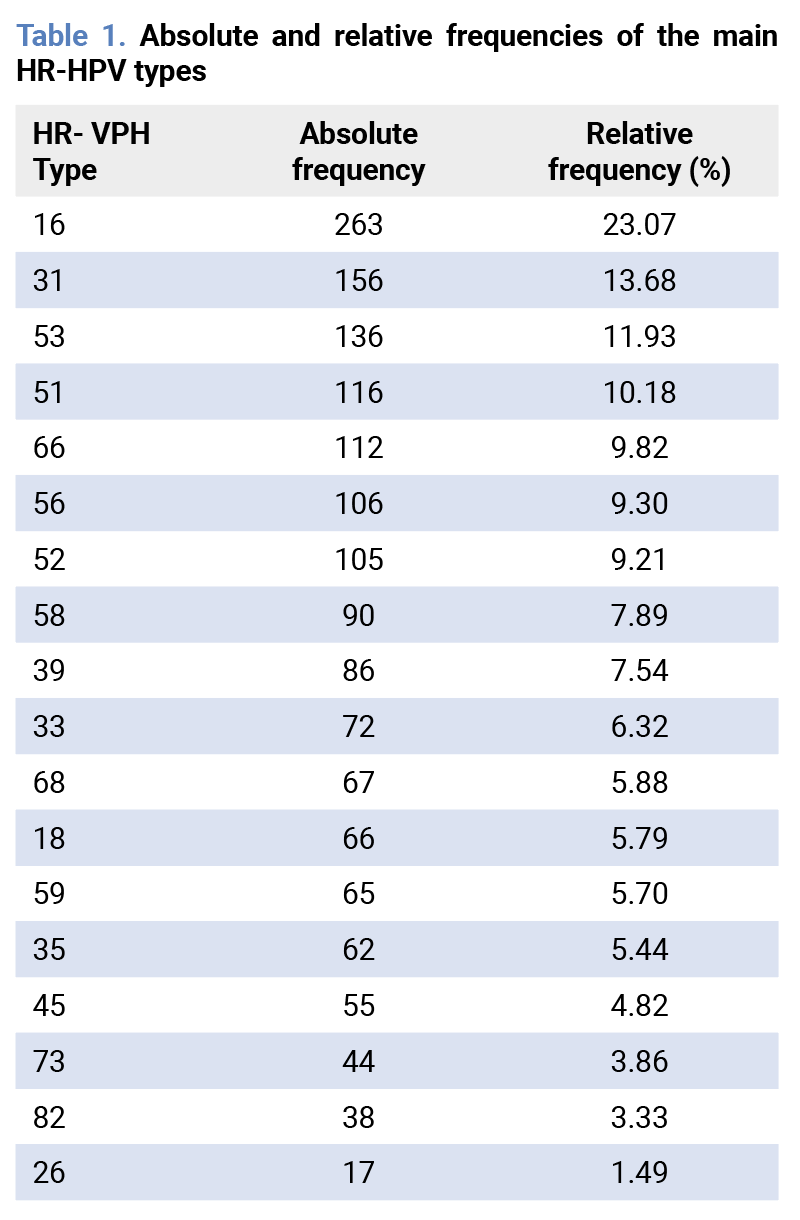
A total of 1,140 HPV-positive cases were analysed. The most frequent genotype was HPV16, followed by HPV31, HPV52, and HPV58. Table 1 shows the absolute and relative frequencies of the main HR-HPV types. For presentation, only the most frequent types are included.
Associations between two HR-HPV types
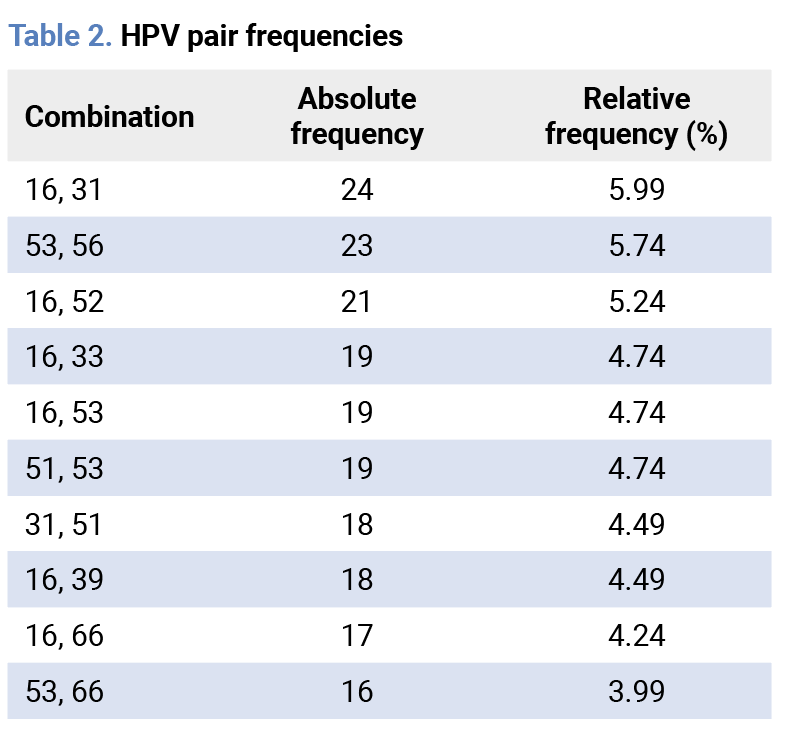
The most frequent genotype pairs were 16+31, 53-56, and 16+52, among others. Most genotype pairs showed O/E ratios close to or below 1, suggesting no clear evidence of strong preferential associations in this exploratory analysis. This suggests that genotype associations are generally random, with no specific pair occurring significantly above chance levels.
For example, the 16+31 combination showed an O/E ratio above 1, whereas combinations such as 53+56 showed ratios below 1, illustrating the heterogeneity of genotype associations.
The particular case of HPV16
HPV16 was the most frequent genotype overall, but its presence in coinfections was much lower than expected. The data showed that HPV16 tended to appear as a single infection more often than in combination with other HR-HPV types.HPV16 appeared more frequently as a monoinfection, with significant differences compared with HPV31, HPV53, and HPV51 (p < 0.05).
Cytology results in HPV16 monoinfections vs. coinfections
The hypothesis that HPV16 monoinfection would be associated with a higher proportion of HSIL was not supported by the data, as HSIL frequency did not differ significantly between HPV16 monoinfections and HPV16 coinfections (23.8% vs. 22.0%; p = 0.365). However, according to the cytology results, it does appear more often only in coinfection. (p=0,0017).
Discussion
This study confirms that HPV16 is the most prevalent genotype in our population, consistent with the literature [2,8]. Its high frequency explains a large part of the burden of cervical cancer worldwide.
Regarding genotype associations, our results indicate that the most common pairs (e.g., 16+31, 53-56, and 16+52) do not occur more frequently than expected under random association. This suggests that, in general, HPV coinfections reflect exposure to multiple types without specific synergistic interactions, consistent with previous studies [5,9,11].
The case of HPV16 is particularly relevant. Our findings show that HPV16 tends to appear as a monoinfection more often than as a coinfection, a behaviour also described by other authors [6,7]. HPV16 alone appeared more frequently across all cytology categories (the overall distribution changes). However, it cannot be stated that “HPV16 alone” results in more HSIL specifically, because that difference is not statistically significant. Although some recent studies have reported a stronger association between HPV16 single-type infections and high-grade lesions, our findings did not confirm this relationship within this opportunistic screening cohort [10].
This has important clinical implications. Although HPV16 is the most frequent genotype and shows a marked tendency to appear as a monoinfection, our analysis indicates that its solitary presence does not translate into a significantly higher risk of HSIL compared with coinfections. Instead, the relevance of HPV16 lies in its overall predominance across cytological categories and its well-established oncogenic potential. These findings support the value of genotype-specific screening strategies, while emphasising that the presence of HPV16—either alone or in combination—should be regarded as a key marker for clinical follow-up in cervical cancer prevention programmes.
One of the strengths of the present study is the large number of HPV-positive samples analysed, collected over an extended study period within a real-world opportunistic screening setting. Importantly, the cohort represents a predominantly pre-vaccination and pre-population-based screening epidemiological context, since organised HPV-based screening programmes had not yet been implemented and most vaccinated cohorts had not yet reached screening age during the study period. Therefore, these findings may provide a useful baseline for future comparisons with genotype distributions observed after the implementation of population-based HPV screening strategies.
The cross-sectional design of the study substantially limits the biological interpretation of the observed genotype distributions. Therefore, the higher frequency of HPV16 monoinfections should be interpreted cautiously, as it may reflect epidemiological or ecological dynamics rather than true biological competition or exclusion between HPV genotypes. In addition, the study population corresponded to an opportunistic screening setting prior to the implementation of population-based HPV screening in our healthcare system, and most vaccinated cohorts had not yet reached the target age for cervical cancer screening during the study period.
Consequently, the observed genotype distribution likely reflects a predominantly pre-vaccination and pre-population-based screening epidemiological context. Furthermore, relevant epidemiological variables such as individual vaccination status, immunosuppression, sexual behaviour, and detailed clinical indications for HPV testing were not available in the retrospective dataset.
Conclusions
1. HPV16 was the most frequent high-risk genotype in the studied population.
2. The most common genotype pairs did not occur more frequently than expected by chance.
3. HPV16 was more frequently observed as a monoinfection than several other HR-HPV genotypes within this opportunistic screening cohort.
4. HPV16 monoinfections were not significantly more associated with high-grade lesions (HSIL) compared to coinfections.
Funding
No funding was received for the research, authorship and/or publication of this article.
Author contributions
Conceptualisation: J.G.C., M.A.B.I., A.B.T.; Funding acquisition: M.A.B.I.; Data collection: J.G.C., M.A.B.I., A.B.T.; Investigation: J.G.C., M.A.B.I., A.B.T.; Formal analysis: J.G.C., M.A.B.I., A.B.T.; Drafting – initial draft: J.G.C., M.A.B.I., A.B.T.; Supervision: J.G.C., M.A.B.I., A.B.T.; Visualisation: J.G.C., M.A.B.I., A.B.T.; Drafting, checking, and editing: J.G.C., M.A.B.I., A.B.T.; Software: J.G.C., M.A.B.I., A.B.T.; Methodology: J.G.C., M.A.B.I., A.B.T.; Resources: J.G.C., M.A.B.I., A.B.T.; Validation: J.G.C., A.B.T.
Conflict of interest
The authors declare that there is no commercial or financial conflict of interest for this research.
Ethics statements
This study was conducted in accordance with the principles of the Declaration of Helsinki and was approved by the Institutional Research Ethics Committee under reference number A011125. The study was based on retrospective anonymized data collected as part of routine clinical practice; therefore, informed consent was waived by the ethics committee.
AI statement
The authors declare that no artificial intelligence tools (such as ChatGPT, Copilot, Gemini, or others) have been used in the writing, analysis, or review of this article.
References
- Clifford GM, Gallus S, Herrero R, Muñoz N, Snijders PJF, Vaccarella S, et al. Worldwide distribution of human papillomavirus types in cytologically normal women in the International Agency for Research on Cancer HPV prevalence surveys: a pooled analysis. Lancet. 2005;366(9490):991-998. Available from: https://doi.org/10.1016/S0140-6736(05)67069-9
- de Sanjose S, Quint WGV, Alemany L, Geraets DT, Klaustermeier JE, Lloveras B, et al. Human papillomavirus genotype attribution in invasive cervical cancer: a retrospective cross-sectional worldwide study. Lancet Oncol. 2010;11(11):1048-1056. Available from: https://doi.org/10.1016/S1470-2045(10)70230-8
- Bosch FX, Broker TR, Forman D, Moscicki AB, Gillison ML, Doorbar J, et al. Comprehensive control of human papillomavirus infections and related diseases. Vaccine. 2013;31 Suppl 7:H1-H31.
- Trottier H, Franco EL. The epidemiology of genital human papillomavirus infection. Vaccine. 2006;24 Suppl 1:S1-S15. Available from: https://doi.org/10.1016/j.vaccine.2005.09.054
- Chaturvedi AK. Beyond cervical cancer: burden of other HPV-related cancers among men and women. J Adolesc Health. 2010;46(4 Suppl):S20-S26. Available from: https://doi.org/10.1016/j.jadohealth.2010.01.016
- Smith JS, Lindsay L, Hoots B, Keys J, Franceschi S, Winer R, et al. Human papillomavirus type distribution in invasive cervical cancer and high-grade cervical lesions: a meta-analysis update. Int J Cancer. 2007;121(3):621-632. Available from: https://doi.org/10.1002/ijc.22527
- Alemany L, de Sanjosé S, Tous S, Quint W, Vallejos CS, Shin HR, et al. Time trends of human papillomavirus types in invasive cervical cancer, from 1940 to 2007. Int J Cancer. 2014;135(1):88-95. Available from: https://doi.org/10.1002/ijc.28636
- Luo Q, Zhang H, Zeng X, Han N, Ma Z, Luo H. HPV specificity and multiple infections and association with cervical cytology in Chongqing, China: a cross-sectional study. BMC Infect Dis. 2024;24:804. Available from: https://doi.org/10.1186/s12879-024-09693-3
- Cassani C, Dominoni M, Pasquali MF, Gardella B, Spinillo A. The role of multiple high-risk human papillomavirus infection on the persistence recurrence of high-grade cervical lesions after standard treatment: a systematic review and a meta-analysis. Acta Obstet Gynecol Scand. 2024;103(6):1028-1035. Available from: https://doi.org/10.1111/aogs.14827
- Baek S, Euerle N, Marnitz S, Mallmann P, Baudewig C, Mallmann MR, et al. Impact of single- versus multiple-type HPV infections on cervical cytological and histological abnormalities: the dominant oncogenic potential of HPV16 single-type infections. Diagnostics (Basel). 2025;15(22):2880. Available from: https://doi.org/10.3390/diagnostics15222880
- Alci A, Yalcin N, Gokkaya M, Sari GE, Turkmenoglu HR, Ureyen I, et al. Does co-infection with HPV 16 have a worse effect on cervical pathology than HPV 16 alone? Med Bull Sisli Etfal Hosp. 2025;59(3):338-344. Available from: https://doi.org/10.14744/SEMB.2025.34682
Explore
Articles
Volumes
About the journal
Most read
Recomendaciones para la prevención y el tratamiento de las infecciones respiratorias en adultos mayores institucionalizados
Revista Española de Quimioterapia
Acute infectious gastroenteritis in childhood: the role of rapid multiplex molecular syndromic panels in diagnosis and clinical management
Revista Española de Quimioterapia
Características epidemiológicas de pacientes con aislamientos de Enterobacterales productores de carbapenemasas-NDM en un hospital de alta complejidad
Revista Española de Quimioterapia
Review on the management of intra-abdominal candidiasis
Revista Española de Quimioterapia
Neoscytalidium dimidiatum: a rare locally acquired deep cutaneous infection in a renal transplant recipient
Revista Española de Quimioterapia