Carta al editor
April 2025, Volume 38, nº 2
7 min
Baseline survey of doravirine resistance among pregnant women with HIV
Javier Alejandro Sfalcin*1 , Diego Cecchini2, Ines Zapiola3 , Alan Gómez1 , Silvina Fernández-Giuliano3 , Claudia Rodríguez2 , Lilia Mammana3 , Analia Seravalle1 , Fabián Fay1 , María Belén Bouzas3
1Molecular biology area, CIBIC Laboratorios, Argentina
2Infectious Diseases Unit, Hospital Cosme Argerich, Argentina
3Virology Unit, Division of Clinical Analysis, Hospital de Enfermedades Infecciosas Francisco J. Muñiz, Argentina
http://www.doi.org/10.37201/req/107.2024
Receipt Date:
10/11/2024
Acceptance Date:
27/01/2025
Publication Date:
05/02/2025
How to cite
Sfalcin JA, Cecchini D, Zapiola I, Gomez A, Fernández-Giuliano S, Rodriguez C, Mamman L, Seravalle A, Fay F, Bouzas MB. Baseline survey of doravirine resistance among pregnant women with HIV. Rev Esp Quimioter. 2025 Feb 6;38(2):139-141. doi: 10.37201/req/107.2024
Metrics
452
Views
44
Downloads
Share
Share
Dear Sir,
New epidemiological surveillance studies on antiretroviral resistance have shown similar results to previous reports, revealing that levels of transmitted resistance to non-nucleoside reverse transcriptase inhibitors (NNRTIs) in the Argentinian population remain high, with K103N as the most frequent mutation [1,2]. In pregnant women with HIV (PWH), it has been reported a prevalence of transmitted resistance to first-generation NNRTIs of 17.8%, with high mutational load indicating a high risk of transmission [3,4].
In Argentina, routine pre-treatment genotyping is recommended for pregnant women living with HIV. While current Latin American antiretroviral treatment guidelines recommend dolutegravir-based regimens as the preferred option during pregnancy, implementation and access to this drug may be gradual across the region. Consequently, some women continue to initiate treatment with first-generation NNRTIs. Additionally, nevirapine remains an option for prophylaxis in high-risk newborns, highlighting the ongoing relevance of understanding NNRTI resistance patterns in this population.
Doravirine (DOR) is a second-generation NNRTI with a different resistance profile compared to first-generation NNRTIs. It has been shown that DOR is effective against the main mutations that emerge in patients failing NNRTI treatment [5]. In this context, the use of DOR may overcome the limitations of first-generation NNRTIs, particularly in populations with a high prevalence of transmitted resistance.
According ANRS mutation list, the resistance profile of DOR includes mutations V106A, Y188L, G190E/S, F227C, and M230L, which have the greatest impact on virological failure. Additionally, combinations of DRM (K103N+L100I, K103N+Y181C, and K103N+P225H) demonstrated reduced susceptibility to DOR and could be particularly relevant in our population with high prevalence of K103N [6].
Although DOR has been approved in Argentina since 2019, data on transmitted resistance to DOR in PWH has not yet been shown.
The objective of our study was to conduct a baseline survey of the prevalence of DRM using samples collected before the introduction of DOR in our country, sourced from a historical cohort of PWH, naïve to treatment therapy.
For this study, we identified the DRM for DOR using the ANRS mutation list in 40 genotypes obtained through ultra-deep sequencing (UDS) from a previous surveillance study conducted in PWH, naïve of treatment therapy, with samples collected from 2008 to 2014. The clinical and epidemiological profile of this cohort has been described previously [3].
UDS and bioinformatics analysis was conducted using HyDRA software, with detection thresholds set at 1%, 2%, 5%, 10%, and 20% according to Taylor et al. [7]. We considered detection limits of conventional techniques are comparable to the 20% UDS.
The main difference between 1% UDS and 20% UDS lies in the ability to detect minority variants that may reduce susceptibility and cause virological failure [7]. DRMs detected below 5% are unlikely to have a significant clinical impact, but they can still provide valuable information in prevalence studies or surveillance.
For UDS 20% threshold, the prevalence of DRM for DOR was 2.5% (n=1, K103N+P225H combination) (Figure 1). No additional mutations were detected with 2%, 5% and 10% UDS thresholds. Instead, for the 1% UDS threshold, the prevalence increased to 7.5%, adding the detection of G190A (n=1) and G190E (n=1) (Figure 2). The subtype of the samples harboring DRM for DOR was BF.
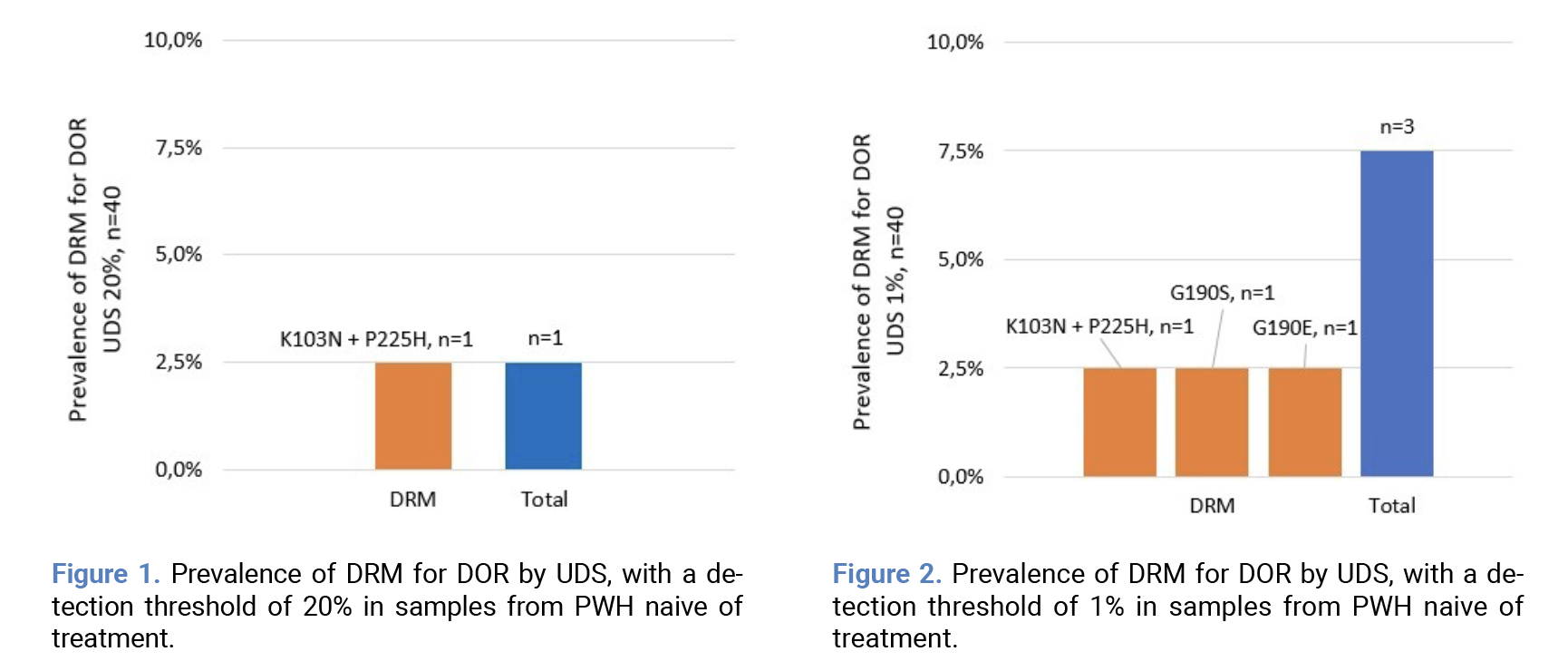 Regardless of the high frequencies of NNRTI mutations in our country, the prevalence of DRM for DOR in a historical cohort of PWH naïve of treatment was lower than historical data for first generation NNRTIs [3,4].
The K103N+P225H combination was detected in our study at the 20% UDS threshold. It was identified as the most frequent NNRTI DRM associated with moderate (B subtype) to high (C subtype) reduced susceptibility for DOR in vitro [8]. Despite the high prevalence of K103N, only one sample in our cohort (2.5% prevalence) exhibited a DRM combination that led to reduced susceptibility for DOR.
DRM detected with a 1% threshold by UDS (G109E and G190S) may not have clinical implications. However, these mutations could be valuable from a surveillance perspective for future studies [9].
Published studies have strongly suggested that most DRMs for DOR were detected in HIV subtype B, which aligns with the fact that subtype B is the most prevalent in the cohorts studied, with few sequences available from Latin America. In our study, the samples with resistance mutations were subtype BF. Future research is needed to draw clearer conclusions about the true impact of DRMs according to viral subtype in our region [10].
In conclusion, this study revealed that the high prevalence of NNRTI DRM had a limited impact on reducing susceptibility to DOR in a cohort of PWH naïve of treatment, before the use of DOR. Further surveillance studies are essential to monitor the evolving patterns of DOR resistance, HIV subtype, and its interactions with major NNRTI DRM. This is especially important considering the historically high prevalence of NNRTI DRM and the recent roll out of DOR in the country.
Acknowledgements
Parts of this research were presented at The 19th European AIDS Conference (EACS2023), Warsaw, Polony, October 2023 (eP.B1.013).
Funding
None to declare.
Conflict of interest
DC participated in educational activities organized by MSD (travel grant, speaker fees). Rest of authors declare no conflict of interest.
Author contributions
D.C., F.F. and M.B.B. conceived the research proposal. D.C. and J.S. drafted and developed the protocol’s final version. D.C. and C.R. conducted the clinical part of this research. J.S., A.G., A.S., I.Z., L.M. and S.F.G produced the experimental data and performed the analysis of this research. D.C., J.S. and M.B.B. drafted the initial version of this manuscript. All authors discussed the results, contributed to the manuscript, and approved the final version.
References
Regardless of the high frequencies of NNRTI mutations in our country, the prevalence of DRM for DOR in a historical cohort of PWH naïve of treatment was lower than historical data for first generation NNRTIs [3,4].
The K103N+P225H combination was detected in our study at the 20% UDS threshold. It was identified as the most frequent NNRTI DRM associated with moderate (B subtype) to high (C subtype) reduced susceptibility for DOR in vitro [8]. Despite the high prevalence of K103N, only one sample in our cohort (2.5% prevalence) exhibited a DRM combination that led to reduced susceptibility for DOR.
DRM detected with a 1% threshold by UDS (G109E and G190S) may not have clinical implications. However, these mutations could be valuable from a surveillance perspective for future studies [9].
Published studies have strongly suggested that most DRMs for DOR were detected in HIV subtype B, which aligns with the fact that subtype B is the most prevalent in the cohorts studied, with few sequences available from Latin America. In our study, the samples with resistance mutations were subtype BF. Future research is needed to draw clearer conclusions about the true impact of DRMs according to viral subtype in our region [10].
In conclusion, this study revealed that the high prevalence of NNRTI DRM had a limited impact on reducing susceptibility to DOR in a cohort of PWH naïve of treatment, before the use of DOR. Further surveillance studies are essential to monitor the evolving patterns of DOR resistance, HIV subtype, and its interactions with major NNRTI DRM. This is especially important considering the historically high prevalence of NNRTI DRM and the recent roll out of DOR in the country.
Acknowledgements
Parts of this research were presented at The 19th European AIDS Conference (EACS2023), Warsaw, Polony, October 2023 (eP.B1.013).
Funding
None to declare.
Conflict of interest
DC participated in educational activities organized by MSD (travel grant, speaker fees). Rest of authors declare no conflict of interest.
Author contributions
D.C., F.F. and M.B.B. conceived the research proposal. D.C. and J.S. drafted and developed the protocol’s final version. D.C. and C.R. conducted the clinical part of this research. J.S., A.G., A.S., I.Z., L.M. and S.F.G produced the experimental data and performed the analysis of this research. D.C., J.S. and M.B.B. drafted the initial version of this manuscript. All authors discussed the results, contributed to the manuscript, and approved the final version.
References
- Laufer N, Bouzas MB, Fernández Giuliano S, Zapiola I, Mammana L, Salomon H et al. Pretreatment HIV-1 Resistance in Argentina: Results from the Second Surveillance Study Following World Health Organization Guidelines (2019). AIDS research and human retroviruses. 2024. 40(8), 464–470. https://doi.org/10.1089/AID.2023.0083.
- Bissio E, Barbás MG, Bouzas MB, Cudolá A, Salomón H, Espínola L et al. Pretreatment HIV-1 drug resistance in Argentina: results from a surveillance study performed according to WHO-proposed new methodology in 2014-15. J Antimicrob Chemother. 2017. 72:504510.doi:10.1093/jac/dkw445.
- Zapiola I, Cecchini D, Fernández GS, Martínez M, Rodríguez C, Bouzas MB. [HIV-1 resistance to antiretroviral drugs in pregnant women from Buenos Aires metropolitan area]. Medicina (B Aires). 2016. 76:349–354. PMID: 27959842.
- Cecchini D, Sfalcin J, Zapiola I, Gómez A, Fernández Giuliano S, Mammana L et al. Reverse transcriptase and protease inhibitors mutational viral load in HIV infected pregnant women with transmitted drug resistance in Argentina. Rev Esp Quimioter. 2021. 34(4):371-375. doi: 10.37201/req/022.2021
- Wong A, Goldstein D, Mallolas J, DeJesus E, Johnson M, Molina JM et al. Efficacy and Safety of Doravirine/Lamivudine/Tenofovir Disoproxil Fumarate (DOR/3TC/TDF) in Treatment-Naive Adults With HIV-1 and Transmitted Nonnucleoside Reverse Transcriptase Inhibitor Resistance Mutations. J Acquir Immune Defic Syndr. 2019. 82(4):e47-e49. doi: 10.1097/QAI.0000000000002153.
- The French ANRS-MIE (National Agency for AIDS Research – Emergent Infectious Diseases). TABLES OF RULES - OCTOBER 2022 - V33. https://hivfrenchresistance.org/hiv-french-resitance-non-nucleoside-reverse-transcriptase-inhibitors-2022/.
- Taylor Taylor T, Lee ER, Nykoluk M, Enns E, Liang B, Capina R et al. A MiSeq-HyDRA platform for enhanced HIV drug resistance genotyping and surveillance. Sci Rep. 2019. 9(1): 8970.doi: 10.1038/s41598-019-45328-3.
- Rhee SY, Schapiro JM, Saladini F, Zazzi M, Khoo S, Shafer RW et al. Potential role of doravirine for the treatment of HIV-1-infected persons with transmitted drug resistance. AIDS Res Ther. 2023. 7;20(1):8. doi: 10.1186/s12981-023-00503-5.
- Casadellà M, Santos JR, Noguera-Julian M, Micán-Rivera R, Domingo P, Antela A, et al. Primary resistance to integrase strand transfer inhibitors in Spain using ultrasensitive HIV-1 genotyping. J Antimicrob Chemother. 2020;75:3517–3524.doi:10.1093/jac/dkaa349.
- Jiang H, Guanghua L, Qiuying Z, Yi F, Shujia L et al. Impacts of HIV-1 Subtype Diversity on Long-Term Clinical Outcomes in Antiretroviral Therapy in Guangxi, China. JAIDS Journal of Acquired Immune Deficiency Syndromes. 2022. 15;89(5):583-591. doi: 10.1097/QAI.0000000000002906.
Explore
Articles
Volumes
About the journal
Most read
Recomendaciones para la prevención y el tratamiento de las infecciones respiratorias en adultos mayores institucionalizados
Revista Española de Quimioterapia
Acute infectious gastroenteritis in childhood: the role of rapid multiplex molecular syndromic panels in diagnosis and clinical management
Revista Española de Quimioterapia
Características epidemiológicas de pacientes con aislamientos de Enterobacterales productores de carbapenemasas-NDM en un hospital de alta complejidad
Revista Española de Quimioterapia
Review on the management of intra-abdominal candidiasis
Revista Española de Quimioterapia
Neoscytalidium dimidiatum: a rare locally acquired deep cutaneous infection in a renal transplant recipient
Revista Española de Quimioterapia