Letter
February 2026, Volume 39, nº 1
7 min
Candida kefyr/Kluyveromyces marxianus infection of aortic endograft
Lucía Gómez-Barral1,2, Blanca Burgoa-Rubido1,2 , Sergio Valverde-García4 , Juan Luis Muñoz-Bellido1,2,5*
1Servicio de Microbiología, Hospital Universitario de Salamanca, Salamanca, España
2Instituto de Investigación Biomédica de Salamanca (IBSAL), Salamanca, España
3Universidad de Salamanca, Salamanca, España
4Servicio de Cirugía Vascular, Hospital Universitario de Salamanca, Salamanca, España
5Departamento de Ciencias Biomédicas y del Diagnóstico, Facultad de Medicina, Universidad de Salamanca, Salamanca, España
http://www.doi.org/10.37201/req/118.2025
Receipt Date:
30/10/2025
Acceptance Date:
09/01/2026
Publication Date:
01/02/2026
How to cite
Gómez-Barral L, Burgoa-Rubido B, Valverde-García S, Muñoz-Bellido JL. Candida kefyr/Kluyveromyces marxianus infection of aortic endograft. Rev Esp Quimioter 2026; 39(1):86-88. Available from: http://www.doi.org/10.37201/req/118.2025
Metrics
231
Views
26
Downloads
Share
Share
Sir,
Candida kefyr (Kluyveromyces marxianus) is an uncommon pathogen in immunocompromised patients. Although it is usually associated with food sources (e.g., dairy products), its role in prosthetic infections is poorly documented [1]. When it affects a graft, infection frequently necessitates graft removal owing to biofilm formation and the need to eradicate the infectious focus to prevent systemic complications or graft failure.
A 65-year-old man presented to the emergency department with a fever >38°C, left lower back pain, and profuse sweating. In 2022, the patient underwent surgery with placement of a vascular endograft (EG) for an abdominal aortic aneurysm.
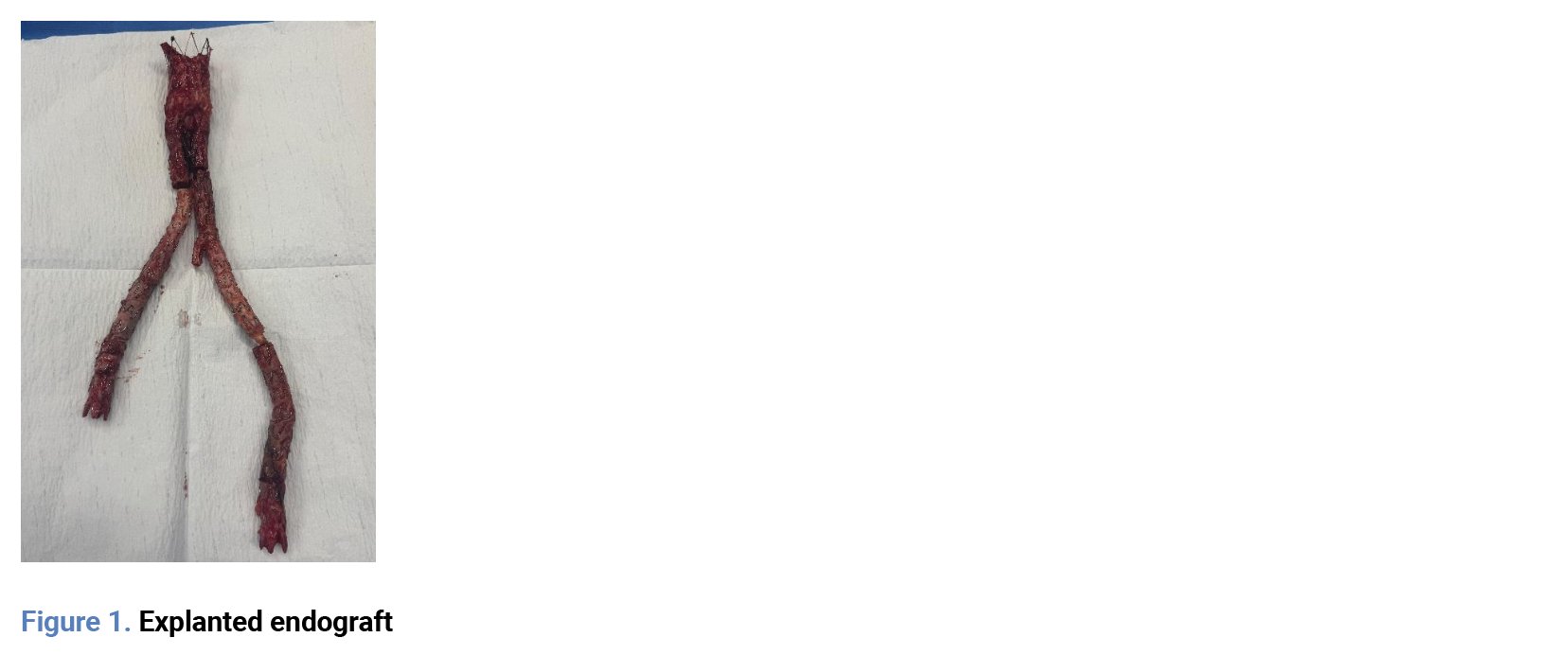
After positron emission tomography–computed tomography (PET-CT) findings were consistent with infection of the abdominal aortic EG, the patient was admitted to Vascular Surgery service (VS) for substitution of the infected EG (Figure 1). Peritoneal fluid and the explanted EG were sent to microbiology for culture. After 24 hours of incubation at 37oC, yeast growth was observed on Sabouraud dextrose agar; isolates were identified as Candida kefyr using MALDI-TOF MS (Bruker Daltonics®, Germany).
 Based on CLSI epidemiological cutoff values (ECVs), the isolate was wild-type for echinocandins but non–wild–type for amphotericin B; however, by Etest, it was classified as wild-type for amphotericin B.
To confirm these results, the isolate was sent to a reference center, which classified it as wild-type for amphotericin B using the CLSI broth microdilution method, as well as identification by ITS sequencing.
Considering these results, we decided to repeat the Sensititre YeastOne® (SYO) test to further confirm the discrepancy between the reference method and SYO.
Once identification and susceptibility were confirmed, treatment with micafungin and meropenem was started. The patient was discharged three weeks after surgery in a clinically stable condition, afebrile, and without signs of persistent infection, and was prescribed oral fluconazole for six months. From an infectious diseases standpoint, the patient remained clinically stable throughout mid- and long-term follow-up, with no febrile episodes or laboratory findings suggestive of infection reactivation.
One of the most feared complications of an endovascular aneurysm repair (EVAR) is aortic endograft infection. This infection is rare, with incidence ranging from 0.2 to 5% according to different published series [2–5], but its overall mortality is close to 50% [5,6]. Staphylococcus spp. are the most common bacterial genera involved in this type of infection [7,8]. Fungal endograft infections are rare, with most of the few reported cases being caused by Candida albicans [8,9]. One series reports fungi being involved in up to 14% of endograft infections [10]. In the 1997-2016 SENTRY Programme, C. kefyr was listed as a rare finding even among invasive candidiasis, accounting for 0.45% of invasive Candida isolates [11].
In epidemiological surveillance studies conducted in Spain, such as the population-based CANDIPOP study and the regional multicenter CANDIMAD study, uncommon species, including C. kefyr, represented less than 7% of isolates from blood and intra-abdominal samples. Approximately 40%-50% of intra-abdominal isolates were C. albicans. [12,13]. Another study evaluating and comparing the outcome of aortic graft infections associated and not associated with Candida spp. found 21 infections caused by fungi, and in only one case was the aetiology C. kefyr [14].
Our discrepancy in susceptibility may be attributed to limitations of SYO testing. However, reduced susceptibility to amphotericin B (rs-AMB) in C. kefyr has been described previously. Asadzadeh et al. studied 81 C. kefyr isolates, eight of which were rs-AMB by Etest. SYO correctly identified all eight rs-AMB isolates, but this reduced susceptibility was not corroborated by a reference method [15] .
In conclusion, C. kefyr has garnered attention as a rare pathogen in graft infections. Fungal infections of vascular devices are a therapeutic challenge due to biofilm formation, which contributes to virulence and potential resistance to antifungal treatment, as well as the frequent need for surgery [16].
This case highlights the importance of microbiological cultures for the management of prosthetic infections. Diagnosis requires a combination of clinical, radiological, and microbiological criteria, as well as a multidisciplinary approach (vascular surgery and microbiology).
Funding
No funding was received for the research, authorship, and/or publication of this article.
Author contributions
Conceptualization, JLMB; investigation and resources, LGB, BBR, SVG; writing—original draft preparation, LGB and BBR; writing—review and editing, JLMB; supervision, JLMB. All authors have read and agreed to the published version of the manuscript.
Conflict of interest
No commercial, financial, or personal conflicts of interest were identified in relation to the research, authorship, and/or publication of this article.
AI statement
No artificial intelligence tools were used in the writing, analysis, interpretation, or review of this article.
References
Based on CLSI epidemiological cutoff values (ECVs), the isolate was wild-type for echinocandins but non–wild–type for amphotericin B; however, by Etest, it was classified as wild-type for amphotericin B.
To confirm these results, the isolate was sent to a reference center, which classified it as wild-type for amphotericin B using the CLSI broth microdilution method, as well as identification by ITS sequencing.
Considering these results, we decided to repeat the Sensititre YeastOne® (SYO) test to further confirm the discrepancy between the reference method and SYO.
Once identification and susceptibility were confirmed, treatment with micafungin and meropenem was started. The patient was discharged three weeks after surgery in a clinically stable condition, afebrile, and without signs of persistent infection, and was prescribed oral fluconazole for six months. From an infectious diseases standpoint, the patient remained clinically stable throughout mid- and long-term follow-up, with no febrile episodes or laboratory findings suggestive of infection reactivation.
One of the most feared complications of an endovascular aneurysm repair (EVAR) is aortic endograft infection. This infection is rare, with incidence ranging from 0.2 to 5% according to different published series [2–5], but its overall mortality is close to 50% [5,6]. Staphylococcus spp. are the most common bacterial genera involved in this type of infection [7,8]. Fungal endograft infections are rare, with most of the few reported cases being caused by Candida albicans [8,9]. One series reports fungi being involved in up to 14% of endograft infections [10]. In the 1997-2016 SENTRY Programme, C. kefyr was listed as a rare finding even among invasive candidiasis, accounting for 0.45% of invasive Candida isolates [11].
In epidemiological surveillance studies conducted in Spain, such as the population-based CANDIPOP study and the regional multicenter CANDIMAD study, uncommon species, including C. kefyr, represented less than 7% of isolates from blood and intra-abdominal samples. Approximately 40%-50% of intra-abdominal isolates were C. albicans. [12,13]. Another study evaluating and comparing the outcome of aortic graft infections associated and not associated with Candida spp. found 21 infections caused by fungi, and in only one case was the aetiology C. kefyr [14].
Our discrepancy in susceptibility may be attributed to limitations of SYO testing. However, reduced susceptibility to amphotericin B (rs-AMB) in C. kefyr has been described previously. Asadzadeh et al. studied 81 C. kefyr isolates, eight of which were rs-AMB by Etest. SYO correctly identified all eight rs-AMB isolates, but this reduced susceptibility was not corroborated by a reference method [15] .
In conclusion, C. kefyr has garnered attention as a rare pathogen in graft infections. Fungal infections of vascular devices are a therapeutic challenge due to biofilm formation, which contributes to virulence and potential resistance to antifungal treatment, as well as the frequent need for surgery [16].
This case highlights the importance of microbiological cultures for the management of prosthetic infections. Diagnosis requires a combination of clinical, radiological, and microbiological criteria, as well as a multidisciplinary approach (vascular surgery and microbiology).
Funding
No funding was received for the research, authorship, and/or publication of this article.
Author contributions
Conceptualization, JLMB; investigation and resources, LGB, BBR, SVG; writing—original draft preparation, LGB and BBR; writing—review and editing, JLMB; supervision, JLMB. All authors have read and agreed to the published version of the manuscript.
Conflict of interest
No commercial, financial, or personal conflicts of interest were identified in relation to the research, authorship, and/or publication of this article.
AI statement
No artificial intelligence tools were used in the writing, analysis, interpretation, or review of this article.
References
- Zareshahrabadi Z, Khaliji S, Roudbari M, Zomorodian K. Antifungal Drug Susceptibility Profile of Candida kefyr Isolated from Clinical Samples and Dairy Products. Can J Infect Dis Med Microbiol. 2024;6594366. Available from: https://doi.org/10.1155/2024/6594366
- Argyriou C, Georgiadis GS, Lazarides MK, Georgakarakos E, Antoniou GA. Endograft Infection After Endovascular Abdominal Aortic Aneurysm Repair: A Systematic Review and Meta-analysis. J Endovasc Ther. 2017;24(5):688-97.Available from: https://doi.org/10.1177/1526602817722018.
- Heyer KS, Modi P, Morasch MD, Matsumura JS, Kibbe MR, Pearce WH, et al. Secondary infections of thoracic and abdominal aortic endografts. J Vasc Interv Radiol 2009;20(2):173–9. Available from: https://doi.org/10.1016/j.jvir.2008.10.032
- Cernohorsky P, Reijnen MMPJ, Tielliu IFJ, van Sterkenburg SMM, van den Dungen JJAM, Zeebregts CJ. The relevance of aortic endograft prosthetic infection. J Vasc Surg. 2011;54(2):327–33. Available from: https://doi.org/10.1016/j.jvs.2010.12.067
- Fernandez Prendes C, Riedemann Wistuba M, Zanabili Al-Sibbai AA, Del Castro Madrazo JA, Santervas LAC, Perez MA. Infrarenal Aortic Endograft Infection: A Single-Center Experience. Vasc Endovascular Surg. 2019;53(2):132–8. Available from: https://doi.org/10.1177/1538574418813606
- Smeds MR, Duncan AA, Harlander-Locke MP, Lawrence PF, Lyden S, Fatima J, et al. Treatment and outcomes of aortic endograft infection. J Vasc Surg. 2016;63(2):332–40. Available from: https://doi.org/10.1016/j.jvs.2015.08.113
- Chakfé N, Diener H, Lejay A, Assadian O, Berard X, Caillon J, et al. Editor’s Choice – European Society for Vascular Surgery (ESVS) 2020 Clinical Practice Guidelines on the Management of Vascular Graft and Endograft Infections. Eur J Vasc Endovasc Surg. 2020;59(3):339–84. Available from: https://doi.org/10.1016/j.ejvs.2019.10.016
- Nemoto T, Tokuda Y, Hirose M, Naitoh Y, Yamasaki Y, Shimizu T, et al. Thoracic Aortic Graft Infection due to Candida Albicans with Multiple Embolism in the Left-side Vessels of the Body. Intern Med. 2017;56(9):1107–11. Available from: https://doi.org/10.2169/internalmedicine.56.7052
- Dominguez-Cainzos J, Rodrigo-Manjon A, Rodriguez-Chinesta JM, Apodaka-Diez A, Bonmatí G, Bereciartua E. Abdominal aortic endograft infection. A decade of experience and literature review. Enferm Infecc Microbiol Clin. 2023;41(3):155–61. Available from: https://doi.org/10.1016/j.eimce.2022.07.002
- Davila VJ, Stone W, Duncan AA, Wood E, Jordan WD, Zea N, et al. A multicenter experience with the surgical treatment of infected abdominal aortic endografts. J Vasc Surg. 2015;62(4):877–83. Available from: https://doi.org/10.1016/j.jvs.2015.04.440
- Pfaller MA, Diekema DJ, Turnidge JD, Castanheira M, Jones RN. Twenty Years of the SENTRY Antifungal Surveillance Program: Results for Candida Species From 1997–2016. Open Forum Infect Dis. 2019;6(Supplement_1):S79–94. Available from: https://doi.org/10.1093/ofid/ofy358
- Díaz-García J, Machado M, Alcalá L, et al. Trends in antifungal resistance in Candida from a multicenter study conducted in Madrid (CANDIMAD study): fluconazole-resistant C. parapsilosis spreading has gained traction in 2022. Antimicrob Agents Chemother. 2023;67(11):e0098623. Available from: https://doi.org/10.1128/aac.00986-23
- López-Cortés LE, Almirante B, Cuenca-Estrella M, et al. Empirical and targeted therapy of candidemia with fluconazole versus echinocandins: a propensity score-derived analysis of a population-based, multicentre prospective cohort. Clin Microbiol Infect. 2016;22(8):733.e1-8. Available from: https://doi.org/10.1016/j.cmi.2016.05.008
- Omran S, Gröger S, Shafei B, Schawe L, Bruder L, Haidar H, et al. Outcomes of Candida and Non-Candida Aortic Graft Infection. Vasc Endovascular Surg. 2023;57(2):97–105. Available from: https://doi.org/10.1177/15385744221129236
- Asadzadeh M, Alfouzan W, Parker JE, Meis JF, Kelly SL, Joseph L, et al. Molecular Characterization and Sterol Profiles Identify Nonsynonymous Mutations in ERG2 as a Major Mechanism Conferring Reduced Susceptibility to Amphotericin B in Candida kefyr. Microbiol Spectr. 2023;11(4):e01474-23. Available from: https://doi.org/10.1128/spectrum.01474-23
- Odabasi Z, Mert A. Candida urinary tract infections in adults. World J Urol. 2020;38(11):2699–707. Available from: https://doi.org/10.1007/s00345-019-02991-5
Explore
Articles
Volumes
About the journal
Most read
Recomendaciones para la prevención y el tratamiento de las infecciones respiratorias en adultos mayores institucionalizados
Revista Española de Quimioterapia
Acute infectious gastroenteritis in childhood: the role of rapid multiplex molecular syndromic panels in diagnosis and clinical management
Revista Española de Quimioterapia
Características epidemiológicas de pacientes con aislamientos de Enterobacterales productores de carbapenemasas-NDM en un hospital de alta complejidad
Revista Española de Quimioterapia
Review on the management of intra-abdominal candidiasis
Revista Española de Quimioterapia
Neoscytalidium dimidiatum: a rare locally acquired deep cutaneous infection in a renal transplant recipient
Revista Española de Quimioterapia