Case report
June 2025, Volume 38, nº 3
4 min
Cefiderocol-associated chromaturia, a secondary side effect to recognize
Victoria Lobo-Antuña1, Marta Lobo-Antuña2*, Margarita Monzón-Torres3, Sebastián Ortiz-Zuluaga2, Armando Mena-Durán2, Carmen Ricart-Olmos4
1Servicio de Medicina Interna, Consorcio Hospital General Universitario de Valencia, Valencia, España
2Servicio de Medicina Interna, Hospital Universitario Clínico San Carlos, Madrid, España
3Servicio de Hematología, Consorcio Hospital General Universitario de Valencia, Valencia, España
4Servicio de Enfermedades Infecciosas, Consorcio Hospital General Universitario de Valencia, Valencia, España
https://www.doi.org/10.37201/req/019.2025
Receipt Date:
07/02/2025
Acceptance Date:
18/02/2025
Publication Date:
09/03/2025
How to cite
Lobo-Antuña V, Lobo-Antuña M, Monzón-Torres M, Ortiz-Zuluaga S, Mena-Durán A, Ricart-Olmos C. Cefiderocol-associated chromaturia, a secondary side effect to recognize. Rev Esp Quimioter. 2025; 38(3): 253-4. Available from: https://doi.org/10.37201/req/019.2025
Metrics
686
Views
56
Downloads
Share
Share
Sir,
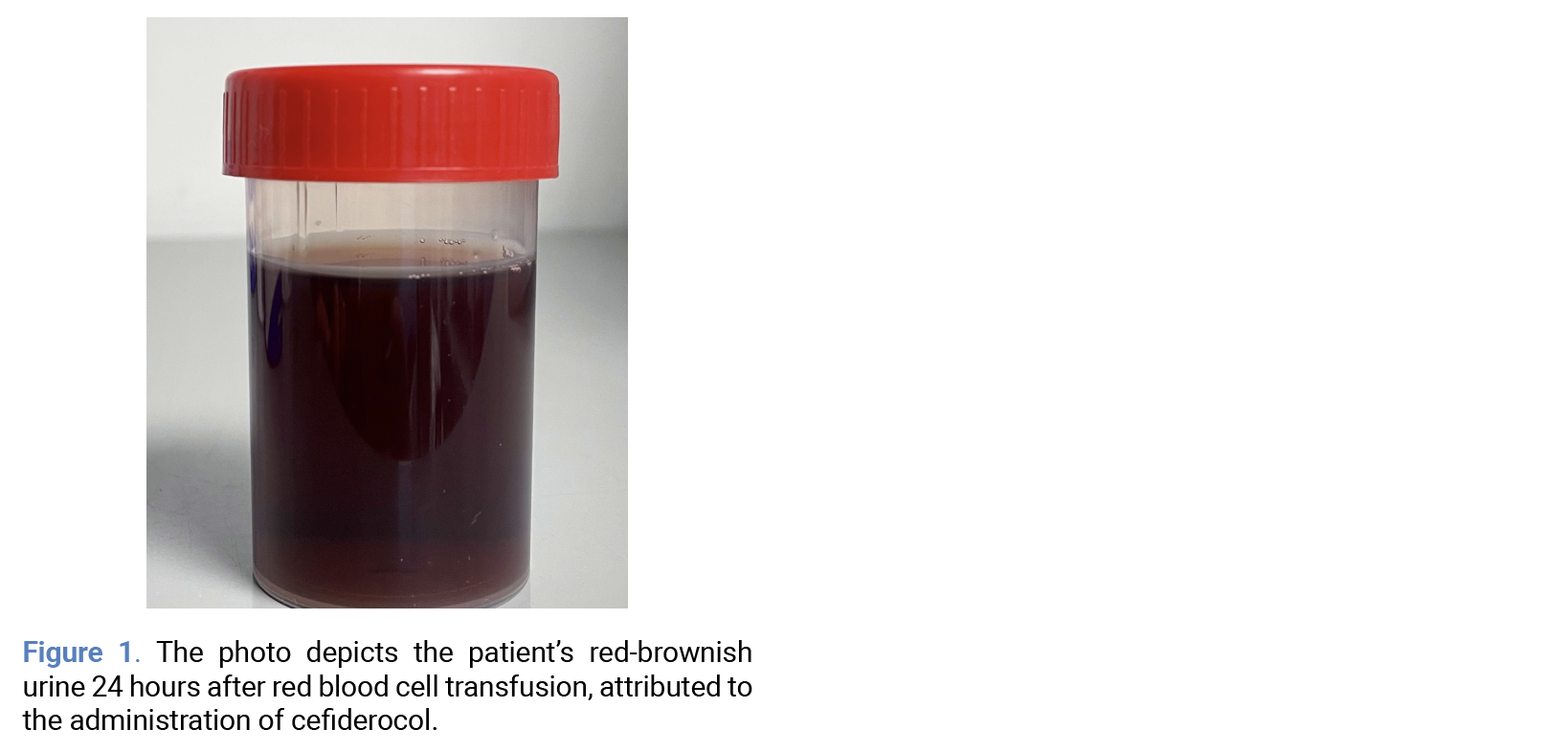
A 33-year-old woman with diffuse large B-cell lymphoma refractory to R-CHOP chemotherapy presented with sepsis secondary to an intestinal perforation caused by a mesenteric mass. Surgical drainage of an intra-abdominal abscess grew Acinetobacter baumannii, and she was treated with cefiderocol, a novel siderophore-cephalosporin, at 2g/8h intravenously. After three weeks of therapy, coinciding with a red blood cell transfusion, her urine changed to a wine-brown color without clots (Figure 1). This discoloration resolved 48 hours after discontinuation of cefiderocol.
 Laboratory findings revealed normal renal function, a urinary pH of 7.2, and a normal urinary sediment with no evidence of erythrocytes neither leukocytes in urine. Serum ferritin levels were markedly elevated (2,600 ng/mL). No abnormalities in creatine kinase were detected.
Chromaturia, or urine discoloration, is a relatively uncommon phenomenon associated with certain drugs. Medications such as rifampin, chloroquine, and levodopa are known to cause this benign yet striking side effect [1]. However, reports linking chromaturia to cefiderocol, a novel siderophore-cephalosporin, remain scarce [2-5].
Cefiderocol is a next-generation cephalosporin effective against multidrug-resistant Gram-negative bacteria by inhibiting penicillin-binding proteins, which are essential for cell wall synthesis [6,7]. It utilizes bacterial iron uptake mechanisms to penetrate cell membranes, forming iron-cephalosporin complexes that mimic natural siderophores. Although the underlying mechanism of chromaturia is not fully understood, it has been associated with the urinary excretion of these iron complexes under alkaline conditions, and its appearance has been related to elevated iron levels or impaired renal function [2,3].
In this patient, chromaturia was temporally associated with cefiderocol use and resolved upon discontinuation. The absence of renal or muscular abnormalities, a normal urinary sediment, and elevated ferritin levels suggest the mechanism may involve the interaction between cefiderocol’s iron-binding properties and the patient’s iron metabolism. The coinciding blood transfusion in a patient with pre-existing altered iron metabolism may have exacerbated this effect.
As cefiderocol and other advanced antibiotics become essential in the fight against multidrug-resistant organisms, it is increasingly important for clinicians to recognize this unusual side effect to prevent diagnostic confusion and unnecessary treatment interruption. Our case also introduces a previously undescribed trigger, blood transfusion, which may contribute to the understanding of the pathophysiology behind cefiderocol-induced chromaturia, highlighting the need for greater awareness and further research into this phenomenon.
Further research into the pathophysiology of cefiderocol-associated chromaturia is warranted. Clinicians should consider this association in patients receiving cefiderocol who develop unexplained urine discoloration.
Differential diagnosis
Laboratory findings revealed normal renal function, a urinary pH of 7.2, and a normal urinary sediment with no evidence of erythrocytes neither leukocytes in urine. Serum ferritin levels were markedly elevated (2,600 ng/mL). No abnormalities in creatine kinase were detected.
Chromaturia, or urine discoloration, is a relatively uncommon phenomenon associated with certain drugs. Medications such as rifampin, chloroquine, and levodopa are known to cause this benign yet striking side effect [1]. However, reports linking chromaturia to cefiderocol, a novel siderophore-cephalosporin, remain scarce [2-5].
Cefiderocol is a next-generation cephalosporin effective against multidrug-resistant Gram-negative bacteria by inhibiting penicillin-binding proteins, which are essential for cell wall synthesis [6,7]. It utilizes bacterial iron uptake mechanisms to penetrate cell membranes, forming iron-cephalosporin complexes that mimic natural siderophores. Although the underlying mechanism of chromaturia is not fully understood, it has been associated with the urinary excretion of these iron complexes under alkaline conditions, and its appearance has been related to elevated iron levels or impaired renal function [2,3].
In this patient, chromaturia was temporally associated with cefiderocol use and resolved upon discontinuation. The absence of renal or muscular abnormalities, a normal urinary sediment, and elevated ferritin levels suggest the mechanism may involve the interaction between cefiderocol’s iron-binding properties and the patient’s iron metabolism. The coinciding blood transfusion in a patient with pre-existing altered iron metabolism may have exacerbated this effect.
As cefiderocol and other advanced antibiotics become essential in the fight against multidrug-resistant organisms, it is increasingly important for clinicians to recognize this unusual side effect to prevent diagnostic confusion and unnecessary treatment interruption. Our case also introduces a previously undescribed trigger, blood transfusion, which may contribute to the understanding of the pathophysiology behind cefiderocol-induced chromaturia, highlighting the need for greater awareness and further research into this phenomenon.
Further research into the pathophysiology of cefiderocol-associated chromaturia is warranted. Clinicians should consider this association in patients receiving cefiderocol who develop unexplained urine discoloration.
Differential diagnosis
- Hematuria: ruled out by the absence of red blood cells in urinary sediment.
- Myoglobinuria or hemoglobinuria: excluded based on normal creatine kinase levels and the absence of hemolysis.
- Other drug-induced discoloration: the patient was not receiving any other medications known to cause chromaturia.
- Cefiderocol-induced chromaturia is benign and resolves upon drug discontinuation. Awareness of this side effect helps prevent unnecessary diagnostic workups and treatment interruptions.
- Blood transfusion in patients with hyperferritinemia may exacerbate urine discoloration due to increased iron levels, suggesting a novel trigger for this phenomenon.
- Recognition of this rare side effect highlights the importance of monitoring for unexpected drug reactions as novel antibiotics like cefiderocol become increasingly utilized.
References
- Martínez-Ávila MC, García-García A, García-García A, et al. Is it the bag or the urine that changed color? Differential diagnosis and clinical relevance. Med Clin Pract. 2021;4(4):100274. doi:10.1016/j.mcpsp.2021.100274.
- Lupia T, Salvador E, Corcione S, De Rosa FG. Dark Brown Urine in a Patient Treated With Cefiderocol. Infez Med. 2023 Jun 1;31(2):265-267. doi: 10.53854/liim-3102-16.
- Smith M, Foong KS. Cefiderocol-associated brown chromaturia. BMJ Case Rep. 2023 Dec 16;16(12):e258207. doi: 10.1136/bcr-2023-258207.
- Lewis TC, Arnouk S. Dark Red Urine in a Patient on Cefiderocol and Ferric Gluconate. Ann Pharmacother. 2022 Sep;56(9):1082-1083. doi: 10.1177/10600280211070029.
- Shaik MR, Shaik NA, Hossain S, Yunasan E, Khachatryan A, Chow R. Purplish Discoloration of Urine in a Patient Receiving Cefiderocol: A Rare Adverse Effect. J Community Hosp Intern Med Perspect. 2023 Nov 4;13(6):43-46. doi: 10.55729/2000-9666.1256.
- Bassetti M, Echols R, Matsunaga Y, Ariyasu M, Doi Y, Ferrer Ret al. Efficacy and safety of cefiderocol or best available therapy for the treatment of serious infections caused by carbapenem-resistant Gram-negative bacteria (CREDIBLE-CR): a randomised, open-label, multicentre, pathogen-focused, descriptive, phase 3 trial. Lancet Infect Dis. 2021 Feb;21(2):226-240. doi: 10.1016/S1473-3099(20)30796-9.
- Yamano Y, Morita I, Ariyasu M. [Cefiderocol: a first and novel class of siderophore cephalosporin for Carbapenem-resistant Gram-negative infection]. Nihon Yakurigaku Zasshi. 2024;159(5):331-340. doi: 10.1254/fpj.24029.
Explore
Articles
Volumes
About the journal
Most read
Recomendaciones para la prevención y el tratamiento de las infecciones respiratorias en adultos mayores institucionalizados
Revista Española de Quimioterapia
Acute infectious gastroenteritis in childhood: the role of rapid multiplex molecular syndromic panels in diagnosis and clinical management
Revista Española de Quimioterapia
Características epidemiológicas de pacientes con aislamientos de Enterobacterales productores de carbapenemasas-NDM en un hospital de alta complejidad
Revista Española de Quimioterapia
Review on the management of intra-abdominal candidiasis
Revista Española de Quimioterapia
Neoscytalidium dimidiatum: a rare locally acquired deep cutaneous infection in a renal transplant recipient
Revista Española de Quimioterapia