Letter
December 2025, Volume 38, nº 6
6 min
Chronic lung infection by Achromobacter xylosoxidans in a patient with cystic fibrosis successfully treated with cefiderocol as a pre and post-lung transplant regimen
Susana Ramos Oliveira1,* , Rodrigo Alonso-Moralejo2, Virginia Pérez2 , Carlos Andrés Quezada2, Alicia de Pablo2, Irene Muñoz-Gallego3, José Tiago Silva4,5,6 , José María Aguado4,5,6, Francisco López-Medrano4,5,6
1Infectious Diseases Department, Hospital Pedro Hispano, Unidade Local de Saúde de Matosinhos, Portugal
2Department of Pneumology, Lung Transplant Unit, Hospital Universitario 12 de Octubre, Madrid, Spain.
3Department of Microbiology, Hospital Universitario 12 de Octubre, Madrid, Spain.
4School of Medicine, Universidad Complutense de Madrid.
5Infectious Diseases Unit, Hospital Universitario 12 de Octubre, Madrid, España. Instituto de Investigación del Hospital 12 de Octubre (i+12). 6Centro de Investigación Biomédica en Red de Enfermedades Infecciosas (CIBERINFEC; CB21/13/00009), Instituto de Salud Carlos III, Madrid, España.
http://www.doi.org/10.37201/req/009.2025
Receipt Date:
12/01/2025
Acceptance Date:
18/09/2025
Publication Date:
20/10/2025
How to cite
Ramos Oliveira S, Alonso-Moralejo R, Pérez V, Quezada CA, de Pablo A, Muñoz-Gallego I, et al. Chronic lung infection by Achromobacter xylosoxidans in a patient with cystic fibrosis successfully treated with cefiderocol as a pre and post-lung transplant regimen. Rev Esp Quimioter. 2025; 38(6):517-520. Available from: http://www.doi.org/10.37201/req/009.2025
Metrics
920
Views
131
Downloads
Share
Share
Sir,
Cystic fibrosis (CF) patients’ life expectancy has consistently increased in the last decade [1]. However, it remains a life-shortening disease due to deterioration of lung function caused by acute respiratory infections and chronic lung inflammation [1–3]. The main bacterial pathogens causing respiratory infections in CF patients are, in order of prevalence, Staphylococcus aureus, Pseudomonas aeruginosa, Haemophilus influenzae, Stenotrophomonas maltophilia and Achromobacter spp. [3].
Kerem et al. [3] analyzed the clinical outcomes of Achromobacter spp. infection in 2,093 CF patients who had never undergone lung transplantation: compared with patients without Achromobacter spp. infection, a higher prevalence of severe disease, i.e., lower forced expiratory volume in the first second (FEV1) percent of predicted was observed, as well as lower body mass index and higher treatment burden. These results prove a link to disease severity, but it remains unclear whether the infection is causally related to clinical worsening.
Therapeutic options for Achromobacter spp. infections are limited due to its several intrinsic resistance mechanisms, biofilm-production capacity, and ability to acquire other resistance mechanisms [2,4,5].
We report the case of a CF patient chronically infected with Achromobacter xylosoxidans who received cefiderocol in a peri-lung transplant regimen, with clinical and microbiological success.
Clinical case
Thirty-six-year-old woman with CF diagnosed at 6 months of age, with chronic colonization with various bacteria since early childhood, the most persistent being methicillin-susceptible S. aureus and A. xylosoxidans. Treatment of respiratory exacerbations was challenging due to the patient’s allergies to multiple beta-lactams, including imipenem.
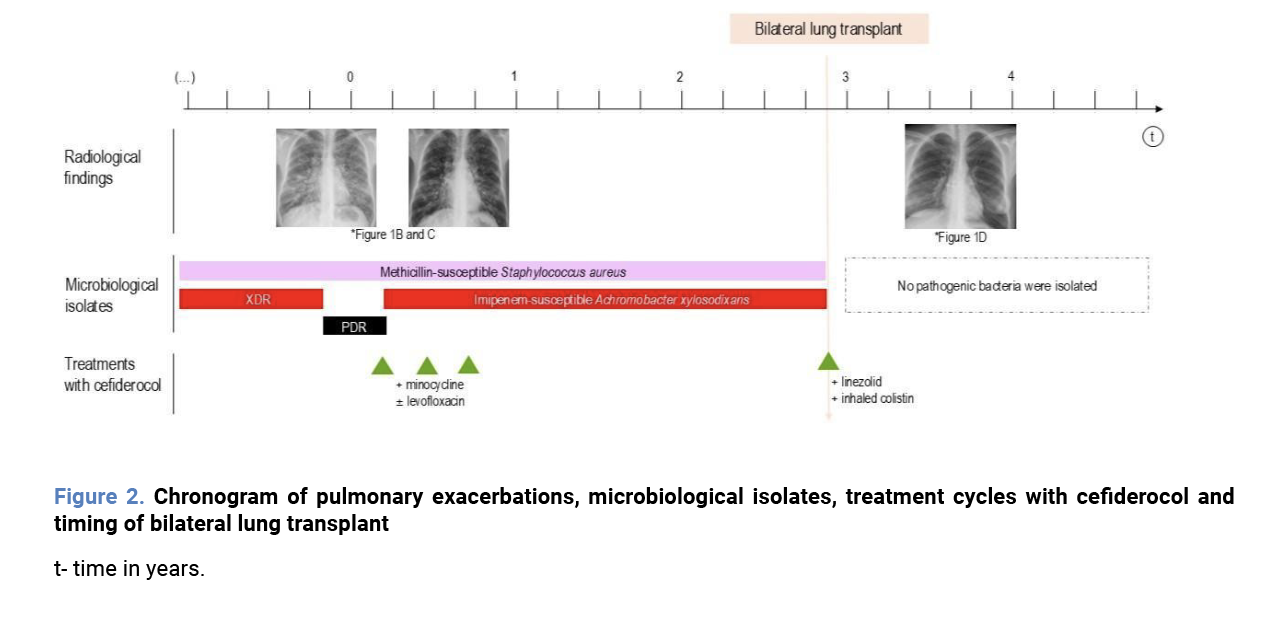
A. xylosoxidans was initially susceptible to multiple antibiotics, but over the years because of numerous antimicrobial treatments, it became pandrug-resistant (PDR) to all tested antibiotics - cotrimoxazole, minocycline, aminoglycosides, quinolones, and all beta-lactams, including imipenem, ceftolozane/tazobactam and ceftazidime/avibactam. After confirming in-vitro cefiderocol susceptibility and discussing the case with the Allergy Department, the patient received three courses of treatment (2 g every 8 hours) for 14 to 21 days, in combination with minocycline, with or without levofloxacin. Following these treatment courses, clinical and radiological improvement was observed (Figure 1A, B and C), and subsequent isolates regained imipenem susceptibility, indicating the eradication of PDR A. xylosoxidans.
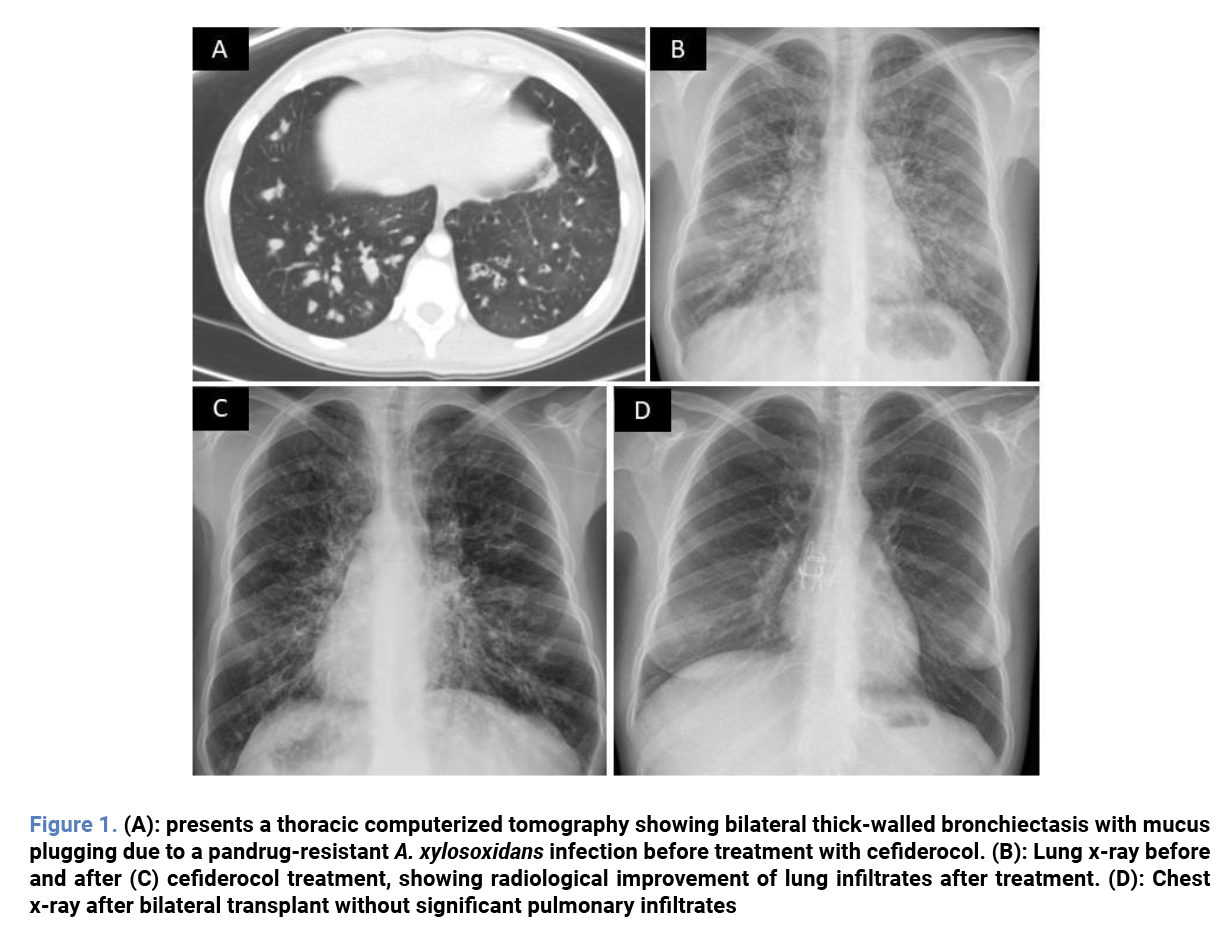 Due to severe respiratory insufficiency, a multidisciplinary decision to proceed with a bilateral lung transplant was made, and cefiderocol was requested (on compassionate use) to ensure immediate postoperative treatment as a preemptive strategy. Thirty-two months after the initial course of cefiderocol, the patient underwent a bilateral lung transplant; A. xylosoxidans was the only relevant pathogen isolated in the explanted lungs, showing susceptibility to imipenem. As planned, the patient received cefiderocol (2 g every 8 hours), linezolid (due to previous S. aureus infection), and inhaled colistin for four weeks postoperatively. Immunosuppression was initiated with basiliximab for induction, followed by tacrolimus, mycophenolate mofetil, and prednisone. Follow-up bronchoscopy did not grow pathogenic bacteria, and hospital discharge occurred one month after transplant as planned.
Two years post-transplant, the patient remains off oxygen therapy and performs daily activities without dyspnea, reporting only occasional episodes of cough, mainly non-productive. Sputum cultures are consistently negative for Achromobacter spp. or other pathogenic bacteria (Figure 2), lung function remains stable with a mean forced vital capacity of 3.445 liters and FEV1 of 3.125 liters, and there is no evidence of relevant radiological lung infiltrates (Figure 1D).
 Lung transplantation is considered in selected patients with CF when all other therapeutic options have proven insufficient; however, infection at the time of transplant increases the risk of postoperative infectious complications, especially due to the intensive immunosuppression required in the early stages, and is associated with a high likelihood of early re-colonization [6].
The challenge of successfully eradicating persistent lung infections in CF patients, combined with the increase in the prevalence of multidrug-resistant (MDR) Gram-negative bacilli, emphasizes the need to optimize antibiotic strategies for this particular population. Cefiderocol is a novel siderophore cephalosporin with broad-spectrum activity, including against MDR Gram-negative bacilli.
Clinical evidence on the use of cefiderocol in CF patients or lung transplant recipients is scarce, relying mostly on case reports of compassionate use [4,5]. Warner et al. [4] reported eight CF patients infected with extensively MDR A. xylosoxidans treated with cefiderocol; of note, six patients received it as a peri-lung transplant regimen. Although most patients accomplished a clinical response, microbiological clearance occurred in a single patient, who received concomitant meropenem-vaborbactam and bacteriophage therapy. More recently, Persaud et al. [5] reported treatment with cefiderocol in fifteen lung transplant recipients, of whom only one was infected with Achromobacter spp., and achieved microbiological success after 42 perioperative days of cefiderocol.
In our patient, compassionate use of cefiderocol successfully treated pulmonary exacerbations caused by PDR A. xylosoxidans, as evidenced by clinical and radiological improvements. Eradication of this PDR strain enabled the patient’s survival while on the transplant waiting list, ultimately leading to a successful bilateral transplant. Our experience suggests that early intensive treatment with cefiderocol after lung transplant may be an effective and safe option in the peri-transplant setting, even in well-established chronic infections.
Author contributions
Conceptualization, FLM; investigation and resources, SRO, RAM, VP, CAQ, AP, IMG, JTS, JMA, FLM; validation, RAM, VP, CAQ, AP, IMG, JTS, FLM; writing—original draft preparation, SRO; writing—review and editing, JMA, FLM; visualization, SRO, FLM; supervision, FLM. All authors have read and agreed to the published version of the manuscript.
Funding
None to declare.
Conflict of interest
Authors declare no conflict of interest.
Due to severe respiratory insufficiency, a multidisciplinary decision to proceed with a bilateral lung transplant was made, and cefiderocol was requested (on compassionate use) to ensure immediate postoperative treatment as a preemptive strategy. Thirty-two months after the initial course of cefiderocol, the patient underwent a bilateral lung transplant; A. xylosoxidans was the only relevant pathogen isolated in the explanted lungs, showing susceptibility to imipenem. As planned, the patient received cefiderocol (2 g every 8 hours), linezolid (due to previous S. aureus infection), and inhaled colistin for four weeks postoperatively. Immunosuppression was initiated with basiliximab for induction, followed by tacrolimus, mycophenolate mofetil, and prednisone. Follow-up bronchoscopy did not grow pathogenic bacteria, and hospital discharge occurred one month after transplant as planned.
Two years post-transplant, the patient remains off oxygen therapy and performs daily activities without dyspnea, reporting only occasional episodes of cough, mainly non-productive. Sputum cultures are consistently negative for Achromobacter spp. or other pathogenic bacteria (Figure 2), lung function remains stable with a mean forced vital capacity of 3.445 liters and FEV1 of 3.125 liters, and there is no evidence of relevant radiological lung infiltrates (Figure 1D).
Lung transplantation is considered in selected patients with CF when all other therapeutic options have proven insufficient; however, infection at the time of transplant increases the risk of postoperative infectious complications, especially due to the intensive immunosuppression required in the early stages, and is associated with a high likelihood of early re-colonization [6].
The challenge of successfully eradicating persistent lung infections in CF patients, combined with the increase in the prevalence of multidrug-resistant (MDR) Gram-negative bacilli, emphasizes the need to optimize antibiotic strategies for this particular population. Cefiderocol is a novel siderophore cephalosporin with broad-spectrum activity, including against MDR Gram-negative bacilli.
Clinical evidence on the use of cefiderocol in CF patients or lung transplant recipients is scarce, relying mostly on case reports of compassionate use [4,5]. Warner et al. [4] reported eight CF patients infected with extensively MDR A. xylosoxidans treated with cefiderocol; of note, six patients received it as a peri-lung transplant regimen. Although most patients accomplished a clinical response, microbiological clearance occurred in a single patient, who received concomitant meropenem-vaborbactam and bacteriophage therapy. More recently, Persaud et al. [5] reported treatment with cefiderocol in fifteen lung transplant recipients, of whom only one was infected with Achromobacter spp., and achieved microbiological success after 42 perioperative days of cefiderocol.
In our patient, compassionate use of cefiderocol successfully treated pulmonary exacerbations caused by PDR A. xylosoxidans, as evidenced by clinical and radiological improvements. Eradication of this PDR strain enabled the patient’s survival while on the transplant waiting list, ultimately leading to a successful bilateral transplant. Our experience suggests that early intensive treatment with cefiderocol after lung transplant may be an effective and safe option in the peri-transplant setting, even in well-established chronic infections.
Author contributions
Conceptualization, FLM; investigation and resources, SRO, RAM, VP, CAQ, AP, IMG, JTS, JMA, FLM; validation, RAM, VP, CAQ, AP, IMG, JTS, FLM; writing—original draft preparation, SRO; writing—review and editing, JMA, FLM; visualization, SRO, FLM; supervision, FLM. All authors have read and agreed to the published version of the manuscript.
Funding
None to declare.
Conflict of interest
Authors declare no conflict of interest.
References
- Kerem E, Orenti A, Adamoli A, Hatziagorou E, Naehrlich L, Sermet-Gaudelus I. Cystic fibrosis in Europe: improved lung function and longevity – reasons for cautious optimism, but challenges remain. Eur Respir J. 2024;63(3). Available from: https://doi.org/10.1183/13993003.01241-2023
- Esposito S, Pisi G, Fainardi V, Principi N. What is the role of Achromobacter species in patients with cystic fibrosis? Front Biosci (Landmark Ed). 2021;26(12):1613–20. Available from: https://doi.org/10.52586/5054
- Kerem E, Orenti A, Zolin A, Annicchiarico L, Drevinek P. Clinical outcomes associated with Achromobacter species infection in people with cystic fibrosis. J Cyst Fibros. 2023;22(2):334–43. Available from: https://doi.org/10.1016/j.jcf.2022.11.001
- Warner NC, Bartelt LA, Lachiewicz AM, et al. Cefiderocol for the treatment of adult and pediatric patients with cystic fibrosis and Achromobacter xylosoxidans infections. Clin Infect Dis. 2021;73(7):e1754–7. Available from: https://doi.org/10.1093/cid/ciaa1847
- Persaud PN, Xhemali X, Neuhaus K, Budev M, Lum J. Cefiderocol utilization in lung transplant recipients at a single center. Transpl Infect Dis. 2024;26(3):e14319. Available from: https://doi.org/10.1111/tid.14319
- Holm AE, Schultz HHL, Johansen HK, et al. Bacterial re-colonization occurs early after lung transplantation in cystic fibrosis patients. J Clin Med. 2021;10(6):1275. Available from: https://doi.org/10.3390/jcm10061275
Explore
Articles
Volumes
About the journal
Most read
Recomendaciones para la prevención y el tratamiento de las infecciones respiratorias en adultos mayores institucionalizados
Revista Española de Quimioterapia
Acute infectious gastroenteritis in childhood: the role of rapid multiplex molecular syndromic panels in diagnosis and clinical management
Revista Española de Quimioterapia
Características epidemiológicas de pacientes con aislamientos de Enterobacterales productores de carbapenemasas-NDM en un hospital de alta complejidad
Revista Española de Quimioterapia
Review on the management of intra-abdominal candidiasis
Revista Española de Quimioterapia
Neoscytalidium dimidiatum: a rare locally acquired deep cutaneous infection in a renal transplant recipient
Revista Española de Quimioterapia