Review
Volume 38; Suppl. 1
15 min
Classification and applicability of new beta-lactamase inhibitors
Emilia Cercenado1,* , Francisco Javier Candel2
1Servicio de Microbiología Clínica y Enfermedades Infecciosas, Hospital General Universitario Gregorio Marañón, Madrid, Spain
2Microbiología Clínica y Enfermedades Infecciosas. IdISS & IML. Hospital Clínico San Carlos. Madrid, Spain
http://www.doi.org/10.37201/req/s01.03.2025
Receipt Date:
22/09/2025
Acceptance Date:
21/09/2025
Publication Date:
23/10/2025
How to cite
Cercenado E, Candel FJ. Classification and applicability of new beta-lactamase inhibitors. Rev Esp Quimioter. 2025; 38(Suppl. 1): 21-26. Available from: http://www.doi.org/10.37201/req/s01.03.2025
Metrics
651
Views
221
Downloads
Share
Share
Abstract (EN)
This non-exhaustive minireview describes the main characteristics of the new beta-lactamase inhibitors (enmetazobactam, avibactam, relebactam, durlobactam, zidebactam, nacubactam, vaborbactam, taniborbactam, and xeruborbactam), their spectrum of inhibition, their activity in combination with different beta-lactams, the main resistance mechanisms that can compromise their activity and the main applications of the different beta-lactam-beta-lactamase inhibitor combinations depending on the type of beta-lactamase/carbapenemase and the microorganism involved.
Keywords (EN):
Enmetazobactam
Vaborbactam
Beta-lactamase inhibitors
Relebactam
Avibactam
Taniborbactam
Introduction
Infections caused by multidrug-resistant microorganisms (MDRO) are a major public health problem. Between 2016 and 2020, the European Centre for Disease Prevention and Control reported an increasing trend in the estimated number of infections caused by MDRO in Europe, ranging from 685,433 in 2016 to 865,767 in 2019, with an annual number of attributable deaths ranging from 30,730 in 2016 to 38,710 in 2019 [1]. In Spain, a recent study in 2023 estimated that the burden of MDRO infections among hospitalised patients reached 2,351, representing a weighted incidence density of 4.41 (3.55–5.27) cases/1000 stays. Moreover, a total of 352 patients died with an MDRO infection, representing a weighted incidence density of 0.62 (0.52–0.72) [2]. Among MDRO, treatment choices for infections caused by Gram-negative bacteria have been limi-ted, including beta-lactam antibiotics as the most commonly prescribed antibacterial agents owing to their high efficacy and safety profile; however, the massive use/overuse of these agents has led to the emergence of resistance due to the bacterial production of extended-spectrum beta-lactamases (ESBLs) and/or carbapenemases. The spread of these enzymes, both in number and variety, as well as their dissemination through numerous and efficient vehicles of horizontal gene transfer, is a growing cli-nical threat that severely limits the choice of therapy. Moreover, this threat has been increased recently by the emergence of clinical isolates carrying multiple carbapenemases [3]. The emergence and spread of carbapenemase-producing Enterobacterales (CPE), Pseudomonas aeruginosa, and Acinetobacter baumannii is especially concerning given the importance of carbapenems as agents of last resort. At present, the most widespread carbapenemases are the class A serine carbapenemase KPC, the class B metallo-β-lactamases (MBLs), including NDM, IMP, and VIM, and the class D enzymes, including OXA-48 (Enterobacterales) and OXA-23 and OXA-24/40 (A. baumannii) [4]. To restore the effectiveness of carbapenems and other beta-lactams (BLs), the most successful strategy is to use them in combination with beta-lactamase inhibitors (BLIs), compounds designed to protect the BLs from enzymatic modification that would otherwise inactivate them. In fact, for more than four decades, various combinations of BLs with “classic” BLIs (clavulanic acid, tazobactam and sulbactam) have been used, although they are not active against many of the enzymes currently in circulation. Fortunately, lately new groups of inhibitors have appeared, and some are now available in the clinical setting, thus extending and recovering the antimicrobial activity of some BLs [5,6].Beta-lactamase inhibitors (BLIs)
The BLIs can be classified into three groups: the peni- cillin based BLIs, the diazabicyclooctanes (DBOs) based, and the boronic acid based. Table 1 shows the characteristics of combinations of BLs with BLIs.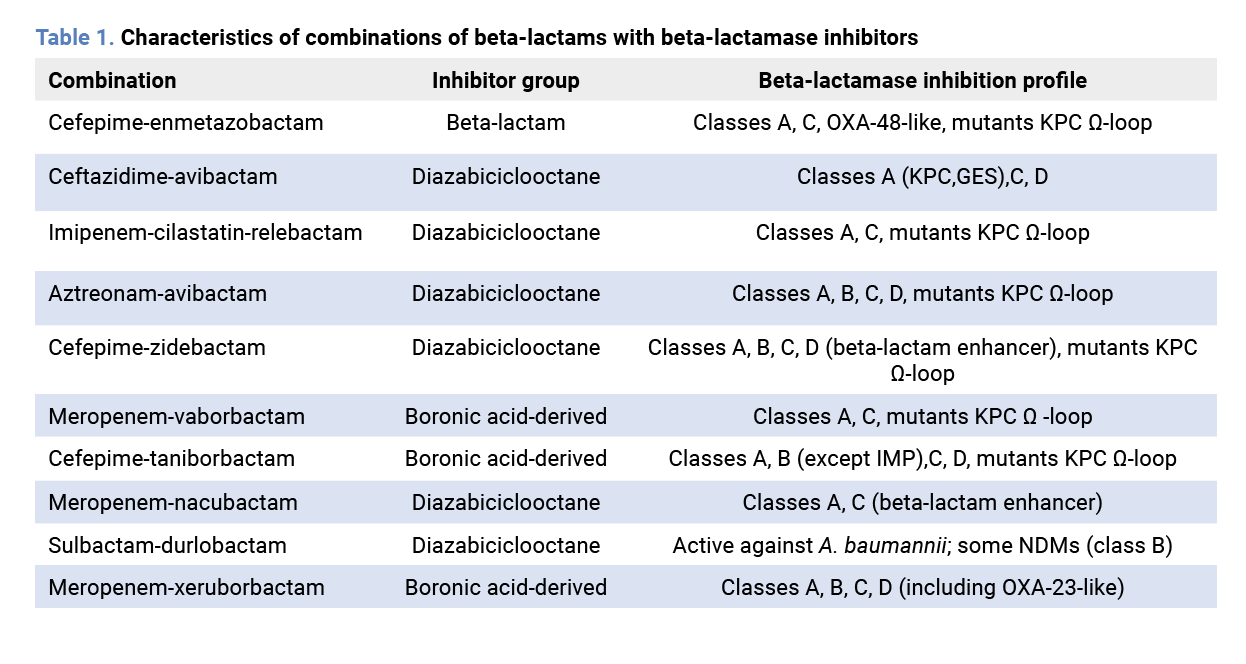
Penicillin-based beta-lactamase inhibitors
Clavulanic acid was the first BLI discovered, followed by sulbactam and tazobactam. These are the so-called classical BLIs. Clavulanic acid is structurally related to the beta-lactam ring. It inhibits all class A beta-lactamases and was approved in combination with amoxicillin and with ticarcillin. Clavulanic acid is a suicide inhibitor that binds covalently to a serine residue in the active site of the beta-lactamase and irreversibly acylates the enzyme. Sulbactam, with a potency superior to that of clavulanic acid, is also an irreversible covalent inhibitor and was approved in combination with ampicillin and with cefoperazone. It has intrinsic antibacterial activity against multidrug-resistant (MDR) A. baumannii. Tazobactam, is the third irreversible covalent BLI of this group, was commercialized in combination with piperacillin and is active against class A, some class C beta-lactamases, and class D oxacillinases, but does not show activity against class A carbapenemases (KPC). Its combination with ceftolozane is active against ESBL-producing Enterobacterales and MDR P. aeruginosa due to the stable activity of ceftolozane against the AmpC-beta-lactamases (PDC) of this species. In addition to the classical penicillin-based BLIs, enmetazobactam is a novel penicillanic acid sulfone (Figure 1). This molecule is similar to tazobactam, but differs in the presence of a methyl group strategically placed, which gives it higher levels of inhibition than tazobactam. It is a good inhibitor of all class A beta-lactamases, including ESBLs, displays slight activity against some class A and class D carbapenemases. Including the carbapenemases KPC-2 and KPC-3, but it is not active against class C beta-lactamases or MBLs. Enmetazobactam is a reversible covalent inhibitor that has been approved in combination with cefepime. Cefepimeenmetazobactam shows high activity against OXA-48 carbapenemases, similar to that of ceftazidime-avibactam, including OXA-48 producers that coproduce ESBLs, or chromosomic/plasmidic AmpC. Its narrower spectrum that ceftazidime-avibactam reduces its ecological impact. It is also active against ceftazidime-avibactam-resistant KPC variants due to amino acid alterations in the omega loop [5-7] (Table 1).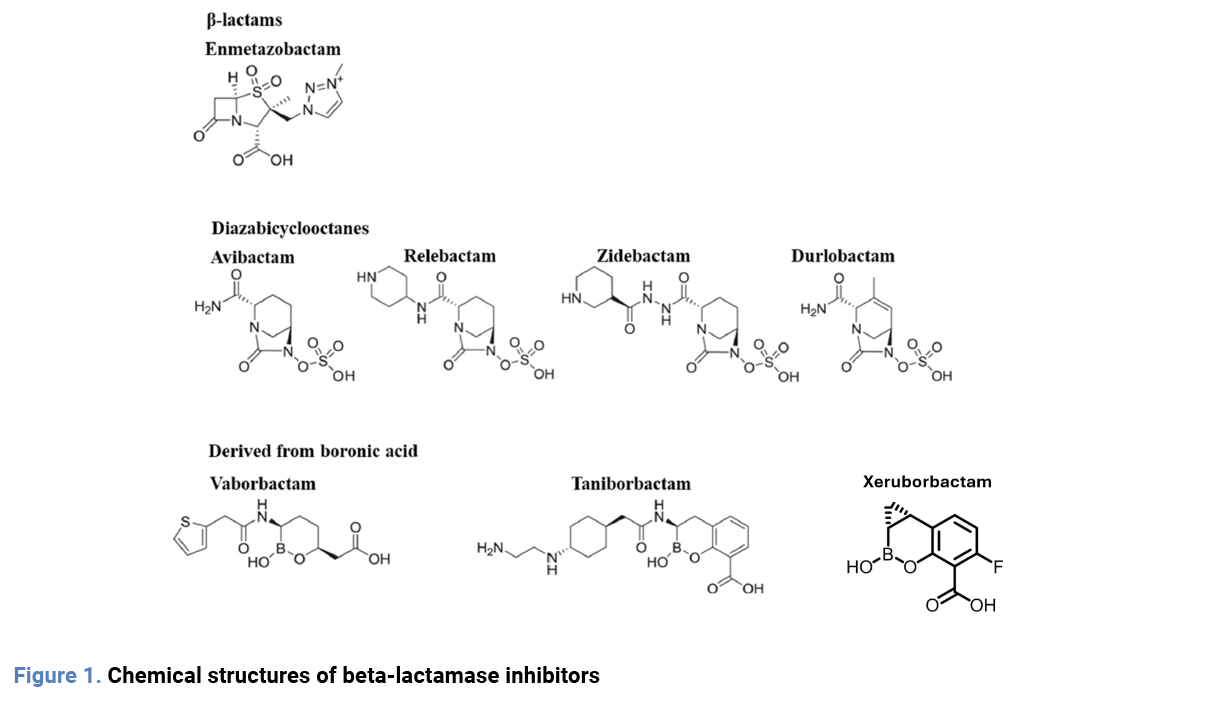
DBOs-based beta-lactamase inhibitors
There are currently three DBOs available for human use: avibactam, relebactam and durlobactam, and another two in development: zidebactam and nacubactam. The beta-lactamase inhibitory activity of DBOs is attributed to their structural similarity to beta-lactam antibiotics (Figure 1). These compounds share a common five-membered DBO ring with an amide group that targets the active-site of serine beta-lactamases through rapid carbamylation and slow diacylation. This mode of action results in a reversible, covalent, and very efficient inhibition that releases the DBOs intact. Avibactam has a broad spectrum of activity against the most clinically relevant class A, C, and certain D beta-lactamases including KPC, GES, CTX-M, SHV, the chromosomal AmpCs of P. aeruginosa, and to a lesser extent OXA-48. It is minimally active against the OXA-23 in A. baumannii, and does not show activity against extended-spectrum OXA enzymes and class B MBLs. Avibactam was first developed in combination with ceftazidime. Studies outlining the in vitro activity of ceftazidime-avibactam have demonstrated that avibactam restores the activity of ceftazidime against large collections of Enterobacterales that produce the most clinically relevant enzymes, such as KPC, OXA-48, and ESBLs. Avibactam is also active against beta-lactam resistant P. aeruginosa, including isolates with very high-levels of AmpC overexpression and OprD deficiency. In a large in vitro study, ceftazidime-avibactam was tested against 6,041 clinical Klebsiella pneumoniae isolates, including ESBL- and carbapenemase- producing isolates, and was active against >99.9%. In the same study, it was active against 97.1% of P. aeruginosa tested [8]. In a recent multicentre study in Spain, analysing the activity of ceftazidime- avibactam and comparators against 1,735 P. aeruginosa isolates from 66 centres, only 3.5% of isolates were resistant to this combination [9]. More recently, avibactam has also been developed in combination with the monobactam aztreonam. As indicated above, avibactam, as other DBOs does not exert inhibitory activity against class B beta- lactamases. However, it protects aztreonam from hydrolysis by serine beta-lactamases (classes A, C, D). Its combination with aztreonam, which is stable to hydrolysis by MBLs, makes the aztreonam-avibactam combination a valuable option to treat infections caused by carbapenemase-producing serine beta-lactamases, MBLs, or both. The combination does not have in vitro activity against MDR strains of P. aeruginosa and A. baumannii; however, it is very active against Stenotrophomonas maltophilia [10]. In a study evaluating a large collection of carbapenem-resistant Enterobacterales, including those non-susceptible to ceftazidime-avibactam, meropenem-vaborbactam, and/or imipenem-relebactam, the aztreonam-avibactam combination was active against ≥98.9% of isolates non-susceptible to these BLI combinations [11]. Relebactam is a derivative of avibactam with a slightly more restricted spectrum of inhibition but potent inhibitory activity against class A and C beta-lactamases and ineffective against MBLs. Unlike avibactam it does not display in vitro activity against class D OXA-48 enzymes and is less able to block class A enzymes such as CTX-M-15 and KPC. The combination of relebactam with imipenem and cilastatin (a renal dehydropeptidase inhibitor) presents synergistic activity against carbapenem-resistant Enterobacterales and P. aeruginosa with diverse resistance mechanisms, including impermeability due to porin loss. The combination is also highly active against XDR P. aeruginosa, including imipenem-resistant strains due to OprD deficiency and against strains with acquired resistance due to the production of GES-1, PER-1 and extended-spectrum OXA enzymes; however, it is not active against A. baumannii isolates producing acquired class D carbapenemases (OXA-23, OXA-24/40, OXA-58). The results of two multicentre studies showed that imipenem-relebactam was active against 85.8% of carbapenemase-producing Enterobacterales [12] and against 97.5% of P. aeruginosa isolates tested [9]. Durlobactam, zidebactam and nacubactam are second generation DBO inhibitors that also have high affinity for the PBP2 of many Gram-negative species, thus exhibiting antimicrobial activity by themselves. They inhibit classes A, C and D beta-lactamases and act as “beta-lactam enhancers” displaying synergy with partner beta-lactams. Durlobactam was specifically designed to inhibit class D carbapenemases, including OXA-48, OXA-23, OXA-24/40, and OXA-48. In combination with sulbactam shows high activity against carbapenemase producing A. baumannii-calcoaceticus complex. It is also active against NDM-producing E. coli with PBP3 insert mutations and can restore the beta-lactam activity against MDR P. aeruginosa [5,6,13]. Zidebactam also inhibits class A and C beta-lactamases, but not class D. It was designed with the objective of increasing PBP2 binding, thus enhancing the beta-lactam activity. It is being developed in combination with cefepime for the treatment of MDR Enterobacterales, P. aeruginosa, A. baumannii and S. maltophilia [5,6,13]. Nacubactam also has a dual mechanism of action: along with inhibiting class A and C beta-lactamases, it has intrinsic antibacterial activity via PBP2 inhibition. In combination with meropenem has shown good activity against MDR Enterobacterales clinical isolates, including MBL-producing isolates, and against carbapenem-resistant P. aeruginosa, but does not show activity against A. baumannii [5,6,13].Boronic acid-based beta-lactamase inhibitors
Currently, only one boronic acid-based BLI is available for human use: vaborbactam. Another two are in development: taniborbactam and xeruborbactam. The cyclic boronates are non-acylating inhibitors that react rapidly with beta-lactamases to form stable enzyme-inhibitor complexes. These BLIs were originally developed as serine-beta-lactamase inhibitors (vaborbactam), but they have recently also been developed as dual serine- and MBLs-inhibitors (taniborbactam and xeruborbactam) (Figure 1). Vaborbactam was the first clinically available cyclic boronate with affinity for serine-based active sites of beta-lactamases due to the formation of a covalent complex between the catalytic serine side chain and the boronate moiety, acting as a competitive inhibitor. It is a potent inhibitor of class A carbape-nemases, mainly KPC, and class C beta-lactamases, however, it does not inhibit the class B and class D beta-lactamases. Vaborbactam was approved for use in combination with meropenem. Meropenem- vaborbactam in tests with large worldwide collections of KPC-producing isolates of Enterobacterales showed activity rates of 99%. However, it has very limited activity against P. aeruginosa and A. baumannii [5,6,14]. Taniborbactam is a bicyclic boronate and the first inhibitor of all classes of beta-lactamases including A, C, D, and MBLs (excluding IMP, NDM-9, NDM-30, and VIM-83) in carbapenemase-producing Enterobacterales and in carbapenem-resistant P. aeruginosa. It inhibits serine-beta-lactamases with slow dissociation, while in MBLs it behaves as a reversible competitive covalent inhibitor. Taniborbactam is undergoing clinical development combined with cefepime. In a multicentre in vitro study, cefepime-taniborbactam was the most active agent among other BL-BLI combinations against populations of both Enterobacterales (97.6% susceptible) and P. aeruginosa (67.1% susceptible) and was the most active combination against both serine-beta-lactamases (97.2%) and MBL producers (93.5%). This combination is also active against S. maltophilia and Burkholderia cepacia complex [5,6,15]. Xeruborbactam is a bicyclic boronate with an ultra-broad-spectrum of activity against both serine and MBLs including KPC, AmpC, OXA-48, OXA-23, VIM, IMP, and NDM, among others. In combination with meropenem, it was found to be the most potent BL-BLI combination tested against all groups of carbapenem resistant Enterobacterales, P. aeruginosa with multiple resistance mechanisms and carbapenem-resistant A. baumannii. Meropenem-xeruborbactam was found to be more potent in vitro than cefepime-taniborbactam against MBL-producing Enterobacterales (MIC90 of 1 mg/L vs. 16 mg/L, respectively). Xeruborbactam also significantly enhances the potency of other beta-lactams, including cefepime, ceftolozane, ceftriaxone, aztreonam, piperacillin, and ertapenem against carbapenem-resistant Enterobacterales. Xeruborbactam is orally bioavailable, and combinations with ceftibuten and tebipenem have also been tested [6,16].Resistance to beta-lactam beta-lactamase inhibitor combinations
Although the introduction of BL-BLI combinations in clinical practice constitutes an excellent therapeutic alternative for infections caused by MDRO and carbapenem-resistant pathogens, the emergence of resistance in susceptible strains during therapy with these combinations is unavoidable. Since the approval of ceftazidime-avibactam, the development of resistance was widely reported involving amino acid substitutions, insertions, or deletions mainly in KPC carbapenemases, leading to variants with enhanced cephalosporinase activity but impaired hydrolysis of carbapenems. Other mechanisms involved include, among others, the structural modification of CTX-M-like or AmpC enzymes, increased expression of KPC or efflux pumps, inactivation of porins, and selection of extended-spectrum OXA-2 or OXA-10 variants in P. aeruginosa. Regarding resistance to imipenem-relebactam and meropenem-vaborbactam, carbapenems are more affected by decreased outer membrane permeability (OmpK35 and OmpK36 loss) and enhanced efflux. Therefore, differences in resistance patterns depend more on the beta-lactam than on the inhibitor, and also on the selection of beta-lactamase mutations leading to enhanced beta-lactam hydrolysis [6]. Although resistance to aztreonam-avibactam is currently uncommon, the alteration of PBP3 has been described as the most relevant resistance mechanism. However, it can also be due to a combination of multiple mechanisms, as in the case of cefepime-enmetazobactam and cefepime-taniborbactam [7,15-17].Applicability
Fortunately, as indicated above, we have multiple therapeutic options for the treatment of infections caused by microorganisms that produce ESBLs and/or carbapenemases (Table 1). Ceftazidime-avibactam is a good option against strains that produce serine beta-lactamases, while meropenem-vaborbactam and imipenem-relebactam are excellent additions against KPC-producing Enterobacterales. Imipenem-relebactam is an alternative against P. aeruginosa with OprD deficiency and/or extended-spectrum OXA enzymes. Aztreonam-avibactam, cefepime-zidebactam, and cefepime-taniborbactam can be new options against MBL-producing microorganisms and against S. maltophilia. Sulbactam-durlobactam is very active against carbapenemase-producing A. baumannii. Cefepime-enmetazobactam is an alternative for ESBLs, AmpC, and OXA-48 to avoid the use of carbapenems and could be an option in strains resistant to ceftazidime-avibactam due to mutations in the Ω-loop. Meropenem-xeruborbactam, currently in development, is the most active combination against all classes of beta-lactamases and is also active against MDR P. aeruginosa and A. baumannii. In any case, the judicious use of these BL-BLI combinations and continuous monitoring of resistance are necessary to prevent the emergence and spread of resistance. Funding None to declare. Conflict of Interest The authors declare no conflict of interest. Author contributions Writing—original draft preparation, E.C and F.J.C.; writing—review and editing, E.C and F.J.C.. All authors have read and agreed to the published version of the manuscriptReferences
- European Centre for Disease Prevention and Control. Assessing the health burden of infections with antibiotic-resistant bacteria in the EU/EEA, 2016-2020. Stockholm: ECDC; 2022. Available from: https://doi.org/10.2900/73460
- Peñalva G, Cantón R, Pérez-Rodríguez MT, González-López JJ, Rodríguez-Baño J, Del Barrio-Tofiño E, et al. Burden of bacterial antimicrobial resistance among hospitalised patients in Spain: findings from three nationwide prospective studies. Lancet Reg Health Eur. 2025;51:101220. Available from: https://doi.org/10.1016/j.lanepe.2025.101220
- Boattini M, Bastos P, Costa C, Bianco G. Carriage and infections by multi-carbapenemases producing Enterobacterales. Diagn Microbiol Infect Dis. 2025;113(4):117035. Available from: https://doi.org/10.1016/j.diagmicrobio.2025.117035
- Bush K. Past and present perspectives on β-lactamases. Antimicrob Agents Chemother. 2018;62(10):e01076-18. Available from: https://doi.org/10.1128/AAC.01076-18
- Jalde SS, Choi HK. Recent advances in the development of β-lactamase inhibitors. J Microbiol. 2020;58:633-47. Available from: https://doi.org/10.1007/s12275-020-0285-z
- Vázquez-Ucha JC, Arca-Suárez J, Bou G, Beceiro A. New carbapenemase inhibitors: clearing the way for the β-lactams. Int J Mol Sci. 2020;21(23):9308. Available from: https://doi.org/10.3390/ijms21239308
- Bonnin RA, Jeannot K, Santerre Henriksen A, Quevedo J, Dortet L. In vitro activity of cefepime-enmetazobactam on carbapenem-resistant Gram-negatives. Clin Microbiol Infect. 2025;31:240-9. Available from: https://doi.org/10.1016/j.cmi.2024.09.031
- Sader HS, Carvalhaes CG, Streit JM, Doyle TB, Castanheira M. Antimicrobial activity of ceftazidime-avibactam, ceftolozane-tazobactam and comparators tested against Pseudomonas aeruginosa and Klebsiella pneumoniae isolates from United States medical centers in 2016-2018. Microb Drug Resist. 2021;27:342-9. Available from: https://doi.org/10.1089/mdr.2020.0217
- Sastre-Femenia MA, Fernández-Muñoz A, Gomis-Font ME, Taltavull B, López-Causapé C, Arca-Suárez J, et al. Pseudomonas aeruginosa antibiotic susceptibility profiles, genomic epidemiology and resistance mechanisms: a nation-wide five-year time lapse analysis. Lancet Reg Health Eur. 2023;34:100736. Available from: https://doi.org/10.1016/j.lanepe.2023.100736
- Mojica MF, Papp-Wallace KM, Taracila MA, Barnes MD, Rutter JD, Jacobs MR, et al. Avibactam restores the susceptibility of clinical isolates of Stenotrophomonas maltophilia to aztreonam. Antimicrob Agents Chemother. 2017;61(10):e00777-17. Available from: https://doi.org/10.1128/AAC.00777-17
- Sader HS, Carvalhaes CG, Kimbrough JH, Mendes RE, Castanheira M. Activity of aztreonam-avibactam against Enterobacterales resistant to recently approved beta-lactamase inhibitor combinations collected in Europe, Latin America, and the Asia-Pacific Region (2020-2022). Int J Antimicrob Agents. 2024;63(4):107113. Available from: https://doi.org/10.1016/j.ijantimicag.2024.107113
- Vázquez-Ucha JC, Seoane-Estévez A, Rodiño-Janeiro BK, González-Bardanca M, Conde-Pérez K, Martínez-Guitián M, et al. Activity of imipenem/relebactam against a Spanish nationwide collection of carbapenemase-producing Enterobacterales. J Antimicrob Chemother. 2021;76:1498-510. Available from: https://doi.org/10.1093/jac/dkab043
- Outeda-García M, Arca-Suárez J, Lence E, Rodriguez-Coello A, Maceiras R, Blanco-Martin T, et al. Advancements in the fight against globally distributed OXA-48 carbapenemase: evaluating the new generation of carbapenemase inhibitors. Antimicrob Agents Chemother. 2025;69(2):e0161424. Available from: https://doi.org/10.1128/aac.01614-24
- Hackel MA, Lomovskaya O, Dudley MN, Karlowsky JA, Sahm DF. In vitro activity of meropenem-vaborbactam against clinical isolates of KPC-positive Enterobacteriaceae. Antimicrob Agents Chemother. 2017;62(1):e01904-17. Available from: https://doi.org/10.1128/AAC.01904-17
- Hernández-García M, García-Castillo M, Ruiz-Garbajosa P, Bou G, Siller-Ruiz M, Pitart C, et al. In vitro activity of cefepime-taniborbactam against carbapenemase- producing Enterobacterales and Pseudomonas aeruginosa isolates recovered in Spain. Antimicrob Agents Chemother. 2022;66(3):e0216121. Available from: https://doi.org/10.1128/aac.02161-21
- Lomovskaya O, Castanheira M, Lindley J, Rubio-Aparicio D, Nelson K, Tsivkovski R, et al. In vitro potency of xeruborbactam in combination with multiple β-lactam antibiotics in comparison with other β-lactam/β-lactamase inhibitor (BLI) combinations against carbapenem-resistant and extended-spectrum β-lactamase-producing Enterobacterales. Antimicrob Agents Chemother. 2023;67(11):e0044023. Available from: https://doi.org/10.1128/aac.00440-23
- Mendes R, Doyle TB, Streit JM, Arhin FF, Sader HS, Castanheira M. Investigation of mechanisms responsible for decreased susceptibility of aztreonam/avibactam activity in clinical isolates of Enterobacterales collected in Europe, Asia and Latin America in 2019. J Antimicrob Chemother. 2021;76:2833-8. Available from: https://doi.org/10.1093/jac/dkab279
Explore
Articles
Volumes
About the journal
Most read
Recomendaciones para la prevención y el tratamiento de las infecciones respiratorias en adultos mayores institucionalizados
Revista Española de Quimioterapia
Acute infectious gastroenteritis in childhood: the role of rapid multiplex molecular syndromic panels in diagnosis and clinical management
Revista Española de Quimioterapia
Características epidemiológicas de pacientes con aislamientos de Enterobacterales productores de carbapenemasas-NDM en un hospital de alta complejidad
Revista Española de Quimioterapia
Review on the management of intra-abdominal candidiasis
Revista Española de Quimioterapia
Neoscytalidium dimidiatum: a rare locally acquired deep cutaneous infection in a renal transplant recipient
Revista Española de Quimioterapia