Original
February 2026, Volume 39, nº 1
18 min
Clinical impact of rapid antimicrobial susceptibility testing in patients with bacteremia due to gram-negative bacilli
Fernando Cobo1* , María del Carmen Olvera-Porcel2, Rafael Ceballos-Atienza3, José María Navarro-Marí1
1Department of Microbiology and Instituto de Investigación Biosanitaria ibs.GRANADA, Hospital Universitario Virgen de las Nieves. Granada, Spain
2Biostatistics, Unidad de Gestión y Apoyo a la Investigación, Hospital Universitario Virgen de las Nieves, Granada, Spain
3University Alfonso X El Sabio Mare Nostrum, Málaga, Spain
http://www.doi.org/10.37201/req/123.2025
Receipt Date:
10/11/2025
Acceptance Date:
17/12/2025
Publication Date:
12/01/2026
How to cite
Cobo F, Olvera-Porcel MC, Ceballos-Atienza R, Navarro-Marí JM. Clinical impact of rapid antimicrobial susceptibility testing in patients with bacteremia due to gram-negative bacilli. Rev Esp Quimioter 2026; 39(1):61-68. Available from: http://www.doi.org/10.37201/req/123.2025
Metrics
624
Views
118
Downloads
Share
Share
Abstract (EN)
Introduction: Bacteremia and sepsis cause high morbidity and mortality worldwide. Rapid identification of bacteria and timely antimicrobial susceptibility testing (AST) can be crucial for patient survival. In the present study, we have compared isolates from patients whose ASTs were processed using MicroScan Walkaway Plus with those patients whose ASTs were processed more quickly using Vitek® Reveal™. We analyzed mortality, turnaround time to targeted therapy, and length of stay between the two groups, as well as other parameters.
Material and methods: In this prospective study, 120 patients with bacteremia caused by Gram-negative bacilli were included. In 60 patients, conventional AST (MicroScan WalkAway Plus) was performed, whereas in the other 60 patients, rapid AST (Vitek® Reveal™) was carried out.
Results: The mortality rates were 13.3% and 38.3% for patients whose ASTs were performed with Vitek® Reveal™ and MicroScan WalkAway Plus, respectively (p=0.002). The average length of stay was 18 days per patient in the Vitek® Reveal™ group and 24.5 days for the MicroScan group (p=0.128). The average turnaround time was 12 hours per patient for Vitek® Reveal™ and 40 hours for MicroScan (p<0.001).
Conclusions: The introduction of rapid AST techniques such as Vitek® Reveal™ has allowed a shorter turnaround time for reports on AST than when using normal AST techniques. This allows most AST results to be available earlier in the Laboratory Information System, allowing physicians to initiate more quickly in establishing correct treatment. Finally, these actions have resulted in reduced mortality due to faster clinical decision-making in these critically ill patients.
Keywords (EN):
Bacteriemia
Test sensibilidad a antibióticos
Vitek reveal
MicroScan
Mortalidad
Introduction
Bacteremia and sepsis are serious diseases that may cause high morbidity and mortality, so they are medical emergencies. A study demonstrated an estimated 48.9 million incident cases of sepsis recorded worldwide and 11 million sepsis-related deaths, representing 19.7% of all global deaths [1]. Predicting antimicrobial resistance (AMR) can be more complex and time-intensive for patients with gram-negative infections. Early diagnosis and appropriate treatment make a critical difference when it comes to improving bloodstream infection management and sepsis patient outcomes. Ideally, empirical antimicrobial treatment should be administered in the first hour after the diagnosis, and then it can be changed depending on data provided by the microbiology laboratory. In sepsis and other severe infections, a shorter time to antibiotic administration is strongly associated with improved patient survival rates [2,3]. Conversely, delays in antibiotic administration can lead to poorer outcomes. Research suggests that for each hour of delay in antibiotic administration, there can be an increase in mortality risk [4]. Until recently, the definitive results of antimicrobial susceptibility testing (AST) from positive blood cultures performed by microdilution systems could be obtained in a period of 18-48 hours, depending on the layout of the microbiology laboratory. Therefore, changes or adjustments to antibiotic treatment cannot be made until this period of time has passed. The rate of inappropriate empirical treatment in our hospital is 25-30% (data not published), which increases the risk of death in seriously ill patients. However, recent advancements and new techniques have been implemented in the microbiology laboratories in order to perform a rapid AST. The introduction of these methods in the laboratory routine can accelerate the possibility of choosing the correct treatment for these kinds of patients, improving their outcome. Vitek® Reveal uses a small molecule sensor technique that detects molecules volatilized by bacterial growth. This technique offers extensive antimicrobial coverage for bloodstream infections caused by Gram-negative bacteria, delivering phenotypic AST results in an average of 5.5-6 hours directly from positive blood culture to better manage bloodstream infections [5]. Included in this platform are Klebsiella pneumoniae, Pseudomonas aeruginosa, Escherichia coli, Enterobacter cloacae, Klebsiella oxytoca, Klebsiella aerogenes, Citrobacter freundii, Citrobacter koseri, Acinetobacter baumannii, and Proteus mirabilis. On the other hand, the MicroScan WalkAway plus system is an automated system used in microbiology for the identification of microorganisms and the performance of AST in an average of 18-24 hours. It works by using panels containing identification substrates and different dilutions of antibiotics. These panels can be processed manually, semi-automatically, or fully automatically [6]. The objective of the present study was to analyze and compare the mortality, the turnaround time to targeted therapy, and the length of stay of the normal AST performed by the MicroScan WalkAway plus system (Beckman-Coulter) and the rapid AST performed by the new Vitek® Reveal technique (BioMérieux) in patients with bloodstream infections caused by Gram-negative bacilli.Material and methods
Study design The University Hospital Virgen de las Nieves is a 1,300-bed centre that serves as a referral hospital for some medical specialties, serving a population of approximately 400,000 inhabitants. Our microbiology department works 24 hours a day, every day of the year. In a prospective cohort analysis during a 1-year period (March 2024-April 2025), data for two groups of patients for whom AST from positive blood cultures was performed were analyzed. One group was formed by patients whose ASTs were processed more rapidly using the Vitek® Reveal™ technique; the other group consisted of patients whose ASTs were performed with a slower method, the MicroScan® Walkaway system. Antimicrobial susceptibility results were interpreted according to EUCAST 2024 breakpoints [7]. When the blood culture yielded a positive result, a Gram stain was performed; in the case of visualization of Gram-negative bacilli, a MALDI-TOF MS (Bruker Biotyper) was performed directly from the positive bottle. Briefly, 8 mL of blood from the positive bottle is centrifuged for 10’ at 3,000 rpm; then the supernatant is discarded, and 1 mL of the resuspended blood is again centrifuged in an Eppendorf vial for 5’ at 1,200 rpm. The resulting pellet is used to perform the MALDI-TOF MS technique. This procedure is routinely used 24 hours a day, including weekends, on all clinically significant positive blood cultures. The Vitek® Reveal method was carried out only when the Gram-negative bacilli included in this platform were identified. In the case of the MicroScan WalkAway Plus method, any Gram-negative bacilli could be included. All verified data from both systems downloads to the laboratory information system (LIS). Verified and validated data were available to physicians via computer access to the LIS at any time. Patients were assigned consecutively and randomly to one group or the other (e.g., the first patient was assigned to the Vitek group and the next one to the MicroScan group, and then consecutively). Only when the microorganism was not included in the Vitek® Reveal platform was it immediately assigned to the MicroScan group, because in this case the AST was not supported by the system. Inclusion criteria were positive blood cultures caused by Gram-negative bacilli from patients seen in our hospital. No exclusion criteria were considered. In addition to its validation in the LIS, the AST result was reported by telephone to the physician during a 24-hour period. Furthermore, in the morning, all bacteremias from the previous afternoon/evening and that morning are reported via email so that the Antimicrobial Stewardship Program team can take appropriate action. AST results were reported as MICs with interpretation of S (susceptible), R (resistant), or I (susceptible, increased exposure). Data analyzed This was a retrospective study of clinical and microbiological data that were recorded in a file after obtaining the results. Patient and clinical data were obtained from our LIS and from the clinical record. Data were gathered on age and sex, microorganisms isolated, resistance mechanisms, empirical and targeted treatment, if there was a change of treatment, cause of the treatment change, time elapsed until change of treatment, source of infection, presence of septic shock, days of hospital stay, risk factors, ward of admission, and outcome (favorable or death attributable to infection). Statistical analysis All analyses were performed with the computer program STATA version 16.1. A descriptive statistical analysis was performed, where the quantitative variables were expressed as median and interquartile range (IQR), and categorical variables using frequency tables and percentages. Subsequently, to determine whether there were differences between the two types of systems (MicroScan WalkAway and Vitek® Reveal) or between infection-related mortality (yes/no) with respect to the quantitative variables, the non-parametric Mann-Whitney U test was used. For the comparison of qualitative variables, Pearson’s chi-square test or Fisher’s exact test was used as appropriate. The association of each independent variable with infection-related mortality was evaluated using crude odds ratios (ORc). To assess the potential influence of variables, a predictive multivariate logistic regression model was constructed; all variables with p≤0.05 in the bivariate analysis were considered. Variables were excluded from the final model based on the likelihood ratio test [8]. Confidence intervals (CIs) were set at 95% for both ORc and adjusted odds ratios ORa. Model fit was assessed using the Hosmer-Lemeshow test, and model discrimination was evaluated by the receiver operating characteristic (ROC) curve. A significance level of p<0.05 was applied.Results
In this retrospective study, 120 patients with bacteremia caused by Gram-negative bacilli were included. In 60 of them a normal AST (MicroScan WalkAway plus) was performed, and in the other 60 a rapid AST (Vitek® Reveal) was carried out. Global data obtained from the descriptive analysis are shown in Table 1. In the group of Vitek® Reveal, the median age of patients was 68.5 years (IQR 20), and females represented 38.3%. Regarding the risk factors for bacteremia in this group, the main underlying disease was the presence of cancer (16/26.6%), followed by the presence of hepatic disease (12/20%). The days of hospital stay range from 2 to 120 days (median= 21 days). Thirty (50%) patients had signs and/or symptoms of septic shock, and the main source of infection was the urinary tract (31/51.6%), followed by abdominal (16/26.6%). The microorganisms more frequently isolated were E. coli (40/66.6%) and K. pneumoniae (10/16.6%). Most of them did not have associated resistance mechanisms (45/75%), and 15 (25%) expressed extended-spectrum β-lactamases (in three cases associated with OXA-48 carbapanemase production). Regarding the empirical treatment, most of the patients were treated initially with carbapenems (27/45%), followed by piperacillin-tazobactam (13/21.6%). There was a change in treatment in 50 (83.3%) patients, and the mean time to change it was 12 hours.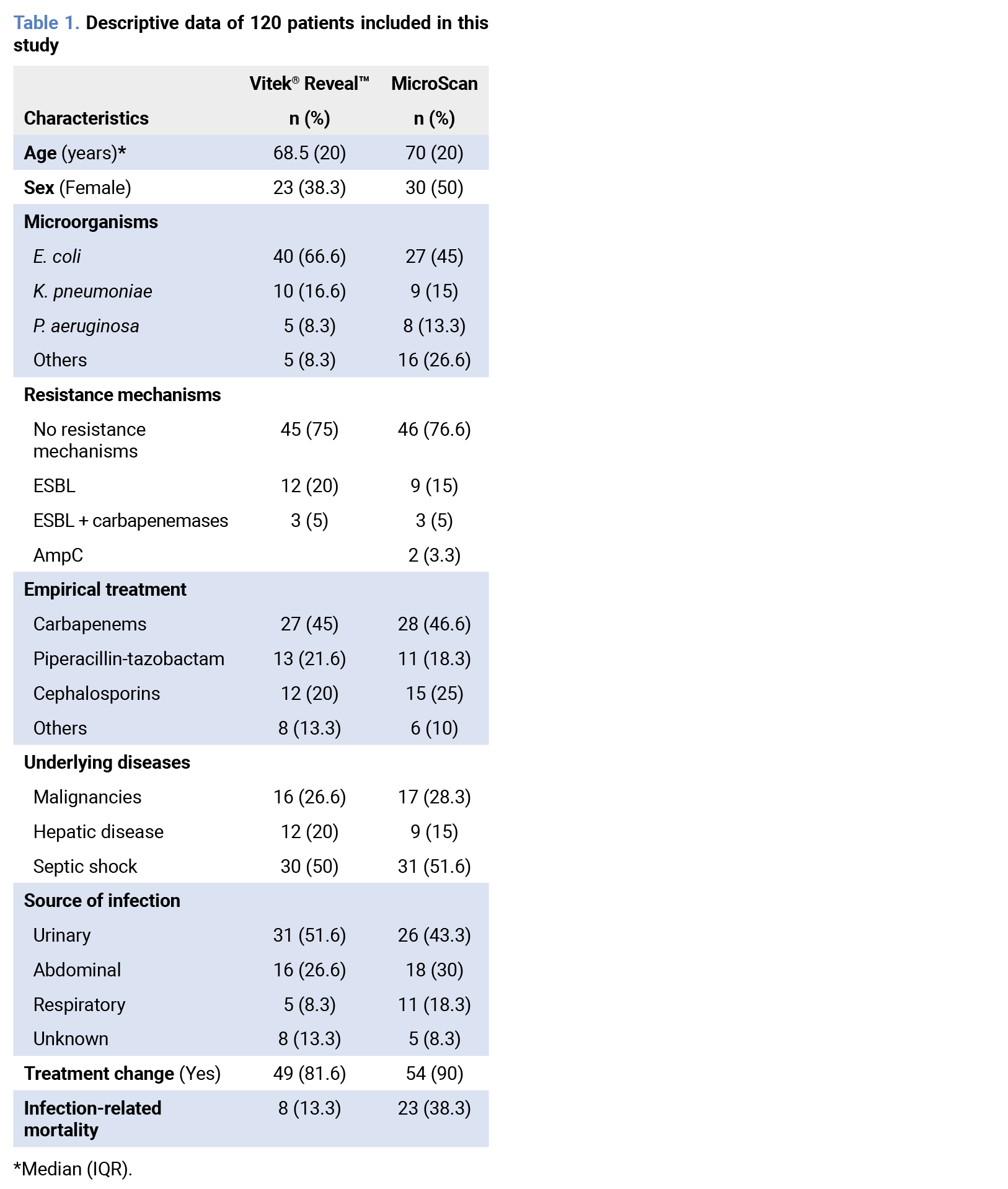 Regarding the causes of the treatment change, most of them were due to the fact that this treatment was not working well, as evidenced by the lack of clinical improvement in the patients (n=28/70%), followed by the presence of resistance to empirical antibiotic treatment (n=12/30%), and by de-escalation of the treatment (n=9/15%). The 30-day mortality of patients because of this infection was 13.3% (n=8 patients). In the group of MicroScan, the median age of patients was 70 years (IQR 20), and females represented 50%. Regarding the risk factors for bacteremia in this group, the main underlying disease was the presence of cancer (17/28.3%), followed by the presence of hepatic disease (9/15%). The days of hospital stay range from 3 to 90 days (median= 24.5 days). Thirty-one (51.6%) patients had signs and/or symptoms of septic shock, and the main source of infection was the urinary tract (26/43.3%), followed by abdominal (18/30%). The microorganisms most frequently isolated in this group were E. coli (27/45%) and K. pneumoniae (9/15%). Most of them did not have associated resistance mechanisms (46/76.6%), 9 (15%) expressed extended-spectrum β-lactamases, 3 expressed ESBLs + carbapenemases (5%) and 2 (3.3%) expressed AmpC enzymes. Regarding the empirical treatment, most patients were treated initially with carbapenems (28/46.6%), followed by piperacillin-tazobactam (11/18.3%). There was a change in treatment in 54 (90%) patients, and the mean time to change it was 40 hours.
With regard to the reasons for treatment modification, most cases were due to the fact that this treatment was not working well, as evidenced by the lack of clinical improvement in the patients (n=27/45%), followed by the presence of resistance to empirical antibiotic treatment (n=15/35%), and by de-escalation of the treatment (n=12/20%). The 30-day mortality of the patients because of this infection was 38.3% (n=23 patients).
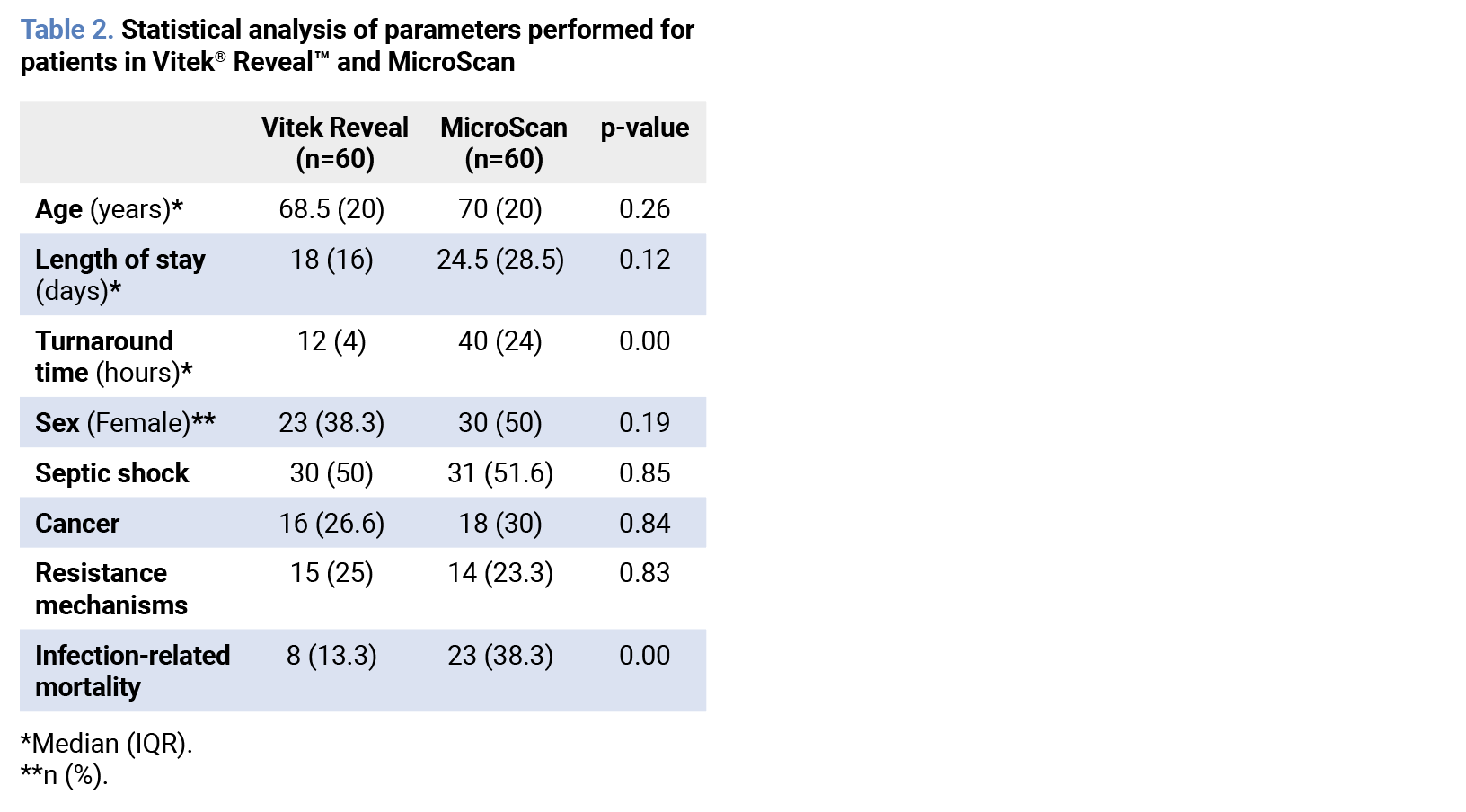
There were also significant differences between the two techniques regarding the time it takes to modify the treatment resulting from the AST. The mean time to change the treatment, if necessary, with the Vitek® Reveal technique was 12 hours, while if MicroScan was used, the mean time to modify the treatment was 40 hours (p<0.0001).
However, there were no differences in mortality between patients whose treatment was modified, depending on the performed technique (90% vs. 83.3%, p=0.283) (IQR=36).
Regarding the length of hospital stay in patients with bacteremia depending on the performed technique, the patients who underwent the AST with Vitek® Reveal had fewer days of hospital stay than the patients who underwent the AST with MicroScan, but the result was not statistically significant (18 vs. 24.5, p=0.128). There were also no differences in mortality when performing one or the other diagnostic technique considering the focus of infection.
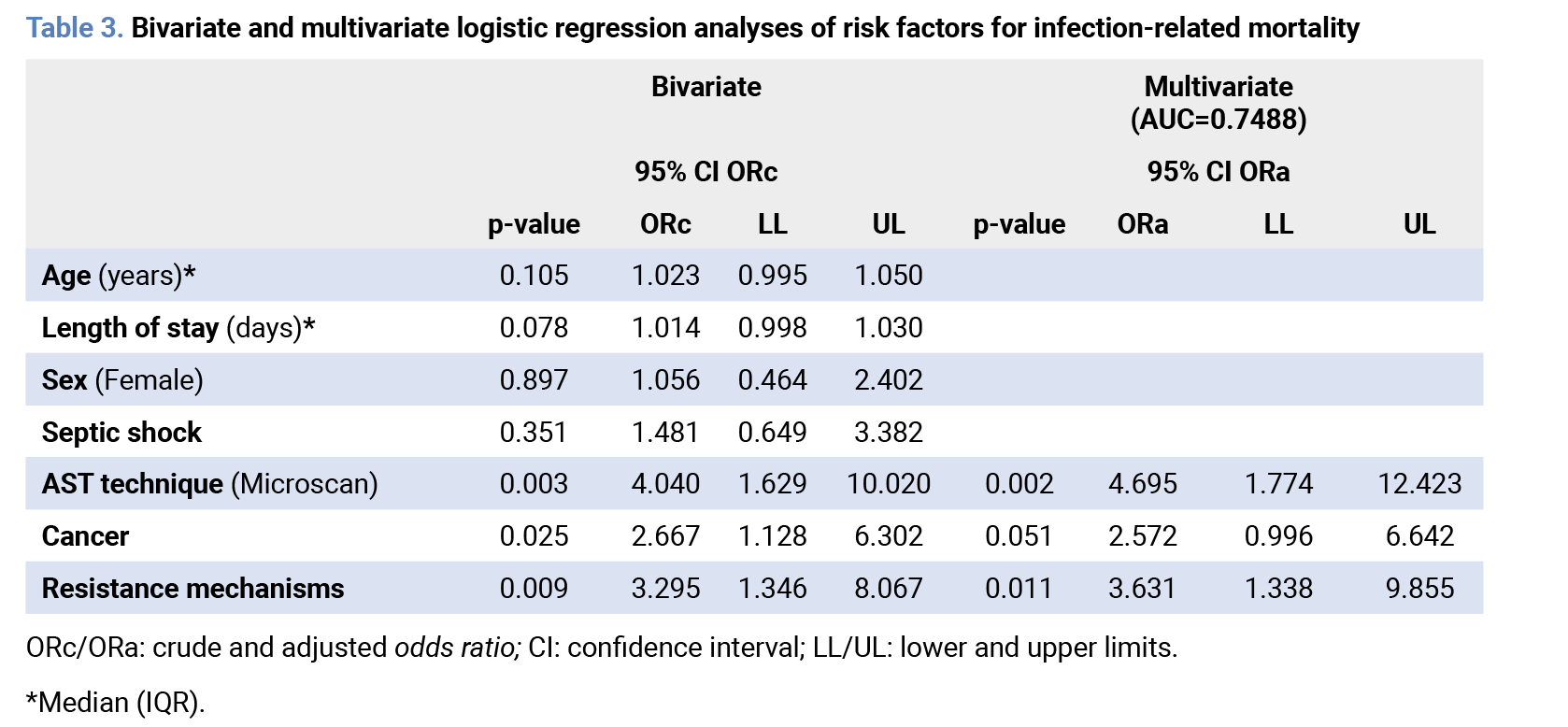
 Bivariate logistic regression showed that the MicroScan AST technique increased the risk of infection-related mortality compared to Vitek® Reveal (OR: 4.040; 95% CI: 1.629–10.020; p=0.003), as did the presence of cancer (OR: 2.667; 95% CI: 1.128–6.302; p=0.025) and resistance mechanisms (OR: 3.295; 95% CI: 1.346–8.067; p=0.009). The length of hospital stay showed a slight increase in the risk of infection-related mortality, with an odds ratio of 1.014 (95% CI: 0.998–1.030); however, this association did not reach statistical significance (p=0.078), indicating only a trend towards significance. Regarding the variables that were ultimately included in the multivariable logistic regression model, the MicroScan AST technique was significantly associated with an increased risk of infection-related mortality (OR: 4.695; 95% CI: 1.774–12.423; p=0.002). Similarly, the presence of resistance mechanisms remained significantly associated with infection-related mortality (OR: 3.631; 95% CI: 1.338–9.855; p=0.011) and the presence of cancer (OR: 2.572; 95% CI: 0.996–6.642; p=0.051) (Table 3). The multivariate logistic regression model demonstrated good discriminative ability with an area under the curve (AUC) of 0.7488.
Discussion
This study confirms the clinical benefits (survival data) of rapid reporting AST results in the setting of a tertiary hospital. The implementation of rapid AST techniques in the microbiology laboratories for samples from patients with severe infections such as bacteremia or sepsis, along with the implementation of 24-hour workflows, means that results are available in the laboratory’s LIS earlier than with conventional techniques, allowing physicians to act more quickly when making decisions about antibiotic treatment. In this case, physicians gain access to crucial information sooner. Statistically significant decreases in mortality and in mean time to change the treatment were observed when a rapid AST by Vitek® Reveal was performed. Of particular interest is the statistically significant difference in mortality of patients in the Vitek® Reveal group compared with the mortality rates of patients in the MicroScan group. This fact would undoubtedly be because the most appropriate targeted treatment is established earlier in the group with the fastest AST (Vitek® Reveal). Another study included two groups of patients in which a rapid AST technique was compared with a normal AST technique; in this case, the mortality rates were 7.9% and 9.6%, respectively, but this result was not statistically significant (p=0.45) [9]. However, a more recent study evaluating the impact of a rapid AST system on clinical processes and outcomes in patients with sepsis and concurrent Gram-negative bacteremia demonstrated that implementation of the BacT/Alert Virtuo and Accelerate Pheno systems improved microbiology laboratory processes, antibiotic utilization processes, and clinical outcomes [10]. In agreement with the study of Barenfanger et al. [9], our study also demonstrated that the turnaround time to targeted therapy is shorter in the Vitek® Reveal group compared to the Microscan group and statistically significant. The most likely reason is that physicians were able to see the AST results and consequently to apply the correct treatment sooner for the Vitek® Reveal group. Regarding the length of stay, our study also shows a decrease in this parameter, although the result is not statistically significant, in contrast to the findings reported by Barenfanger et al. [9]. More studies are needed to corroborate this data, although it seems logical to think that if the AST result is faster, the targeted treatment will be established earlier, making the patients evolve better. Our study did not analyze the final costs resulting from applying one technique or the other. Although the Vitek® Reveal technique is more expensive than the Microscan technique, it is logical to assume that, as in other studies [9], both the hospital stay and antibiotic treatment will be shorter, so overall hospitalization costs are expected to decrease. A study analyzed the clinical impact of the introduction of rapid diagnostic tools (RDT) on antibiotic optimization in critically ill patients with Gram-negative bloodstream infections. A quasi-experimental study comparing antibiotic optimisation before and after the implementation of innovative RDT, such as blood culture identification 2 (BCID2, Biofire®) and the panel Vitek® Reveal was performed. The implementation of RDT significantly shortened time to results but did not improve antibiotic therapy optimization [11]. In our study, the turnaround time to targeted therapy is also shorter in the group of rapid AST (Vitek® Reveal), which allows a faster optimization of anti-infective therapy. However, the proportion of patients receiving optimized therapy is similar in both groups, but in the group of Vitek® Reveal the treatment is changed earlier. Another study analyzed the clinical impact of the accelerated PhenoTest® BC system on patients with Gram-negative bacteremia and high risk of antimicrobial resistance. The implementation of this technique resulted in a shorter time to beneficial antimicrobial change [12]. In addition, a recent study demonstrated that the use of a rapid commercial antimicrobial susceptibility testing (dRAST) significantly reduces time-to-result, time to antimicrobial stewardship recommendations, and time to appropriate therapy changes, particularly in critically ill patients. These results highlight the potential of rapid diagnostic technologies to optimize patient outcomes and enhance antimicrobial stewardship efforts in real-world clinical settings [13]. Currently, most microbiology laboratories use automated techniques (e.g., MicroScan Walkaway, Vitek 2, and Phoenix BD system) to perform the AST. These systems are routinely used and provide the complete result within 18–24 hours. Rapid AST techniques have been available on the market for some time now and are being introduced. These include several systems such as Quantamatrix dRAST, Alfred Alifax, the FASTinov system, and the Vitek® Reveal system [14-17]. These techniques have a turnaround time ranging from 2 to 7 hours and provide MICs for several antibiotics, both in Gram-positive and Gram-negative bacteria. Overall, these systems seem to be reliable, and the results of their comparison with the techniques used until now have a high degree of agreement. For approximately two years, we have introduced in our microbiology laboratory the Vitek® Reveal system to perform the AST in all bacteremias caused by Gram-negative bacilli that are included in its system and that account for 90-95% of bacteremias in our hospital. The introduction of this system, along with the presence of a microbiologist 24 hours a day, 365 days a year, is allowing us to perform rapid AST tests on the most serious infections, such as bloodstream infections. During this period, mortality has been reduced by around 25%. The implementation of the Vitek® Reveal system has been carried out because it is a reliable system. In a recent study comparing the AST results between Vitek® Reveal and both the Sensititre and Vitek 2 systems, both the essential and categorical agreement between the two systems was greater than 96% [17]. Our group performed a comparative analysis of the AST results between Vitek® Reveal and MicroScan, and we also obtained a categorical agreement of 97.3% with only 1% of major errors and 0.4% of very major errors (Presentation at the XXVII Congress of the Spanish Society of Infectious Diseases and Microbiology (SEIMC), May 30-June 1, Zaragoza, Spain). Since then, we only perform this technique on the patients mentioned above. The main limitation of this study is the low number of patients included, so additional studies such as a multicenter study will be necessary to reach a definitive conclusion. Regarding bias, there was no patient selection bias, as all patients were included consecutively. There may have been some bias in group selection, particularly in patients initially assigned to the Vitek group who had to be reassigned to the MicroScan group because the microorganism was not included in the panel. In summary, the introduction of rapid AST techniques such as Vitek® Reveal has allowed a turnaround time to targeted therapy for reports on AST to be an average of 12 hours (range 7 to 24 hours) (p<0.001). This permits almost all AST results to be visible in the LIS, allowing the physicians to initiate more quickly in establishing correct treatment. Finally, these actions have resulted in a decrease in mortality due to the faster response of physicians to these seriously ill patients. In this regard, more studies are needed in different types of laboratories and with different types of techniques to corroborate these results. Funding None to declare. Author contributions Conceptualization, F.C., R.C-A., and J.M.N-M.; methodology, F.C. and J.M.N-M; formal analysis, M.C.O-P.; data curation, R.C-A.; writing—original draft preparation, F.C. and R.C-A.; writing—review and editing, J.M.N-M. All authors have read and agreed to the published version of the manuscript. Conflict of interest F.C. has served as a speaker at meetings organized by bioMérieux. The other authors declare no conflicts of interest. AI statement No artificial intelligence tools were used in the writing, analysis, interpretation, or review of this article.References
- Rudd KE, Johnson SC, Agesa KM, Shackelford KA, Tsoi D, Kievlan DR, et al. Global, regional, and national sepsis incidence and mortality, 1990-2017: analysis for the global burden of disease study, Lancet. 2020;395:200-211. Available from: https://doi.org/10.1016/S0140-6736(19)32989-7
- Liu VX, Fielding-Singh V, Greene JD, Baker JM, Iwashyna TJ, Bhattacharya J, et al. The timing of early antibiotics and hospital mortality in sepsis. Am J Respir Crit Care Med. 2017;196:856-863. Available from: https://doi.org/10.1164/rccm.201609-1848OC
- Leung LY, Huang HL, Hung KKC, Leung CY, Lam CCY, Lo RS, et al. Graham, Door-to-antibiotic time and mortality in patients with sepsis: systematic review and meta-analysis. Eur J Intern Med. 2024;129:48-61. Available from: https://doi.org/10.1016/j.ejim.2024.06.015
- Seymour CW, Kahn JM, Martin-Gill C, Callaway CW, Yealy DM, Scales D, et al. Delays from first medical contact to antibiotic administration for sepsis. Crit Care Med. 2017;45:759-765. Available from: https://doi.org/10.1097/CCM.0000000000002264
- Bianco G, Boattini M, Comini S, Bondi A, Curtoni A, Piccinini G, et al. Detection of volatile organic compounds as new paradigm to accelerate antimicrobial susceptibility testing: performance evaluation of Vitek® RevealTM. J Antimicrob Chemother. 2024;79:2237-2245. Available from: https://doi.org/10.1093/jac/dkae219
- Krüger A, Körber-Irrgang B, Flüh G, Gielen J, Scholz CJ, Wisplinghoff H, et al. Rapid Antimicrobial Susceptibility Testing Using the MicroScan System: Performance Evaluation of a 4-Hour Bacterial Cultivation From Positive Blood Cultures. Curr Microbiol. 2024;81:261. Available from: https://doi.org/10.1007/s00284-024-03768-9
- European Committee on Antimicrobial Susceptibility Testing. Breakpoint tables for interpretation of MICs and zone diameters. Version 14.0, 2024.
- Hosmer DW, Lemeshow S. Applied logistic regression. New York: Wiley;1989.
- Barenfanger J, Drake C, Kacich G. Clinical and financial benefits of rapid bacterial identification and antimicrobial susceptibility testing. J Clin Microbiol. 1999;37:1415-1418. Available from: https://doi.org/10.1128/JCM.37.5.1415-1418.1999
- Babowicz F, La Plante R, Mitchell C, O’Donnell JN, Tobin E, George M, et al. Impact of Accelerate Pheno and BacT/Alert Virtuo on clinical processes and outcomes in patients with sepsis and concurrent Gram-negative bacteremia. Antimicrob Agents Chemother. 2021;65:e02364-20. Available from: https://doi.org/10.1128/aac.02364-20
- Oudiane L, Benyahia M, Salipante F, Dubois A, Muller L, Lavigne JP, et al. Clinical impact of the BCID2 and rapid AST Vitek® RevealTM on antibiotic optimisation in critically ill patients with Gram-negative bloodstream infections: a quasi-experimental pre/post interventional study. J Antimicrob Chemother. 2025;80:2665-2675. Available from: https://doi.org/10.1093/jac/dkaf271
- Brosh-Nissimov T, Tzur A, Grupel D, Cahan A, Ma’aravi N, Heled-Akiva M, et al. Clinical impact of the accelerate PhenoTest® BC system on patients with gram-negative bacteremia and high risk of antimicrobial resistance: a prospective before-after implementation study. Ann Clin Microbiol Antimicrob. 2023;22:62. Available from: https://doi.org/10.1186/s12941-023-00619-6
- Halperin AV, Escudero R, García-Castillo M, Cardenas-Isasi MJ, Gioia F, Cobo J, et al. Randomized controlled diagnostic trial to assess dRAST time to result and its utility for antimicrobial stewardship recommendation in bacteremic patients. Microbiol Spectr. 2025;13:e0028825.
- Kim JH, Kim TS, Jung HG, Kang CK, Jun KI, Han S, et al. Prospective evaluation of a rapid antimicrobial susceptibility test (QMAC-dRAST) for selecting optimal targeted antibiotics in positive blood culture. J Antimicrob Chemother. 2019;74:2255-2260. Available from: https://doi.org/10.1093/jac/dkz168
- Anton-Vázquez V, Adjepong S, Suarez C, Planche T. Evaluation of a new rapid antimicrobial susceptibility system for Gram-negative and Gram-positive bloodstream infections: speed and accuracy of Alfred 60AST. BMC Microbiol. 2019;19:268. Available from: https://doi.org/10.1186/s12866-019-1654-9
- Silva-Dias A, Pérez-Viso B, Martins-Oliveira I, Gomes R, Rodrigues AG, Cantón R, et al. Evaluation of FASTinov ultrarapid flow cytometry antimicrobial susceptibility testing directly from positive blood cultures. J Clin Microbiol. 2021;59:e0054421. Available from: https://doi.org/10.1128/JCM.00544-21
- Tibbetts R, George S, Burwell R, Rajeev L, Rhodes PA, Singh P, et al. Performance of the Reveal rapid antibiotic susceptibility testing system on Gram-negative blood cultures at a large urban hospital. J Clin Microbiol. 2022;60:e0009822. https://doi.org/10.1128/jcm.00098-22
Explore
Articles
Volumes
About the journal
Most read
Recomendaciones para la prevención y el tratamiento de las infecciones respiratorias en adultos mayores institucionalizados
Revista Española de Quimioterapia
Acute infectious gastroenteritis in childhood: the role of rapid multiplex molecular syndromic panels in diagnosis and clinical management
Revista Española de Quimioterapia
Características epidemiológicas de pacientes con aislamientos de Enterobacterales productores de carbapenemasas-NDM en un hospital de alta complejidad
Revista Española de Quimioterapia
Review on the management of intra-abdominal candidiasis
Revista Española de Quimioterapia
Neoscytalidium dimidiatum: a rare locally acquired deep cutaneous infection in a renal transplant recipient
Revista Española de Quimioterapia