Review
Volume 38; Suppl. 1
7 min
Comprehensive approach to primary immunodeficiencies in adulthood: recognition and diagnosis
Laura Muñoz-Echeverria1, Juan Gabriel Sánchez-Cano1 , Juan Emilio Losa-García1,*
1Hospital Universitario Fundación Alcorcón, Universidad Rey Juan Carlos, Madrid, Spain.
https://doi.org/10.37201/req/s01.06.2025
Receipt Date:
02/09/2025
Acceptance Date:
01/09/2025
Publication Date:
23/10/2025
How to cite
Muñoz-Echeverria L, Sánchez-Cano JG, Losa-García JE. Comprehensive approach to primary immunodeficiencies in adulthood: recognition and diagnosis. Rev Esp Quimioter. 2025; 38(Suppl. 1): 38-42. Available from: https://doi.org/10.37201/req/s01.06.2025
Metrics
529
Views
103
Downloads
Share
Share
Abstract (EN)
Primary immunodeficiencies, now referred to as inborn errors of immunity (IEI), are increasingly recognized in adults, not only in the pediatric population. In adults, they may present with recurrent, severe, or unusual infections, but also with autoimmunity, malignancy, allergies, or inflammation, posing a diagnostic challenge. This review is based on clinical experience and the 2022 International Union of Immunological Societies classification. It includes four clinical cases and proposes a practical approach for the evaluation of adults. In the presence of suspected IEI, a stepwise laboratory approach is proposed to facilitate early detection and improve prognosis. Initial screening with basic immunological tests—including complete blood count, immunoglobulin and complement levels, and lymphocyte immunophenotyping—is emphasized. Confirmation of each IEI requires more specific testing, often involving molecular techniques.
Keywords (EN):
Clinical diagnosis
Adult patients
Laboratory approach
Inborn errors of immunity
Introduction
Primary immunodeficiencies, now termed inborn errors of immunity (IEI), comprise a heterogeneous group of nearly 500 distinct disorders that impair the development and/or function of the immune system. Up to 25% of cases have been reported to be diagnosed in adulthood. Diagnostic delay may result from milder phenotypes, partial immune defects, or late-onset presentations. Recognizing IEIs in adults is crucial, as late diagnosis can lead to significant morbidity, including recurrent infections, autoimmune complications, and malignancies [1-3]. This review offers a practical perspective on the current classification of IEIs, outlines their clinical manifestations in adults, and presents key diagnostic strategies supported by illustrative clinical cases.Classification of primary immunodeficiencies
The 2022 classification of the International Union of Immunological Societies (IUIS) defines ten main categories of IEIs based on genetic, clinical, and immunological characteristics [4-5] (Table 1). In adult populations, the most common are: 1. Predominantly antibody deficiencies, involving insufficient or dysfunctional immunoglobulin production, often leading to recurrent bacterial sinopulmonary infections. Typical examples include common variable immunodeficiency (CVID), IgG subclass deficiencies, and IgA deficiency, the most frequent IEI in adults. 2. Defects in intrinsic and innate immunity. These patients often present with mycobacterial, enteric, or viral infections (including respiratory viruses, cutaneous viral infections, and herpes simplex). One example is interferon-γ receptor deficiency. 3. Complement deficiencies. These typically present with neisserial infections. Some disorders also increase susceptibility to lupus and renal disease. 4. Phenocopies, acquired conditions that clinically resemble genetic immunodeficiencies but arise from non-hereditary mechanisms, such as autoantibodies against key cytokines (e.g., IFN-γ, IL-17), predisposing to severe infections (e.g., mycobacterial diseases). In this intriguing group, new disorders are increasingly being described, including anti-CD4 antibodies that prevent immune recovery in patients with HIV despite antiretroviral treatment, anti–IL-23 antibodies, and antibodies against type I interferons, which are associated with severe forms of COVID-19 [6-9].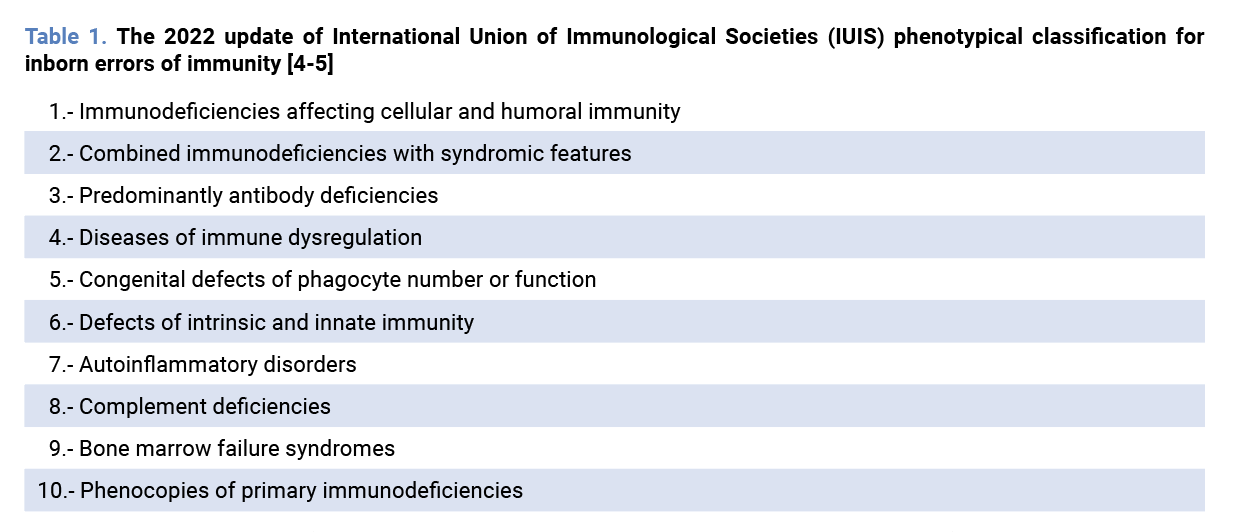
Clinical approach
In adults, IEIs may not always present with classic recurrent infections (Figure 1). A thorough clinical history is essential when evaluating suspected IEI. This should include a detailed record of all infections and their etiologies, as well as a comprehensive family history—not only of infections but also of malignancies and autoimmune diseases—with particular attention to early deaths and consanguinity. The physical examination may reveal findings suggestive of conditions not apparent from the history.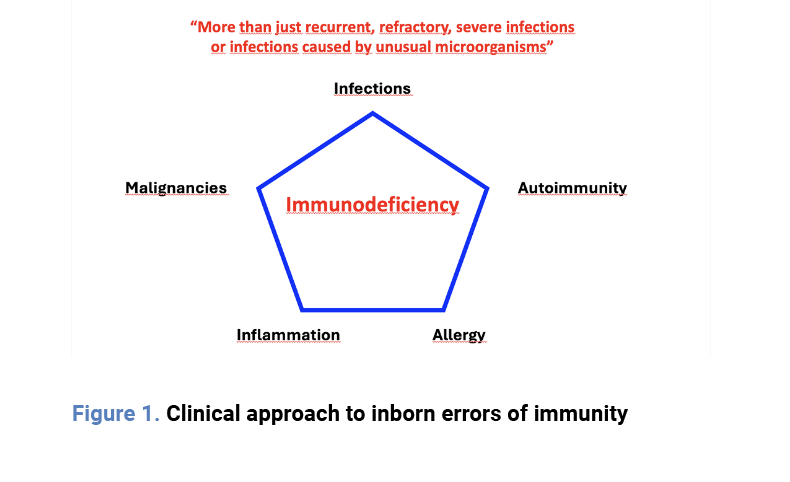 Before considering IEI in an adult with recurrent infections, more common causes should first be excluded. The initial step is to rule out anatomical and physiological abnormalities associated with recurrent infections, such as nasal polyps in recurrent sinusitis. Second, conditions associated with secondary immunodeficiency should be considered, including immunosuppressive therapy, HIV, malignancies, and disorders of biochemical homeostasis such as diabetes mellitus, renal insufficiency or nephrotic syndrome/dialysis, liver failure or cirrhosis, and malnutrition, among others [3].
When suspicion of an IEI is well-founded, certain considerations should be made depending on the site of infection. Isolated skin infections are generally not indicative of IEI, although exceptions exist. Crohn’s disease may cause recurrent skin abscesses, and both antibody deficiency and chronic granulomatous disease are among the IEIs associated with Crohn’s disease. Chronic mucocutaneous candidiasis is another representative IEI. Some cases of recurrent or refractory herpes simplex infection may result from quantitative or qualitative natural killer (NK) cell deficiencies. Regarding respiratory infections, recurrent sinusitis suggests IEI only when accompanied by other respiratory tract infections, such as otitis media or pneumonia, and is most often due to antibody deficiencies such as CVID or IgG subclass deficiencies (particularly IgG2 and IgG4). Recurrent pneumonia raises suspicion only if it involves different lobes. Urinary tract infections are generally not indicative of IEI. Gastrointestinal infections may suggest IEI when recurrent enterocolitis is caused by pathogens such as Giardia, Campylobacter, enterovirus, cytomegalovirus, Microsporidium, Cyclospora, or Isospora. In the central nervous system, recurrent meningococcal meningitis requires evaluation for terminal complement pathway deficiency, whereas recurrent meningitis caused by other encapsulated bacteria suggests an underlying antibody deficiency. Importantly, in cases of recurrent bacteremia, C3 deficiency should be suspected when caused by Streptococcus pneumoniae, Haemophilus influenzae, or Salmonella [3].
Clinically, four major patterns of primary immunodeficiencies have been identified [1]:
1.- Immunoglobulin and/or complement protein deficiencies. Common pathogens include encapsulated bacteria (S. pneumoniae, H. influenzae type b, and N. meningitidis), as well as Campylobacter, Giardia, and Cryptosporidium. These deficiencies are associated with recurrent sinopulmonary infections, chronic gastrointestinal infections, bacteremia, and meningitis.
2.- Cell-mediated immunity defects. Typical pathogens include cytomegalovirus, Epstein-Barr virus (EBV), other herpesviruses, mycobacteria (both M. tuberculosis and nontuberculous mycobacteria), and fungi (Candida, Cryptococcus, and Pneumocystis). Progressive infections with otherwise “benign” viruses, opportunistic intracellular pathogens, or fungi suggest impaired cell-mediated immunity, particularly T-cell defects.
3.- Granulocyte (neutrophil) defects. Characteristic pathogens include catalase-positive organisms (S. aureus, Enterobacteriaceae, P. aeruginosa), Aspergillus, and Nocardia. Recurrent invasive infections of the skin and soft tissues, particularly focal abscesses requiring incision and drainage, are associated with neutrophil defects.
4.- Natural killer (NK) cell defects. These defects may present with severe or fulminant herpesvirus infections, including EBV.
Laboratory approach and screening tools
Although diagnosis is initially based on clinical suspicion, confirmation of IEIs in adults requires laboratory testing. These tests, summarized in Tables 2 and 3, can be classified as basic (used for screening) or specific (used for confirmation) [1]. Genetic sequencing studies, which identify specific genetic disorders, are increasingly becoming the primary method for diagnosing IEIs.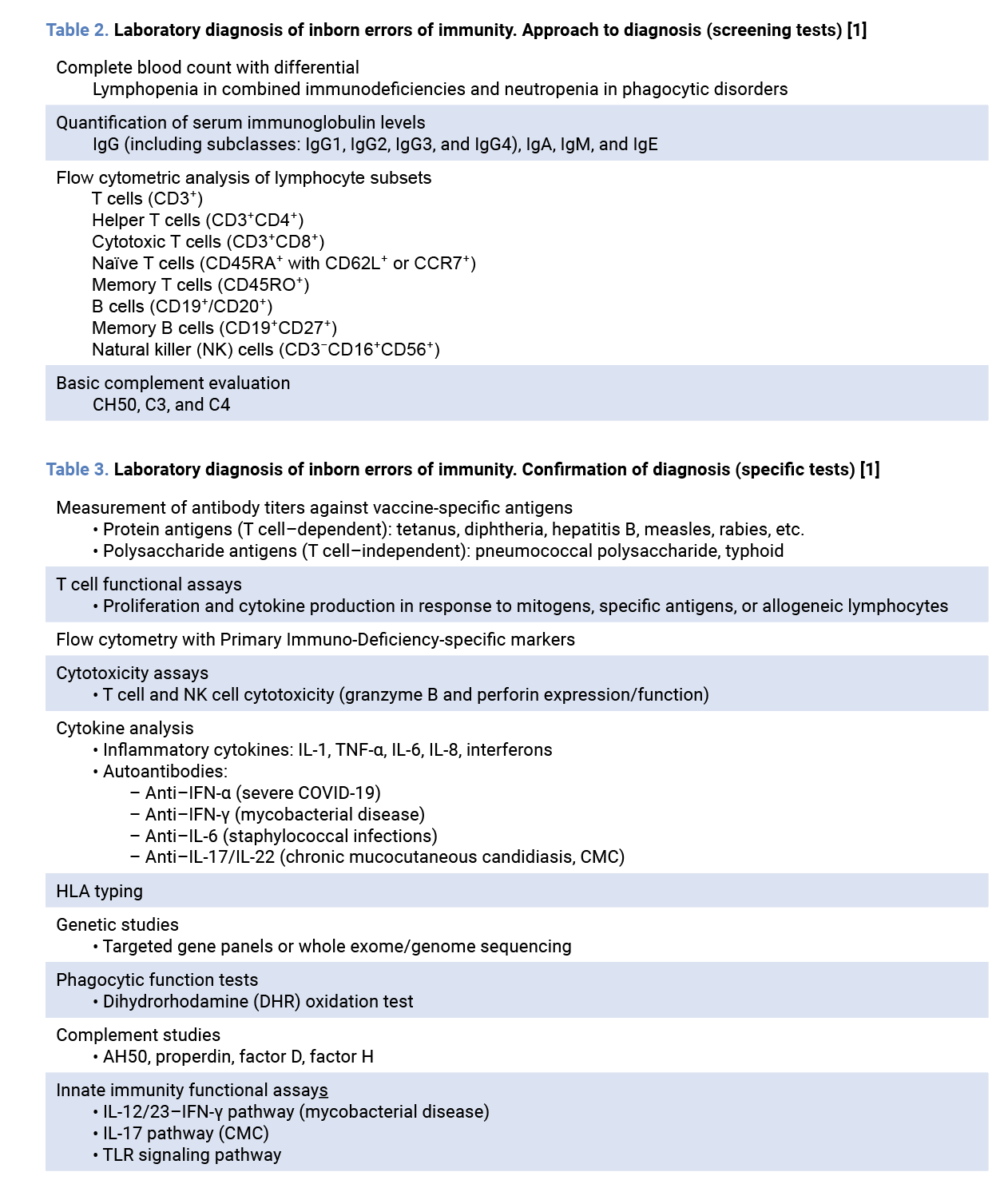
Clinical case series
Four adult patients were referred to the Infectious Diseases Unit at Fundacion Alcorcon University Hospital, presenting with infections suggestive of immunodeficiency: Case 1: 53-year-old woman with treatment-resistant giardiasis, Campylobacter enteritis, and a childhood history of hepatitis and sinusitis. Immunological evaluation revealed selective IgA and IgG4 deficiency with anti-IgA autoantibodies. Case 2: 50-year-old man with chronic lymphopenia and herpes zoster following acute otitis media. HIV repeatedly negative. CD4 count of 30 cells/uL. Diagnosis: idiopathic CD4 lymphopenia. Case 3: 55-year-old woman with prolonged fevers and cerebrospinal fluid pleocytosis, with a borderline-low CD4 count, non-responder to hepatitis B vaccination, and normal immunological screening; extended studies are ongoing. Case 4: 29-year-old pregnant woman with a history of nephritic syndrome and recurrent sinusitis (one episode complicated by a brain abscess). Despite normal immunological findings, her clinical presentation suggested an underlying immune defect. These cases illustrate the variability of IEI presentations in adulthood and the importance of maintaining clinical suspicion even in the absence of overt immunological abnormalities. Key considerations include: - Atypical or persistent infections warrant immunological screening. - Negative results do not rule out functional IEI or phenocopies. - Clinical suspicion should be maintained even with normal laboratory findings.Conclusions
Some inborn errors of immunity may go undetected until adulthood, but they are less common than anatomical abnormalities, physiological changes, or secondary IEIs. Humoral IEIs are the most common in adults, typically presenting with recurrent infections that are frequently associated with autoimmune manifestations. Screening is based on complete blood count, quantification of immunoglobulins and complement, and immunophenotyping of lymphocyte subpopulations. Confirmation of each IEI requires specific laboratory tests, and genetic sequencing is increasingly becoming the primary method for definitive diagnosis. Funding None to declare. Conflict of Interest The authors declare no conflict of interest. Author contributions LME: writing JGSC: original draft preparation JELG: review and editingReferences
- Butte MJ. Laboratory evaluation of the immune system. Notarangelo LD, editor. UpToDate. Last updated Jan, 2025. Available from: https://www.uptodate.com [Consulted: 5 Feb 2025]
- Sullivan KE, et al. Inborn errors of immunity (primary immunodeficiencies): Classification. Orange JS, editor. UpToDate. Available from: https://www.uptodate.com [Consulted: 5 Feb 2025]
- Pasternack MS. Approach to the adult with recurrent infections. Orange JS, editor. UpToDate. Last updated Oct, 2022. Available from: https://www.uptodate.com [Consulted: 5 Feb 2025]
- Tangye SG, Al-Herz W, Bousfiha A, Cunningham-Rundles C, Franco JL, Holland SM, et al. Human inborn errors of immunity: 2022 update on classification. J Clin Immunol 2022; 42: 1473–507.
- Bousfiha A, Moundir A, Tangye SG, Picard C, Jeddane L, Al-Herz W, et al. The 2022 update of IUIS phenotypical classification for IEI. J Clin Immunol 2022; 42: 1508–20.
- Cheng A, Holland SM, Salvator H, Rosen LB, Colby DL, Ardeshir-Larijani F, et al. Anti–interleukin-23 autoantibodies in adult-onset immunodeficiency. N Engl J Med 2024; 390: 1105–17.
- Bastard P, Rosen LB, Zhang Q, Michailidis E, Hoffmann H-H, Zhang Y, et al. Autoantibodies neutralizing type I IFNs and COVID-19 mortality. Sci Immunol 2021 Aug; 6(62):eabl4340. Available from: https://doi.org/10.1126/sciimmunol.abl4340
- Zhang Q, Bastard P, Liu Z, Le Pen J, Moncada-Velez M, Chen J, et al. Inborn errors of type I IFN immunity in severe COVID-19. Science 2020 Oct; 370 (6515): eabd4570. Available from: https://doi.org/10.1126/science.abd4570
- Epling BP, Lisco A, Manion M, Laidlaw E, Galindo F, Anderson M, et al. Impact of anti-CD4 autoantibodies on immune reconstitution in advanced HIV. Clin Infect Dis 2025; 80:1340–8.
Explore
Articles
Volumes
About the journal
Most read
Recomendaciones para la prevención y el tratamiento de las infecciones respiratorias en adultos mayores institucionalizados
Revista Española de Quimioterapia
Acute infectious gastroenteritis in childhood: the role of rapid multiplex molecular syndromic panels in diagnosis and clinical management
Revista Española de Quimioterapia
Características epidemiológicas de pacientes con aislamientos de Enterobacterales productores de carbapenemasas-NDM en un hospital de alta complejidad
Revista Española de Quimioterapia
Review on the management of intra-abdominal candidiasis
Revista Española de Quimioterapia
Neoscytalidium dimidiatum: a rare locally acquired deep cutaneous infection in a renal transplant recipient
Revista Española de Quimioterapia