Review
April 2026, Volume 39, nº 2
56 min
Delafloxacin: what does a new fluoroquinolone offer?
Emilia Cercenado1,*  , Oscar Murillo2,3
1Servicio de Microbiología Clínica y Enfermedades Infecciosas, Hospital General Universitario Gregorio Marañón, Madrid, Spain
2Servicio de Enfermedades Infecciosas, Hospital Universitari Bellvitge, L'Hospitalet de Llobregat, Spain
3CIBER de Enfermedades Infecciosas (CIBERINFEC), Instituto de Salud Carlos III, Madrid, España
*Correspondence:
Emilia Cercenado. ecercenado@gmail.com
Receipt Date:
30/01/2026
Acceptance Date:
01/03/2026
Publication Date:
10/03/2026
How to cite
Cercenado E, Murillo O. Delafloxacin: what does a new fluoroquinolone offer?. Rev Esp Quimioter. 2026; 39(3):104-124. Available from: http://www.doi.org/10.37201/req/151.2026
Metrics
1094
Views
150
Downloads
Share
Share
Abstract (EN)
Delafloxacin is a novel anionic fluoroquinolone with a different chemical structure from currently marketed fluoroquinolones, which gives it distinct physicochemical characteristics, being active in both acidic and neutral environments. Delafloxacin is also unique in showing a dual-targeted equipotent inhibition of the essential bacterial enzymes DNA gyrase and topoisomerase IV, which may explain the very low frequencies of spontaneous mutations in vitro. It shows potent in vitro activity against a broad spectrum of Gram-negative bacteria, including some fluoroquinolone-resistant strains, and increased efficiency against Gram-positive bacteria, including methicillin-resistant Staphylococcus aureus, although it is always necessary to determine the in vitro activity of delafloxacin against fluoroquinolone-resistant isolates. Delafloxacin exhibits linear pharmacokinetics, a wide volume of distribution, and a concentration-dependent pattern of antimicrobial killing, a property that allows the use of high doses for greater effectiveness in some difficult-to-treat infections. Delafloxacin is available for clinical use in oral and intravenous formulations and has been approved for the treatment of acute bacterial skin and skin-structure infections and community-acquired bacterial pneumonia based on the results from phase II and III clinical trials. Overall, delafloxacin has been well tolerated and has a low profile of drug-drug interactions. Its activity in local acidic environments and biofilms could play a role in the treatment of biofilm-related infections such as osteoarticular and medical device-associated infections, and due to its broad spectrum, it can also be useful in polymicrobial infections. Delafloxacin is an interesting new addition to the therapeutic arsenal against common and difficult-to-treat infections.
Keywords (EN):
Topoisomerases
Resistance
Fluoroquinolones
Delafloxacin
Community-acquired bacterial pneumonia
Methicillin-resistant [i]Staphylococcus aureus[/i]
Acute bacterial skin and skin structure infections
Introduction
Antimicrobial resistance (AMR) to essential antibiotics poses a growing threat to global health. The Global Antimicrobial Resistance and Use Surveillance System (GLASS) established by the World Health Organization (WHO), has recently reported that resistance to essential antibiotics, particularly among Gram-negative bacteria, is widespread and increasing, although it is unevenly distributed [1]. Despite significant geographical differences, globally, Escherichia coli and Klebsiella pneumoniae are the leading antimicrobial-resistant Gram-negative bacteria, with more than 40% of E. coli resistant to third-generation cephalosporins and ciprofloxacin, and over 55% and 45% of K. pneumoniae resistant to third-generation cephalosporins and ciprofloxacin, respectively. Other essential life-saving antibiotics, such as carbapenems, are also losing effectiveness, with 15% of K. pneumoniae resistant to them. Among the Gram-positive bacteria, methicillin-resistant
Staphylococcus aureus (MRSA) remains a problem, with a global level of resistance in bloodstream infections of 27.1%. In the case of Streptococcus pneumoniae, although the burden of infection has decreased with the introduction of pneumococcal conjugate vaccines, it remains an important cause of community-acquired bloodstream infections, often secondary to pneumonia, with variable levels of resistance to different antibiotics, while globally the level of resistance to penicillin remained low, at 5.2% [1].
In response to the AMR threat, the WHO launched its first Bacterial Priority Pathogens List (BPPL) in 2017, subsequently updated in 2024, with the aim of guiding and promoting the research and development of new antibacterials as part of efforts to address the growing global AMR threat [2,3]. In this context, a new compound from the fluoroquinolone family was developed with the aim of creating a broad-spectrum antibiotic to overcome the limitations and resistance associated with other fluoroquinolones. The novel anionic fluoroquinolone, delafloxacin, presented a different chemical structure, which confers distinct physicochemical characteristics. It is active in both acidic and neutral environments and shows dual-targeted equipotent inhibition of the essential bacterial enzymes DNA gyrase and topoisomerase IV. In addition, it shows potent in vitro activity against a broad spectrum of Gram-negative bacteria, including several fluoroquinolone-resistant strains, and increased efficiency against Gram-positive bacteria, including those carrying specific resistance mutations such as MRSA. This process culminated in 2017 with the authorization of delafloxacin (Baxdela®), in oral and intravenous formulations, by the Food and Drug Administration (FDA) for the treatment of adults with acute bacterial skin and skin structure infections (ABSSSI), when it is considered inappropriate to use other antibacterial agents that are commonly recommended for the initial treatment of these infections, and for the treatment of community-acquired bacterial pneumonia (CABP) [4]. The European Medicines Agency (EMA) approved delafloxacin (Quofenix®) in 2019 for the treatment of ABSSSI and later, in 2021, also authorised delafloxacin for the treatment of CABP [5].
ABSSSI are among the most common human bacterial infections and occur in both the community and hospital settings. These infections include cellulitis, erysipelas, wound infections (traumatic or post-surgical), and major abscesses. Cellulitis and abscesses are frequent in the community and also often result in hospitalisation. Other ABSSSI, such as surgical site infections and burn infections, are also seen in the hospital setting. The clinical manifestations of ABSSSI vary considerably and range from uncomplicated, superficial infections to life-threatening infections and represent a common indication for antibiotic use. Initial treatment of ABSSSI is usually empirical because culture results are not immediately available, and patients with ABSSSI benefit from the rapid initiation of appropriate therapy [6].
CABP is a global health problem with significant morbidity and mortality. It is the most common infectious cause of hospital admission in adults and poses a high economic burden. The main management decisions should be guided by the severity of the disease. With the increasing availability of rapid molecular testing methods, antimicrobial therapy for hospitalised patients should be based on the results of diagnostic studies to allow pathogen-directed therapy. If rapid diagnostic tests are not available, patients can be treated empirically to cover the most likely bacterial pathogens [7].
This article aims to review the main differential characteristics of delafloxacin compared to other fluoroquinolones regarding its distinctive structural, chemical, and pharmacological characteristics and its in vitro activity, as well as its clinical use, including case reports and clinical trials that provide insights into the real-world application of delafloxacin.
Structure-activity relationships and mechanism of action of delafloxacin
Fluoroquinolones (FQs) are a family of broad-spectrum antibiotics that have been widely used in human medicine for many years. They are active against both Gram-positive and Gram-negative bacteria, including mycobacteria and anaerobes. Their mechanism of action is the inhibition of the bacterial nucleic acid synthesis through disruption of the enzymes topoisomerase IV and DNA gyrase, causing breakage of bacterial chromosomes. However, due to the overuse of FQs, bacteria have acquired resistance to these compounds, and FQs are currently facing increasing resistance and other challenges [8]. In this scenario, delafloxacin appears as a new quinolone with differential characteristics.
Delafloxacin (formerly known as ABT-492, RX-3341, and WQ-3034) is a novel fully synthetic anionic non-zwitterionic FQ with modifications to the quinolone structure that lead to increased efficiency in acidic conditions, an enhanced spectrum of antibacterial activity, and improved pharmacokinetic and toxicity profiles.
Delafloxacin is 1-(6-amino-3,5-difluoro-2-pyridinyl)-8-chloro-6-fluoro-7-(3-hydroxy-1-azetidinyl)-4-oxo-1,4-dihydro-3-quinolinecarboxylate (Figure 1). The molecule differs from previous FQs by three changes in the chemical structure of quinolones, namely: 1) the presence of a heteroaromatic substituent at position N-1, which enhances its antibacterial activity and steric hindrance, restoring its activity against bacterial strains resistant to other FQs; 2) the presence of chlorine at position C-8, which confers weak polarity, enhancing its activity against quinolone-resistant Gram-positive bacteria and anaerobes; and 3) the absence of a basic group at position C-7, resulting in a weak acidity and increased activity in acidic environments (such as in ABSSSIs, CABP, and biofilm) and preventing delafloxacin from existing under a zwitterionic form [9-11].
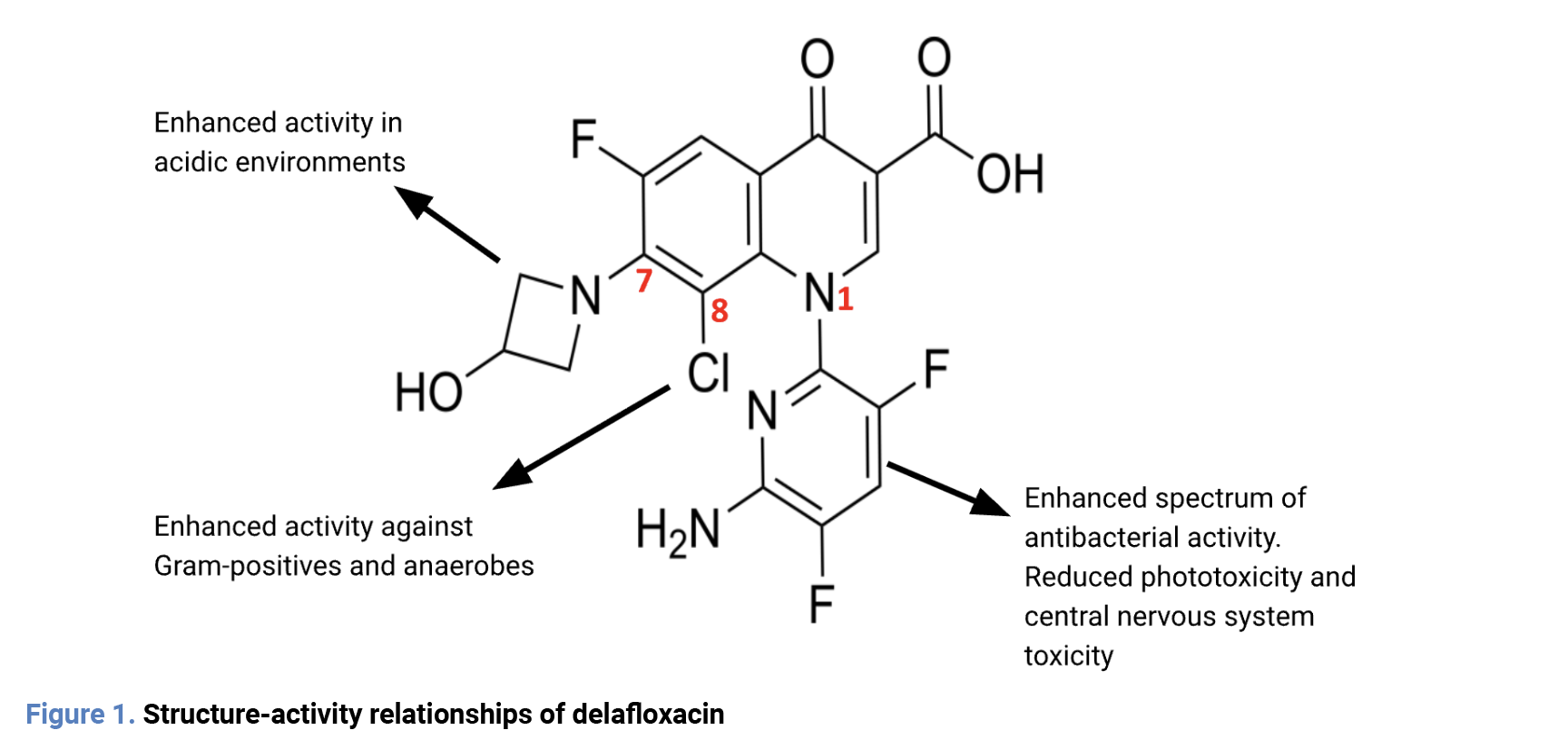
At neutral pH = 7.4, delafloxacin prevails under anionic form, but at acidic pH = 5.5 the dominant is the non-ionized delafloxacin which diffuses more easily through cell membranes and maintains an increased accumulation within bacterial cells. This property also translates into greater in vitro activity and a 4- to 5-fold decrease in MIC values from neutral to acidic conditions. The delafloxacin MIC decrease has been observed against S. aureus, Escherichia coli, Klebsiella pneumoniae, Stenotrophomonas maltophilia, and Pseudomonas aeruginosa under acidic conditions [12-17].
The chemical structure of delafloxacin also has an impact on its toxicity profile, since the large heterocycle at position N-1 decreases phototoxicity and reduces central nervous system toxicity compared with other FQs [18].
The antibacterial activity of delafloxacin is due to the dual inhibition with equal affinity of essential bacterial enzymes, DNA gyrase (topoisomerase II) and topoisomerase IV, in both Gram-negative and Gram-positive bacteria. This distinguishes it from other FQs (ciprofloxacin, levofloxacin) that exhibit greater inhibition of either DNA gyrase, preferably in Gram-negative bacteria, or topoisomerase IV in Gram-positive bacteria. As a consequence of this particularity, delafloxacin demonstrates excellent antibacterial potency against most clinically relevant microorganisms and a reduced the risk of the emergence of resistance, which would require multiple simultaneous mutations in both targets. In addition, delafloxacin is not a good substrate for efflux pumps, and the concentration of delafloxacin required to prevent the selection of resistant mutants is one and four times the MIC lower than those of comparator FQs [9,10,19-25].
Delafloxacin breakpoints and susceptibility testing
To date, the European Committee on Antimicrobial Susceptibility Testing (EUCAST) has defined clinical breakpoints for delafloxacin for the following bacterial species: S. aureus (≤0.016 mg/L in community-acquired pneumonia and ≤0.25 mg/L in skin and skin-structure infections), Streptococcus pyogenes, Streptococcus dysgalactiae, Streptococcus agalactiae, and the Streptococcus anginosus group (≤0.03 mg/L), and E. coli (≤0.125 mg/L). It has also established an ECOFF of 0.06 mg/L for S. pneumoniae and 2 mg/L for P. aeruginosa [26-28]. The FDA has also defined clinical breakpoints for susceptible S. aureus and S. haemolyticus (≤0.25 mg/L), S. pyogenes, S. agalactiae and the S. anginosus group (≤0.06 mg/L), E. faecalis (≤0.12 mg/L), E. coli, K. pneumoniae, and E. cloacae (≤0.25 mg/L), and P. aeruginosa (≤0.5 mg/L) [29].
The EUCAST recommended method for susceptibility testing is broth microdilution [26]. Alternatively, gradient diffusion MIC test strips may be used for delafloxacin MIC testing, which generally perform similarly to the broth microdilution method [30]. In addition, the Gram-negative susceptibility cards VITEK®2 AST-XN38 and VITEK®2 AST-XN39 (Biomérieux, Marcy-l’Etoile, France), both including delafloxacin, have recently been introduced to the market and can be used for routine determination of delafloxacin MICs in clinical laboratories.
Activity of delafloxacin in biofilms and in acidic environments
A particularly important advantage of delafloxacin is its activity in biofilms due to its increased potency under acidic conditions. Biofilms consist of communities of bacteria encased in a matrix made of polysaccharides, proteins, and extracellular DNA that can develop on the surface of tissues or foreign bodies. In an in vitro model, Siala et al. compared delafloxacin to daptomycin and vancomycin using biofilms produced by seven clinical isolates of S. aureus, including methicillin-susceptible and MRSA, with a range of delafloxacin MIC values of 0.004-0.125 mg/L. Delafloxacin displayed potent activity at clinically achievable concentrations against five of the seven isolates tested, and the antibiotic penetration within the biofilms ranged from 0.6 to 52% for delafloxacin, 0.2 to 10% for daptomycin, and 0.2 to 1% for vancomycin. Acidic pH considerably increased the potency of delafloxacin when tested against planktonic forms of S. aureus by increasing its intrabacterial accumulation, but it did not substantially affect the potency of vancomycin or daptomycin [11]. The potency and efficacy of delafloxacin against biofilms are benefited by its penetration into the matrix and the local acidic microenvironmental pH [11,31]. In another study, delafloxacin showed greater activity against S. maltophilia under acidic conditions compared with levofloxacin. The MIC50 of delafloxacin decreased from 8 mg/L (in neutral pH conditions) to 0.25 mg/L (at pH = 6.5), whereas levofloxacin MIC values remained the same [15].
Delafloxacin has been shown to have excellent lung and biofilm penetration and enhanced activity in low-pH environments, such as those observed in the cystic fibrosis lung. Craddock et al. determined the MICs of delafloxacin, ciprofloxacin, and levofloxacin against six P. aeruginosa strains using standard culture media (pH 7.3), artificial sputum media (pH 6.9), and a cystic fibrosis sputum time-kill model. Delafloxacin exhibited 2- to 4-fold MIC reductions at pH 6.9, which corresponded with significantly greater killing compared with ciprofloxacin and levofloxacin [16].
In a recent study, Alexandre et al. evaluated the pH-dependent antimicrobial activities of delafloxacin and ciprofloxacin against 81 isogenic E. coli strains carrying diverse fluoroquinolone resistance mechanisms and found that the ciprofloxacin MIC90 increased from 8 mg/L at pH 7.3 to 128 mg/L at pH 5.0, while the delafloxacin MIC90 decreased from 64 mg/L to 16 mg/L. At pH 5.0, the median MIC of delafloxacin was 2 mg/L versus 64 mg/L for ciprofloxacin (P < 0.001), demonstrating clinically relevant activity of delafloxacin in acidic environments [32].
In another study, Cortès-Tarragó et al. characterized in an in vitro infection model the intracellular activity of delafloxacin compared with levofloxacin against Legionella spp. in terms of culturability and viability and found that delafloxacin had higher intracellular activity than levofloxacin, decreasing the culturability of Legionella spp. from 5 to 10 times more than did levofloxacin, demonstrating the improved activity of delafloxacin in acidic environments [33].
In summary, the increased antibacterial efficacy of delafloxacin under acidic (inflammatory) environments may be a promising feature for the treatment of infections in acidic anatomical sites such as the urinary tract, skin, soft tissue, abscesses, respiratory tract, phagolysosomes, or biofilms [11,15,32,33].
In vitro antibacterial activity of delafloxacin
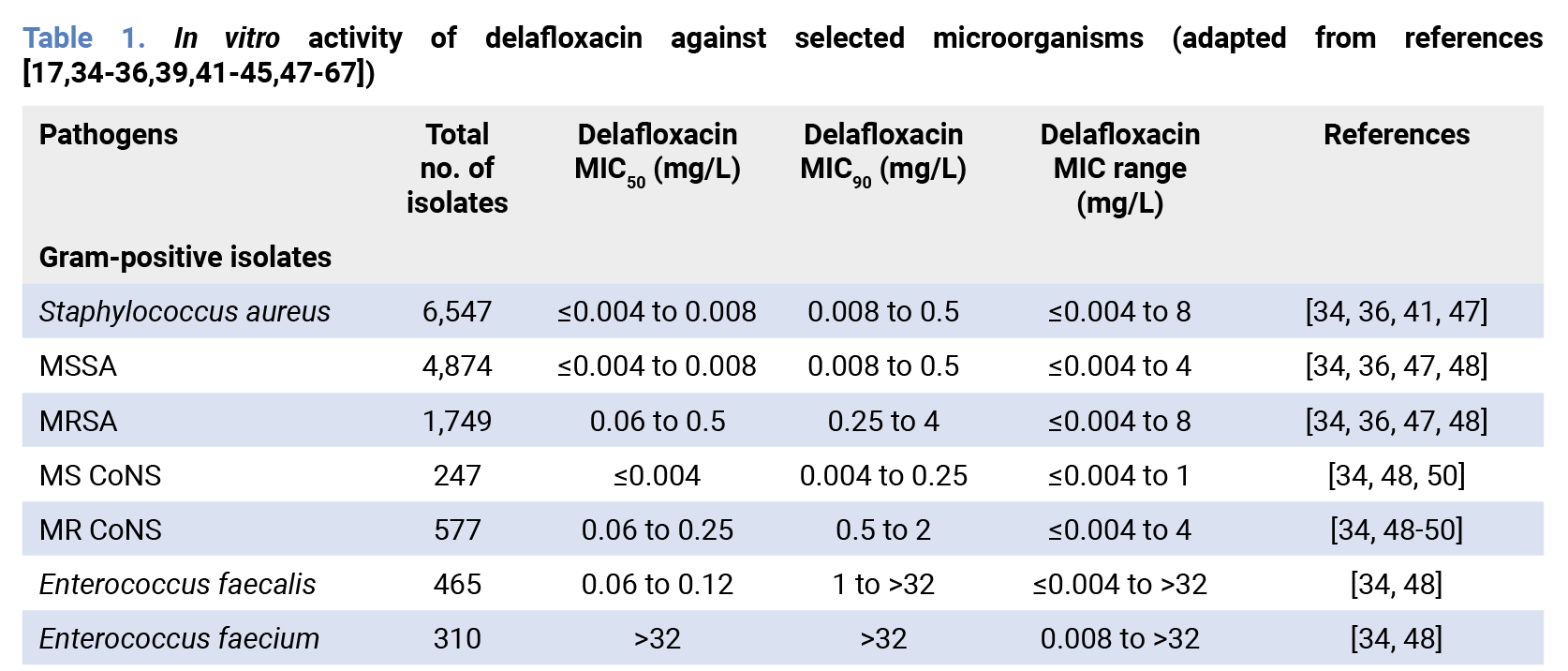
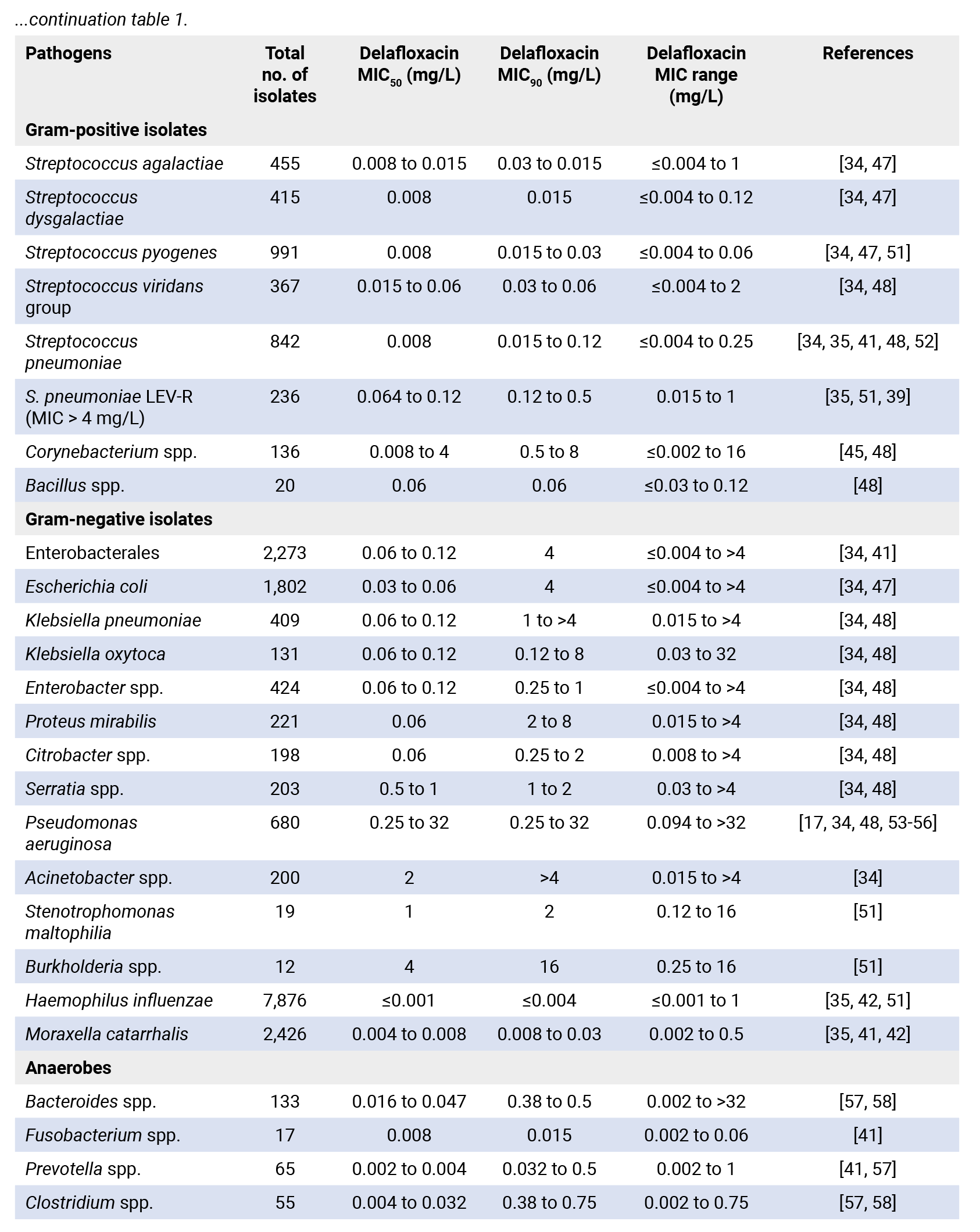
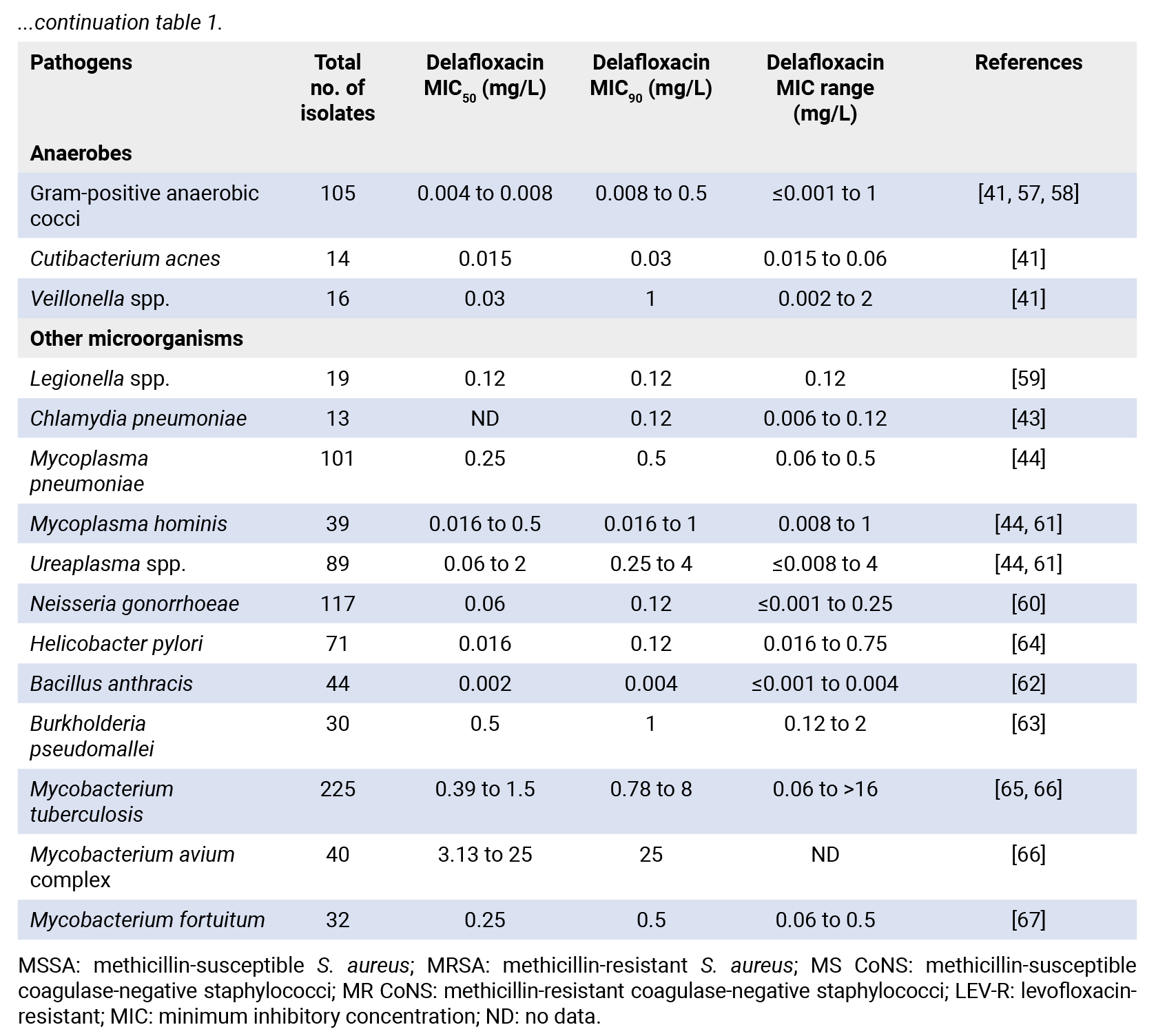
Delafloxacin has a broad spectrum of activity with improved potency compared with levofloxacin and moxifloxacin against Gram-positive pathogens (S. aureus, including MRSA; different species of coagulase-negative staphylococci (CoNS); S. pneumoniae; β-hemolytic streptococci; the Streptococcus mitis group; some Enterococcus spp.; and Corynebacterium spp.), Gram-negative bacteria (Enterobacterales, Haemophilus influenzae, Moraxella catarrhalis, Neisseria meningitidis, Neisseria gonorrhoeae, Pseudomonas spp., S. maltophilia), anaerobes (Bacteroides spp., Prevotella spp., Clostridioides difficile, Clostridium perfringens, Cutibacterium acnes), and other microorganisms such as Legionella pneumophila, Mycoplasma pneumoniae, Mycoplasma hominis, Ureaplasma spp., Chlamydia spp. and Mycobacterium tuberculosis [9,10,15,34-46] (Table 1).
Activity against Gram-positive microorganisms
Delafloxacin shows potent in vitro activity against Gram-positive microorganisms. Several international multicenter studies have reported ranges of MIC50 and MIC90 values for S. aureus of ≤0.004 to 0.008 mg/L and 0.008 to 0.5 mg/L, respectively. Against MRSA, the MIC50 and MIC90 ranges were 0.06 to 0.5 mg/L, and 0.25 to 4 mg/L, respectively, which represents an activity at least 8-fold greater than that of levofloxacin or moxifloxacin [34,36,41,47,48]. Regarding CoNS, its activity is similar, with MIC50 of ≤0.004 mg/L and MIC90 of 0.004 to 0.25 mg/L against methicillin-susceptible CoNS (MS-CoNS) and ranges of MIC50 and MIC90 of 0.06 to 0.25 mg/L, and 0.5 to 2 mg/L, respectively, against methicillin-resistant CoNS (MR-CoNS) [34,48-50]. In a large multicenter study including bacterial isolates from Europe and the United States, 99.5% of MSSA isolates (from both Europe and the United States), MRSA (95.3% and 91.2% of isolates from Europe and the United States, respectively), MS-CoNS (100% and 97.6%), and MR-CoNS (95.5% and 84.5%) isolates were inhibited by delafloxacin at an MIC of ≤ 0.5 mg/L. Notably, among fluoroquinolone-resistant S. aureus and CoNS isolates, 88.3% (484/548 isolates) were inhibited by ≤ 0.5 mg/L of delafloxacin [34]. In another multicenter study, delafloxacin also showed low MIC50 (0.06 mg/L) and MIC90 (0.50 mg/L) values against a series of linezolid-resistant Staphylococcus epidermidis involved in bone and joint infections [49]. In light of these results, it may be necessary to determine the susceptibility of staphylococcal isolates to delafloxacin regardless of their resistance pattern to other fluoroquinolones.
Against enterococci, the activity of delafloxacin is variable. While its activity against Enterococcus faecalis is at least 8-fold greater than that of levofloxacin, with ranges of MIC50 and MIC90 of 0.06 to 0.12 mg/L and of 1 to >32 mg/L, respectively, it shows poor activity against Enterococcus faecium (MIC50 and MIC90 >32 mg/L), although it is active against isolates that are susceptible to levofloxacin [34,48].
Delafloxacin shows excellent in vitro activity against the S. viridans group (MIC50 and MIC90 at 0.015 and 0.06 mg/L, respectively) and against S. pyogenes, S. agalactiae, and S. dysgalactiae (MIC50 at 0.008 and MIC90 at 0.015 to 0.03 mg/L) [34,47,48,51]. In relation to its activity against S. pneumoniae, delafloxacin also displays an excellent activity (MIC50 at 0.008 and MIC90 at 0.015 to 0.12 mg/L), being 32- to 64-fold more active than levofloxacin [34,35,41,48,52]. It is also very active against levofloxacin-resistant S. pneumoniae isolates (MIC50 at 0.064 to 0.12 and MIC90 at 0.12 to 0.5 mg/L [35,51,39]. As indicated before, the characteristics of delafloxacin, as a dual-targeting fluoroquinolone against topoisomerase IV and DNA gyrase, decrease the selection of resistance by diminishing the likelihood of multiple mutational events in both enzymes. Thus, in one study, among 82 pneumococcal isolates resistant to levofloxacin, 71 (87%) were susceptible to delafloxacin despite the presence of mutations in gyrA+parC that lead to high level resistance to levofloxacin [23]. Finally, delafloxacin is also active against other Gram-positive bacteria such as Corynebacterium spp. and Bacillus spp. Against Corynebacterium spp. its activity varies depending on the species, with MIC values ranging from ≤0.002 to 16 mg/L [45,48] (Table 1).
Activity against Gram-negative microorganisms
Data from multicentre studies have shown that, in general, the activity of delafloxacin against Enterobacterales is similar to that of ciprofloxacin, presenting very good activity against E. coli, K. pneumoniae, K. oxytoca, and Enterobacter spp., among others, with MIC90 values ranging from ≤0.004 to >4 mg/L [34,41,47,48] (Table 1). However, as described above, it is important to note that in acidic infection sites such as abscesses, biofilms, and the urinary tract, while ciprofloxacin and other fluoroquinolones lose substantial activity, delafloxacin maintains and even enhances its antimicrobial potency [32]. Against E. coli and K. pneumoniae isolates producing extended-spectrum β-lactamases (ESBLs), its activity decreases, with MICs increasing up to 32-fold [34].
Against P. aeruginosa, the activity of delafloxacin (MIC50 and MIC90 range from 0.25 to >32 mg/L) is similar to that of ciprofloxacin (MIC50 and MIC90 at 0.25 and >4 mg/L, respectively) [17,34,48,53-56]. However, in one study, among 28 ciprofloxacin-resistant isolates, 10 were susceptible to delafloxacin (36%) [55]. In another study, among 101 P. aeruginosa isolates resistant to both ciprofloxacin and levofloxacin, 30 (29.7%) were susceptible to delafloxacin with an MIC <0.5 mg/L [54], demonstrating the diversity in antibacterial efficacy of delafloxacin against P. aeruginosa. This diversity makes it necessary to determine the susceptibility of P. aeruginosa isolates to delafloxacin in routine clinical laboratories, regardless of their ciprofloxacin and levofloxacin susceptibility results [53,56].
Against other non-fermentative Gram-negative bacilli, delafloxacin also shows variable activity, exhibiting MIC50/90 values of 1/2 mg/L for S. maltophilia, 4/16 mg/L for Burkholderia cepacia, and 2/>4 mg/L for Acinetobacter spp. [34,51]. Delafloxacin is also very active against respiratory pathogens such as H. influenzae (MIC50 ≤0.001 mg/L; MIC90 ≤0.004 mg/L) and M. catarrhalis (MIC50 ≤0.008 mg/L; MIC90 ≤0.03 mg/L) [35,42,51].
Activity against other microorganisms
Delafloxacin exhibits high activity against Gram-positive and Gram-negative anaerobes, including Clostridium spp. (MIC50 ≤0.03 mg/L; MIC90 ≤0.75 mg/L), Cutibacterium acnes (MIC50 0.015 mg/L; MIC90 0.03 mg/L), Gram-positive anaerobic cocci (MIC50 ≤0.08 mg/L; MIC90 ≤0.5 mg/L), Bacteroides spp. (MIC50 ≤0.047 mg/L; MIC90 ≤0.5 mg/L), Fusobacterium spp. (MIC50 0.08 mg/L; MIC90 0.015 mg/L), Prevotella spp. (MIC50 ≤0.04 mg/L; MIC90 ≤0.5 mg/L), and Veillonella spp. (MIC50 0.03 mg/L; MIC90 1 mg/L). Overall, these values translate into an improvement in activity at least 32-fold higher than that of levofloxacin [41,57,58] (Table 1). The good activity of delafloxacin against anaerobes adds significant value as an alternative treatment option for polymicrobial skin and soft tissue infections.
Delafloxacin also has high in vitro activity against so-called atypical respiratory pathogens, including Mycoplasma pneumoniae (MIC50 0.25 mg/L; MIC90 0.5 mg/L), Chlamydia pneumoniae (MIC90 0.12 mg/L), and Legionella spp. (MIC90 0.12 mg/L). In all cases, its activity was 4-fold higher than that of levofloxacin [43,44,59].
It is also active against some organisms causing sexually transmitted diseases, including ciprofloxacin-resistant Neisseria gonorrhoeae (MIC50 0.06 mg/L; MIC90 0.125 mg/L) [60], Mycoplasma hominis, Ureaplasma spp. and Chlamydia trachomatis, showing improved activity in levofloxacin-resistant strains [44,59,61] (Table 1). In addition, it is 16-fold more potent than ciprofloxacin against the biothreat pathogens Bacillus anthracis (MIC50 0.002 mg/L; MIC90 0.004 mg/L) and Burkholderia pseudomallei (MIC50 0.5 mg/L; MIC90 1 mg/L) [62,63].
Delafloxacin is also active in vitro against Helicobacter pylori (MIC50 0.016 mg/L; MIC90 0.125 mg/L). The enhanced antibacterial efficacy of delafloxacin in acidic environments enables it for therapeutic use against H. pylori infections [64]. Finally, regarding mycobacteria, the activity of delafloxacin is highly variable depending on the species. It shows moderate activity against Mycobacterium tuberculosis (MIC50 ≤0.5 mg/L; MIC90 ≤8 mg/L) [65, 66], lower activity than moxifloxacin or ciprofloxacin against Mycobacterium avium complex with MICs ranging from 4 to 25 mg/L [66], and similar activity to ciprofloxacin against Mycobacterium fortuitum (MIC50 0.25 mg/L; MIC90 0.5 mg/L) [67].
Activity of delafloxacin against fluoroquinolone-resistant Staphylococcus aureus and fluoroquinolone-resistant Pseudomonas aeruginosa in Spain
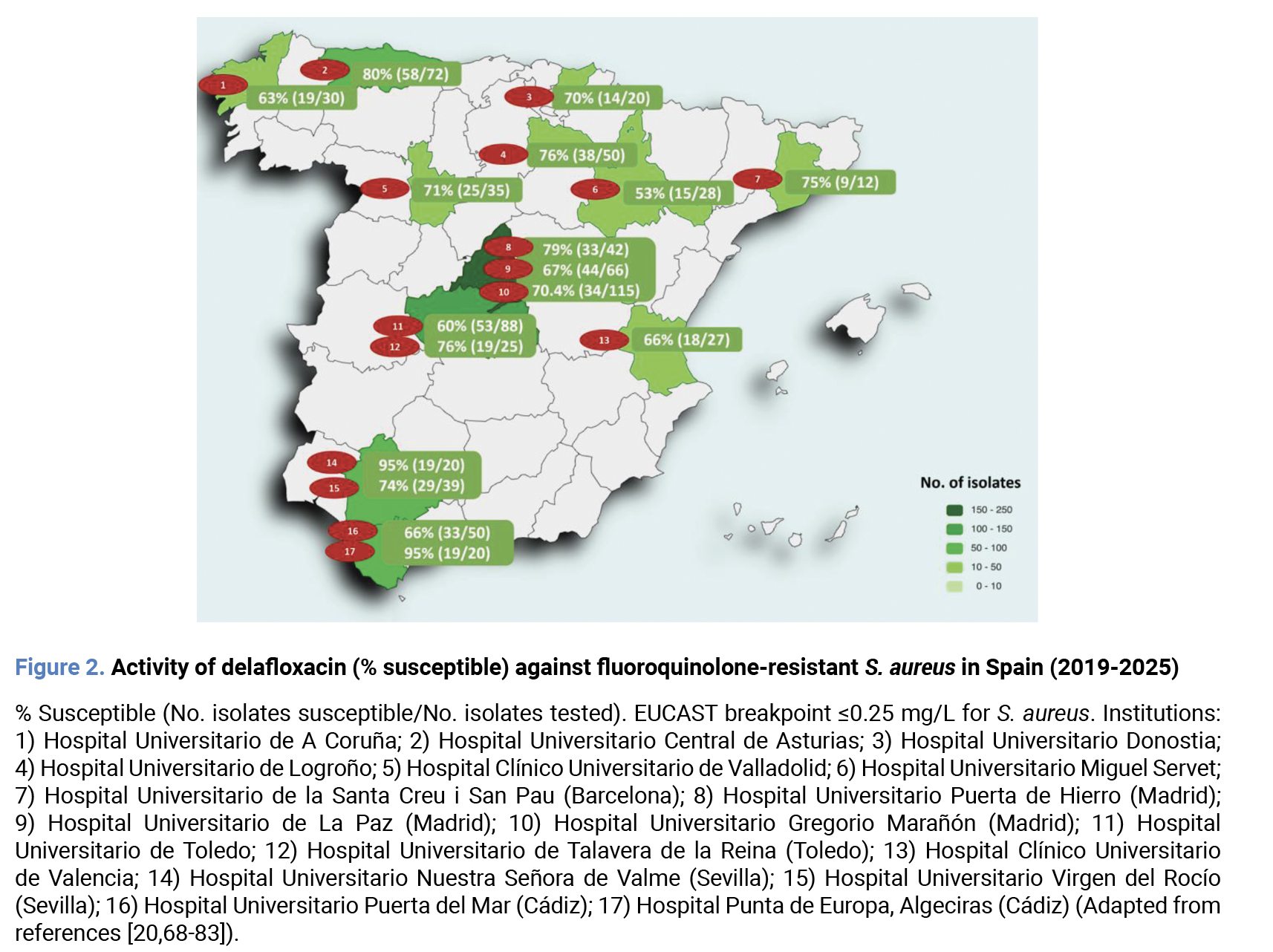
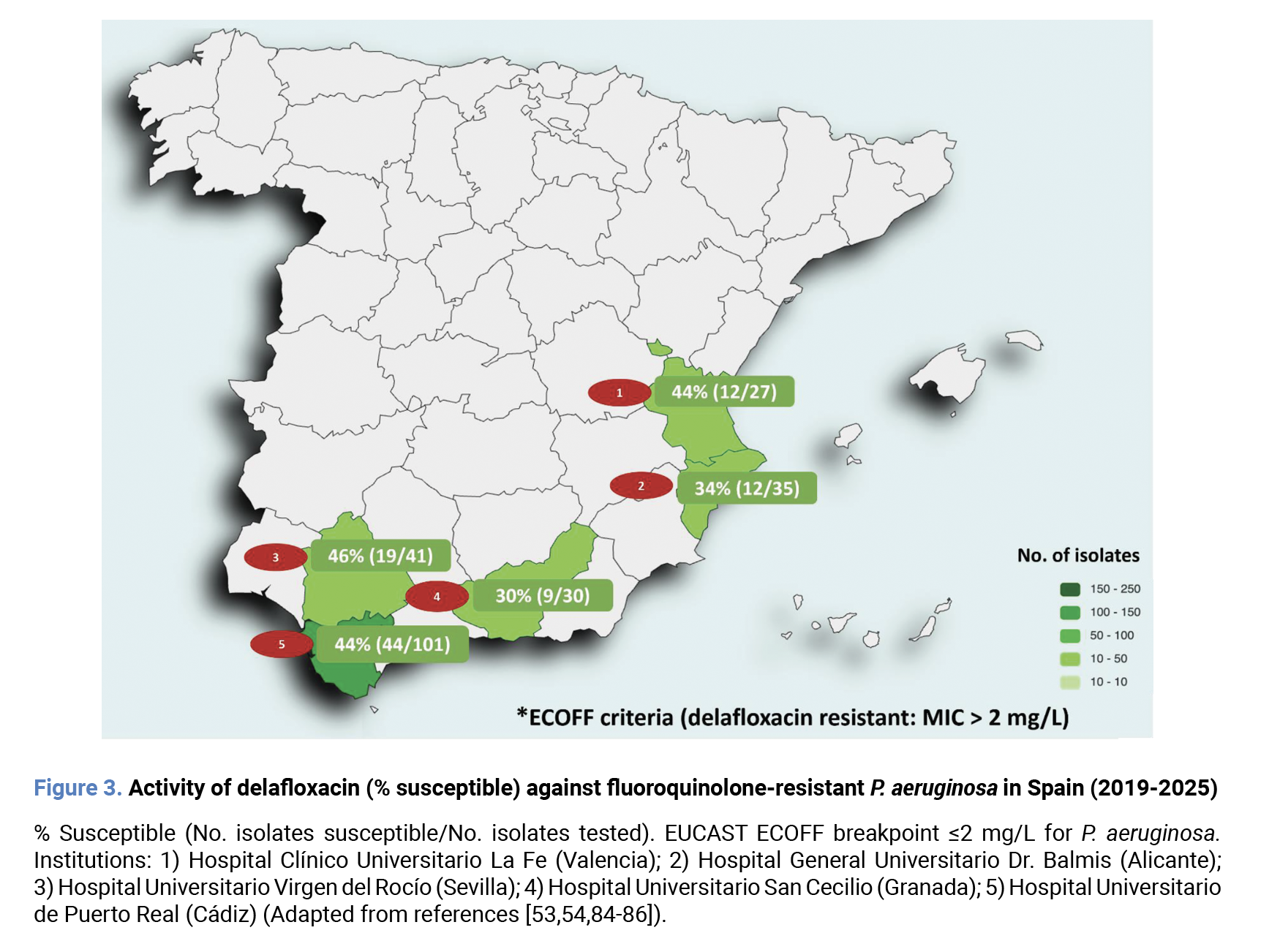
From 2019 to 2025, several studies have analyzed the activity of delafloxacin against fluoroquinolone-resistant S. aureus [20,68-83] and against fluoroquinolone-resistant P. aeruginosa [53,54,84-86] in different institutions across Spain. The institutions represented different geographical areas (Figures 2 and 3).
A total of 17 studies analyzed the activity of delafloxacin against S. aureus, and the percentages of susceptibility ranged from 53% to 95%. The 5 studies that analysed the activity of delafloxacin against fluoroquinolone-resistant P. aeruginosa, showed susceptibility ranges from 30% to 46% (Figures 2 and 3). Overall, these susceptibility data observed in Spain are lower than those found in other international multicentre studies [34]. However, it is important to note that the isolates analysed were not collected consecutively, but were selected based on their fluoroquinolone resistance pattern or their multiresistance to other antimicrobials and where treatment options were limited. Moreover, despite being multidrug-resistant strains, a significant percentage are susceptible to delafloxacin.
Although most studies include limited numbers of isolates, the information is relevant because it indicates that even with resistance to other quinolones, some strains can still be rescued with delafloxacin. For this reason, it is important to determine the susceptibility of multiresistant S. aureus and P. aeruginosa to delafloxacin in difficult-to-treat infections, since it can be an alternative even in isolates resistant to other fluoroquinolones.
Pharmacokinetic/pharmacodynamic profile of delafloxacin
Pharmacokinetics
The pharmacokinetic profile of delafloxacin was initially evaluated in healthy volunteers using single and multiple ascending doses up to 1,200 mg and 1,600 mg of intravenous and oral drug, respectively [87-89]. Delafloxacin exhibits linear pharmacokinetics, in which ascending doses provide proportional increases in Cmax and a little more proportional AUC values. The recommended intravenous dosage is 300 mg every 12 h, which allows a median Cmax of 9-10 mg/L, and AUC0-inf 21-24 mg h/L.
The bioavailability of the oral formulation is 59%, which is lower than that of previous quinolones levofloxacin or moxifloxacin; however, the oral dose of 450 mg is equivalent to 300 mg intravenously, and the AUC values are similar. In fact, switching between these equivalent intravenous and oral doses (300 mg q12h and 450 mg q12h, respectively) was approved by the FDA. Of note, the Cmax after oral administration of delafloxacin is reduced by 20% when administered with food compared with the fasting state; however, no differences in AUC values were observed with or without food, suggesting no impact on clinical efficacy [88,90]. Delafloxacin possesses a large volume of distribution (35-48 L), which is almost equivalent to the total body water, and its protein binding is approximately 84%. High distribution in lung tissue has been reported [91], although information regarding its penetration into other tissues is still lacking. Recently, the penetration of delafloxacin into cerebrospinal fluid was evaluated in a murine model and showed a penetration ratio (cerebrospinal fluid/plasma) of 49% [92]. The mean half-life of delafloxacin is 3.7 h after a single intravenous 300 mg dose [89], and it increases to 4-8 h following multiple oral doses.
Delafloxacin is predominantly excreted via the kidney (65%), although additional clearance pathways have been identified, particularly fecal excretion of unchanged drug (30-50%). Delafloxacin is moderately metabolised via glucuronidation in humans with approximately 70% of the dose excreted unchanged [89].
The pharmacokinetic parameters of delafloxacin have been studied in patients with renal impairment [93,94]. In general, regardless of intravenous or oral administration, the total exposure of delafloxacin increased proportionally as the degree of renal impairment worsened. Thus, approximately 2-fold higher AUC values were observed in patients with severe renal impairment and end-stage renal disease undergoing hemodialysis compared with those with normal renal function, whereas this fact was not observed on the Cmax values that did not differ significantly between groups. According to this information and supported by pharmacokinetic models and Monte Carlo simulations [95,96], the FDA recommends a dose adjustment of delafloxacin to 200 mg given intravenously every 12 hours in patients with severe renal impairment (eGFR, 15–29 mL/min/1.73 m2); by contrast, no dose adjustment for oral delafloxacin is warranted in the same situation, although it could also be considered [96,97]. Since increases in drug exposure may cause more toxicity, more information regarding the requirement for dose adjustment in patients with renal impairment is needed; while waiting for more studies, we note that in the study of Hoover et al. there were no trends toward increased adverse events correlating with increased exposure in the group of renal impairment subjects following a single dose of intravenous or oral delafloxacin [93].
Regarding hepatic impairment, a study showed no changes in delafloxacin clearance; therefore, it is not recommended to adjust the dose in this situation, including the severe Child-Pugh class C group [98]. Of interest, the inhibitory effects of delafloxacin on cytochrome P450 have been evaluated both in vitro and in vivo using midazolam as a paradigm of cytochrome P450 substrate [96,99]; overall, the results of these studies showed no significant inhibitory impact of delafloxacin, and no drug-drug interaction in the case of midazolam. Finally, neither sex nor age had any significant effect on the pharmacokinetics of delafloxacin [88].
Pharmacodynamics
Delafloxacin, as well as other fluoroquinolones, shows a concentration-dependent pattern of antimicrobial killing, with the 24-h free-drug area under the curve/MIC value (fAUC/MIC) being the pharmacodynamic parameter that best correlates with efficacy [90]. Based on previous results, target AUC/MIC values differ between microorganisms.
Regarding S. aureus isolates, several studies have evaluated the pharmacodynamics against ciprofloxacin-susceptible and -resistant strains and compared the efficacy of delafloxacin with that of other fluoroquinolones. Initially, Firsov et al. used an in vitro pharmacodynamic model and mimicked several clinical achievable AUC/MIC ratios of delafloxacin and levofloxacin [100]; in this study, delafloxacin showed greater efficacy and prevention of the emergence of resistant strains. Of note, in this work the authors did not consider the protein binding of both drugs and thus acknowledged that the effects of delafloxacin might have been overestimated due to its high protein binding compared with levofloxacin. The pharmacodynamic targets for delafloxacin against S. aureus were also determined using the murine neutropenic thigh infection model [96]. Based on the results of this study, the median fAUC24/MIC ratios associated with net bacterial stasis and a 1-log10 CFU reduction were 9.3 and 14.3, respectively. Subsequently, two more studies evaluated the pharmacodynamics of delafloxacin in a murine lung model and observed high penetration into the lung compartment [91,101]. In these studies, the fAUC24/MIC ratios associated with a stasis effect and 1-log10 CFU reduction ranged from 0.4 to 1.4 for MSSA strains and were higher for MRSA (24.7 to achieve 1-log CFU reduction). In any case, the authors noted that these fAUC24/MIC endpoints were >2-fold lower than those reported for other earlier fluoroquinolones. In the same studies, the authors also evaluated S. pneumoniae isolates and observed similar pharmacodynamic values.
Pharmacodynamic studies of delafloxacin have also been carried out against Gram-negative microorganisms, mainly E. coli, K. pneumoniae and P. aeruginosa isolates. Using the murine neutropenic thigh infection model and the murine lung infection model, the AUC/MIC ratio was confirmed as the best pharmacodynamic parameter to correlate with delafloxacin activity. Briefly, the median 24-h fAUC/MIC values associated with net stasis and 1-log kill for E. coli, K. pneumoniae, and P. aeruginosa were 14.5 and 26.2, 28.6 and 5.66, and 64.1 and 14.3, respectively [91,101,102].
Finally, population pharmacokinetic models and Monte Carlo simulations have been reported and have helped identify the most appropriate clinical dosages according to the probability of pharmacodynamic target attainment (PTA) [95,96,103,104]. According to the current clinical dosages of delafloxacin, for S. aureus isolates with MIC≤0.25 mg/L, the PTA associated with net stasis and a 1-log CFU reduction ranged from 91 to 100%, whereas for isolates with MIC=0.5 mg/L, the PTA was 90 and 86.8%, respectively. Similarly, the simulations for P. aeruginosa strains predicted a PTA of 97% for a stasis effect and 86% for a 1-log CFU reduction at MIC values of 1 mg/L.
Clinical efficacy
Delafloxacin is available for clinical use in oral and intravenous formulations. To date, clinical efficacy has been evaluated in phase II and phase III studies among patients with acute bacterial skin and skin structure infections, community-acquired bacterial pneumonia, uncomplicated gonorrhea, and surgical site infections.
Acute bacterial skin and skin structure infections (ABSSSI)
The first study was conducted by O’Riordan et al. and evaluated the clinical efficacy of delafloxacin (two different intravenous dosages) in comparison with tigecycline for different types of ABSSSI (cellulitis, wound infections, and abscesses) [105]. The study showed no differences between groups, with all groups achieving clinical cure rates >90%, and provided good results for an intravenous dose of 300 mg of delafloxacin, which was selected for further studies.
The study by Kingsley et al. compared the efficacy of delafloxacin (300 mg IV q12h), vancomycin (15 mg/kg IV q12h), and linezolid (600 mg IV q12h) [106]. Delafloxacin and linezolid achieved similar cure rates, whereas delafloxacin had a higher cure rate than vancomycin, particularly in the group of obese patients. Regarding microbiological eradication, there were no differences between groups; notably, S. aureus was the most frequently identified organism (90.9%), of which 67.2% were MRSA.
Two phase III studies were conducted; they included a total of 1,510 patients and compared the efficacy and safety of delafloxacin with vancomycin plus aztreonam. In the first study by Pullman et al. delafloxacin (300 mg IV q12h) demonstrated non-inferiority, achieving a cure rate of 78.2% compared with 80.9% of the comparator arm [107]. Bacterial eradication was similar between groups, and adverse events leading to discontinuation of therapy were lower in the delafloxacin group than in the vancomycin/aztreonam group (0.9% vs. 4.3%, respectively). The second study had a similar design but included the oral switch in the delafloxacin dose on day 3 of inclusion (300 mg IV q12h to 450 mg PO q12h), except for those cases with a creatinine clearance of 15-29 mL/min, which received delafloxacin 200 mg IV q12h throughout the entire treatment [108]. Delafloxacin showed non-inferiority to vancomycin/aztreonam (cure rate: 83.7% vs. 80.6%, respectively), was well tolerated, and presented a lower rate of discontinuation due to related adverse events than vancomycin/aztreonam (1.2% vs. 2.4%, respectively). Overall, when the data from both studies were analysed together, the most prevalent pathogen isolated from the infection site was S. aureus, and among all cases of ABSSSI caused by levofloxacin-resistant S. aureus (n=81), bacterial eradication was noticed in 80 cases.
Community-acquired bacterial pneumonia (CABP)
One phase III clinical trial was conducted to evaluate the comparative efficacy and safety of delafloxacin and moxifloxacin [109]. In this multicenter, randomized, double-blind trial, both drugs were administered initially intravenously, but the switch to oral treatment was allowed after 6 intravenous doses, and the total duration of treatment was 5-10 days. If MRSA was confirmed while on treatment with moxifloxacin, linezolid therapy was started in a blinded manner. Delafloxacin proved non-inferiority with similar early clinical response compared with moxifloxacin (88.9% vs. 89%, respectively), whereas the secondary efficacy endpoint (early clinical response and improvement in vital signs) favored delafloxacin (52.7% vs. 43%, respectively). Of note, delafloxacin achieved better results than moxifloxacin, particularly in the subgroup of patients with chronic obstructive pulmonary disease or asthma.
Uncomplicated gonorrhea
A multicenter, randomized phase III clinical trial compared a single oral dose of delafloxacin (900 mg) with a single intramuscular dose (250 mg) of ceftriaxone in patients with uncomplicated gonorrhea [110]. Delafloxacin did not demonstrate non-inferiority to ceftriaxone, achieving cure rates of 85.1% and 91%, respectively. Failure rates were higher among N. gonorrhoeae isolates with delafloxacin MICs ≥0.008 mg/L. Moreover, adverse events related to delafloxacin dose were common, considered as mild in intensity, and mainly were gastrointestinal symptoms.
Surgical site infections
One recent phase III clinical trial evaluated the efficacy of delafloxacin compared with the best available therapy for the treatment of surgical site infections following a cardiothoracic or abdominal procedure [111]. Patients were randomized 1:1 to receive delafloxacin 300 mg IV q12h/450 mg PO q12h or the comparator (vancomycin or linezolid, and piperacillin/tazobactam or tigecycline for cardiothoracic and abdominal surgical site infections, respectively). Due to the COVID-19 pandemic, the study finally included only 266 patients, most of them with abdominal post-surgical infections (n=246), therefore the group of cardiothoracic infections was not well represented. Delafloxacin demonstrated non-inferiority to the comparators (clinical success 91.8% vs. 90.2%, respectively), and microbiological response was also comparable between the treatment groups. Whereas the eligibility for switching to the oral formulation was slightly in favor of delafloxacin, time to discharge was comparable between the two treatment arms.
Safety
The main adverse events reported of delafloxacin to date derive from clinical trials; most were considered mild to moderate in intensity, and the most frequent were gastrointestinal disorders (diarrhea and vomiting, around 8%) and headache [9,90,112,113]. Particularly, Clostridioides difficile infection has been reported in less than 1% in previous studies, this being like in the comparator arms. Among hepatic toxicity, the most frequent event reported is the transaminase increase; particularly, in the study by Horcajada et al. transaminase values up to 5-fold the upper limit of normal were observed in 1.4% of patients in the delafloxacin group [109].
Some class-related adverse events of fluoroquinolones have been particularly evaluated for delafloxacin. Phototoxicity was examined in a phase I study with healthy volunteers, in which delafloxacin showed results similar to placebo with no evidence of toxicity [114]. In addition, cardiac toxicity was assessed by evaluating QT interval prolongation; in this phase I study, delafloxacin did not induce significant QT interval modifications at therapeutic and supratherapeutic doses (300 mg-900 mg), whereas moxifloxacin showed significant changes compared with placebo [115].
Other adverse events related to fluoroquinolones, such as peripheral or central neuropathy and tendinopathies, have been reported at very low frequency in previous clinical trials. In particular, seizures occurred in one patient with a previous history of seizure disorder in the study by O’Riordan et al., and it was considered possibly related to delafloxacin [105].
Overall, delafloxacin has been well tolerated in all clinical trials, and the rate of adverse events did not differ from that of the comparators. As with other new antibiotics, additional information from a wider use of drugs in clinical practice is always needed, since safety data is initially limited due to the small number of healthy volunteers and patients recruited from trials, in which there are several exclusion criteria that limit the generalizability of the results to many real-world situations.
Place in clinical practice: potential benefits and limitations
Delafloxacin has been approved for the treatment of ABSSSI and CABP, and has also demonstrated efficacy against surgical site infections after abdominal surgeries. In the case of ABSSSI, notable advantages include the possibility of intravenous-oral switch during the treatment, its low profile of adverse events, and its activity against most of the Gram-positive microorganisms involved, including MRSA and other pathogens resistant to previous fluoroquinolones. Indeed, there are currently several therapeutic options for ABSSSI, including new drugs, so it will be important to evaluate which alternative is the most suitable for each patient based on the spectrum of activity (broad versus narrow), the possibility of adverse effects and drug-drug interactions, and treatment adherence. Another approved indication of delafloxacin is CABP, for which delafloxacin also exhibits an appropriate in vitro spectrum of activity. In the same line, other respiratory tract infections could potentially be treated adequately with delafloxacin.
A potential and relevant advantage of delafloxacin is its activity in acidic local environments and biofilms. In this regard, delafloxacin appears to be a promising therapy for infections not only in some anatomical sites, such as urinary and respiratory tracts, but also in the presence of abscesses and intracellular bacteria. In addition, delafloxacin could play a role in the treatment of biofilm-related infections, such as osteoarticular infections and medical device-associated infections, in which effective therapies against persistent cells, intracellular, and biofilm-embedded bacteria are still needed. In this scenario, it should be of particular interest to study in depth the diffusion of delafloxacin into the bone tissue, and the potential benefits with the delafloxacin and rifampicin combination since staphylococcal infections are common and difficult to cure.
In relation to its broad coverage spectrum and the existence of intravenous and oral formulations, delafloxacin could be used for the treatment of polymicrobial infections, and may also be useful to complete an entire treatment course and facilitate early hospital discharge with oral therapy. In this regard, the activity of delafloxacin against levofloxacin-resistant isolates of methicillin-susceptible and -resistant staphylococci, as well as other fluoroquinolone-resistant Gram-negative bacilli, including P. aeruginosa, is of particular interest. While it is always necessary to determine the susceptibility to delafloxacin of these isolates resistant to previous fluoroquinolones, it may provide an additional chance to use quinolones in scenarios where they have proven benefits, such as osteoarticular and biofilm-associated infections [116,117].
The low profile of drug-drug interactions places delafloxacin favorably in the growing and common scenario of polypharmacy among patients. Delafloxacin demonstrated mild induction of cytochrome P450 isoenzymes in vitro, and it did not affect the Cmax and AUC values for midazolam (a sensitive CYP3A4 substrate) when administered to healthy volunteers [99]. Finally, delafloxacin can also be an alternative therapy for patients with relevant drug allergies, such as those allergic to β-lactams.
Regarding the limitations of the current use of delafloxacin, they are mainly related to the approved indications derived from clinical trials, and therefore further clinical information from a wider use in other types of infections is needed. Furthermore, while delafloxacin can regain activity against Gram-positive and Gram-negative microorganisms resistant to previous fluoroquinolones, it is always advisable not to generalize its use as an empirical treatment in clinical situations with a high risk of multidrug-resistant bacteria as causative agents.
Future research and conclusions
Based on the distinctive properties of delafloxacin described so far, it seems of great interest to delineate further research that may allow clinicians to consider its use in other scenarios. Studies focusing on the diffusion of delafloxacin in specific tissues are needed, such as bone or prostatic tissues. Particularly, bone and joint infections, including prosthetic joint infections and osteosynthesis-associated infections, are a good niche for the use of delafloxacin, and therefore, data on its diffusion to bone tissue would be of potential relevance. Considering the main role of rifampicin against staphylococcal osteoarticular infections, it would be of great interest to study the combination of delafloxacin with rifampicin in terms of synergistic activity, lack of relevant drug-drug interaction, and appropriate tolerance in patients. Beyond this combination therapy, information on the effects of delafloxacin with other antibiotics would also be welcome, such as the combination with new beta-lactams and β-lactam/β-lactamase inhibitor associations.
In line with the recent growing interest in the human microbiome and the impact of antibiotic use, it seems appropriate to address future research with delafloxacin on this topic. Particularly, it would be desirable to study the impact of delafloxacin on the gut microbiota and the risk of C. difficile disease, especially considering what the outcome may be since delafloxacin is excreted unchanged in the feces in a non-negligible proportion, and that it has intrinsic activity against this species.
According to the concentration-dependent killing characteristic of fluoroquinolones, the use of high doses provides higher efficacy in some scenarios of difficult-to-treat microorganisms or infections. As an example, while the daily dosage of levofloxacin and ciprofloxacin may range from 500 mg to 1,000 mg, or 500 mg to 1,500-2,000 mg, respectively, there are no data on the use of delafloxacin at doses higher than those currently approved and during prolonged treatments. Information in this regard would be of great interest for the appropriate management of delafloxacin in difficult-to-treat scenarios according to the efficacy obtained, the safety for patients, and the protection against the emergence of resistant strains. The latter appears to be crucial in some clinical situations, such as those caused by microorganisms resistant to the previous fluoroquinolones but still susceptible to delafloxacin. In this case, the isolates usually have relevant mutations in the quinolone targets, and this may lead to a narrower margin of protection against new mutations that could cause resistance to delafloxacin. However, the dual targeting activity and the demonstration of increased potency of delafloxacin at acidic pH may have an advantage in this regard, since delafloxacin levels will remain far above the actual mutant prevention concentration at the low-pH site, further impeding the selection of resistant mutants [24]. In a preliminary mouse renal abscess model, delafloxacin reduced bacterial load in abscesses with reduced pH [118]. This experimental model opens a new path for investigating delafloxacin’s ability to reduce the emergence of drug-resistant mutants in vivo, and warrants further investigation for the potential treatment of drug-resistant infections.
It is noteworthy that when delafloxacin-resistant mutants are selected, a considerable fitness cost is observed, but resistance can also emerge through different mechanisms often acting in combination. In this regard, overexpression of efflux systems is a significant resistance mechanism, reducing intracellular drug concentrations and often acting synergistically with target site mutations, substantially increasing the risk of therapeutic failure. In addition, gene amplification can lead to rapid evolution of resistance against many classes of antibiotics, including those that have multiple targets in the cell. Future studies of combinatorial mutagenesis, genome-wide screens, and whole-genome sequencing may thus be critical for providing more comprehensive predictions of delafloxacin resistance.
In conclusion, delafloxacin is a novel anionic fluoroquinolone with unique properties. Its chemical structure, different from that of other quinolones, gives it distinct physicochemical characteristics, being active in both acidic and neutral environments, and showing a dual-targeted equipotent inhibition of the essential bacterial enzymes DNA gyrase and topoisomerase IV. As a consequence of dual targeting, delafloxacin shows a low risk of the emergence of resistance and potent in vitro activity against a broad spectrum of Gram-negative bacteria, including several fluoroquinolone-resistant isolates. Compared to levofloxacin and moxifloxacin, it shows increased efficiency against Gram-positive bacteria, including methicillin-resistant Staphylococcus aureus. Its increased antibacterial efficacy under acidic environments is an important potential advantage for the treatment of infections in acidic anatomic sites such as the urinary tract, skin, soft tissue, abscesses, and respiratory tract, but also in phagolysosomes, abscesses, and biofilm-related infections.
Currently, delafloxacin has been approved for the treatment of ABSSSI and community-acquired bacterial pneumonia based on the results from phase II and III clinical trials, in which delafloxacin showed non-inferiority compared to the standard-of-care therapy. Additionally, delafloxacin has been shown to be effective against surgical site infections after abdominal surgery, opening the possibility for its use in a new indication. The broad coverage spectrum and the existence of intravenous and oral formulations are also interesting aspects for its clinical use. Finally, delafloxacin appears to have a low profile of drug-drug interactions, and to date, it has been shown to be safe in all clinical trials with a rate of adverse effects similar to that of the comparators; however, it would always be desirable to continue accumulating more data on this topic through wider use of delafloxacin in clinical practice. Overall, the promising experimental and clinical data detailed here suggest an additional and interesting drug for the current pipeline against common and difficult-to-treat infections.
Funding
No funding was received for the research, authorship. The publication of this article was funded by Menarini in collaboration with the Sociedad Española de Quimioterapia (SEQ).
Author contributions
Writing—original draft preparation, E.C. and O.M. Writing—review and editing, E.C. and O.M. Both authors have read and agreed to the published version of the manuscript.
Conflict of interest
E.C. and O.M. have received spoken support on behalf of Menarini.
AI statement
No artificial intelligence tools were used in the writing, analysis, interpretation, or review of this article.
References
- World Health Organization. Global antibiotic resistance surveillance report 2025: WHO Global Antimicrobial Resistance and Use Surveillance System (GLASS) [Internet]. Geneva: World Health Organization; 2025. Available from: https://www.who.int/publications/i/item/9789240116337
- World Health Organization. Prioritization of pathogens to guide discovery, research and development of new antibiotics for drug-resistant bacterial infections, including tuberculosis [Internet]. Geneva: World Health Organization; 2017. Available from: https://apps.who.int/iris/handle/10665/311820
- World Health Organization. WHO bacterial priority pathogens list, 2024: bacterial pathogens of public health importance to guide research, development and strategies to prevent and control antimicrobial resistance [Internet]. Geneva: World Health Organization; 2024.
- Melinta Therapeutics. Baxdela (delafloxacin) tablets, for oral use; Baxdela (delafloxacin) for injection, for intravenous use: US prescribing information [Internet]. 2019 [cited 2026 Mar 1]. Available from: https://baxdela.com/docs/baxdela-prescribing-information.pdf
- European Medicines Agency. Quofenix (delafloxacin) [Internet]. [cited 2026 Mar 1]. Available from: https://www.ema.europa.eu/en/medicines/human/EPAR/quofenix#overview
- Pollack CV Jr, Amin A, Ford WT Jr, Finley R, Kaye KS, Nguyen HH, et al. Acute bacterial skin and skin structure infections (ABSSSI): practice guidelines for management and care transitions in the emergency department and hospital. J Emerg Med. 2015;48(4):508-19. Available from: https://doi.org/10.1016/j.jemermed.2014.12.001
- Welte T, Torres A, Nathwani D. Clinical and economic burden of community-acquired pneumonia among adults in Europe. Thorax. 2012;67(1):71-9. Available from: https://doi.org/10.1136/thx.2009.129502
- Pham TDM, Ziora ZM, Blaskovich MAT. Quinolone antibiotics. Medchemcomm. 2019;10(10):1719-39. Available from: https://doi.org/10.1039/c9md00120d
- Turban A, Guérin F, Dinh A, Cattoir V. Updated review on clinically-relevant properties of delafloxacin. Antibiotics (Basel). 2023;12(8):1241. Available from: https://doi.org/10.3390/antibiotics12081241
- Scott LJ. Delafloxacin: a review in acute bacterial skin and skin structure infections. Drugs. 2020;80(12):1247-58. Available from: https://doi.org/10.1007/s40265-020-01358-0
- Siala W, Mingeot-Leclercq MP, Tulkens PM, Hallin M, Denis O, Van Bambeke F. Comparison of the antibiotic activities of daptomycin, vancomycin, and the investigational fluoroquinolone delafloxacin against biofilms from Staphylococcus aureus clinical isolates. Antimicrob Agents Chemother. 2014;58(11):6385-97. Available from: https://doi.org/10.1128/AAC.03482-14
- Lemaire S, Tulkens PM, Van Bambeke F. Contrasting effects of acidic pH on the extracellular and intracellular activities of the anti-Gram-positive fluoroquinolones moxifloxacin and delafloxacin against Staphylococcus aureus. Antimicrob Agents Chemother. 2011;55(2):649-58. Available from: https://doi.org/10.1128/AAC.01201-10
- So W, Crandon JL, Nicolau DP. Effects of urine matrix and pH on the potency of delafloxacin and ciprofloxacin against urogenic Escherichia coli and Klebsiella pneumoniae. J Urol. 2015;194(2):563-70. Available from: https://doi.org/10.1016/j.juro.2015.01.094
- Bassetti M, Della Siega P, Pecori D, Scarparo C, Righi E. Delafloxacin for the treatment of respiratory and skin infections. Expert Opin Investig Drugs. 2015;24(3):433-42. Available from: https://doi.org/10.1517/13543784.2015.1005205
- Vialichka A, Biagi M, Meyer K, Wu T, Shajee A, Tan X, et al. Activity of delafloxacin and levofloxacin against Stenotrophomonas maltophilia at simulated plasma and intrapulmonary pH values. Microbiol Spectr. 2022;10(4):e0270521. Available from: https://doi.org/10.1128/spectrum.02705-21
- Craddock VD, Steere EL, Harman H, Britt NS. Activity of delafloxacin and comparator fluoroquinolones against multidrug-resistant Pseudomonas aeruginosa in an in vitro cystic fibrosis sputum model. Antibiotics (Basel). 2023;12(6):1078. Available from: https://doi.org/10.3390/antibiotics12061078
- Loïez C, Charlet A, Duployez C, Le Guern R, Wallet F. Beta-lactamase inhibitors, cefiderocol and delafloxacin: evaluating promising antibiotics options for Pseudomonas aeruginosa in adults with cystic fibrosis. New Microbiol. 2025;48(3):234-37.
- Lodise T, Corey R, Hooper D, Cammarata S. Safety of delafloxacin: focus on adverse events of special interest. Open Forum Infect Dis. 2018;5(10):ofy220. Available from: https://doi.org/10.1093/ofid/ofy220.
- Kakoullis L, Papachristodoulou E, Chra P, Panos G. Mechanisms of antibiotic resistance in important Gram-positive and Gram-negative pathogens and novel antibiotic solutions. Antibiotics (Basel). 2021;10(4):415. Available from: https://doi.org/10.3390/antibiotics10040415
- Bolaños S, Acebes C, Martínez-Expósito Ó, Boga JA, Fernández J, Rodríguez-Lucas C. Role of parC mutations at position 84 on high-level delafloxacin resistance in methicillin-resistant Staphylococcus aureus. Antibiotics (Basel). 2024;13(7):641. Available from: https://doi.org/10.3390/antibiotics13070641
- Kubicskó A, Kamotsay K, Szabó D, Kocsis B. Analysis of molecular mechanisms of delafloxacin resistance in Escherichia coli. Sci Rep. 2024;14(1):26423. Available from: https://doi.org/10.1038/s41598-024-78124-9
- Kubicskó A, Juhász J, Kamotsay K, Szabó D, Kocsis B. Detection of delafloxacin resistance mechanisms in multidrug-resistant Klebsiella pneumoniae. Antibiotics (Basel). 2025;14(1):62. Available from: https://doi.org/10.3390/antibiotics14010062
- Cercenado E, Marín M, Iglesias M, Jiménez L, Pérez-Abeledo M, Sanz JC. Molecular characterization of fluoroquinolone resistance in invasive clinical isolates of Streptococcus pneumoniae susceptible to delafloxacin. J Antimicrob Chemother. 2025;80(10):2834-43. Available from: https://doi.org/10.1093/jac/dkaf308
- Remy JM, Tow-Keogh CA, McConnell TS, Dalton JM, Devito JA. Activity of delafloxacin against methicillin-resistant Staphylococcus aureus: resistance selection and characterization. J Antimicrob Chemother. 2012;67(12):2814-20. Available from: https://doi.org/10.1093/jac/dks307
- Van Bambeke F. Delafloxacin, a non-zwitterionic fluoroquinolone in Phase III of clinical development: evaluation of its pharmacology, pharmacokinetics, pharmacodynamics and clinical efficacy. Future Microbiol. 2015;10(7):1111-23. Available from: https://doi.org/10.2217/fmb.15.39.
- European Committee on Antimicrobial Susceptibility Testing. EUCAST clinical breakpoint table, version 16.0 [Internet]. 2026 [cited 2026 Mar 1]. Available from: https://www.eucast.org/clinical_breakpoints/
- European Committee on Antimicrobial Susceptibility Testing. Data from the EUCAST MIC distribution website [Internet]. [cited 2026 Mar 1]. Available from: https://www.eucast.org/mic_and_zone_distributions_and_ecoffs/
- European Committee on Antimicrobial Susceptibility Testing. Delafloxacin: rationale for EUCAST clinical breakpoints, version 1.2 [Internet]. 2022 [cited 2026 Mar 1]. Available from: https://www.eucast.org/fileadmin/src/media/PDFs/EUCAST_files/Rationale_documents/Delafloxacin_Rationale_Document_v1.2_20220117.pdf
- Sheikh J. Clinical microbiology review: delafloxacin. NDA 208610, 208611. Silver Spring (MD): Center for Drug Evaluation and Research, US Food and Drug Administration; 2017.
- Koeth LK, DiFranco-Fisher JM, Hardy DJ, Mortensen JE, Palavecino E, Windau AW. Multilab evaluation of delafloxacin MIC Test Strip against Gram-negative and Gram-positive organisms. Diagn Microbiol Infect Dis. 2019;95(3):114868. Available from: https://doi.org/10.1016/j.diagmicrobio.2019.07.006
- Bauer J, Siala W, Tulkens PM, Van Bambeke FA. Combined pharmacodynamic quantitative and qualitative model reveals the potent activity of daptomycin and delafloxacin against Staphylococcus aureus biofilms. Antimicrob Agents Chemother. 2013;57(6):2726–37. Available from: https://doi.org/10.1128/AAC.00181-13
- Alexandre K, Murillo-Torres M, Docobo-Pérez F, Pascual Á, Rodríguez-Martínez JM. Effect of pH on antimicrobial activity of delafloxacin against Escherichia coli isogenic strains carrying diverse chromosomal and plasmid-mediated fluoroquinolone resistance mechanisms. Microbiol Spectr. 2025;13(12):e0233825. Available from: https://doi.org/10.1128/spectrum.02338-25
- Cortés-Tarragó R, Arqué E, Vinyeta L, Altieri MB, Elizondo SM, Sopena N, et al. In vitro characterization of delafloxacin activity against intracellular Legionella: exploring new treatment options for Legionnaires’ disease. Int J Infect Dis. 2026;162:108165. Available from: https://doi.org/10.1016/j.ijid.2025.108165
- Pfaller MA, Sader HS, Rhomberg PR, Flamm RK. In vitro activity of delafloxacin against contemporary bacterial pathogens from the United States and Europe, 2014. Antimicrob Agents Chemother. 2017;61(4):e02609–e2616. Available from: https://doi.org/10.1128/AAC.02609-16
- Flamm RK, Rhomberg PR, Huband MD, Farell DJ. In vitro activity of delafloxacin tested against isolates of Streptococcus pneumoniae, Haemophilus influenzae, and Moraxella catarrhalis. Antimicrob Agents Chemother. 2016;60(10):6381-5. Available from: https://doi.org/10.1128/AAC.00941-16
- McCurdy S, Lawrence L, Quintas M, Woosley L, Flamm R, Tseng C, et al. In vitro activity of delafloxacin and microbiological response against fluoroquinolone-susceptible and nonsusceptible Staphylococcus aureus isolates from two phase 3 studies of acute bacterial skin and skin structure infections. Antimicrob Agents Chemother. 2017;61(9):e00772–e817. Available from: https://doi.org/10.1128/AAC.00772-17
- Shortridge D, Pfaller MA, Streit JM, Flamm RK. Update on the activity of delafloxacin against acute bacterial skin and skin-structure infection isolates from European hospitals (2014-2019). J Glob Antimicrob Resist. 2020;23:278-83. Available from: https://doi.org/10.1016/j.jgar.2020.09.027
- Candel FJ, Peñuelas M. Delafloxacin: design, development and potential place in therapy. Drug Des Devel Ther. 2017;11:881-91. Available from: https://doi.org/10.2147/DDDT.S106071
- Cercenado E, Loras C, Cobos A, Sanz JC. In vitro activity of delafloxacin against highly levofloxacin-resistant invasive isolates of Streptococcus pneumoniae. Enferm Infecc Microbiol Clin (Engl Ed) 2022; 40(3):131-3. Available from: https://doi.org/10.1016/j.eimce.2020.09.009
- Jorgensen SCJ, Mercuro NJ, Davis SL, Rybak MJ. Delafloxacin: place in therapy and review of microbiologic, clinical and pharmacologic properties. Infect Dis Ther. 2018;7(2):197-217. Available from: https://doi.org/10.1007/s40121-018-0198-x
- Goldstein EJC, Citron DM, Merriam CV, Warren YA, Tyrrell KL, Fernandez HT. In vitro activities of ABT-492, a new fluoroquinolone, against 155 aerobic and 171 anaerobic pathogens isolated from antral sinus puncture specimens from patients with sinusitis. Antimicrob Agents Chemother. 2003;47(9):3008-11. Available from: https://doi.org/10.1128/AAC.47.9.3008-3011.2003
- Zhanel GG, Palatnick L, Nichol KA, Low DE, Hoban DJ, CROSS Study Group. Antimicrobial resistance in Haemophilus influenzae and Moraxella catarrhalis respiratory tract isolates: results of the Canadian Respiratory Organism Susceptibility Study, 1997 to 2002. Antimicrob Agents Chemother. 2003;47(6):1875-81. Available from: https://doi.org/10.1128/AAC.47.6.1875-1881.2003
- Hammerschlag MR, Roblin PM. The in vitro activity of a new fluoroquinolone, ABT-492, against recent clinical isolates of Chlamydia pneumoniae. J Antimicrob Chemother. 2004;54(1):281-2. Available from: https://doi.org/10.1093/jac/dkh304
- Waites KB, Crabb DM, Duffy LB. Comparative in vitro susceptibilities and bactericidal activities of investigational fluoroquinolone ABT-492 and other antimicrobial agents against human mycoplasmas and ureaplasmas. Antimicrob Agents Chemother. 2003;47(12):3973-5. Available from: https://doi.org/10.1128/AAC.47.12.3973-3975.2003
- Muñoz-Rosa M, Elías-López C, Pedraza R, Riazzo C, Arjona-Torres C, Machuca I, et al. In vitro activity of delafloxacin against Corynebacterium spp. Antibiotics (Basel). 2025;14(10):973. Available from: https://doi.org/10.3390/antibiotics14100973
- Kocsis B, Gulyás D, Szabó D. Delafloxacin, finafloxacin, and zabofloxacin: novel fluoroquinolones in the antibiotic pipeline. Antibiotics (Basel). 2021;10(12):1506. Available from: https://doi.org/10.3390/antibiotics10121506
- Shortridge D, Pfaller MA, Streit JM, Flamm RK. Update on the activity of delafloxacin against acute bacterial skin and skin-structure infection isolates from European hospitals (2014-2019). J Glob Antimicrob Resist. 2020;23:278-83. Available from: https://doi.org/10.1016/j.jgar.2020.09.027
- Gerges B, Rolston K, Shelburne SA, Rosenblatt J, Prince R, Raad I. The in vitro activity of delafloxacin and comparator agents against bacterial pathogens isolated from patients with cancer. JAC Antimicrob Resist. 2023;5(2):dlad034. Available from: https://doi.org/10.1093/jacamr/dlad034
- Coustillères F, Renault V, Corvec S, Dupieux C, Simões PM, Lartigue MF, et al. CRIOGO (Centre de Référence des Infections Ostéo-articulaires du Grand Ouest) Study Team. Clinical, bacteriological, and genetic characterization of bone and joint infections involving linezolid-resistant Staphylococcus epidermidis: a retrospective multicenter study in French Reference Centers. Microbiol Spectr. 2023;11(3):e0419022. Available from: https://doi.org/10.1128/spectrum.04190-22
- Tessier E, Ruffier d’Epenoux L, Lartigue MF, Chaufour L, Plouzeau-Jayle C, Chenouard R, et al. CRIOGO study group. Comparison of the in vitro activities of delafloxacin and comparators against Staphylococcus epidermidis clinical strains involved in osteoarticular infections: a CRIOGO multicentre retrospective study. J Antimicrob Chemother. 2024;79(5):1045-50. Available from: https://doi.org/10.1093/jac/dkae071
- Almer LS, Hoffrage JB, Keller EL, Flamm RK, Shortridge VD. In vitro and bactericidal activities of ABT-492, a novel fluoroquinolone, against Gram-positive and Gram-negative organisms. Antimicrob Agents Chemother. 2004;48(7):2771-7. Available from: https://doi.org/10.1128/AAC.48.7.2771-2777.2004
- McCurdy SP, Sheets AJ, Cammarata SK, Vidal JE. Serotype distribution and antimicrobial susceptibility of Streptococcus pneumoniae isolates from a Phase III community-acquired bacterial pneumonia (CABP) trial. JAC Antimicrob Resist. 2021;3(2):dlab057. Available from: https://doi.org/10.1093/jacamr/dlab057
- García-Rivera C, Navarro M, Parra M, Sánchez Bautista A, Gómez I, Ventero MP, et al. In vitro activity of delafloxacin against clinical isolates of carbapenem-resistant Pseudomonas aeruginosa in a stage prior to the clinical use of this drug. Rev Esp Quimioter. 2024;37(1):104-5. Available from: https://doi.org/10.37201/req/080.2023.
- Jordán-Chaves JDD, Lobato-Cano R, Casas-Ciria J, Freyre-Carillo C, Santotoribio JD, De-la-Rubia-Martin MF. In vitro susceptibility to delafloxacin of Pseudomonas aeruginosa with resistance to other quinolones (ciprofloxacin and levofloxacin). Clin Microbiol Infect. 2024;30(3):405-6. Available from: https://doi.org/10.1016/j.cmi.2023.12.008
- Millar BC, McCaughan J, Rendall JC, Moore JE. Delafloxacin—A novel fluoroquinolone for the treatment of ciprofloxacin-resistant Pseudomonas aeruginosa in patients with cystic fibrosis. Clin Respir J. 2021;15(1):116-20. Available from: https://doi.org/10.1111/crj.13262
- Kubicskó A, Kamotsay K, Banczerowski P, Sipos L, Szabó D, Kocsis B. Variable in vitro efficacy of delafloxacin on multidrug-resistant Pseudomonas aeruginosa and the detection of delafloxacin resistance determinants. Antibiotics (Basel). 2025;14(6):542. Available from: https://doi.org/10.3390/antibiotics14060542
- Cobo F, Franco-Acosta A, Martín-Hita L, Rodríguez-Granger J, Sampedro-Martínez A, Reguera-Márquez JA, et al. In vitro activity of delafloxacin against anaerobic bacteria compared with other antimicrobials. Anaerobe. 2023;85:102816. Available from: https://doi.org/10.1016/j.anaerobe.2023.102816
- Boyanova L, Yordanov D, Ouzounova-Raykova V, Markovska R, Marteva-Proevska Y, Mitov I. Activity of delafloxacin versus that of levofloxacin against anaerobic and microaerophilic isolates. Anaerobe. 2020;62:102150. Available from: https://doi.org/10.1016/j.anaerobe.2020.102150
- Nilius AM, Shen LL, Hensey-Rudloff D, Almer LS, Beyer JM, Balli DJ, et al. In vitro antibacterial potency and spectrum of ABT-492, a new fluoroquinolone. Antimicrob Agents Chemother. 2003;47(10):3260-9. Available from: https://doi.org/10.1128/AAC.47.10.3260-3269.2003.
- Soge OO, Salipante SJ, No D, Duffy E, Roberts MC. In vitro activity of delafloxacin against clinical Neisseria gonorrhoeae isolates and selection of gonococcal delafloxacin resistance. Antimicrob. Agents Chemother. 2016;60(5):3106-11. Available from: https://doi.org/10.1128/AAC.02798-15
- Kong Y, Li C, Li G, Yang T, Draz MS, Xie X, et al. In vitro activity of delafloxacin and finafloxacin against Mycoplasma hominis and Ureaplasma species. Microbiol Spectr. 2022, 10, e00099-22. Microbiol Spectr. 2022;10(3):e0009922. Available from: https://doi.org/10.1128/spectrum.00099-22
- McCurdy S, Halasohoris SA, Babyak AL, Lembirik S, Hoover R, Hickman M, et al. Efficacy of delafloxacin against the biothreat pathogen Bacillus anthracis. J Antimicrob Chemother. 2023;78(3):810-6. Available from: https://doi.org/10.1093/jac/dkad015
- McCurdy S, Duffy E, Hickman M, Halasohoris S, Zumbrun SD. Efficacy of delafloxacin against the biothreat pathogen Burkholderia pseudomallei. Antimicrob Agents Chemother. 2021;65(10):e0073621. Available from: https://doi.org/10.1128/AAC.00736-21
- Boyanova L, Markovska R, Medeiros J, Gergova G, Mitov I. Delafloxacin against Helicobacter pylori, a potential option for improving eradication success?. Diagn Microbiol Infect Dis. 2020;96(4):114980. Available from: https://doi.org/10.1016/j.diagmicrobio.2019.114980
- Kong Y, Geng Z, Jiang G, Jia J, Wang F, Jiang X, et al. Comparison of the in vitro antibacterial activity of ofloxacin, levofloxacin, moxifloxacin, sitafloxacin, finafloxacin, and delafloxacin against Mycobacterium tuberculosis strains isolated in China. Heliyon. 2023;9(11):e21216. Available from: https://doi.org/10.1016/j.heliyon.2023.e21216
- Tomioka H, Sato K, Kajitani H, Akaki T, Shishido S. Comparative antimicrobial activities of the newly synthesized quinolone WQ-3034, levofloxacin, sparfloxacin, and ciprofloxacin against Mycobacterium tuberculosis and Mycobacterium avium complex. Antimicrob Agents Chemother. 2000;44(2):283-6. Available from: https://doi.org/10.1128/AAC.44.2.283-286.2000
- Chew KL, Octavia S, Go J, Yeoh SF, Teo J. MIC Distributions of routinely tested antimicrobials and of rifabutin, eravacycline, delafloxacin, clofazimine, and bedaquiline for Mycobacterium fortuitum. Antimicrob Agents Chemother. 2021;65(10):e0059321. Available from: https://doi.org/10.1128/AAC.00593-21
- Rilo-Antelo R, Velasco-Fernández A, Fernández-González A, Aja-Macaya P, Pampín-García M, Estevez-Alfaya R, et al. Actividad de delafloxacino en Staphylococcus aureus resistentes a meticilina y fluoroquinolonas aislados durante 2023 en el área sanitaria de A Coruña. In: XXVII Congreso de la Sociedad Española de Enfermedades Infecciosas y Microbiología Clínica (SEIMC); 2024 May–Jun; Zaragoza, Spain. Abstract 0572.
- Manzanal AI, Martín T, López-Olaizola M, Cilla G, Vicente D. Actividad de delafloxacino frente a Staphylococcus aureus resistente a meticilina y Staphylococcus coagulasa negativa resistentes a linezolid. In: XXV Congreso de la Sociedad Española de Enfermedades Infecciosas y Microbiología Clínica (SEIMC); 2022 Jun; Granada, Spain. Abstract 484.
- Eguizábal P, Bellés-Bellés A, Mormeneo S, García M, Latorre-Fernández J, Lozano C, et al. Detection of MRSA and MSSA CC398 isolates in osteoarticular infections in patients of a Spanish hospital. In: 33rd European Congress of Clinical Microbiology and Infectious Diseases 2023 (ECCMID 2023); 2023 Apr; Copenhagen, Denmark. Abstract P0012.
- González Espinosa N, Nebreda-Mayoral TM, Tejedro Cantero L, Cerpa Almenara V, Guevara Osorio JE, Requejo Baruque B, et al. Actividad in vitro de delafloxacino en Staphylococcus aureus resistente a otras quinolonas. In: XXVIII Congreso de la Sociedad Española de Enfermedades Infecciosas y Microbiología Clínica (SEIMC); 2025 May; Málaga, Spain. Abstract 0628.
- Ariza MP, Franco LE, Frutos V, Burillo N, Sanz S, Viñeta V, et al. Actividad in vitro de delafloxacino en Staphylococcus aureus resistente a meticilina. In: XXVII Congreso de la Sociedad Española de Enfermedades Infecciosas y Microbiología Clínica (SEIMC); 2024 May–Jun; Zaragoza, Spain. Abstract 0649.
- Rivera A, de Benito N, Altaba R, Martínez Y, Soares C, Gallego A, et al. Actividad de delafloxacino frente a estafilococos resistentes a levofloxacino aislados de infecciones de implantes ortopédicos. In: XXVI Congreso de la Sociedad Española de Enfermedades Infecciosas y Microbiología Clínica (SEIMC); 2023 Jun; Santiago de Compostela, Spain. Abstract 550.
- Santamaría Alcantud B, Rodríguez Guerrero S, Sánchez Romero MI, Crozzoli RA, López Dosil M. Actividad de una nueva quinolona en cepas de Staphylococcus aureus. In: XXIII Congreso de la Sociedad Española de Enfermedades Infecciosas y Microbiología Clínica (SEIMC); 2019 May; Madrid, Spain. Abstract 013.
- Liras Hernández M, García Rodríguez J, Gómez R. Delafloxacin in vitro in skin and soft tissue infections by methilin-resistant and levofloxacin resistant Staphylococcus aureus. In: 30th European Congress of Clinical Microbiology and Infectious Diseases 2020 (ECCMID 2020); 2020 Apr; Paris (France). Abstract 3561.
- Sánchez-Martínez C, Martín-Martín C, Camero-García Rodiles F, Carrasco-Gil T, Urbina L, Marín M, et al. In vitro activity of delafloxacin against quinolone resistant Staphylococcus aureus should always be tested. In: 35th European Congress of Clinical Microbiology and Infectious Diseases 2025 (ECCMID 2025); 2025 Apr; Vienna (Austria). Abstract P1398.
- Regodón Domínguez M, Rivera Arriero L, Heredero Gálvez. Actividad in vitro de delafloxacino frente a cepas SARM resistentes a quinolonas de segunda y tercera generación. In: XXVIII Congreso de la Sociedad Española de Enfermedades Infecciosas y Microbiología Clínica (SEIMC); 2025 May; Málaga, Spain. Abstract 0572.
- Beteta A. Actividad in vitro de delafloxacino frente a aislados de Staphylococcus aureus sensibles y resistentes a meticilia. In: XXV Congreso de la Sociedad Española de Enfermedades Infecciosas y Microbiología Clínica (SEIMC); 2022 Jun; Granada, Spain. Abstract 259.
- De Michelena P, Hernández B, Camacho J, Carretero D, Costa R, Sánchez D, et al. Actividad in vitro de delafloxacino en Staphylococcus aureus resistente a meticilina y quinolonas. In: XXVI Congreso de la Sociedad Española de Enfermedades Infecciosas y Microbiología Clínica (SEIMC); 2023 Jun; Santiago de Compostela, Spain. Abstract 0655.
- Fernández Pérez N, Oliver N, García E, García JL, Bernal S. Sensibilidad in vitro a delafloxacino de las cepas de MRSA del área de gestión sanitaria sur de Sevilla (AGSSS). In: XXIV Congreso de la Sociedad Española de Enfermedades Infecciosas y Microbiología Clínica (SEIMC), virtual; 2021 Jun. Abstract 191.
- Aznar Fernández A, Ortiz de la Rosa JM, Rodríguez-Vilodres A, Duran Parejo P, Cisneros J, Lepe JA. Actividad del delafloxacino frente a aislados clínicos de Staphylococcus aureus del Hospital Universitario Virgen del Rocío. In: 1st Congreso de la Sociedad Andaluza de Microbiología Clínica y Enfermedades Infecciosas (SAMICEI); 2022 Nov; Málaga, Spain.
- Rodríguez Pallares S, Panés Ortega P, Guerrero Lozano I, Galán Sánchez F, Rodríguez Iglesias MA. Delafloxacino: una nueva opción terapéutica en bacterias grampositivas. In: Reunión de la Sociedad Andaluza de Microbiología y Parasitología Clínicas (SAMPAC); 2019; Sevilla, Spain.
- Ropero Pinto F, Franco García MC, Pena Morcillo M, Pérez Zapata I, del Prado Montoro C. Estudio de la sensibilidad a delafloxacino en cepas de Staphylococcus aureus resistentes a meticilina y fluoroquinolonas en infecciones de piel y partes blandas. In: XXVII Congreso de la Sociedad Española de Enfermedades Infecciosas y Microbiología Clínica (SEIMC); 2024 May–Jun; Zaragoza, Spain. Abstract 0582.
- Ruiz-Gaitan AC, Pérez Royo JM, Hernández Cabezas A, Aviñó-Garcia J, Sigona-Giangreco I, Pardo García J, et al. Actividad in vitro de delafloxacino en aislados de Pseudomonas aeruginosa resistentes a ciprofloxacino de pacientes con infección respiratoria. In: XXIV Congreso de la Sociedad Española de Enfermedades Infecciosas y Microbiología Clínica (SEIMC), virtual; 2021 Jun. Abstract 127.
- Cintora Mairal C, Rodríguez-Vilodres A, Ortiz de la Rosa JM, Martín Gutiérrez G, Lepe JA. Actividad in vitro de delafloxacino frente a otras fluoroquinolonas en aislados clínicos de Pseudomonas aeruginosa. In: XXVIII Congreso de la Sociedad Española de Enfermedades Infecciosas y Microbiología Clínica (SEIMC); 2025 May; Málaga, Spain. Abstract 0438.
- Badillo Carrasco A, Sánchez-Yebra W, García-Valdecasas E, Chueca Porcuna N, Guillot Suay V. Susceptibilidad in vitro de delafloxacino en Pseudomonas aeruginosa resistente a fluoroquinolonas: un análisis clínico y microbiológico. In: XXVIII Congreso de la Sociedad Española de Enfermedades Infecciosas y Microbiología Clínica (SEIMC); 2025 May; Málaga, Spain. Abstract 0591.
- Hoover R, Hunt T, Benedict M, Paulson SK, Lawrence L, Cammarata S, et al. Safety, tolerability, and pharmacokinetic properties of intravenous delafloxacin after single and multiple doses in healthy volunteers. Clin Ther. 2016;38(1):53-65. Available from: https://doi.org/10.1016/j.clinthera.2015.11.019
- Hoover R, Hunt T, Benedict M, Paulson SK, Lawrence L, Cammarata S, et al. Single and multiple ascending-dose studies of oral delafloxacin: effects of food, sex, and age. Clin Ther. 2016;38(1):39-52. Available from: https://doi.org/10.1016/j.clinthera.2015.10.016
- McEwen A, Lawrence L, Hoover R, Stevens L, Mair S, Ford G, et al. Disposition, metabolism and mass balance of delafloxacin in healthy human volunteers following intravenous administration. Xenobiotica. 2015;45(12):1054-62. Available from: https://doi.org/10.3109/00498254.2015.1042946
- Eudaley S. Delafloxacin (Baxdela) for skin infections. Am Fam Physician. 2018;98(4):246-7.
- Thabit AK, Crandon JL, Nicolau DP. Pharmacodynamic and pharmacokinetic profiling of delafloxacin in a murine lung model against community-acquired respiratory tract pathogens. Int J Antimicrob Agents. 2016;48(5):535-41. Available from: https://doi.org/10.1016/j.ijantimicag.2016.08.012
- Lahouati M, Dias Meireles V, Rougnon-Glasson C, Petitcollin A, Xuereb F. Evaluation of cerebrospinal fluid penetration of delafloxacin in a murine model. Antimicrob Agents Chemother 2026;70(2):e0166025. Available from: https://doi.org/10.1128/aac.01660-25
- Hoover R, Alcorn H Jr, Lawrence L, Paulson SK, Quintas M, Cammarata SK. Pharmacokinetics of intravenous delafloxacin in patients with end-stage renal disease. J Clin Pharmacol. 2018;58(7):913-9. Available from: https://doi.org/10.1002/jcph.1099
- Hoover RK, Alcorn H Jr, Lawrence L, Paulson SK, Quintas M, Cammarata SK. Delafloxacin pharmacokinetics in subjects with varying degrees of renal function. J Clin Pharmacol. 2018;58(4):514-21. Available from: https://doi.org/10.1002/jcph.1041
- Lv JX, Huang YH, Kafauit F, Wang YH, Su C, Ma JH, et al. Pharmacokinetics and pharmacodynamics of intravenous delafloxacin in healthy subjects: model-based dose optimization. Antimicrob Agents Chemother. 2024;68(7):e0042824. Available from: https://doi.org/10.1128/aac.00428-24
- Wu K, Yan Z. FDA Center for Drug Evaluation and Research: NDA 208610Orig1s000 clinical pharmacology review [Internet]. Silver Spring (MD): US Food and Drug Administration; 2016 [cited 2026 Mar 1]. Available from: https://www.accessdata.fda.gov/drugsatfda_docs/nda/2017/208610Orig1s000,208611Orig1s000ClinPharmR.pdf
- Shiu J, Ting G, Kiang TK. Clinical pharmacokinetics and pharmacodynamics of delafloxacin. Eur J Drug Metab Pharmacokinet. 2019;44(3):305-17. Available from: https://doi.org/10.1007/s13318-018-0520-8
- Hoover R, Marbury TC, Preston RA, Quintas M, Lawrence LE, Paulson SK, et al. Clinical pharmacology of delafloxacin in patients with hepatic impairment. J Clin Pharmacol. 2017;57(3):328-35. Available from: https://doi.org/10.1002/jcph.817
- Paulson SK, Wood-Horrall RN, Hoover R, Quintas M, Lawrence LE, Cammarata SK. The pharmacokinetics of the CYP3A substrate midazolam after steady-state dosing of delafloxacin. Clin Ther. 2017;39(6):1182-90. Available from: https://doi.org/10.1016/j.clinthera.2017.04.009
- Firsov AA, Vostrov SN, Lubenko IY, Arzamastsev AP, Portnoy YA, Zinner SH. ABT492 and levofloxacin: comparison of their pharmacodynamics and their abilities to prevent the selection of resistant Staphylococcus aureus in an in vitro dynamic model. J Antimicrob Chemother. 2004;54(1):178–86.Available from: https://doi.org/10.1093/jac/dkh242
- Lepak AJ, Andes DR. In vivo pharmacodynamic target assessment of delafloxacin against Staphylococcus aureus, Streptococcus pneumoniae, and Klebsiella pneumoniae in a murine lung infection model. Antimicrob Agents Chemother. 2016;60(8):4764-9. Available from: https://doi.org/10.1128/AAC.00647-16
- Zhao M, Lepak AJ, Marchillo K, Andes DR. In vivo pharmacodynamic target determination for delafloxacin against Klebsiella pneumoniae and Pseudomonas aeruginosa in the neutropenic murine pneumonia model. Antimicrob Agents Chemother. 2019;63(10):e01131-19. Available from: https://doi.org/10.1128/AAC.01131-19
- Bhavnani SM, Zhang L, Ambrose PG, Flamm RK, Cammarata SK, Rubino CM. Population pharmacokinetic (PPK) and pharmacokinetic-pharmacodynamic (PK-PD) target attainment analyses for delafloxacin to support dose selection for the treatment of patients with acute bacterial skin and skin structure infections (ABSSSI). Open Forum Infect Dis. 2017;4:S530. Available from: https://doi.org/10.1093/ofid/ofx163.1381
- Zhang L, Bhavnani SM, Ambrose PG, Cammarata SK, Rubino C. Population pharmacokinetic (PPK) analysis for intravenous (IV) and oral (PO) delafloxacin using data from phase 1 studies. Open Forum Infect Dis. 2016;3(suppl 1):1975. Available from: https://doi.org/10.1093/ofid/ofw172.1523
- O’Riordan W, Mehra P, Manos P, Kingsley J, Lawrence L, Cammarata S. A randomized phase 2 study comparing two doses of delafloxacin with tigecycline in adults with complicated skin and skin structure infections. Int J Infect Dis. 2015;30:67-73. Available from: https://doi.org/10.1016/j.ijid.2014.10.009
- Kingsley J, Mehra P, Lawrence LE, Henry E, Duffy E, Cammarata SK, et al. A randomized, double-blind, Phase 2 study to evaluate subjective and objective outcomes in patients with acute bacterial skin and skin structure infections treated with delafloxacin, linezolid or vancomycin. J Antimicrob Chemother. 2016;71(3):821-9. Available from: https://doi.org/10.1093/jac/dkv411
- Pullman J, Gardovskis J, Farley B, Sun E, Quintas M, Lawrence L, et al. PROCEED Study Group. Efficacy and safety of delafloxacin compared with vancomycin plus aztreonam for acute bacterial skin and skin structure infections: a phase 3, double-blind, randomized study. J Antimicrob Chemother. 2017;72(12):3471–80. Available from: https://doi.org/10.1093/jac/dkx329
- O’Riordan W, McManus A, Teras J, Poromanski I, Cruz-Saldariagga M, Quintas M, et al. PROCEED Study Group. A comparison of the efficacy and safety of intravenous followed by oral delafloxacin with vancomycin plus aztreonam for the treatment of acute bacterial skin and skin structure infections: a phase 3, multinational, double-blind, randomized study. Clin Infect Dis. 2018;67(5):657-66. Available from: https://doi.org/10.1093/cid/ciy165
- Horcajada JP, Salata RA, Álvarez-Sala R, Nitu FM, Lawrence L, Quintas M, et al. DEFINE-CABP. Study Group. A phase 3 study to compare delafloxacin with moxifloxacin for the treatment of adults with community-acquired bacterial pneumonia (DEFINE-CABP). Open Forum Infect Dis. 2019;7(1):ofz514. Available from: https://doi.org/10.1093/ofid/ofz514
- Hook EW 3rd, Golden MR, Taylor SN, Henry E, Tseng C, Workowski KA, et al. Efficacy and safety of single-dose oral delafloxacin compared with intramuscular ceftriaxone for uncomplicated gonorrhea treatment: an open-label, noninferiority, phase 3, multicenter, randomized study. Sex Transm Dis. 2019;46(5):279-86. Available from: https://doi.org/10.1097/OLQ.0000000000000971
- Belev N, Tein A, Mangialardi G, Nuti A, Merlo GM, Scartoni S, et al. A randomized, observer-blinded, active-controlled, phase IIIb study to compare IV/oral delafloxacin fixed-dose monotherapy with best available treatments in a microbiologically enriched population with surgical site infections: the DRESS Study. Open Forum Infect Dis. 2025;12(9):ofaf476. Available from: https://doi.org/10.1093/ofid/ofaf476
- He R, Lin F, Yu B, Qiu J, Zheng L. The efficacy and adverse events of delafloxacin in the treatment of acute bacterial infections: a systematic review and metaanalysis of randomized controlled trials. Front Pharmacol. 2022;13:975578. Available from: https://doi.org/10.3389/fphar.2022.975578
- Tulkens PM, Van Bambeke F, Zinner SH. Profile of a novel anionic fluoroquinolone: delafloxacin. Clin Infect Dis. 2019;68(Suppl 3):S213-S222. Available from: https://doi.org/10.1093/cid/ciy1079
- Dawe RS, Ferguson J, Ibbotson S, Lawrence L, Paulson S, Duffy E, et al. Lack of phototoxicity potential with delafloxacin in healthy male and female subjects: comparison to lomefloxacin. Photochem Photobiol Sci. 2018;17(6):773-80. Available from: https://doi.org/10.1039/c8pp00019k
- Litwin JS, Benedict MS, Thorn MD, Lawrence LE, Cammarata SK, Sun E. A thorough QT study to evaluate the effects of therapeutic and supratherapeutic doses of delafloxacin on cardiac repolarization. Antimicrob Agents Chemother. 2015;59(6):3469-73. Available from: https://doi.org/10.1128/AAC.04813-14
- Rodríguez-Pardo D, Pigrau C, Lora-Tamayo J, Soriano A, del Toro MD, Cobo J, et al. REIPI Group for the Study of Prosthetic Infection. Gram-negative prosthetic joint infection: outcome of a debridement, antibiotics, and implant retention approach. A large multicentre study. Clin Microbiol Infect. 2014;20(11):O911-9. Available from: https://doi.org/10.1111/1469-0691.12649
- Lora-Tamayo J, Euba G, Cobo J, Horcajada JP, Soriano A, Sandoval E, et al. Prosthetic Joint Infection Group of the Spanish Network for Research in Infectious Diseases-REIPI. Short- versus long-duration levofloxacin plus rifampicin for acute staphylococcal prosthetic joint infection managed with implant retention: a randomised clinical trial. Int J Antimicrob Agents. 2016;48(3):310-6. Available from: https://doi.org/10.1016/j.ijantimicag.2016.05.021
- Ding Y, Villet R, Lee J, Hooper D. Treatment of renal abscesses caused by Staphylococcus aureus MW2, using delafloxacin and moxifloxacin. Clin Microbiol Infect. 2011; 17(Suppl 4):S429. Poster P1506.
Explore
Articles
Volumes
About the journal
Most read
Recomendaciones para la prevención y el tratamiento de las infecciones respiratorias en adultos mayores institucionalizados
Revista Española de Quimioterapia
Acute infectious gastroenteritis in childhood: the role of rapid multiplex molecular syndromic panels in diagnosis and clinical management
Revista Española de Quimioterapia
Características epidemiológicas de pacientes con aislamientos de Enterobacterales productores de carbapenemasas-NDM en un hospital de alta complejidad
Revista Española de Quimioterapia
Review on the management of intra-abdominal candidiasis
Revista Española de Quimioterapia
Neoscytalidium dimidiatum: a rare locally acquired deep cutaneous infection in a renal transplant recipient
Revista Española de Quimioterapia