Brief report
April 2026, Volume 39, nº 2
10 min
Detection of a blaKPC-2 carrying IncP-6 plasmid in Aeromonas caviae isolated from a clinical sample in a Spanish hospital
Carlos González-Corralejo1*  , Cristina García-Salguero1, Mercedes Martínez-Rodríguez1, Alberto Delgado-Iribarren García-Campero1, Esther Culebras-López1
1Servicio de Microbiología y Parasitología Clínicas, Instituto de Medicina del Laboratorio, Hospital Clínico San Carlos, Madrid, España
*Correspondence:
Carlos González-Corralejo. carlosgoncor19@gmail.com
Receipt Date:
04/12/2025
Acceptance Date:
28/01/2026
Publication Date:
15/02/2026
How to cite
González-Corralejo C, García-Salguero C, Martínez-Rodríguez M, Delgado-Iribarren García-Campero A, Culebras-López E. Detection of a blaKPC-2 carrying IncP-6 plasmid in Aeromonas caviae isolated from a clinical sample in a Spanish hospital. Rev Esp Quimioter 2026; 39(2):143-147. Available from: http://www.doi.org/10.37201/req/127.2025
Metrics
613
Views
101
Downloads
Share
Share
Abstract (EN)
La aparición de especies de Aeromonas productoras de carbapenemasa es motivo de preocupación debido a su posible papel como reservorios y diseminadores de genes de resistencia a los antimicrobianos en entornos acuáticos y clínicos. En este estudio, describimos la caracterización genómica de una cepa aislada de muestra clínica de Aeromonas caviae que alberga una carbapenemasa de tipo KPC codificada por un plásmido. Este microorganismo fue aislado de una muestra de heces de un paciente con gastroenteritis aguda en mayo de 2025. La secuenciación del genoma completo, seguida de un análisis bioinformático con ResFinder, PlasmidFinder y MobileElementFinder, reveló la presencia del gen bla[sub]KPC-2 [/sub]localizado en un plásmido de tipo IncP-6. El plásmido portaba múltiples secuencias de inserción y transposones compuestos, incluidos IS26, ISKpn3 e IS6100, lo que sugiere una plataforma genética altamente móvil. El análisis comparativo indica que la estructura del plásmido se asemeja a los plásmidos portadores de KPC encontrados anteriormente en Enterobacterales, lo que pone de manifiesto posibles eventos de transferencia entre especies. Según nuestro conocimiento, este es uno de los pocos informes que describen un plásmido IncP-6 portador de bla[sub]KPC-2 [/sub]en Aeromonas caviae. Estos hallazgos subrayan la importancia de la vigilancia ambiental y clínica de potenciales bacterias productoras de carbapenemasas.
Keywords (EN):
Aeromonas
IncP-6
blaKPC-2
Carbapenemase
Introduction
Members of the genus Aeromonas are ubiquitous Gram-negative bacteria commonly found in aquatic environments and increasingly recognized as opportunistic human pathogens. Although Aeromonas species are intrinsically resistant to several β-lactams, acquired carbapenemase genes remain uncommon in this genus [1]. The emergence of carbapenemase-producing Aeromonas, particularly those carrying Klebsiella pneumoniae carbapenemase (KPC), represents a concerning event that expands the ecological and clinical boundaries of these resistance determinants. The blaKPC-2 gene is typically associated with transferable plasmids, including broad-host-range backbones such as IncP-6, which have been implicated in interspecies gene dissemination among Enterobacterales, Pseudomonas, and environmental bacteria [2]. The identification of such plasmids in Aeromonas suggests a potential role of aquatic ecosystems as reservoirs for carbapenem resistance. Here, we describe the genomic analysis and structural characterization of an IncP-6 plasmid harboring blaKPC-2 in a clinical isolate of Aeromonas caviae. Using whole-genome sequencing and comprehensive bioinformatic tools, we aimed to elucidate the genetic context of the resistance determinants and associated mobile elements. This work provides novel insights into the molecular epidemiology and evolutionary dynamics of carbapenemase dissemination in non-Enterobacterales pathogens.
Material and methods
Bacterial isolate and clinical background
A clinical isolate of Aeromonas caviae was recovered from a stool sample of a middle-aged patient admitted to the Clínico San Carlos hospital (Madrid) with an episode of acute gastroenteritis in May 2025. The patient was examined in the emergency department. He required fluid and electrolyte replacement therapy but no antibiotic treatment. After making good progress, the patient was discharged the following day and referred to his primary care physician for follow-up. He had not traveled recently and had no history of previous hospital admissions. It was not possible to conduct a study of rectal carriers of multidrug-resistant bacteria. The isolate was identified using standard microbiological methods and confirmed by MALDI-TOF mass spectrometry. Antimicrobial susceptibility testing was performed according to European Committee on Antimicrobial Susceptibility Testing (EUCAST) guidelines v16.0, using the broth microdilution method with the automated Microscan Walk-Away® Panel system for Gram-negative bacilli (NEG MIC 63).
Whole-genome sequencing and assembly
Genomic DNA was extracted using the Microbiome DNA Extraction Kit from Altair Health (Madrid, Spain) following the manufacturer’s instructions. Whole-
genome sequencing was carried out using the Oxford Nanopore Technologies (ONT) MinION platform, employing the Rapid Barcoding Sequencing Kit (SQK-RBK11424). The initial assembly and bioinformatic analysis of the genomic sequences were performed using Epidemiological Surveillance NGS (Altair Health Biotechnology, Madrid, Spain). Raw reads were quality-
checked and trimmed using Guppy and Filtlong, and the de novo assembly was performed with Flye v2.9. Assembly polishing was conducted with Medaka to improve base-calling accuracy.
Genome annotation and bioinformatic analysis Genome assembly statistics were obtained through Pathogenwatch analysis (v 23.5.5). Multilocus sequence typing (MLST) according to the Aeromonas PubMLST database (v2.0.9). Genome annotation was performed using Prokka (v1.2.0) implemented in the Proksee platform (https://proksee.ca/). The presence of antimicrobial resistance genes was analyzed with ResFinder (v4.7.2), plasmid replicons were identified with PlasmidFinder (v2.0.1), and insertion sequences and transposons were detected with MobileElementFinder (v1.1.2). The circular plasmid map was generated and visualized using Proksee (v2.0.0).
Identification of resistance and mobility elements
Functional annotation of resistance determinants and associated mobile elements was conducted based on BLASTn (v1.5.5) comparisons against curated databases, including ResFinder (v4.7.2) and CARD (v1.3.1). The genetic context surrounding the blaKPC-2 gene was manually inspected to identify insertion sequences (IS) and composite transposons contributing to gene mobilization.
Results
Whole-genome sequencing and assembly of the Aeromonas caviae isolate yielded a genome size of 5.16 Mb, distributed in 28 contigs, with an N50 value of 3.7 Mb and a GC content of 60.8%. MLST analysis classified the strain as ST6861. Plasmid replicon analysis using PlasmidFinder v2.0.1 detected an IncP-6-type plasmid (99.876% identity, 100% coverage) associated with the contig carrying the blaKPC-2 gene. The structural analysis of the plasmid revealed multiple insertion sequences, including IS26, ISKpn3, IS6100, and ISAeme19, forming composite transposons typical of KPC-associated mobile elements. The plasmid circular map (Figure 1) illustrates the genetic organization, highlighting the blaKPC-2 gene within a mobile genetic context flanked by IS elements. Analysis using ResFinder v4.7.2 identified multiple resistance genes, highlighting the presence of the blaKPC-2 gene, responsible for the production of KPC-type carbapenemase, with 100% identity and complete coverage with respect to the reference sequence (GenBank accession number AY034847). In addition, other β-lactamase genes from the blaTEM family (blaTEM-1A, blaTEM-1B, and blaTEM-1C) were detected. The blaKPC-2 gene was located in a contig identified by PlasmidFinder as belonging to the IncP-6 replicon, with 99.9% identity to the reference sequence (GenBank accession number LT992437), indicating its plasmid location. Additionally, the analysis revealed the presence of resistance genes to other antimicrobial groups, including aminoglycosides: AAC(6’)-Ib, aph(3’)-Ia, aph(6)-Id, AADA2b; folate antagonists: sul1; macrolides: ere(A); amphenicols: cmx.
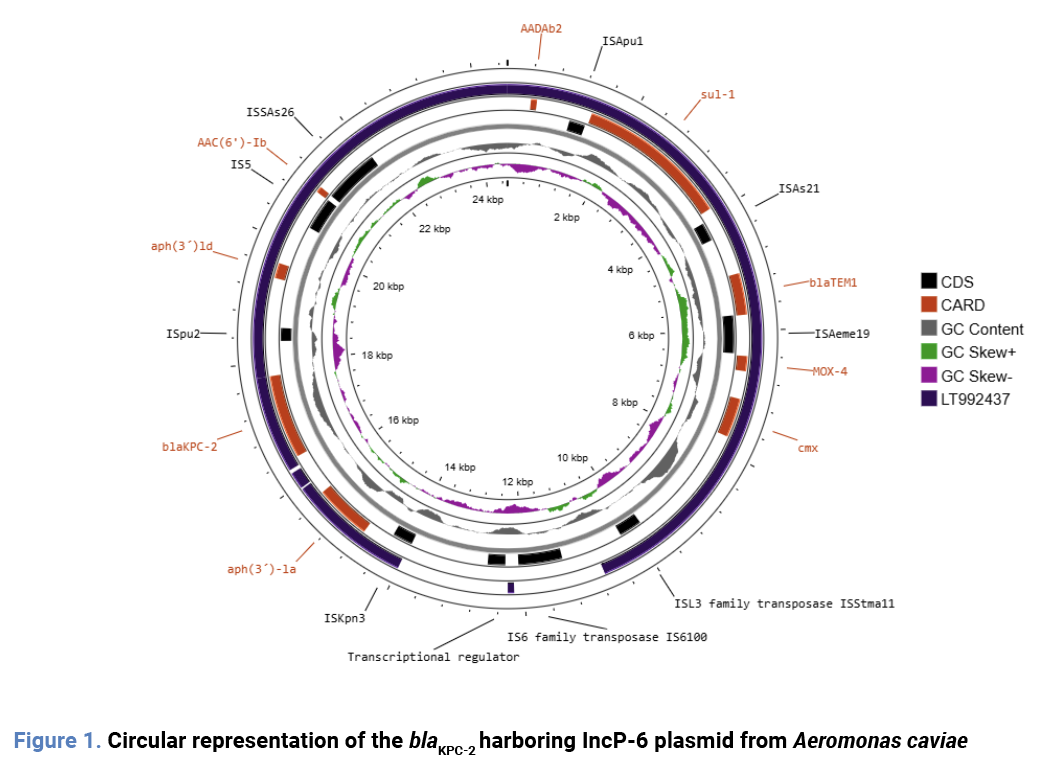
Circular map of the Aeromonas caviae plasmid carrying the blaKPC-2 gene. The outer ring (black) represents the predicted coding sequences (CDS), while red segments indicate antimicrobial resistance genes identified by the CARD database (v1.3.1), including blaKPC-2, blaTEM-1, MOX-4, sul-1, cmx, aadA2, and aminoglycoside-modifying enzymes (aph(3’)-Ia, aph(3’)-Id, aac(6’)-Ib). Mobile genetic elements such as IS26, IS6100, ISKpn3, ISAs21, ISAeme19, and IS5 are also annotated. Inner rings depict GC content (gray) and GC skew (green and purple). The reference plasmid LT992437 is shown in violet for comparative alignment. Genes are color-coded according to function, and arrows indicate gene orientation.
Analysis of mobile genetic elements using MobileElementFinder v1.1.2 revealed the presence of multiple insertions and transposons distributed throughout the assembly, including ISAs26, ISAeme19, ISAs21, ISAs2, IS5, and ISKpn3 sequences, many of which are associated with genetic environments of resistance genes in Gram-negative bacilli. Of particular interest, the blaKPC-2 gene was located in a plasmid contig carrying the IncP-6 replicon, flanked by ISKpn3 and IS5 insertion elements, forming part of a composite transposon of approximately 6.6 kb identified as Tn4401a. Likewise, multiple copies of ISAs26 and ISAeme19 identified, which are grouped in regions close to resistance genes, probably contribute to plasmid recombination and restructuring. The detection of IS6100, ISApu1, and ISApu2 is typically involved in transposition and interplasmid transfer.
In vitro susceptibility testing showed resistance to amino and ureido penicillins with beta-lactamase inhibitors, third- and fourth-generation cephalosporins: ceftazidime MIC >16 mg/L (Resistant), cefepimeMIC >16 mg/L (Resistant), carbapenems: meropenem MIC >8 mg/L (Resistant); quinolones: ciprofloxacin MIC >2 mg/L (Resistant), and trimethoprim-sulfamethoxazole MIC >4/76 mg/L (Resistant). It showed susceptibility to ceftazidime-avibactam MIC 0.5 mg/L (Susceptible) and meropenem-vaborbactam MIC <8 mg/L (Susceptible). Susceptibility results were obtained by microdilution in automated panel reading, using the clinical cut-off points from the EUCAST guidelines.
Discussion
The discovery of a strain of Aeromonas caviae carrying the blaKPC-2 gene is a rare event with high epidemiological relevance. Although KPC-type carbapenemases are common in Klebsiella pneumoniae and other Enterobacterales, their identification in Aeromonas spp. suggests the ability of these environmental microorganisms to act as reservoirs and vectors for the spread of critical resistance genes. The location of blaKPC-2 on an IncP-6 plasmid is particularly significant, capable of transferring between bacteria of different genera. IncP-6 is documented in environmental and clinical species in Spain and elsewhere in the world, such as Citrobacter freundii and Klebsiella variicola. This replicon type has been previously described as a broad-host-range plasmid responsible for carbapenemase dissemination across multiple Gram-negative species [2]. As of the date of publication, no cases of Aeromonas caviae carrying this plasmid have been found in the literature in clinical isolates in Spain. However, they have been previously described in other species of the same genus (A. hydrophila, A. veronii) in greater abundance in the country, and there are more cases published worldwide in both clinical and environmental strains [3].
The finding of associated mobile genes reinforces the hypothesis of a horizontal transfer mechanism mediated by mobile genetic elements [4]. The identified genetic environment, composed of ISKpn3, IS5, and other mobile elements (ISAs26, ISAeme19), forms a structure similar to the Tn4401a transposon. The Tn4401a isoform is frequently associated with increased expression of the resistance gene due to the creation of a stronger promoter [5]. This type of structure is characteristic of genetic environments that facilitate the mobilisation of the blaKPC-2 gene between different bacterial hosts [6]. However, it was not possible to perform in vitro transferability tests on the plasmid.
The coexistence of other resistance genes—blaTEM, sul1, AAC(6’)-Ib, ere(A), cmx—and the presence of multiple recombinant ISs indicate sustained selective pressure that could have favoured the accumulation of resistance determinants in this plasmid [7]. In this context, Aeromonas caviae should be considered not only an opportunistic pathogen but also a potential reservoir of resistance genes with high clinical impact, underscoring the need for active molecular surveillance even in bacteria traditionally considered environmental. The detection of IS6100, ISApu1, and ISApu2, typically involved in transposition and interplasmid transfer, reinforces the evidence that the IncP-6 plasmid carrying blaKPC-2 has a high capacity for mobilisation [8]. In addition, other β-lactamase genes from the blaTEM family were detected, contributing to the phenotypically observed profile of resistance to β-lactams in the in vitro susceptibility.
These results underscore the importance of including Aeromonas spp. in genomic and epidemiological surveillance programmes for antimicrobial resistance, especially in hospital or aquatic environments, where it can act as an environmental reservoir and contribute to the circulation of carbapenemases. And may be included in the study of multidrug-resistant carriers in hospitalized patients to prevent its spread. However, in this specific case, the patient presented with a self-limiting condition that did not require hospitalization, broad-spectrum antibiotic therapy, or additional health measures.
Taken together, analyses by ResFinder, PlasmidFinder, and MobileElementFinder suggest that blaKPC-2 is integrated into an IncP-6-type conjugative plasmid with a complex genetic environment composed of multiple insertion sequences and composite transposons, which favours horizontal transfer of the resistance determinant.
Funding
Servicio de Microbiología Clínica. Instituto Medicina de Laboratorio (IML), Fundación para la Investigación Biomédica del Hospital Clínico San Carlos (IdISSC), Hospital Clínico San Carlos, Madrid, Spain.
Author contribution
CGC: investigation, formal analysis, writing original draft; CGS: investigation, writing–review; ECL: investigation, writing–review; MMR: investigation; ADIGC: writing–review.
Conflicts of interest
The authors declare no conflicts of interest.
AI statement
No artificial intelligence tools were used in the writing, analysis, interpretation, or review of this article.
References
- Tang X, Oyetoran A, Jones T, Bray C. Aeromonas caviae-Associated Severe Bloody Diarrhea. C Reports in Gastro Med. 2023; 2023:4966879. Available from: https://doi.org/10.1155/2023/4966879
- Ota Y, Prah I, Nukui Y, Koike R, Saito R. blaKPC-2- Encoding IncP-6 Plasmids in Citrobacter freundii and Klebsiella variicola Strains from Hospital Sewage in Japan. Appl Environ Microbiol. 2022; 26;88(8). Available from: https://doi.org/10.1128/aem.00019-22
- Alonso-González I, Gallego-Rodrigo M, Barrios-Andrés JL. Bacteriemia por Aeromonas hydrophila Multirresistente. Enferm Infecc Microbiol Clin. 2023; 41;(4):247-248. Available from: https://doi.org/10.1016/j.eimc.2022.06.009
- Tokuda M, Shintani M. Microbial Evolution Through Horizontal Gene Transfer by Mobile Genetic Elements. Microb Biotechnol. 2024; 17(1):e14408. Available from: https://doi.org/10.1111/1751-7915.14408
- Hammer Dedet F, Jumas Bilak E, Licznar Fajardo P. The Hydric Environment: A Hub for Clinically Relevant Carbapenemase Encoding Genes. Antibiotics. 2020; 9(10):699. Available from: https://doi.org/10.3390/antibiotics9100699
- Oliveira PH, Touchon M, Cury J, Rocha EPC. The Chromosomal Organization of Horizontal Gene Transfer in Bacteria. Nat commun. 2017; 8(1):841. Available from: https://doi.org/10.1038/s41467-017-00808-w
- Dewan I, Uecker H. A Mathematician’s Guide to Plasmids: An Introduction to Plasmid Biology for Modellers. Microbiology (Reading, England). 2023; 169(7):001362. Available from: https://doi.org/10.1099/mic.0.001362
- Forero-Hurtado D, Corredor-Rozo ZL, Ruiz-Castellanos JS, Márquez-Ortiz RA, Abril D, Vanegas N, et al. Worldwide Dissemination of blaKPC Gene by Novel Mobilization Platforms in Pseudomonas aeruginosa: A Systematic Review. Antibiotics. 2023; 12(4):658. Available from: https://doi.org/10.3390/antibiotics12040658
Explore
Articles
Volumes
About the journal
Most read
Recomendaciones para la prevención y el tratamiento de las infecciones respiratorias en adultos mayores institucionalizados
Revista Española de Quimioterapia
Acute infectious gastroenteritis in childhood: the role of rapid multiplex molecular syndromic panels in diagnosis and clinical management
Revista Española de Quimioterapia
Características epidemiológicas de pacientes con aislamientos de Enterobacterales productores de carbapenemasas-NDM en un hospital de alta complejidad
Revista Española de Quimioterapia
Review on the management of intra-abdominal candidiasis
Revista Española de Quimioterapia
Neoscytalidium dimidiatum: a rare locally acquired deep cutaneous infection in a renal transplant recipient
Revista Española de Quimioterapia