Review
Volume 38; Suppl. 1
25 min
Diagnostic stewardship in sepsis: minding the gap from the microbiology lab to ward
Rafael Cantón1,2 , Ana Verónica Halperin1
1Servicio de Microbiología, Hospital Ramón y Cajal and Instituto Ramón y Cajal de Investigación Sanitaria (IRYCIS), Madrid, Spain.
2CIBER de Enfermedades Infecciosas (CIBERINFEC), Instituto Salud Carlos III (ISCIII), Madrid, Spain.
http://www.doi.org/10.37201/req/s01.02.2025
Receipt Date:
01/09/2025
Acceptance Date:
31/08/2025
Publication Date:
23/10/2025
How to cite
Cantón R, Halperin AV. Diagnostic stewardship in sepsis: Minding the gap from lab to ward. Rev Esp Quimioter. 2025; 38(Suppl. 1): 11-20. Available from: http://www.doi.org/10.37201/req/s01.02.2025
Metrics
664
Views
135
Downloads
Share
Share
Abstract (EN)
Sepsis is a life-threatening condition resulting from the body’s dysregulated response to infection that demands timely diagnosis and effective antimicrobial treatment to reduce mortality and healthcare burden. Microbiology laboratories play a critical role in sepsis management by delivering rapid and accurate diagnostic information. This article explores the framework and implementation of diagnostic stewardship programs, their integration with antimicrobial stewardship programs, and the evolving microbiological techniques enabling earlier, targeted antimicrobial therapy in sepsis. We highlight the critical synergy between microbiology, clinical teams and innovation, in optimizing patient outcomes.
Keywords (EN):
Sepsis
Innovation
Blood culture
Diagnostic stewardship
Antimicrobial stewardship
The sepsis challenge and diagnostic delay
According to the international Surviving Sepsis Campaign, a joint initiative of the Society of Critical Care Medicine (SCCM) and the European Society of Intensive Care Medicine (ESICM), sepsis affects millions of people worldwide and remains a leading cause of death in intensive care units (ICUs) [1]. Multiple studies have demonstrated that timely diagnosis and rapid response significantly improve survival rates. This involves not only the early identification of septic patients but also the prompt initiation of appropriate antimicrobial therapy. For optimal diagnosis and treatment, extraction of blood cultures and their prompt incubation is relevant to allow the identification of the pathogen involved when positive and determine its susceptibility to antimicrobial agents. This can be better achieved with continuous availability of the clinical microbiology laboratory [2]. However, in most hospitals, clinical microbiology departments operate with restricted hours, leading to diagnostic delays that can negatively impact patient management by postponing the administration of optimal treatment. This was demonstrated in a retrospective study in a hospital analyzing 50,955 blood cultures collected over a 30-month period from 7,035 adult patients with sepsis with a clinical microbiology laboratory that only accepts blood cultures during restricted opening hours (Monday to Friday, 8:00 a.m. to 4:00 p.m., and Saturdays, 8:00 a.m. to 2:00 p.m) [3]. They compared the results of those collected during laboratory opening hours that were immediately processed with those collected during closing hours and stored at room temperature in clinical wards until transported and processed during opening hours. In all cases, blood cultures were incubated using automated systems. The analysis showed that each hour of delay from blood collection to incubation was associated with a 0.3% decrease (P<0.001) in the likelihood of obtaining a positive result. Furthermore, the prevalence of positive cultures was significantly lower when the laboratory was closed (11% vs. 13%, P<0.001), and the probability of a positive result decreased by 16% under these conditions (P<0.01). These findings underscore the necessity of continuous laboratory operation, so-called 24/7 availability, to optimize sepsis diagnosis and treatment. A recent cross-sectional study across European hospitals further revealed that, unfortunately, only 10.4% offered continuous microbiology services, including 24/7 blood culture incubation and reporting [4]. This limitation is associated with lower blood culture positivity rates and delayed report of the results, directly affecting clinical decision-making and patient outcomes.The impact of timeliness: from culture to cure
Because timely initiation of appropriate antimicrobial therapy is a critical determinant of clinical outcomes in sepsis management, numerous studies have investigated the impact of treatment delays on patient mortality. A landmark study by Kumar et al. [5] demonstrated that, in patients with septic shock, each hour of delay in administering effective antibiotics was associated with a 7.6% decrease in survival. Subsequent research has consistently confirmed these findings, highlighting that the interval to appropriate therapy is a modifiable factor influencing sepsis mortality [1]. In a more recent retrospective study, 10,628 routine medical records from 9,192 patients with bacteraemia were analysed to assess the association between the timing of appropriate treatment, adjusted according to antimicrobial susceptibility results, and mortality [6]. Logistic regression analyses were performed for different initiation times. The crude 30-day mortality rate was approximately 14% among patients with bacteraemia, increasing to 25% in those who developed septic shock. Time-to-treatment analysis revealed that delays exceeding appropriate antimicrobial 12 hours after blood cultures were obtained were significantly associated with higher mortality, underscoring a critical window of opportunity in which blood culture results, including pathogen identification, can guide life-saving interventions. Many diagnostic efforts in microbiology laboratories are therefore directed at reducing response times, being part of broader diagnostic stewardship strategies aimed at improving patient outcomes in sepsis [2].Diagnostic stewardship programs and sepsis
Diagnostic stewardship is a coordinated approach aimed at maximizing the clinical and economic value of microbiological testing. It ensures that the right test is performed for the right patient at the right time, optimizing laboratory resources to guide effective therapy [7]. These programs emphasize timely sample collection and processing, minimize pre-analytical and post-analytical delays, integrate diagnostic activities with antimicrobial stewardship, and enable rapid feedback to clinical teams. This transforms the laboratory from a passive service into an active participant in clinical decision-making, effectively bridging the gap between diagnosis and treatment. In many institutions, antimicrobial stewardship programs incorporate a “sepsis code” to rapidly identify septic patients and predict adverse outcomes using validated scoring systems such as the Sequential Organ Failure Assessment (SOFA), quick Sepsis-related Organ Failure Assessment (qSOFA), and National Early Warning Score (NEWS) [1,8]. Once a patient is recognized as septic, antimicrobials should be administered immediately—ideally within one hour of diagnosis [1]. Clinical biochemistry laboratories can provide rapid results for biomarkers such as C-reactive protein (CRP) and procalcitonin, aiding in early diagnosis. In contrast, clinical microbiology workflows still depend on blood culture growth, which inherently delays definitive results. Nonetheless, several initiatives have been implemented to reduce time-to-results and support timely, appropriate antimicrobial use [2]. In the context of sepsis, the implementation of diagnostic stewardship in clinical microbiology laboratories has led to substantial reductions in the time required to report blood culture results. This, in turn, allows antimicrobial stewardship teams to provide recommendations sooner, potentially improving patient outcomes, reducing hospital length of stay, and lowering the overall cost of care. Within the diagnostic stewardship background, most of the efforts have been focused in the analytical part of the blood culture, but they can also be applied to the pre-analytical and post-analytical parts of the workflow. A recent review and meta-analysis highlighted that all of these efforts are more efficient if they are aligned with specific actions with the antimicrobial stewardship teams [9]. Preanalytic factors affecting sepsis diagnosis. In the pre-analytical workflows involving diagnostic stewardship strategies, various interventions have aimed to reduce blood culture contamination rates below the commonly accepted threshold of 3% and to optimize blood bottle fill volumes, which are linked to higher positivity rates [10]. A randomized controlled trial showed that modifying blood culture collection techniques significantly reduced contamination rates. Similarly, a systematic review reported that contaminated blood cultures lead to substantial increases in healthcare costs [11]. Across the studies analyzed (n = 49), overall contamination rates ranged from 0.9% to 41%. Most contaminants were gram-positive microorganisms, predominantly coagulase-negative staphylococci, resulting in up to 60% of patients receiving unnecessary parenteral vancomycin. This inappropriate treatment generated additional pharmacy charges of $210–$12,611 per patient, laboratory charges of $2,397–$11,152 per patient, and prolonged hospital stays by 1 to 22 days. In another randomized controlled trial, contamination rates and costs were reduced using an initial-specimen diversion technique. This involved changing the order of blood sampling with regular vacuum specimen tubes instead of commercially available sterile diversion devices. The intervention achieved a 66% reduction in contamination (5% with the standard method vs. 1.6% with the new technique), without compromising the detection of true bloodstream infections and at no additional cost. Notably, hospital-wide implementation was associated with a 1.1% reduction in hospitalization days [12]. Regarding blood bottle fill volumes, a multi-center study involving 10 hospitals and three laboratories found that underfilled bottles were extremely common. However, coordinated operational and educational strategies led to sustained improvements, even in a complex hospital network. Increased fill volumes enhanced pathogen detection, with significant implications for the management of bloodstream infections and sepsis. Strategies included education, standardized data collection, innovative and transparent feedback systems, targeted communication, and bottle volume markings for phlebotomists, a specific team for blood culture sampling. Fill volumes were monitored automatically using an electronic tracking system [13]. Analytic procedures and diagnosis of sepsis in the microbiology laboratory. The concept of “microbiologistics” has been applied to the management of samples and procedures in clinical microbiology laboratories to enable the timely diagnosis of infectious diseases and particularly sepsis [2]. This approach involves streamlining every step of the microbiological diagnostic workflow, ultimately influencing positivity rates and reducing time-to-report. Key processes for sepsis include blood sampling, inoculation into culture bottles, incubation in automatic systems (e.g., BACTEC-FX, VIRTUO), Gram staining and preliminary reporting, rapid identification, currently using MALDI-TOF MS, antimicrobial susceptibility testing (AST), and final report delivery. Within these processes, major efforts have focused on the direct identification of bacteria from positive blood cultures using MALDI-TOF MS, as well as on direct AST once blood cultures flag positive and Gram staining/identification have been performed. The advantages of these strategies have been extensively reviewed, including their impact on patient management, the support they provide to antimicrobial stewardship teams, and their potential economic implications [14-19]. MALDI-TOF MS enables rapid pathogen identification directly from positive blood cultures, reducing time-to-result by 10 to 28 hours. Clinical studies have shown that its use is associated with earlier initiation of targeted therapy, decreased mortality, and lower healthcare costs [15]. However, despite more than 15 years since its introduction, access to this technology remains largely restricted in low and middle-income countries [20,21]. Moreover, traditional AST requires 24–48 hours to generate results. In contrast, emerging methods for AST now provide results within 6–8 hours or less. Among them, disk diffusion protocols applied directly to positive blood cultures (RAST) have been standardized by both EUCAST and CLSI [22-24]. These protocols enable phenotypic susceptibility and resistance detection within 4–8 hours, can be implemented in most laboratories with minimal effort, and are mainly limited by the need for additional personnel to read inhibition zones outside of standard shifts [17]. This can be easily performed in institutions that are open 24/7 and have staff available to perform rapid AST on second and third shifts. Nevertheless, a retrospective modelling study demonstrated that there is a clinical value of rapid AST even in centers that process positive blood cultures during a single shift [25]. Rapid AST automated systems such as QuickMIC (Gradientech), QMAC-dRAST (QuantaMatrix), VITEK Reveal (bioMérieux), ASTar (Q-linea) or PhenoTest BC (Accelerate Diagnostics) further allow MIC-based AST directly from positive cultures within 4-7 hours, with accuracy and performance validated in different studies [18]. Other innovative approaches include flow cytometry, which can provide AST results in as little as 2 hours [26] and novel techniques such as cantilever-based detection of microbial movement, which show promising results [27]. Interestingly, some of these rapid systems also allow the detection of resistance mechanisms on top of phenotypic susceptibility testing and clinical categorization of the results [18]. However, special attention should also be given to the incubation process of blood culture bottles. This step is typically carried out in continuously monitored automated systems located in the microbiology laboratory, which means that transportation to the laboratory is required before the incubation can begin. Ideally, incubation should start immediately upon arrival at the laboratory, as several studies have shown that delays in placing blood culture bottles into incubators can significantly reduce positivity rates [3,28-30]. Nevertheless, in some hospitals, the absence of technical staff during evening and night shifts leads to unavoidable delays. To address this issue, certain institutions have decentralized the incubation process by installing satellite blood culture incubators in emergency departments or intensive care units. This strategy, often referred to as the use of “point-of-care blood culture incubators,” enables immediate incubation at the site of collection. Once a bottle is flagged as positive, it can then be transported to the microbiology laboratory for further processing [3,28-30]. A similar model may also be advantageous in settings where microbiology laboratories are centralized outside the hospital. Incubation process decentralization was evaluated in an emergency department where an additional blood culture instrument was installed and compared against a historical control group. This modification led to a significant reduction in Gram stain reporting time, from 21.5 hours (IQR 15.5–26.7) to 13.5 hours (IQR 11.2–20.9). Interestingly, the length of hospital stay was also reduced by up to one day [31]. A more complex scenario was reported in which blood cultures collected in the emergency department were first transported by pneumatic tube system to a central medical laboratory with 24/7 operations for initial incubation in decentralized incubators. Subsequently, both negative and positive bottles were transported three times per day to a microbiology laboratory (not operating 24/7) located 20 minutes away. Incubation continued until bottles flagged positive, after which processing resumed during working hours. A comparison of pre-analytical and analytical parameters over a 3-month period before and after implementation showed that, despite this complex workflow, decentralization of incubators reduced median time to positivity (21.5 h vs. 16.2 h, p<0.05), median time to Gram stain reporting by phone (28.9 h vs. 22.5 h, p=0.001) and median time to medical validation (29.3 h vs. 23.1 h, p<0.005). Interestingly, the proportion of positive cultures increased from 1.1% to 3.2%, although this difference did not reach statistical significance [32]. The authors concluded that decentralization improved reporting times, although the benefit was limited by the lack of a fully operational 24/7 microbiology laboratory. Unfortunately, a survey performed in 1,023 hospitals in 69 countries in Europe and published in 2025 revealed that microbiological service was limited in time in nearly 90% of the hospitals, lacking the possibility to incubate blood cultures, to identify pathogens, and to communicate results outside the main working hours or on weekends and holidays [4]. Molecular testing and syndromic panels. The current standard of care for the detection of pathogens in bacteremia and sepsis in the clinical microbiology laboratory is the blood culture in broth media. As previously described, once a blood culture bottle flags positive, a Gram stain is performed, followed by pathogen identification and AST. In recent years, alternative methods independent of blood culture have been developed for the simultaneous detection of pathogens and resistance genes directly from positive blood cultures [18,33,34]. These so-called syndromic panels are based on molecular techniques (Table 1). One of the most widely used systems is the FilmArray platform (bioMérieux). It is a fully automated system that integrates nucleic acid extraction, real-time PCR, and high-resolution melting analysis. It can detect nearly 45 pathogens—including Gram-positive and Gram-negative bacteria and yeasts, as well as major resistance genes, such as those encoding ESBLs, carbapenemases, colistin resistance, methicillin resistance, and vancomycin resistance. Reported overall sensitivity and specificity for pathogen identification are 91–96% and 98–100%, respectively, while detection of resistance markers reaches 100% for both parameters. Key advantages include a rapid turnaround time (<1 h) and minimal hands-on time for laboratory personnel (2–5 min) [35,36]. The main limitation is the higher per-test cost compared with conventional methods. However, cost-effectiveness studies indicate that syndromic panels may reduce overall healthcare costs by enabling earlier targeted antimicrobial therapy and shortening hospital stays [36,37]. These panels have been evaluated in critically ill patients, including those admitted to intensive care units, where their clinical impact has been compared against standard diagnostic workflows [33].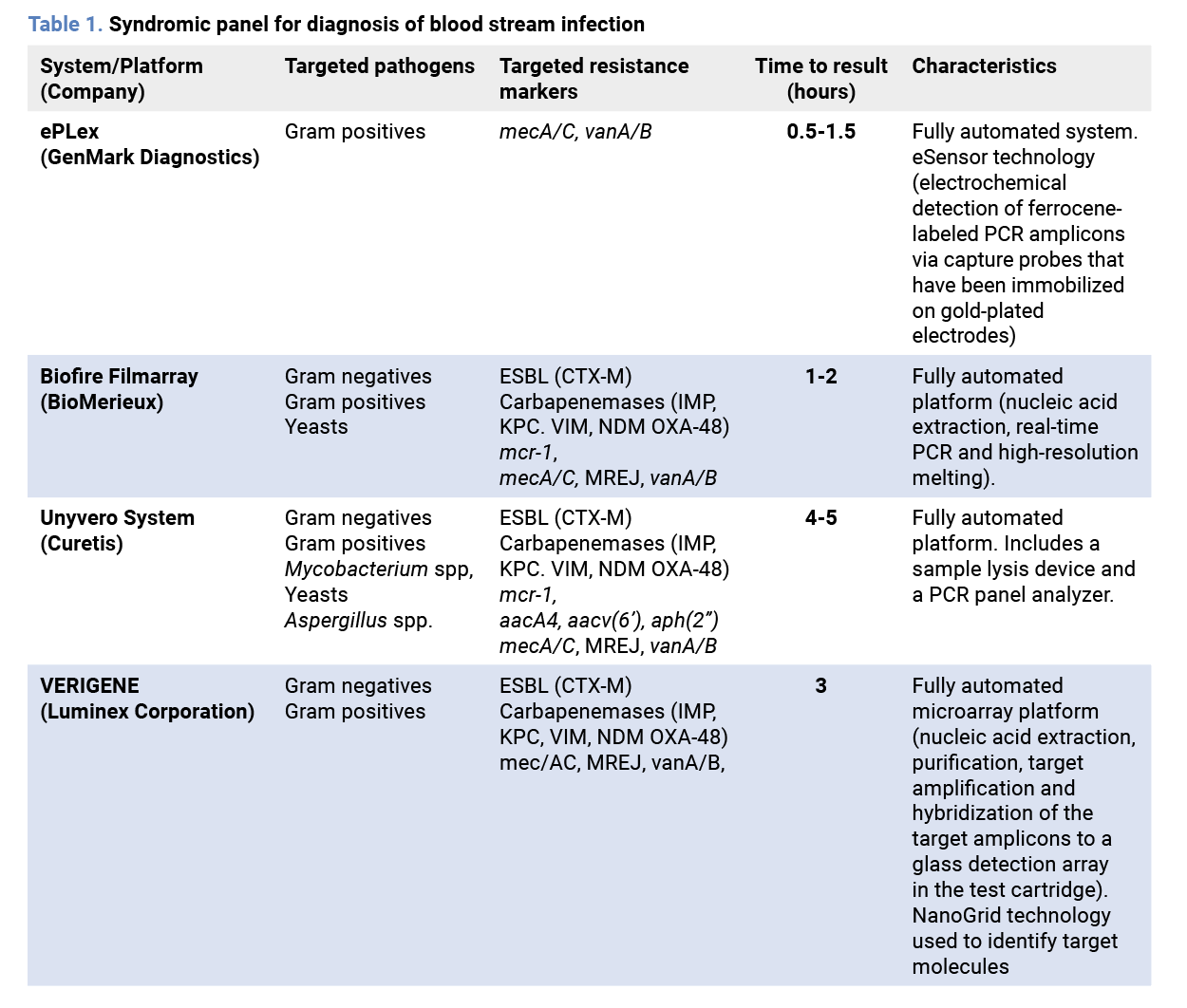 It is important to note that syndromic panels are applied directly to blood culture bottles after positivity is detected; they are not suitable for direct testing of whole blood samples. This limitation arises from the very low microbial load in bloodstream infections (<1×10² CFU/ml), which results in insufficient analytical sensitivity. Nevertheless, alternative platforms have been designed to detect microorganisms and resistance genes directly from blood. Among these, LightCycler Septifast, IRIDICA BAC BSI Assay, and T2Bacteria were notable.
LightCycler Septifast, now discontinued, was pioneer detecting microorganisms directly in blood. It could detect main pathogens involved in sepsis, had higher specificity than sensitivity, and did not include resistance markers, precluding effectively introduction in the management of patients with sepsis [38,39]. The IRIDICA system, also discontinued, combined nucleic acid amplification with latter electrospray ionization mass spectrometry [39,40]. Its main drawbacks were the high per-test cost and relatively long detection time (approximately 7 h). Its discontinuation was also influenced by the widespread adoption of MALDI-TOF MS in clinical microbiology laboratories at the time of its launch. The T2 system, also no longer marketed, employed nucleic acid amplification to detect pathogens and resistance markers, followed by hybridization with paramagnetic nanoparticles, detected via probes [41,42]. This platform offered a very low limit of detection (1 CFU/ml), with sensitivity around 90% and specificity of 96-98% for pathogen detection, as well as good concordance for resistance marker identification. The turnaround time ranged from 3 to 5 hours.
A couple of solutions for detecting pathogens and resistance mechanisms with short development times have recently been presented. One of them, already CE marked, uses 0.4 ml of blood and is capable of detecting up to 26 pathogens, bacteria, or yeasts in 3 hours, using real-time qPCR (https://microbio.com.au/product/). The other solution, which is not yet commercially available, uses multiplex PCR starting with 8 ml of blood and detects up to 32 pathogens and 9 resistance markers in less than an hour. It is associated with a random access platform for up to 8 samples (https://deepull.com/). In both cases, the publication of their analytical and clinical validation is pending.
Clinical integration of microbiology laboratory: from laboratory to bedside
The synergy between diagnostic stewardship and antimicrobial stewardship programs is crucial, as demonstrated by the integration of rapid diagnostic tests in clinical microbiology laboratories. Evidence shows that even in hospitals with well-established antimicrobial stewardship procedure, the addition of rapid diagnostic testing improves patient outcomes by reducing the time to effective therapy, lowering mortality, and decreasing both hospital stay and healthcare costs [9]. Implementation of rapid tests, together with procedures that optimize blood culture yield, consistently provides these benefits, although demonstrating a direct reduction in mortality remains challenging [43]. Early advantages were documented with the introduction of MALDI-TOF MS for bacterial identification directly from positive blood cultures, particularly when combined with ASP interventions in critically ill patients [44]. Beyond improving the adequacy of antimicrobial therapy, MALDI-TOF implementation was associated with shorter hospitalization and, consequently, reduced healthcare costs [45]. An additional, less frequently explored benefit of reduced hospital stays is a potential decrease in adverse events, including healthcare-associated infections. Rapid AST further shortens diagnostic turnaround times. Several clinical trials and retrospective studies evaluating pre- versus post-implementation of rapid AST have confirmed its positive clinical impact, particularly when results are integrated into antimicrobial stewardship programs decision-making workflows [46,47]. These tools enable earlier de-escalation of empiric therapy, promote more judicious antibiotic use, and may ultimately contribute to mitigating antimicrobial resistance. In our experience, a randomized clinical trial comparing conventional AST (results after overnight incubation) with rapid AST (results available within 5 hours and promptly communicated to the antimicrobial stewardship team) demonstrated significantly shorter times to ASP intervention and to appropriate therapy modification, especially in critically ill patients [47]. Similar benefits have been observed with syndromic panels designed to detect pathogens and resistance mechanisms in positive blood cultures. These approaches have been associated with faster initiation of targeted therapy (notably anti-methicillin-resistant Staphylococcus aureus agents), reduced duration of broad-spectrum antibiotic use, and improved 60-day survival in patients with bloodstream infections [48,49]. Finally, the impact of rapid diagnostic methods depends not only on the availability of results but also on their timely translation into medical decisions. Laboratory information must be effectively integrated with antimicrobial stewardship activities to optimize sepsis management. Efforts to reduce reporting times lose clinical value if results are not promptly translated into actions that benefit the patient. In this regard, a recent study demonstrated that real-time communication of microbiology results regarding the diagnosis of sepsis to ASP teams, compared with delayed reporting until the following morning shift, led to improved clinical outcomes, including increased survival [50].Conclusions: a microbiology-driven model for sepsis care and future directions in innovation
We are currently at a stage where clinical microbiology laboratories have consolidated the use of innovative techniques that enable rapid diagnosis. Among these are proteomics-based methods (such as MALDI-TOF MS) and real-time PCR techniques for the detection of multidrug-resistant microorganisms, including syndromic panels. Many of them are simple, highly adaptable methods to automation, while others are more innovative and disruptive for assessing AST. Also, whole genome sequencing is increasingly transforming several fields within the microbiology laboratory [50]. This integrated model, assisted by artificial intelligence and real-time clinical alerts, represents the future of infectious disease management. At the same time, traditional techniques of great clinical value, such as Gram staining and culture, remain in routine use, while straightforward methods that require minimal training, such as lateral flow or immunochromatography assays, have been efficiently integrated into diagnostic workflows. All of these tools provide clear benefits for the diagnosis of sepsis. However, their implementation in many centers is still constrained to varying degrees, by organizational challenges, resource availability (including trained laboratory staff capable of providing continuous coverage across all shifts), and the presence of multidisciplinary teams dedicated to antimicrobial stewardship and results management. The incorporation of new technologies and the reorganization of laboratory workflows have made it evident that the role of the microbiology laboratory extends well beyond simply generating test results. Through diagnostic stewardship, microbiology becomes an active, clinically integrated partner in the fight against sepsis and antimicrobial resistance. These programs promote timely, accurate, and clinically actionable diagnostics, which in turn enable earlier interventions and improved patient outcomes. As both technology and healthcare systems continue to evolve, the adoption of 24/7 diagnostic models and the integration of microbiologists into antimicrobial stewardship initiatives and sepsis code teams will be essential, not only to optimize patient outcomes, but also to ensure the sustainability and cost-effectiveness of healthcare delivery [7,52]. The introduction of new technologies for sepsis diagnosis that shorten time-to-result in clinical microbiology laboratories and demonstrate tangible clinical benefits is becoming increasingly challenging. The margin for improvement is narrowing, even when diagnostic stewardship and antimicrobial stewardship programs are well aligned, and outcomes often depend heavily on the characteristics of the study population. A clear example is the persistent difficulty in demonstrating a direct impact on the reduction of mortality. This situation is not new: before the arrival of mass spectrometry in clinical microbiology laboratories, it was equally challenging to show measurable clinical benefits, yet the technology ultimately revolutionized blood culture processing in microbiology laboratories. A similar scenario is now unfolding with rapid AST systems and syndromic panels applied to positive blood culture bottles [17,33,51]. Looking ahead, a true paradigm shift will occur when rapid, highly sensitive and specific technologies capable of detecting any pathogen directly from blood samples, while simultaneously identifying resistance mechanisms or even providing complete genomic sequences, become available in affordable, user-friendly formats (Figure 1). In many cases, these advances will be strengthened by integration with decision-support algorithms powered by artificial intelligence.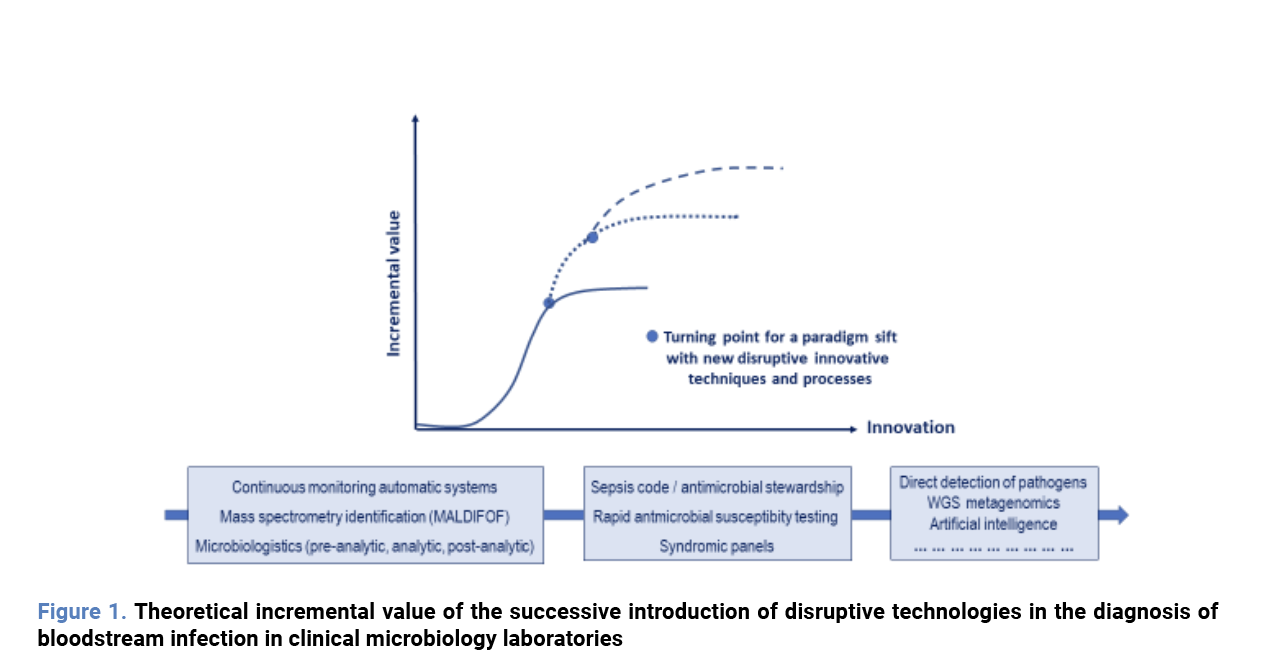 Conflict of interest
RC has participated in educational programs sponsored by BD, BioMérieux and QuantaMatrix and has received research grants from BioMérieux and QuantaMatrix. AVH has participated in educational programs and has received research grants from BioMérieux and QuantaMatrix.
Funding
Research studies of RC are funded by Instituto de Salud Carlos III, Subdirección General de Redes y Centros de Investigación Cooperativa, Ministerio de Economía, Industria y Competitividad, CIBER de Enfermedades Infecciosas (CIBERINFEC) (CB21/13/00084), Spain
Author contributions
R.C.; conceptualization, writing—original draft preparation, A.V.H; writing—review and editing. All authors have read and agreed to the published version of the manuscript.
References
- Evans L, Rhodes A, Alhazzani W, Antonelli M, Coopersmith CM, French C, et al. Surviving Sepsis Campaign: International guidelines for management of sepsis and septic Shock 2021. Crit Care Med. 2021;49(11):e1063-e1143. Available from: https://doi.org/10.1097/CCM.0000000000005337
- Lamy B, Sundqvist M, Idelevich EA. Bloodstream infections – Standard and progress in pathogen diagnostics. Clin Microbiol Infect. 2020;26(2):142-150. Available from: https://doi.org/10.1016/j.cmi.2019.11.017
- Venturelli C, Righi E, Borsari L, Aggazzotti G, Busani S, Mussini C, et al. Impact of pre-analytical time on the recovery of pathogens from blood cultures: results from a large retrospective survey. PLoS One. 2017 Jan;12(1):e0169466. Available from: https://doi.org/10.1371/journal.pone.0169466
- Scheer CS, Giamarellos-Bourboulis EJ, Ferrer R, Idelevich EA, Annane D, Artigas A, et al. Status of sepsis care in European hospitals: results from an international cross-sectional survey. Am J Respir Crit Care Med. 2025;211(4):587-599. Available from: https://doi.org/10.1164/rccm.202406-1167OC.
- Kumar A, Roberts D, Wood KE, Light B, Parrillo JE, Sharma S, et al. Duration of hypotension before initiation of effective antimicrobial therapy is the critical determinant of survival in human septic shock. Crit Care Med. 2006; 34:1589-96. Available from: https://doi.org/10.1097/01.CCM.0000217961.75225.E9
- Van Heuverswyn J, Valik JK, van der Werff SD, Hedberg P, Giske C, Nauclér P. Association between time to appropriate antimicrobial treatment and 30-day mortality in patients with bloodstream infections: A retrospective cohort study. Clin Infect Dis. 2023 Feb;76(3):469-478. Available from: https://doi.org/10.1093/cid/ciac727
- Bou G, Cantón R, Martínez-Martínez L, Navarro D, Vila J. Fundamentals and implementation of microbiological diagnostic stewardship programs. Enferm Infecc Microbiol Clin. 2021; 39:248-51. Available from: https://doi.org/10.1016/j.eimc.2020.02.019
- Qiu X, Lei YP, Zhou RX. SIRS, SOFA, qSOFA, and NEWS in the diagnosis of sepsis and prediction of adverse outcomes: a systematic review and meta-analysis. Expert Rev Anti Infect Ther. 2023 Jul-Dec;21(8):891-900. Available from: https://doi.org/10.1080/14787210.2023.2237192
- Peri AM, Chatfield MD, Ling W, Furuya-Kanamori L, Harris PNA, Paterson DL. Rapid diagnostic tests and antimicrobial stewardship programs for the management of bloodstream infection: what is their relative contribution to improving clinical outcomes? A systematic review and network meta-analysis. Clin Infect Dis. 2024; 79:502-15. Available from: https://doi.org/10.1093/cid/ciae234
- Bunn JD, Cornish NE. Blood Culture Contamination and diagnostic stewardship: from a clinical laboratory quality monitor to a national patient safety measure. J Appl Lab Med. 2025;10:162-70. Available from: https://doi.org/10.1093/jalm/jfae132
- Dempsey C, Skoglund E, Muldrew KL, Garey KW. Economic health care costs of blood culture contamination: A systematic review. Am J Infect Control. 2019; 47:963-7. Available from: https://doi.org/10.1016/j.ajic.2018.12.020
- Lalezari A, Cohen MJ, Svinik O, Tel-Zur O, Sinvani S, Al-Dayem YA, et al. A simplified blood culture sampling protocol for reducing contamination and costs: a randomized controlled trial. Clin Microbiol Infect. 2020; 26:470-4. Available from: https://doi.org/10.1016/j.cmi.2019.09.005
- Khare R, Kothari T, Castagnaro J, Hemmings B, Tso M, Juretschko S. Active monitoring and feedback to improve blood culture fill volumes and positivity across a large integrated health system. Clin Infect Dis. 2020; 70:262-8. Available from: https://doi.org/10.1093/cid/ciz198
- Faron ML, Buchan BW, Ledeboer NA. Matrix-Assisted Laser Desorption Ionization-Time of Flight Mass Spectrometry for use with positive blood cultures: methodology, performance, and optimization. J Clin Microbiol. 2017; 55:3328-38. Available from: https://doi.org/10.1128/JCM.00868-17
- Yo CH, Shen YH, Hsu WT, Mekary RA, Chen ZR, Lee WJ, et al. MALDI-TOF mass spectrometry rapid pathogen identification and outcomes of patients with bloodstream infection: A systematic review and meta-analysis. Microb Biotechnol. 2022; 15:2667-82. Available from: https://doi.org/10.1111/1751-7915.14124
- Banerjee R, Humphries R. Rapid antimicrobial susceptibility testing methods for blood cultures and their clinical impact. Front Med (Lausanne). 2021 Mar;8:635831. Available from: https://doi.org/10.3389/fmed.2021.635831
- MacVane SH, Dwivedi HP. Evaluating the impact of rapid antimicrobial susceptibility testing for bloodstream infections: a review of actionability, antibiotic use and patient outcome metrics. J Antimicrob Chemother. 2024 Sep;79(12 Suppl 2):i13-i25. Available from: https://doi.org/10.1093/jac/dkae282
- Hattab S, Ma AH, Tariq Z, Vega Prado I, Drobish I, Lee R, et al. Rapid Phenotypic and genotypic antimicrobial susceptibility testing approaches for use in the clinical laboratory. Antibiotics (Basel). 2024 Aug 22;13(8):786. Available from: https://doi.org/10.3390/antibiotics13080786
- Reszetnik G, Hammond K, Mahshid S, AbdElFatah T, Nguyen D, Corsini R, et al. Next-generation rapid phenotypic antimicrobial susceptibility testing. Nat Commun. 2024 Nov;15(1):9719. Available from: https://doi.org/10.1038/s41467-024-53930-x
- Ombelet S, Ronat JB, Walsh T, Yansouni CP, Cox J, Vlieghe E, et al. Clinical bacteriology in low-resource settings: today’s solutions. Lancet Infect Dis. 2018; 18:e248-58. Available from: https://doi.org/10.1016/S1473-3099(18)30093-8
- Wilson ML, Fleming KA, Kuti MA, Looi LM, Lago N, Ru K. Access to pathology and laboratory medicine services: a crucial gap. Lancet. 2018; 391:1927-38. Available from: https://doi.org/10.1016/S0140-6736(18)30458-6
- Chandrasekaran S, Abbott A, Campeau S, Zimmer BL, Weinstein M, Thrupp L, et al. Direct-from-blood-culture disk diffusion to determine antimicrobial susceptibility of gram-negative bacteria: preliminary report from the Clinical and Laboratory Standards Institute Methods Development and Standardization Working Group. J Clin Microbiol. 2018 Feb;56(3):e01678-17. Available from: https://doi.org/10.1128/JCM.01678-17
- Jonasson E, Matuschek E, Kahlmeter G. The EUCAST rapid disc diffusion method for antimicrobial susceptibility testing directly from positive blood culture bottles. J Antimicrob Chemother. 2020; 75:968-78. Available from: https://doi.org/10.1093/jac/dkz548
- Åkerlund A, Jonasson E, Matuschek E, Serrander L, Sundqvist M, Kahlmeter G; RAST Study Group. EUCAST rapid antimicrobial susceptibility testing (RAST) in blood cultures: validation in 55 European laboratories. J Antimicrob Chemother. 2020; 75:3230-8. Available from: https://doi.org/10.1093/jac/dkaa333
- Yuceel-Timur I, Thierry E, Chainier D, Ndao I, Labrousse M, Grélaud C, et al. Retrospective evaluation of rapid genotypic ID and phenotypic AST systems on positive blood culture turnaround time and simulated potential impacts on bloodstream infection management. J Antimicrob Chemother. 2024; 79(12 Suppl 2):i26-31. Available from: https://doi.org/10.1093/jac/dkae280
- Silva-Dias A, Pérez-Viso B, Martins-Oliveira I, Gomes R, Rodrigues AG, Cantón R, et al. Evaluation of FASTinov ultrarapid flow cytometry antimicrobial susceptibility testing directly from positive blood cultures. J Clin Microbiol. 2021 Sep;59(10):e0054421. Available from: https://doi.org/10.1128/JCM.00544-21.
- Sturm A, Jóźwiak G, Verge MP, Munch L, Cathomen G, Vocat A, et al. Accurate and rapid antibiotic susceptibility testing using a machine learning-assisted nanomotion technology platform. Nat Commun. 2024 Mar;15(1):2037. Available from: https://doi.org/10.1038/s41467-024-46213-y
- Rönnberg C, Mildh M, Ullberg M, Özenci V. Transport time for blood culture bottles: underlying factors and its consequences. Diagn Microbiol Infect Dis. 2013; 76:286-90. Available from: https://doi.org/10.1016/j.diagmicrobio.2013.03.031
- Ling CL, Roberts T, Soeng S, Cusack TP, Dance DAB, Lee SJ, et al. Impact of delays to incubation and storage temperature on blood culture results: a multi-centre study. BMC Infect Dis. 2021 Feb;21(1):173. Available from: https://doi.org/10.1186/s12879-021-05872-8
- Deas G, Hamilton F, Williams P. Less haste, more speed: Does delayed blood culture transport time lead to adverse incubation times or yield? J Infect. 2025 Jul;91(1):106520. Available from: https://doi.org/ 10.1016/j.jinf.2025.106520
- Bruins MJ, Egbers MJ, Israel TM, Diepeveen SH, Wolfhagen MJ. Reduced length of hospital stay through a point of care placed automated blood culture instrument. Eur J Clin Microbiol Infect Dis. 2017; 36:619-23. Available from: https://doi.org/10.1007/s10096-016-2837-z
- Schaumburg F, Schuler F, Fobker M, Esser J. Integrated decentralized blood culture incubation: A step towards a 24/7 microbiology service? J Microbiol Methods. 2024 Aug;223:106973. Available from: https://doi.org/10.1016/j.mimet.2024.106973
- Candel FJ, Salavert M, Cantón R, Del Pozo JL, Galán-Sánchez F, Navarro D, et al. The role of rapid multiplex molecular syndromic panels in the clinical management of infections in critically ill patients: an experts-opinion document. Crit Care. 2024 Dec;28(1):440. Available from: https://doi.org/10.1186/s13054-024-05224-3
- Liborio MP, Harris PNA, Ravi C, Irwin AD. Getting up to speed: rapid pathogen and antimicrobial resistance diagnostics in sepsis. Microorganisms. 2024 Sep;12(9):1824. Available from: https://doi.org/10.3390/microorganisms12091824
- Holma T, Torvikoski J, Friberg N, Nevalainen A, Tarkka E, Antikainen J, et al. Rapid molecular detection of pathogenic microorganisms and antimicrobial resistance markers in blood cultures: evaluation and utility of the next-generation FilmArray Blood Culture Identification 2 panel. Eur J Clin Microbiol Infect Dis. 2022 Mar;41(3):363-371. Available from: https://doi.org/10.1007/s10096-021-04314-2
- Yang M, Tao C. Diagnostic efficiency of the FilmArray blood culture identification (BCID) panel: a systematic review and meta-analysis. J Med Microbiol. 2023 Sep;72(9). Available from: https://doi.org/10.1099/jmm.0.001608
- Mponponsuo K, Leal J, Spackman E, Somayaji R, Gregson D, Rennert-May E. Mathematical model of the cost-effectiveness of the BioFire FilmArray blood culture identification (BCID) panel molecular rapid diagnostic test compared with conventional methods for identification of Escherichia coli bloodstream infections. J Antimicrob Chemother. 2022; 77:507-516. Available from: https://doi.org/10.1093/jac/dkab398
- Dark P, Blackwood B, Gates S, McAuley D, Perkins GD, McMullan R, et al. Accuracy of LightCycler(®) SeptiFast for the detection and identification of pathogens in the blood of patients with suspected sepsis: a systematic review and meta-analysis. Intensive Care Med. 2015; 41:21-33. Available from: https://doi.org/10.1007/s00134-014-3553-8
- Stevenson M, Pandor A, Martyn-St James M, Rafia R, Uttley L, Stevens J, et al. The LightCycler SeptiFast Test MGRADE®, SepsiTest™ and IRIDICA BAC BSI assay for rapidly identifying bloodstream bacteria and fungi - a systematic review and economic evaluation. Health Technol Assess. 2016 Jun;20(46):1-246. Available from: https://doi.org/10.3310/hta20460
- Metzgar D, Frinder MW, Rothman RE, Peterson S, Carroll KC, Zhang SX, et al. The IRIDICA BAC BSI Assay: Rapid, sensitive and culture-independent identification of bacteria and candida in blood. PLoS One. 2016 Jul;11(7):e0158186. Available from: https://doi.org/10.1371/journal.pone.0158186
- Nguyen MH, Clancy CJ, Pasculle AW, Pappas PG, Alangaden G, Pankey GA, et al. Performance of the T2Bacteria panel for diagnosing bloodstream infections: a diagnostic accuracy study. Ann Intern Med. 2019; 170:845-52. Available from: https://doi.org/10.7326/M18-2772
- Giacobbe DR, Crea F, Morici P, Magnasco L, Di Pilato V, Briano F, et al. T2Bacteria and T2Resistance assays in Critically ill patients with sepsis or septic shock: A descriptive experience. Antibiotics (Basel). 2022 Dec;11(12):1823. Available from: https://doi.org/10.3390/antibiotics11121823
- Anton-Vazquez V, Hine P, Krishna S, Chaplin M, Planche T. Rapid versus standard antimicrobial susceptibility testing to guide treatment of bloodstream infection. Cochrane Database Syst Rev. 2021 May 4;5(5):CD013235. Available from: https://doi.org/10.1002/14651858.CD013235.pub2
- Huang AM, Newton D, Kunapuli A, Gandhi TN, Washer LL, Isip J, et al. Impact of rapid organism identification via matrix-assisted laser desorption/ionization time-of-flight combined with antimicrobial stewardship team intervention in adult patients with bacteremia and candidemia. Clin Infect Dis. 2013; 57:1237-45. Available from: https://doi.org/10.1093/cid/cit498
- Perez KK, Olsen RJ, Musick WL, Cernoch PL, Davis JR, Land GA, et al. Integrating rapid pathogen identification and antimicrobial stewardship significantly decreases hospital costs. Arch Pathol Lab Med. 2013; 137:1247-54. Available from: https://doi.org/10.5858/arpa.2012-0651-OA
- Ehren K, Meißner A, Jazmati N, Wille J, Jung N, Vehreschild JJ, et al. Clinical impact of rapid species identification from positive blood cultures with same-day phenotypic antimicrobial susceptibility testing on the management and outcome of bloodstream infections. Clin Infect Dis. 2020; 70:1285-93.
- Halperin AV, Escudero R, García-Castillo M, Cardenas-Isasi MJ, Gioia F, Cobo J, et al. Randomized controlled diagnostic trial to assess dRAST time to result and its utility for antimicrobial stewardship recommendation in bacteremic patients. Microbiol Spectr. 2025 Aug 15:e0028825. Available from: https://doi.org/10.1128/spectrum.00288-25
- Banerjee R, Teng CB, Cunningham SA, Ihde SM, Steckelberg JM, Moriarty JP, et al. andrekar JN, Patel R. Randomized trial of rapid multiplex Polymerase Chain Reaction-Based Blood Culture Identification and Susceptibility Testing. Clin Infect Dis. 2015 Oct;61(7):1071-80. Available from: https://doi.org/10.1093/cid/civ447
- Okamoto M, Maejima M, Goto T, Mikawa T, Hosaka K, Nagakubo Y, et al. Impact of the FilmArray rapid multiplex PCR assay on clinical outcomes of patients with bacteremia. Diagnostics. 2023 Jun;13(11):1935. Available from: https://doi.org/10.3390/diagnostics13111935
- Fidalgo B, Morata L, Cardozo C, Del Río A, Morales J, Fernández-Pittol M, et al. Information delay of significant bloodstream isolates and patient mortality: A retrospective analysis of 6225 adult patients with bloodstream infections. Clin Infect Dis. 2023; 77:680-6. Available from: https://doi.org/10.1093/cid/ciad243
- Vila J, Martínez-Trejo A, Rubio E, Horvath L, Fernández-Pittol M, Casals-Pascual C. Revisiting diagnostics: introduction of new technologies. Clin Microbiol Infect. 2025; 31:1532-8. Available from: https://doi.org/10.1016/j.cmi.2025.02.035
- Bou G, Calbo E, Crespo M, Cantón R, Álvarez de Luna FF, García Rodríguez J, et al. Justification for 24/7 clinical microbiology services. Enferm Infecc Microbiol Clin. 2022; 40:1-4. Available from: https://doi.org/10.1016/j.eimce.2021.08.014
Explore
Articles
Volumes
About the journal
Most read
Recomendaciones para la prevención y el tratamiento de las infecciones respiratorias en adultos mayores institucionalizados
Revista Española de Quimioterapia
Acute infectious gastroenteritis in childhood: the role of rapid multiplex molecular syndromic panels in diagnosis and clinical management
Revista Española de Quimioterapia
Características epidemiológicas de pacientes con aislamientos de Enterobacterales productores de carbapenemasas-NDM en un hospital de alta complejidad
Revista Española de Quimioterapia
Review on the management of intra-abdominal candidiasis
Revista Española de Quimioterapia
Neoscytalidium dimidiatum: a rare locally acquired deep cutaneous infection in a renal transplant recipient
Revista Española de Quimioterapia