Review
April 2026, Volume 39, nº 2
42 min
Eravacycline: From broad-spectrum coverage to novel clinical applications
Marta Albanell-Fernández1,2 , Miguel Ángel Verdejo3,4,5, José Barberán6, Josep Mensa3,4, Álex Soriano3,4,5,7,*
1Pharmacy Service, Division of Medicines, Hospital Clinic of Barcelona, Universitat de Barcelona, Barcelona, Spain
2Department of Physiological Science, School of Medicine, Universitat de Barcelona (UB), L’Hospitalet de Llobregat, Barcelona, Spain
3Department of Infectious Diseases, Hospital Clinic of Barcelona, Universitat de Barcelona, Barcelona, Spain
4Institut d’investigació Biomèdica August Pi i Sunyer (IDIBAPS), Barcelona, Spain
5Faculty of Medicine, University of Barcelona, Barcelona, Spain
6University Center for Health Sciences—HM Hospitals (CUHMED), Camilo Jose Cela University, HM Hospitals Health Research Institute, Madrid, Spain
7CIBERINFEC, CIBER in infectious diseases, ISCIII, Madrid, Spain
*Correspondence:
Álex Soriano. asoriano@clinic.cat
Receipt Date:
28/12/2025
Acceptance Date:
14/01/2026
Publication Date:
22/01/2026
How to cite
Albanell-Fernández M, Verdejo MA, Barberán J, Mensa J, Soriano A. Eravacycline: From broad-spectrum coverage to novel clinical applications. Rev Esp Quimioter. 2026; 39(2):89-103. Available from: http://www.doi.org/10.37201/req/141.2025
Metrics
1376
Views
195
Downloads
Share
Share
Abstract (EN)
[justify]Eravacycline is a novel, fully synthetic fluorocycline antibiotic with broad-spectrum activity against Gram-positive, Gram-negative, aerobic, and anaerobic pathogens, including multidrug-resistant (MDR) strains. It maintains efficacy despite common tetracycline resistance mechanisms, such as efflux pumps and ribosomal protection proteins. Its pharmacokinetic profile is characterized by extensive tissue penetration, particularly into the epithelial lining fluid and alveolar macrophages. Eravacycline is particularly active against MDR pathogens such as carbapenem-resistant Enterobacterales and [i]Acinetobacter baumannii[/i]. It also demonstrates efficacy against [i]Achromobacter[/i] spp., [i]Burkholderia cepacia [/i]complex, [i]Stenotrophomonas maltophilia[/i], and rapidly growing mycobacteria. Moreover, owing to its minimal disruption of the intestinal microbiota, it may help reduce the risk of [i]Clostridioides difficile[/i] infection and could serve as an adjunctive therapeutic option in severe or fulminant cases. Phase III trials (IGNITE1 and IGNITE4) demonstrated noninferiority of eravacycline compared with carbapenems in complicated intra-abdominal infections (cIAIs), supporting its approval for this indication. It is generally well tolerated, with adverse effects mainly limited to mild gastrointestinal. Beyond its approved indication for cIAIs, eravacycline shows therapeutic potential in multiple clinical contexts, such as polymicrobial infections from skin and soft tissue (necrotizing fasciitis) or pelvic inflammatory disease, pulmonary and biliary tract infections, β-lactam allergy, infections in immunocompromised patients, [i]C. difficile[/i] infection, and community-acquired sepsis of unknown source. Collectively, real-world evidence and its broad-spectrum antimicrobial activity support eravacycline as a promising therapeutic option with potential utility extending beyond its current indications.[/justify]
Keywords (EN):
Complicated intra-abdominal infection
Resistance
Tetracycline
Eravacycline
1. Introduction
Tetracyclines are broad-spectrum antibiotics used to treat infections ranging from community-acquired respiratory diseases to acne; however, their extensive use in both clinical and agricultural settings has promoted widespread resistance, compromising their efficacy [1–4].
The scientific development of tetracyclines reflects over six decades of multidisciplinary contributions encompassing basic research, clinical practice, and pharmaceutical innovation [5]. The first tetracycline, chlortetracycline, was isolated from Streptomyces aureofaciens in the 1940s and became one of the earliest broad-spectrum antibacterial agents, exhibiting activity against diverse bacteria, including Escherichia coli, actinomycetes, and intracellular pathogens such as rickettsiae and Mycoplasma spp. [1,6,7].
The elucidation of the tetracycline four-ring core structure (D-ring) in the 1950s enabled the development of semisynthetic derivatives, such as tetracycline, which exhibited improved potency, chemical stability, and gastrointestinal tolerability. Further side-chain modifications yielded second-generation agents, including doxycycline and minocycline, the latter introduced in the early 1970s with an expanded antibacterial spectrum [1–3,6,8].
Developed via semisynthetic methods and approved in 2005, tigecycline was the first intravenous (IV) glycylcycline, exhibiting broad-spectrum activity including strains harboring tetracycline efflux pump and ribosomal protection resistance mechanisms [1,6,8]. Its clinical utility, however, is limited by a high incidence of gastrointestinal adverse effects [8,9].
Although semisynthetic approaches have supported the development of glycylcyclines, they are intrinsically limited in the range of functional groups that can be introduced at C-7 and C-9 of the D-ring [10,11]. This limitation was overcome through total synthesis, which enabled broader chemical modifications at C-7, C-8, and C-9, leading to the generation of novel tetracycline derivatives [10]. In 2018, eravacycline and omadacycline were introduced as third-generation tetracyclines with activity against tetracycline-resistant organisms [12].
2. Eravacycline: antibacterial activity
2.1 In vitro activity
Eravacycline (TP-434;7-fluoro-9-pyrrolidinoacetamido-6-demethyl-6-deoxytetracycline; Xerava™) is a novel, fully synthetic fluorocycline [5,10]. It exerts its antibacterial effect by reversibly binding to the 30S ribosomal subunit, disrupting protein synthesis [13]. While this mechanism is generally bacteriostatic, eravacycline has demonstrated bactericidal in vitro activity against certain strains of Acinetobacter baumannii, E. coli, and Klebsiella pneumoniae [2,4,12,13].
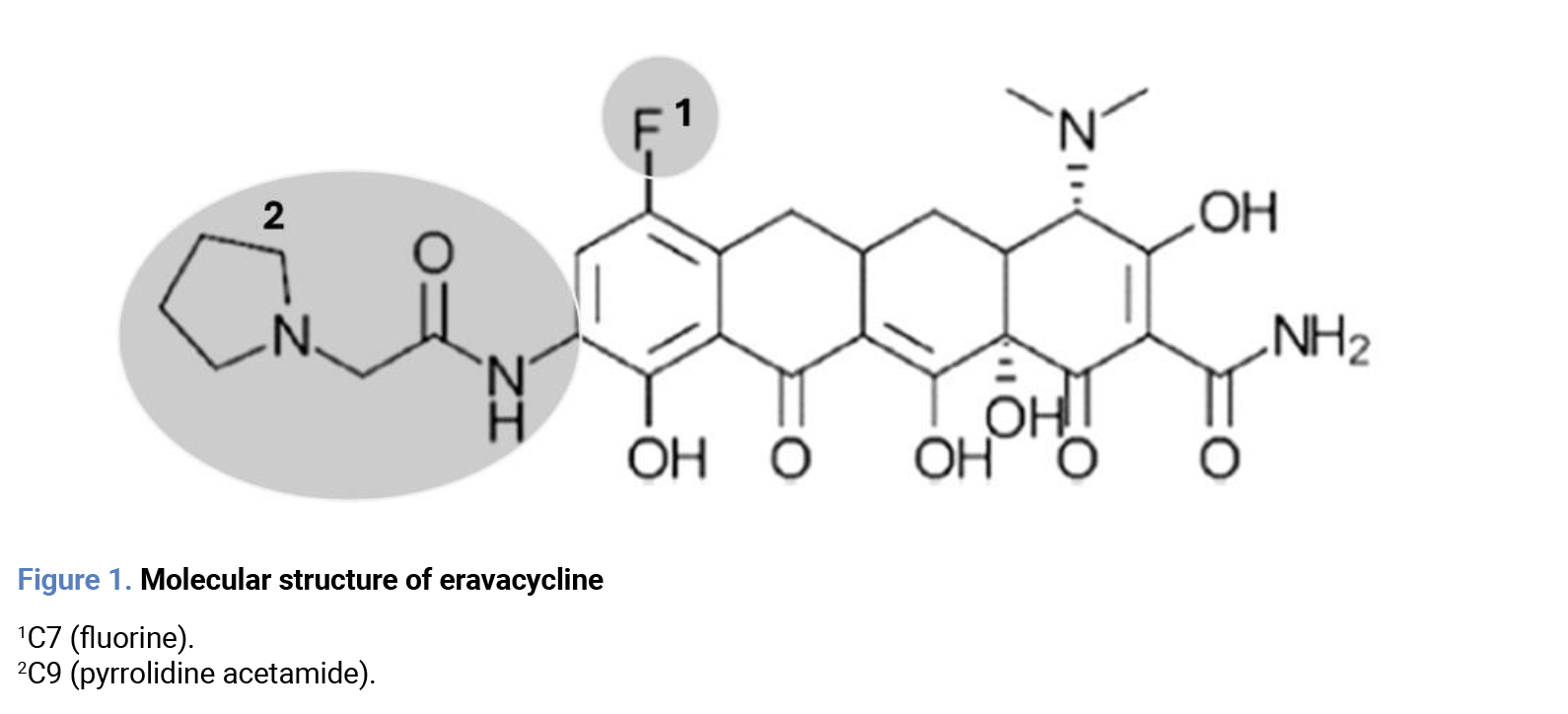
Its distinctive D-ring modifications at C7 (fluorine) and C9 (pyrrolidinoacetamido) confer broad-spectrum activity against Gram-positive and Gram-negative, aerobic and anaerobic pathogens (Figure 1) [5,13–15]. According to the US and EU prescribing information [16,17] and recent studies, it retains in vitro activity against the following organisms:
- Gram-positive bacteria: Enterococcus faecalis, Enterococcus faecium (including vancomycin-resistant isolates), methicillin-susceptible Staphylococcus aureus (MSSA) and methicillin-resistant S. aureus (MRSA), Streptococcus pneumoniae, and viridans Streptococcus spp. (MIC90 ≤ 0.12 mg/L) [5,8,13,16–18].
- Gram-negative bacteria:
- Enterobacteriaceae: Citrobacter freundii, Citrobacter koseri, Enterobacter aerogenes, Enterobacter cloacae, E. coli, Klebsiella oxytoca, and K. pneumoniae, Salmonella, and Serratia spp. (MIC90 ≤ 0.25 mg/L) [5,8,13,16–20].
- A. baumannii, Stenotrophomonas maltophilia, Achromobacter spp., and Elizabethkingia spp. (MIC90 1–2 mg/L) [5,8,13,16–21].
- Haemophilus influenzae, Neisseria gonorrhoeae, Moraxella catarrhalis, and Legionella pneumophila (MIC90 ≤ 0.5 mg/L) [8,15,20].
- Francisella tularensis, Yersinia pestis, Bacillus anthracis, Burkholderia mallei, Burkholderia cenocepacia, Burkholderia pseudomallei, Burkholderia cepacia, and Helicobacter pylori (MIC90 ≤ 0.5 mg/L) [2,8,12,15,22,23].
- Anaerobic bacteria: Anaerococcus spp., Bacteroides spp., including B. fragilis, Clostridium perfringens, Cutibacterium, Lactobacillus, Parabacteroides distasonis, Parabacteroides assaccharolyticus, and Prevotella spp. (MIC90 ≤ 1 mg/L) [5,8,13,15–19,21]. Also displays activity against C. difficile (MIC90 ≤ 0.12 mg/L) [12,19,24].
- Other microorganisms: Non-tuberculous mycobacteria, including rapidly growing mycobacteria (RGM), such as Mycobacterium abscessus subsp. Abscessus, M. abscessus subsp. Massiliense, Mycobacterium chelonae, Mycobacterium immunogenum, Mycobacterium fortuitum, (MIC90 ≤ 0.25 mg/L), and some isolates of slowly growing mycobacteria (SGM) like Mycobacterium kansasii and Mycobacterium marinum (MIC50 ≤ 0.5 mg/L) [25–28].
In vitro data indicate that Pseudomonas aeruginosa is resistant [16,17] while Proteus spp., Providencia spp., and Morganella spp. exhibit reduced susceptibility or resistance.
Notably, susceptibility standards differ between the European Committee on Antimicrobial Susceptibility Testing (EUCAST) and the Clinical and Laboratory Standards Institute (CLSI) in the USA [8,13,29]. According to EUCAST, the minimum inhibitory concentration (MIC) breakpoints for eravacycline are 0.5 mg/L for E. coli, 0.25 mg/L for S. aureus and Enterococcus spp., and 0.125 mg/L for viridans Streptococcus spp. [16]. For the CLSI, breakpoints are 0.5 mg/L for Enterobacteriaceae and anaerobes, and 0.06 mg/L for S. aureus, E. faecalis, E. faecium, and the Streptococcus anginosus group [29].
2.2 Resistance
Tetracycline-specific resistance arises from four main mechanisms: efflux pumps, ribosomal protection proteins (RPPs), drug inactivation, and rRNA mutations, with efflux pumps and RPPs being the most prevalent [30]. In Gram-negative bacteria, the most common efflux pumps are encoded by tetA and tetB, whereas in Gram-positive bacteria, they are encoded by tetK and tetL. Efflux-mediated resistance [13] and RPPs (most frequently tetO and tetM), which confer resistance to first- and second-generation tetracyclines, have minimal impact on eravacycline [2,13].
Eravacycline maintained potent activity against S. aureus overexpressing the MepA efflux pump, exhibiting only a fourfold MIC increase compared with a 62.5-fold increase for tigecycline, indicating that clinical resistance via MepA is unlikely [15]. Resistance to eravacycline may result from upregulation of non-specific intrinsic MDR efflux pumps or target-site modifications, including alterations in 16S rRNA, 30S ribosomal proteins (e.g., S10), or rpsJ mutations in Enterococcus spp. Eravacycline showed no target-based cross-resistance with other agents, such as fluoroquinolones, penicillins, cephalosporins, or carbapenems [13].
Eravacycline exhibited unchanged activity against E. coli expressing tetM, tetB, or tetK, and only minimal reduction against tetA-expressing strains. In tetA-expressing E. coli, the MIC increased fourfold, markedly lower than the ≥16-fold increase observed for other tetracyclines [14].
In summary, eravacycline maintains activity against common tetracycline-resistant microorganisms [5,13–15] and exhibits superior potency compared with other semisynthetic tetracyclines against Gram-negative species with tetracycline resistance, extended-spectrum β-lactamases (ESBL) production, carbapenem-resistant (CR), and MDR phenotypes [5,15].
3. Pharmacokinetics and pharmacodynamics properties
Eravacycline is administered intravenously over approximately 1 hour at a dose of 1 mg/kg every 12 hours [16,17].
It demonstrates concentration-dependent plasma protein binding, ranging from 79% at 0.1 to 90% at 10 mg/L [16,17]. The steady-state volume of distribution (Vss) after IV administration is approximately 4.2 L/kg, reflecting extensive tissue penetration [16,17]. Comparatively, tigecycline exhibited a Vss of 6–9.1 L/kg, omadacycline ~2.6 L/kg, and older tetracyclines such as tetracycline and doxycycline display lower Vss values of 1.3 and 0.7 L/kg, respectively, underscoring the enhanced tissue distribution of newer tetracyclines [31,32].
Eravacycline demonstrated extensive distribution into epithelial lining fluid (ELF) and alveolar macrophages (AM), reaching concentrations approximately 6-fold and 50-fold higher than plasma, respectively [33]. A pulmonary distribution population pharmacokinetic (PK) model confirmed wide penetration into lung tissues, compared with tigecycline, which exhibited lower ELF concentrations [34], corresponding to a lung exposure of 9.18 vs. 6.32 µg × h/mL for eravacycline and tigecycline, respectively [34,35]. In contrast, penetration into the cerebrospinal fluid is negligible [36], although a case has been reported in which the combination of systemic and intraventricular eravacycline was successfully used with high-dose sulbactam to treat meningitis caused by A. baumannii [37].
Eravacycline is predominantly present unchanged in plasma and urine and undergoes metabolism mainly via CYP3A4 and FMO-mediated oxidation to pharmacologically inactive compounds. It is a substrate for P-gp, OATP1B1, and OATP1B3 [16,17]. Co-administration with strong CYP3A4 inducers (e.g., rifampicin, phenytoin, and St. John’s wort) accelerates metabolism, necessitating a ~50% dose increase to 1.5 mg/kg/12h. Eravacycline and its metabolites neither inhibit nor induce CYP enzymes or transporters, indicating minimal potential for drug–drug interactions [13,16,17].
Elimination occurs via renal (~35%), reaching concentrations in urine of 8.6–13.3 mg/L at steady-state, and biliary/direct intestinal (~48%) pathways, with a mean half-life of ~20 hours [16,17]. For the multiple-dose study, the mean total CL was 13.6 L/h [38]. Its PK is not meaningfully affected by age (18–86 years), gender, or race, and no dose adjustments are required for renal or hepatic impairment, including in patients undergoing intermittent haemodialysis [16,17]. In obese patients, the dose should be calculated based on the total body weight. The drug maintains its efficacy across all body mass index (BMI) categories, with similar efficacy in normal-weight (94%), overweight (87%), and obese patients (85.3%) [39]. No data are available for weight >137 kg [16,40].
PK in continuous renal replacement therapy and extracorporeal membrane oxygenation (ECMO) has not yet been evaluated. A case report of a patient undergoing continuous venovenous hemodialysis (CVVHD) and ECMO demonstrated increased AUC0-12h, although it would not be expected to impact antimicrobial efficacy [41].
The primary pharmacokinetic/pharmacodynamic (PK/PD) predictor of eravacycline efficacy is the ratio of the area under the plasma concentration–time curve to the time above the minimum inhibitory concentration (AUC/MIC) [16,17]. Its PK profile is generally linear; total and peak plasma concentrations increased dose-proportionally after both single and multiple doses. The mean AUC0-12h and Cmax, at steady state, were 4.38 µg × h/mL and 1.83 µg/mL, respectively [32]. The steady state is achieved within 5-7 days during multiple dosing, with modest systemic accumulation [32]. In severe infections, a 1.5 mg/kg loading dose may be advisable, as it has proven safe in certain patients [42] and may facilitate a more rapid attainment of steady state.
4. Efficacy in clinical trials
Eravacycline IV has been investigated for the treatment of complicated intra-abdominal infection (cIAIs) in adults (≥18 years) through two randomized, double-blind, phase 3 noninferiority trials: IGNITE1 [43], which compared eravacycline with ertapenem, and IGNITE4 [40], which compared it with meropenem. These findings are reinforced by results from a preceding phase 2 dose-ranging study [44].
IGNITE1 [43]: A phase III trial compared eravacycline (1 mg/kg every 12 h) with ertapenem (1g every 24h) in 541 hospitalized adults with cIAI. Clinical cure rates at test-of-cure were 86.8% for eravacycline and 87.6% for ertapenem (difference –0.8%; 95% CI –7.1 to 5.5%), meeting the noninferiority criteria. The drug was well tolerated, supporting it as a safe and effective alternative to ertapenem.
IGNITE4 [40]: A phase III, randomized, double-blind study in hospitalized adults with cIAI, eravacycline (1 mg/kg every 12 h) was compared with meropenem (1 g every 8 h) for 4–14 days. Eravacycline demonstrated noninferior clinical cure rates versus meropenem at test-of-cure (90.8% vs. 91.2%; 95%CI −6.3 to 5.3) across all populations, including infections with ESBL-producing Enterobacterales (87.5% vs. 84.6% in the eravacycline and meropenem groups, respectively), and was generally well tolerated.
A systematic review and meta-analysis of randomized controlled trials evaluating the efficacy and safety of eravacycline in the treatment of cIAIs confirmed its efficacy and demonstrated a tolerability profile comparable to that of other antibiotics [45].
IGNITE2 and IGNITE3 evaluated the efficacy of eravacycline for the treatment of complicated urinary tract infections (cUTI); however, both failed to meet their predefined primary endpoints.
An oral formulation of eravacycline was developed but subsequently discontinued due to suboptimal outcomes in IGNITE2, a phase 3 study of cUTI against per os (PO) levofloxacin. The PK analyses of the oral formulation revealed a 28% bioavailability and a pronounced food effect that further reduced absorption, resulting in substantially lower urinary concentrations compared with IV administration [8,46]. Subsequent investigations assessed the impact of meal timing on oral eravacycline exposure, demonstrating that by day 7, when administered fasted, the AUC0-24h reached 65% of day 1 values, and both systemic exposure and urinary concentrations remained within the expected therapeutic range [46]. It is possible that modifying the administration regimen, either by administering the drug fasted, increasing the dose, or modifying the dosing interval from 200 mg orally q12 h to q8 h, the desired exposure may have been achieved. Work is ongoing to optimize the dose and meal schedule [39]. Thus, the suboptimal clinical outcomes in IGNITE2 could potentially be overcome by giving the drug without meals.
The IGNITE3 study evaluated the efficacy and safety of IV eravacycline versus ertapenem in cUTI, allowing IV-to-PO transition to daily levofloxacin after 5 days of IV therapy. The trial failed to demonstrate non-inferiority of eravacycline, with a higher proportion of non-responders (11.9% vs. 1.7% for ertapenem) for the primary endpoint of combined clinical and microbiological cure at the end-of-infusion visit [36,47,48]. However, the absence of fully published results limits the ability to draw definitive conclusions.
5. Expanded antimicrobial scope of eravacycline
Eravacycline was approved by the Food and Drug Administration (FDA) and European Medicines Agency (EMA) in 2018 for treating adult cIAIs, supported by the Phase III IGNITE1 [43] and IGNITE4 [40] trials. However, its effectiveness has also been demonstrated in several types of infections beyond its currently approved indications, as discussed below.
5.1 MDR infections
The rising prevalence of MDR Gram-negative bacteria represents a major global health threat, largely due to limited therapeutic options and poor clinical outcomes. Among these pathogens, carbapenem-resistant Enterobacterales (CRE) such as E. coli, K. pneumoniae, and Enterobacter spp. are of particular concern [18]. Eravacycline retains activity against MDR pathogens, including ESBL and CR strains, those carrying KPC, OXA-48, and metallo-β-lactamases [57,58].
5.1.1 A. baumannii infections
Outbreaks caused by multidrug-resistant A. baumannii have been reported all around the world with ever-increasing frequency [36,49,50]. Colistin remains one of the few agents with retained activity against A. baumannii; however, its clinical utility is limited by nephrotoxicity and suboptimal serum concentrations. Furthermore, resistance is increasing, particularly in regions with widespread MDR microorganisms, which have driven reliance on this agent [50,51]. New options such as cefiderocol and sulbactam–durlobactam have recently expanded the therapeutic armamentarium against carbapenem-resistant A. baumannii (CRAB) [52]. However, clinical outcomes with cefiderocol have been disappointing, showing a mortality imbalance favoring the best available therapy [53], and the emergence of cefiderocol-resistant A. baumannii strains has already been documented [54].
Eravacycline has an in vitro activity against A. baumannii compared with tigecycline by a 2-fold to 8-fold MIC reduction [36,50,55]. In an in vitro study, 96.5% (276/286) of the isolates of A. baumannii had MICs of ≤1mg/L, and it was active against isolates that were resistant to sulbactam, imipenem/meropenem, levofloxacin, and amikacin/tobramycin [50]. In A. baumannii strains isolated from respiratory and bloodstream sources, eravacycline MIC50/90 were 0.5/1 mg/L [56]. However, the clinical significance of eravacycline susceptibility against A. baumannii remains uncertain due to the absence of CLSI breakpoints [36,56]. An epidemiological cut-off value (ECOFF) of 0.25 mg/L has been proposed, and current Infectious Diseases Society of America (IDSA) guidelines recommend its use only in combination as a salvage therapy [36].
Eravacycline demonstrates certain synergistic or additive activity in combination with colistin [57], cefiderocol [58], ceftazidime [59], or imipenem [60] against A. baumannii, highlighting its potential when used in combination therapy in difficult-to-treat infections.
Eravacyclin could also prevent the development of biofilm-associated infections caused by A. baumannii. 1×MIC eravacycline solution inhibited biofilm formation by 84%, when combined with colistin 86%, and 85% with meropenem [61].
Overall, the provided data support eravacycline as a valuable option to the limited therapeutic armamentarium against CRAB, particularly in immunosuppressive patients when employed especially as a salvage therapy in combination regimens (with carbapenems, colistin, or cefiderocol) because of its enhanced combined activity [36,50,61].
5.1.2 Achromobacter spp.
Treatment of Achromobacter spp. infections remain challenging due to both intrinsic and acquired resistance to commonly used antimicrobials and the absence of established clinical breakpoints [21,62]. This pathogen is most frequently associated with respiratory tract infections, with A. xylosoxidans being the predominant species. A recent study reported eravacycline activity against 91% of A. xylosoxidans isolates (MIC50 ≤2 mg/L) and 97% of isolates (MIC90 ≤4 mg/L). Although clinical breakpoints are not defined, EUCAST data suggest that eravacycline may be active against Achromobacter spp. [21].
Eravacycline has shown activity against Achromobacter spp. including colistin-resistant strains. In vitro time-kill studies demonstrated that eravacycline combined with colistin produced bactericidal and synergistic effects over 24h in most strains tested, with no evidence of antagonism. These findings indicate that its combination may represent a promising option for infections caused by difficult-to-treat resistant (DTR) Achromobacter spp. [62].
5.1.3 B. cepacia complex
B. Cepacia complex (BCC) typically affects immunocompromised patients, particularly those exposed to prolonged courses of broad-spectrum antibiotics. Certain species, such as B. cenocepacia, are associated with poorer prognosis, higher mortality rates, and an increased risk of developing cepacia syndrome (septicemia and necrotizing pneumonia) in patients with cystic fibrosis [23,63]. BCC is intrinsically resistant to most β-lactams but retains some susceptibility to ceftazidime. Tetracyclines represent a valuable therapeutic option; among them, eravacycline demonstrated the lowest MIC distribution (MIC90 ~1 mg/L) compared with minocycline, tigecycline, and omadacycline [23].
5.1.4 S. maltophilia
S. Maltophilia infections remain challenging to manage due to limited therapeutic options. In an analysis of 41 patients with S. maltophilia infection, predominantly pneumonia (56.1%) and bacteremia (14.6%), treatment with eravacycline, administered as monotherapy in 90% of cases, achieved a clinical cure rate of 73.2%, a 30-day survival rate of 68.3%, and a low incidence of adverse events (9.8%) [64]. The MIC90 for eravacycline is 4 mg/L [65].
5.2 Mycobacterial infections
Third-generation tetracyclines show efficacy against multidrug-resistant rapidly growing mycobacteria (RGM), causing severe pulmonary and skin infections with high mortality, particularly in immunocompromised patients, and posing major treatment challenges due to broad antibiotic resistance [12,28].
Newer tetracyclines have shown promising activity against RGM. Among them, omadacycline appears to hold the greatest promise for clinical application due to its potent antimicrobial activity, favorable safety profile, and convenient oral administration. Eravacycline emerges as an alternative to omadacycline, as it has demonstrated potential in the treatment of non-tuberculous mycobacterial (NTM) infections, particularly M. abscessus, as well as M. chelonae and M. immunogenum. In vitro studies with clinical isolates confirmed consistent activity across RGM, with MIC90 ≤0.25 mg/L, indicating substantial inhibitory effects. These findings support its use as a potential therapeutic option for difficult-to-treat NTM infections [25–28].
By contrast, eravacycline, like other tetracyclines, has shown poor activity against slowly growing mycobacteria (SGM), including M. avium complex, M. intracellulare, and M. kansasii. The high level of resistance in SGM underscores the need for new drugs capable of overcoming these resistance mechanisms [66].
5.3 Clostridioides difficile
Preliminary evidence indicates that eravacycline may represent a promising therapeutic option for C. difficile infections (CDIs). In an in vitro human gut model, eravacycline did not trigger CDI despite transient alterations in the intestinal microbiota [67]. Furthermore, the drug demonstrated bactericidal activity against diverse C. difficile strains, independent of ribotype, vancomycin susceptibility, or the presence of tetracycline resistance genes [24]. Eravacycline was active against all tested C. difficile isolates at concentrations ≤1 mg/L, including strains with elevated MICs (4 mg/L) to vancomycin and metronidazole. The MIC90 was 0.12 mg/L [19].
These findings have been supported in clinical settings. In a retrospective study of 50 critically ill patients receiving eravacycline, only one case of post-treatment CDI was reported, despite 40% of patients having experienced CDI in the preceding 12 months [68]. Although the mechanisms underlying the reduced risk of CDI for eravacycline remain incompletely understood, potential contributing factors include high intraluminal drug concentrations, relatively limited disruption of the gut microbiota compared with other antibiotics, and direct in vitro and in vivo activity against C. difficile [4,69]. Eravacycline exposure may not induce C. difficile spore germination and, consequently, does not lead to toxin production [67].
6. Safety and tolerability
Eravacycline demonstrated a favorable tolerability profile across phase 2 and 3 trials [40,43,44], with most treatment-emergent adverse events (TEAEs) being mild to moderate. In the IGNITE1 [43] and IGNITE4 [40] trials, eravacycline showed a higher overall incidence of TEAEs compared with comparator arms (41.9% vs. 28.0% and 37.2% vs. 30.9%, respectively), although rates of severe, life-threatening, or fatal TEAEs were similar. Gastrointestinal events were the most common adverse effects, with nausea (6.5%) and vomiting (3.8%) leading, followed by diarrhea and phlebitis [45]. Gastrointestinal TEAEs were more frequent in patients with higher BMI [39] and tended to increase with rising eravacycline Cmax [4].
Nevertheless, only 1.6% TEAEs led to treatment discontinuation [40,43]. These class-related effects appear less pronounced with eravacycline than with tigecycline, suggesting a more favorable tolerability profile [12,70].
Real-world evidence has linked eravacycline to hypofibrinogenemia (<200 mg/dL), particularly after prolonged treatment, with levels normalizing rapidly upon discontinuation, consistent with previous reports on tigecycline [71]. Pharmacovigilance data from the FDA Adverse Event Reporting System identified eravacycline with the highest reporting odds ratio for this adverse event (ROR 2173.84; 95% CI, 1208.80–3909.30) [72]. In septic patients receiving eravacycline for longer therapies (>10 days), monitoring fibrinogen levels is advisable. Synthetic tetracyclines associated with hypofibrinogenemia (tigecycline, eravacycline, omadacycline) share a C9 substitution on the D ring, with eravacycline uniquely carrying a C7 fluorine, whereas tetracycline itself shows no such association [2,73]. This suggests that drug formulation or structural differences might contribute to the distinct impacts on fibrinogen levels [72,74]. Whether this represents a class effect remains uncertain; however, prolonged omadacycline use beyond 30 days has been well-tolerated with stable fibrinogen levels [75].
Eravacycline has also been associated with hepatobiliary disorders, although with a weaker correlation than tigecycline [74]. Other infrequent adverse events reported in real-world settings are a case of acute pancreatitis after 10 days of therapy [76]; a severe hypoesthesia secondary to infusion [77]; and a case of rhabdomyolysis [78]. All were resolved after drug discontinuation.
Class-specific warnings and precautions associated with tetracyclines should also be considered, including hypersensitivity and infusion-site reactions [16,17].
7. Potential clinical applications and expert opinion
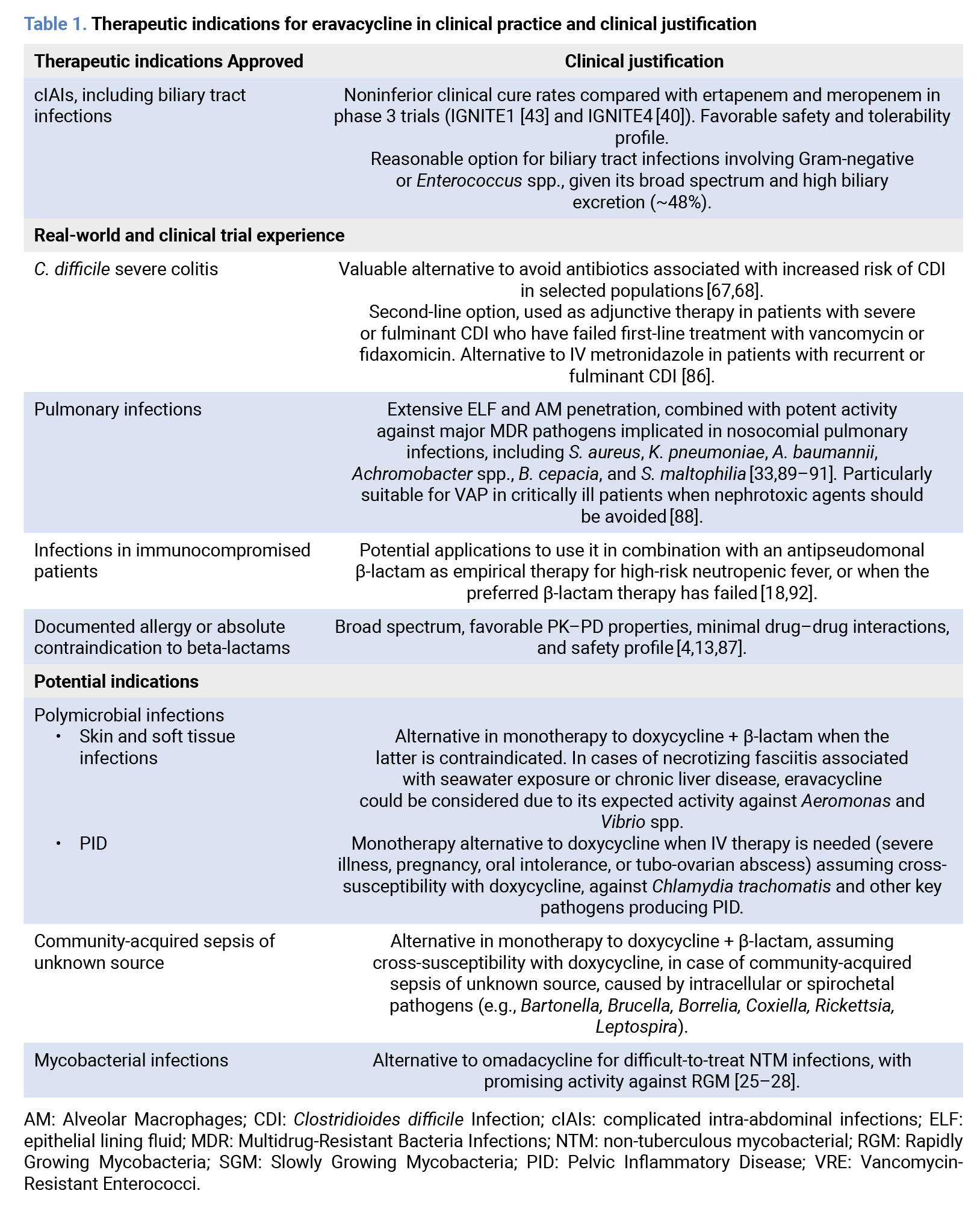
The indications and potential therapeutic indications for eravacycline in clinical practice based on its antimicrobial spectrum, PK/PD profile, and safety are summarized in Table 1.
7.1 cIAI, including biliary tract infections
Intra-abdominal infections, such as those associated with gastrointestinal perforation, peritonitis, intra-abdominal abscesses, or complicated appendicitis, typically involve Enterobacterales (particularly E. coli), Enterococcus spp., and anaerobic organisms most frequently isolated, alongside occasional non-fermenting Gram-negative bacilli [79]. While combination therapy is often required in these settings, the broad activity of eravacycline (excluding activity against Pseudomonas spp.) enables its potential use as monotherapy [16,17]. IGNITE1 [43] and IGNITE4 [40] supported its approval for cIAI.
Eravacycline is especially suitable for infections caused by vancomycin-resistant enterococci (VRE), including isolates resistant to other antibiotics, such as linezolid [80,81]. E. faecium typically displays MIC90 values of 0.12–0.25 mg/L [13,65,80,81]. This activity is comparable to or up to twofold greater than that of tigecycline [65].
Moreover, eravacycline constitutes a reasonable therapeutic option for complicated biliary infections, such as cholangitis or cholecystitis, particularly when caused by Gram-negative bacteria and/or Enterococcus spp., due to its high biliary excretion (~48%) and broad antimicrobial spectrum. This rationale is supported by the data of the pivotal trials IGNITE1 [43] and IGNITE4 [40], in which 44 (20%) and 40 (21.3%) patients, respectively, in the eravacycline arms presented with complicated cholecystitis, demonstrating non-inferiority to ertapenem and meropenem (although subgroup-specific outcomes were not reported). Notably, patients with acute suppurative cholangitis were excluded from these studies.
7.2 Polymicrobial infections
Eravacycline’s broad antimicrobial activity further supports its use in polymicrobial infections that require coverage of anaerobes, Enterococcus, Gram-negative bacilli, and MRSA, pathogens commonly involved in the following types of infections:
7.2.1 Skin and soft tissue infections
In necrotizing cellulitis or fasciitis, early surgical debridement is essential. Antibiotic therapy should generally be maintained for 5–7 days after the final complete debridement (source control). Antibiotic treatment usually involves broad-spectrum antibiotics active against MRSA, Gram-negative, and anaerobic organisms guided by susceptibility testing and local epidemiology [82,83]. In necrotizing fasciitis associated with seawater exposure or in patients with chronic liver disease, doxycycline plus a third-generation cephalosporin is recommended [82]. In such infections, eravacycline in monotherapy may represent a therapeutic alternative; although clinical data remain limited, its broad-spectrum activity is expected to include Aeromonas and Vibrio spp. (inferred from other tetracyclines), pathogens commonly involved in these infections.
7.2.2 Pelvic inflammatory disease (PID)
Tetracyclines, particularly doxycycline, are a cornerstone of first-line regimens for PID due to their efficacy against Chlamydia trachomatis and other common pathogens. Current guidelines recommend combination therapy, most often ceftriaxone plus doxycycline plus metronidazole, to ensure broad-spectrum coverage [83,84], with ampicillin-sulbactam plus doxycycline as an alternative [84,85]. Hospitalization and parenteral therapy are reserved for severe illness, pregnancy, inability to tolerate oral therapy, or tubo-ovarian abscess, with a switch to oral doxycycline and metronidazole once feasible [85]. Although doxycycline remains the standard of care, eravacycline in monotherapy may represent a reasonable IV alternative in patients with contraindications to beta-lactams, given its broader spectrum and favorable tolerability profile.
7.3 C. difficile infection
In clinical settings, patients aged ≥65 years, immunocompromised, or those with a history of severe CDI or infections caused by hypervirulent ribotypes represent a high-risk group in whom antibiotics associated with increased CDI risk should be avoided. In such cases, eravacycline may provide a valuable therapeutic option [4]. Its low risk of producing CDI makes it especially valuable as part of the antimicrobial stewardship programs in patients at increased risk of this iatrogenic complication [67]. In a real-world cohort of 50 patients treated with eravacycline, mostly for >14 days, only one case of CDI occurred within 30 days after therapy, despite 20 patients (40%) having experienced a prior CDI episode within the preceding 12 months of therapy [68].
In the treatment of CDI, eravacycline may represent a second-line option, used as adjunctive therapy in patients with severe or fulminant CDI who have failed first-line treatment with vancomycin or fidaxomicin. Eravacycline has demonstrated low C. difficile MIC50/90 values. It may be considered as an alternative to IV metronidazole in patients with recurrent or fulminant CDI, particularly in cases of treatment failure or refractoriness, defined as persistent symptoms after 5 days of first-line therapy or clinical deterioration at any point during treatment.
Recent real-world data further support its role as adjunctive therapy in severe or fulminant CDI. In a cohort of 75 patients, 33% with severe and 67% with fulminant CDI, with 40% immunocompromised and 61% in ICU, adjunctive eravacycline was associated with a low rate of CDI-related colectomy, suggesting a potential benefit in high-risk populations [86].
7.4 Documented allergy or absolute contraindication to beta-lactams
Eravacycline represents a rational therapeutic alternative for patients with severe, documented β-lactam allergy, including anaphylactic reactions, delayed hypersensitivity, DRESS syndrome, or Stevens–Johnson syndrome, or for those with proven β-lactam–related toxicity (such as leukopenia during prolonged treatment courses). In this context, newer tetracycline-class agents offer an effective and safer therapeutic option [4].
The IDSA supports the use of eravacycline as an alternative option for intra-abdominal and other tissue infections caused by MDR pathogens when beta-lactams are contraindicated, due to its lower MICs and improved tolerability compared to tigecycline [13,87]. It also represents an alternative for patients with a history of recent or severe CDI in whom the use of a β-lactam antibiotic is preferably avoided due to the increased risk of recurrence.
Its favorable PK-PD profile, including suitability for monotherapy in selected isolates, broad antimicrobial spectrum, absence of renal dose adjustment, and minimal drug–drug interactions, makes eravacycline particularly advantageous for patients with β-lactam allergy.
7.5 Pulmonary infections
Eravacycline exhibits extensive penetration into ELF and AM, with higher lung exposure than tigecycline, supporting its potential for respiratory infections [33].
It has demonstrated potent activity against key MDR pathogens implicated in nosocomial pulmonary infections, including S. aureus, K. pneumoniae, A. baumannii, Achromobacter spp., B. cepacia, and S. maltophilia.
Its broad spectrum and extensive pulmonary distribution make it particularly suitable for the treatment of ventilator-associated pneumonia (VAP) in critically ill patients. Moreover, eravacycline may represent a valuable therapeutic option, especially in the presence of carbapenem resistance or when nephrotoxic agents such as colistin or aminoglycosides should be avoided [88].
Some real-world studies [89,90] support its use in respiratory infections caused by A. baumannii [33,36,50]. A retrospective study of 24 patients with VAP by CRAB treated with eravacycline-based combination therapy, most commonly with ampicillin/sulbactam and inhaled colistin, reported clinical and microbiological resolution in 71% (17/24) of cases [90]. In a retrospective study of DTR A. baumannii pneumonia, eravacycline was associated with increased mortality compared with the best available therapy; however, patients receiving eravacycline had COVID-19 co-infection more frequently (22% vs. 2%), and bacteremia (15% vs. 3%), both associated with higher in-hospital 30-day mortality. By excluding these patients, the difference was no longer significant [89].
In real-world settings, eravacycline has also been used successfully against less common pathogens causing pulmonary infections. Elizabethkingia anophelis is an opportunistic pathogen associated with severe and life-threatening infections. A case of pulmonary infection caused by MDR E. anophelis was successfully managed with a combination of trimethoprim–sulfamethoxazole and eravacycline [91].
7.6 Infections in immunocompromised patients
Eravacycline may represent a valuable therapeutic option for oncology [18] and other immunocompromised patients, who are particularly vulnerable to bacterial infections caused by MDR pathogens. In this context, one study demonstrated that early empirical initiation of eravacycline (≤72 h from index culture collection) significantly reduced rates of clinical failure and microbiological recurrence compared with delayed initiation (>72 h) when used as rescue therapy due to failure of the initial empirical treatment with a carbapenem, aminoglycoside, colistin, or tigecycline [92].
Potential applications include its use in combination with an antipseudomonal β-lactam as empirical therapy for high-risk neutropenic fever, or when the preferred β-lactam therapy has failed. More clinical studies are needed to validate its role in these settings [18] and to determine the outcomes in CRE infections among solid organ transplant recipients [93].
7.7 Community-acquired sepsis of unknown source
In cases of community-acquired sepsis of unknown source, depending on the patient’s clinical history, epidemiological context, and seasonal factors, the infection by intracellular pathogens such as Bartonella, Brucella, Borrelia spp., Coxiella spp., Rickettsia spp., and Leptospira cannot be ruled out. In these scenarios, empirical therapy with a β-lactam combined with doxycycline is justified, given the latter’s potent activity against intracellular and spirochetal pathogens and its excellent ability to penetrate host cells. While doxycycline’s efficacy is well supported by extensive clinical experience, in vitro data for eravacycline are currently limited; nonetheless, the use of newer tetracyclines such as eravacycline as monotherapy could be considered, assuming susceptibility to doxycycline.
7.8 Therapeutic value in infections causing bacteremia
Any of the previously described infections could be associated with bacteremia. In those cases of secondary bacteremia, eravacycline could represent a reasonable therapeutic alternative. Its relatively low Cmax compared with other antibiotics could theoretically raise concerns regarding its use in intravascular infections; however, recent real-world data support its efficacy in treating bacteremia [37,42,91,92]. In a large US case series of patients treated with eravacycline for more than 72 hours, either alone or in combination, 81 of 416 patients (19.5%) had bacteremia; the overall clinical success was 75.5% [42].
A pooled analysis of the IGNITE1 and IGNITE4 trials in patients with concurrent bacteremia and cIAI caused by Gram-negative pathogens identified 32 (7.7%) and 31 (7.2%) cases, respectively, with no differences in clinical cure (87.5% eravacycline vs. 77% carbapenem) or microbiologic response at 28 days (97.1% vs. 97.2%) [94]. In a small case series, combination regimens including eravacycline were successful in treating three patients with hematologic malignancies and bloodstream infections caused by pan-resistant, NDM-producing CRE [95]. Additionally, a case report described successful eravacycline monotherapy in a patient with DTR A. baumannii bacteremia [96].
Although eravacycline’s PK–PD profile may raise concerns about its use as monotherapy for bloodstream infections, clinical experience indicates that, once the infectious focus is controlled, its efficacy at the tissue source of bacteremia is comparable to that of other agents. Accordingly, it remains a valuable agent in secondary bacteremia arising from an intra-abdominal source, in monotherapy or in combination regimens, particularly in infections caused by MDR pathogens.
8. Conclusion
Eravacycline has established its role in the treatment of cIAIs, with phase III trials (IGNITE1 [43] and IGNITE4 [40]) demonstrating noninferiority to carbapenems and a favorable safety profile. Its broad-spectrum activity against MDR Gram-positive, Gram-negative, and anaerobic pathogens helps to reduce carbapenem overuse and the consequent selection of carbapenem-resistant bacteria, together with advantageous PK–PD properties, which support its use beyond cIAIs in selected scenarios such as polymicrobial infections from skin and soft tissue (necrotizing fasciitis) or PID, pulmonary and biliary tract infections, β-lactam allergy, infections in immunocompromised patients, CDI infection, and community-acquired sepsis of unknown source. In polymicrobial infections, it allows for monotherapy, avoiding the need for combination regimens with β-lactams and additional agents targeting Gram-positive and anaerobic bacteria. The available real-world evidence, together with its broad-spectrum activity, positions eravacycline as a promising therapeutic agent with potential clinical applications beyond its currently approved indications.
Funding
No funding was received for the research, authorship, and/or publication of this article.
Author contributions
Conceptualization, MAF, AS, and JM; design, MAF, AS, and JM; data curation, MAF; supervision, MAF, AS, and JM; data analysis, MAF; interpretation, MAF; writing-original draft, MAF; writing-review and editing, MAF, AS, MAV, JB, and JM. All authors have read and agreed to the published version of the manuscript.
Conflict of interest
M. Albanell-Fernández has received fees for lectures from Pfizer. A. Soriano has received fees for lectures and/or participation on advisory boards from Pfizer, Shionogi, Advance Pharma, Angelini, Menarini, and Gilead. M.Á. Verdejo has received fees for lectures and/or attendance at scientific events from Pfizer, Shionogi, Viatris, Angelini, and Menarini. The other authors declare no relevant affiliations or financial involvement with any organization or entity with a financial interest in or potential conflict of interest with the subject matter or materials discussed in the manuscript other than those disclosed.
AI statement
No artificial intelligence tools were used in the writing, analysis, interpretation, or review of this article.
References
- Zhanel GG, Homenuik K, Nichol K, Noreddin A, Vercaigne L, Embil J, et al. The Glycylcyclines: a comparative review with the tetracyclines. Drugs. 2004;64(1):63-88. Available from: https://doi.org/10.2165/00003495-200464010-00005
- Zhanel GG, Cheung D, Adam H, Zelenitsky S, Golden A, Schweizer F, et al. Review of Eravacycline, a Novel Fluorocycline Antibacterial Agent. Drugs. 2016;76(5):567-588. Available from: https://doi.org/10.1007/s40265-016-0545-8
- Chopra I, Roberts M. Tetracycline Antibiotics: Mode of Action, Applications, Molecular Biology, and Epidemiology of Bacterial Resistance. Microbiol Mol Biol Rev. 2001;65(2):232-260. Available from: https://doi.org/10.1128/MMBR.65.2.232-260.2001
- LaPlante KL, Dhand A, Wright K, Lauterio M. Re-establishing the utility of tetracycline-class antibiotics for current challenges with antibiotic resistance. Ann Med. 2022;54(1):1686-1700. Available from: https://doi.org/10.1080/07853890.2022.2085881
- Bassetti M, Righi E. Eravacycline for the treatment of intra-abdominal infections. Expert Opin Investig Drugs. 2014;23(11):1575-1584. Available from: https://doi.org/10.1517/13543784.2014.965253
- Nelson ML, Levy SB. The history of the tetracyclines. Ann N Y Acad Sci. 2011;1241(1):17-32. Available from: https://doi.org/10.1111/j.1749-6632.2011.06354.x
- Cornejo J, Yevenes K, Avello C, Pokrant E, Maddaleno A, Martin BS, et al. Determination of Chlortetracycline Residues, Antimicrobial Activity and Presence of Resistance Genes in Droppings of Experimentally Treated Broiler Chickens. Molecules. 2018;23(6):1264. Available from: https://doi.org/10.3390/molecules23061264
- Heaney M, Mahoney MV, Gallagher JC. Eravacycline: The Tetracyclines Strike Back. Ann Pharmacother. 2019;53(11):1124-1135. Available from: https://doi.org/10.1177/1060028019850173
- Peterson LR. A review of tigecycline—the first glycylcycline. Int J Antimicrob Agents. 2008;32:S215-S222. Available from: https://doi.org/10.1016/S0924-8579(09)70005-6
- Xiao X-Y, Hunt DK, Zhou J, Clark RB, Dunwoody N, Fyfe C, et al. Fluorocyclines. 1. 7-Fluoro-9-pyrrolidinoacetamido-6-demethyl-6-deoxytetracycline: A Potent, Broad Spectrum Antibacterial Agent. J Med Chem. 2012;55(2):597-605. Available from: https://doi.org/10.1021/jm201465w
- Clark RB, Hunt DK, He M, Achorn C, Chen C-L, Deng Y, et al. Fluorocyclines. 2. Optimization of the C-9 Side-Chain for Antibacterial Activity and Oral Efficacy. J Med Chem. 2012;55(2):606-622. Available from: https://doi.org/10.1021/jm201467r
- Kounatidis D, Dalamaga M, Grivakou E, Karampela I, Koufopoulos P, Dalopoulos V, et al. Third-Generation Tetracyclines: Current Knowledge and Therapeutic Potential. Biomolecules. 2024;14(7):783. Available from: https://doi.org/10.3390/biom14070783
- Scott LJ. Eravacycline: A Review in Complicated Intra-Abdominal Infections. Drugs. 2019;79(3):315-324. Available from: https://doi.org/10.1007/s40265-019-01067-3
- Grossman TH, Starosta AL, Fyfe C, O’Brien W, Rothstein DM, Mikolajka A, et al. Target- and Resistance-Based Mechanistic Studies with TP-434, a Novel Fluorocycline Antibiotic. Antimicrob Agents Chemother. 2012;56(5):2559-2564. Available from: https://doi.org/10.1128/AAC.06187-11
- Sutcliffe JA, O’Brien W, Fyfe C, Grossman TH. Antibacterial Activity of Eravacycline (TP-434), a Novel Fluorocycline, against Hospital and Community Pathogens. Antimicrob Agents Chemother. 2013;57(11):5548-5558. Available from: https://doi.org/10.1128/AAC.01288-13
- European Medicines Agency. Xerava (Eravacycline): summary of product characteristics. Amsterdam: European Medicines Agency; 2018. [Accessed 2025 Aug 14]. Available from: http://www.ema.europa.eu/
- Tetraphase Pharmaceuticals Inc. Xerava (Eravacycline): US prescribing information. Silver Spring (MD): Food and Drug Administration; 2018. [Accessed 2025 Aug 14]. Available from: http://www.fda.gov
- Rolston K, Gerges B, Nesher L, Shelburne SA, Prince R, Raad I. In vitro activity of eravacycline and comparator agents against bacterial pathogens isolated from patients with cancer. JAC Antimicrob Resist. 2023;5(2). Available from: https://doi.org/10.1093/jacamr/dlad020
- Snydman DR, McDermott LA, Jacobus NV, Kerstein K, Grossman TH, Sutcliffe JA. Evaluation of the In Vitro Activity of Eravacycline against a Broad Spectrum of Recent Clinical Anaerobic Isolates. Antimicrob Agents Chemother. 2018;62(5). Available from: https://doi.org/10.1128/AAC.02206-17
- Lagacé-Wiens PRS, Adam HJ, Laing NM, Baxter MR, Martin I, Mulvey MR, et al. Antimicrobial susceptibility of clinical isolates of Neisseria gonorrhoeae to alternative antimicrobials with therapeutic potential. J Antimicrob Chemother. 2017;72(8):2273-2277. Available from: https://doi.org/10.1093/jac/dkx147
- Ray S, Flemming LK, Scudder CJ, Ly MA, Porterfield HS, Smith RD, et al. Comparative phenotypic and genotypic antimicrobial susceptibility surveillance in Achromobacter spp. through whole genome sequencing. Microbiol Spectr. 2025;13(4). Available from: https://doi.org/10.1128/spectrum.02527-24
- Grossman TH, Anderson MS, Christ D, Gooldy M, Henning LN, Heine HS, et al. The Fluorocycline TP-271 Is Efficacious in Models of Aerosolized Francisella tularensis SCHU S4 Infection in BALB/c Mice and Cynomolgus Macaques. Antimicrob Agents Chemother. 2017;61(8). Available from: https://doi.org/10.1128/AAC.00448-17
- Li K, Jia H, Gu Y, Xiao Y, Li S, Qu Y, et al. Species Distribution and Antimicrobial Susceptibility of Diverse Strains Within Burkholderia cepacia Complex. Microb Drug Resist. 2025;31(5):154-161. Available from: https://doi.org/10.1089/mdr.2024.0220
- Bassères E, Begum K, Lancaster C, Gonzales-Luna AJ, Carlson TJ, Miranda J, et al. In vitro activity of eravacycline against common ribotypes of Clostridioides difficile. J Antimicrob Chemother. 2020;75(10):2879-2884. Available from: https://doi.org/10.1093/jac/dkaa289
- Zhang T, Du J, Dong L, Wang F, Zhao L, Jia J, et al. In Vitro Antimicrobial Activities of Tigecycline, Eravacycline, Omadacycline, and Sarecycline against Rapidly Growing Mycobacteria. Microbiol Spectr. 2023;11(1). Available from: https://doi.org/10.1128/spectrum.03238-22
- Brown-Elliott BA, Wallace RJ. In Vitro Susceptibility Testing of Eravacycline against Nontuberculous Mycobacteria. Antimicrob Agents Chemother. 2022;66(9). Available from: https://doi.org/10.1128/aac.00689-22
- Kaushik A, Ammerman NC, Martins O, Parrish NM, Nuermberger EL. In Vitro Activity of New Tetracycline Analogs Omadacycline and Eravacycline against Drug-Resistant Clinical Isolates of Mycobacterium abscessus. Antimicrob Agents Chemother. 2019;63(6). Available from: https://doi.org/10.1128/AAC.00470-19
- Li A, He S, Li J, Zhang Z, Li B, Chu H. Omadacycline, Eravacycline, and Tigecycline Express Anti-Mycobacterium abscessus Activity In Vitro. Microbiol Spectr. 2023;11(3). Available from: https://doi.org/10.1128/spectrum.00718-23
- US Food and Drug Administration. Eravacycline—injection products: FDA-identified interpretive criteria. Silver Spring (MD): Food and Drug Administration; [Accessed 2025 Aug 15]. Available from: https://www.fda.gov/drugs/development-resources/eravacycline-injection-products. Accessed 15 Aug 2025.
- Nguyen F, Starosta AL, Arenz S, Sohmen D, Dönhöfer A, Wilson DN. Tetracycline antibiotics and resistance mechanisms. Biol Chem. 2014;395(5):559-575. Available from: https://doi.org/10.1515/hsz-2013-0292
- Agwuh KN, MacGowan A. Pharmacokinetics and pharmacodynamics of the tetracyclines including glycylcyclines. J Antimicrob Chemother. 2006;58(2):256-265. Available from: https://doi.org/10.1093/jac/dkl224
- Newman JV, Zhou J, Izmailyan S, Tsai L. Randomized, Double-Blind, Placebo-Controlled Studies of the Safety and Pharmacokinetics of Single and Multiple Ascending Doses of Eravacycline. Antimicrob Agents Chemother. 2018;62(11). Available from: https://doi.org/10.1128/AAC.01174-18
- Connors KP, Housman ST, Pope JS, Russomanno J, Salerno E, Shore E, et al. Phase I, Open-Label, Safety and Pharmacokinetic Study To Assess Bronchopulmonary Disposition of Intravenous Eravacycline in Healthy Men and Women. Antimicrob Agents Chemother. 2014;58(4):2113-2118. Available from: https://doi.org/10.1128/AAC.02036-13
- Ji X-W, Mak WY, Xue F, Yang W-Y, Kuan IH-S, Xiang X-Q, et al. Population pharmacokinetics and pulmonary modeling of eravacycline and the determination of microbiological breakpoint and cutoff of PK/PD. Antimicrob Agents Chemother. 2025;69(3). Available from: https://doi.org/10.1128/aac.01065-24
- Gotfried MH, Horn K, Garrity-Ryan L, Villano S, Tzanis E, Chitra S, et al. Comparison of Omadacycline and Tigecycline Pharmacokinetics in the Plasma, Epithelial Lining Fluid, and Alveolar Cells of Healthy Adult Subjects. Antimicrob Agents Chemother. 2017;61(9). Available from: https://doi.org/10.1128/AAC.01135-17
- Kubin CJ, Garzia C, Uhlemann A-C. Acinetobacter baumannii treatment strategies: a review of therapeutic challenges and considerations. Antimicrob Agents Chemother. 2025;69(8):e0106324. Available from: https://doi.org/10.1128/aac.01063-24
- Liu Q, Zhou X, Du Z, Wang X, Li N. Intraventricular injection of eravacycline in the treatment of carbapenem-resistant Acinetobacter baumannii meningitis: a case report. J Antimicrob Chemother. 2025;80(5):1453-1454. Available from: https://doi.org/10.1093/jac/dkaf069
- Horn P, Sutcliffe J, Walpole S, et al. Pharmacokinetics, safety and tolerability of a novel fluorocycline, TP-434 following multiple dose administration. [abstract no. 603 plus poster]. In: Proceedings of the 49th Annual Meeting of the Infectious Diseases Society of America; 2011 Oct 20–23; Boston (MA).
- Asempa TE, Izmailyan S, Lawrence K, Nicolau DP. Efficacy and Safety of Eravacycline in Obese Patients: A Post Hoc Analysis of Pooled Data From the IGNITE1 and IGNITE4 Clinical Trials. Open Forum Infect Dis. 2020;7(12). Available from: https://doi.org/10.1093/ofid/ofaa548
- Solomkin JS, Gardovskis J, Lawrence K, Montravers P, Sway A, Evans D, et al. IGNITE4: Results of a Phase 3, Randomized, Multicenter, Prospective Trial of Eravacycline vs Meropenem in the Treatment of Complicated Intraabdominal Infections. Clin Infect Dis. 2019;69(6):921-929. Available from: https://doi.org/10.1093/cid/ciy1029
- Igneri LA, Green D, Dunwoody N, Peterson L-KN, Bartock JL, Puri N. Eravacycline pharmacokinetics in a critically ill patient receiving venovenous extracorporeal membrane oxygenation and continuous venovenous haemodialysis. J Antimicrob Chemother. 2021;76(10):2738-2739. Available from: https://doi.org/10.1093/jac/dkab238
- Kunz Coyne AJ, Alosaimy S, Lucas K, Lagnf AM, Morrisette T, Molina KC, et al. Eravacycline, the first four years: health outcomes and tolerability data for 19 hospitals in 5 U.S. regions from 2018 to 2022. Microbiol Spectr. 2024;12(1). Available from: https://doi.org/10.1128/spectrum.02351-23
- Solomkin J, Evans D, Slepavicius A, Lee P, Marsh A, Tsai L, et al. Assessing the Efficacy and Safety of Eravacycline vs. Ertapenem in Complicated Intra-abdominal Infections in the Investigating Gram-Negative Infections Treated With Eravacycline (IGNITE 1) Trial. JAMA Surg. 2017;152(3):224. Available from: https://doi.org/10.1001/jamasurg.2016.4237
- Solomkin JS, Ramesh MK, Cesnauskas G, Novikovs N, Stefanova P, Sutcliffe JA, et al. Phase 2, Randomized, Double-Blind Study of the Efficacy and Safety of Two Dose Regimens of Eravacycline versus Ertapenem for Adult Community-Acquired Complicated Intra-Abdominal Infections. Antimicrob Agents Chemother. 2014;58(4):1847-1854. Available from: https://doi.org/10.1128/AAC.01614-13
- Lan S-H, Chang S-P, Lai C-C, Lu L-C, Chao C-M. The Efficacy and Safety of Eravacycline in the Treatment of Complicated Intra-Abdominal Infections: A Systemic Review and Meta-Analysis of Randomized Controlled Trials. J Clin Med. 2019;8(6):866. Available from: https://doi.org/10.3390/jcm8060866
- Horn P, Redican S, Tsai L. Impact of Meal Timing on Eravacycline Exposure During the Oral Portion of an IV to Oral Transition Dosing Regimen. Open Forum Infect Dis. 2017;4(suppl_1):S522-S523. Available from: https://doi.org/10.1093/ofid/ofx163.1362
- Efficacy and Safety Study of Eravacycline Compared With Ertapenem in Participants With Complicated Urinary Tract Infections (IGNITE3). ClinicalTrials.gov; 2017. [Accessed 2025 Sep 2]. Available from: https://www.clinicaltrials.gov/study/NCT03032510
- Wang H, Nguyen N, Cruz C. Eravacycline for the treatment of complicated intra‐abdominal infections. Adv Dig Med. 2021;8(4):203-210. Available from: https://doi.org/10.1002/aid2.13216
- Tomaschek F, Higgins PG, Stefanik D, Wisplinghoff H, Seifert H. Head-to-Head Comparison of Two Multi-Locus Sequence Typing (MLST) Schemes for Characterization of Acinetobacter baumannii Outbreak and Sporadic Isolates. PLoS One. 2016;11(4):e0153014. Available from: https://doi.org/10.1371/journal.pone.0153014
- Seifert H, Stefanik D, Sutcliffe JA, Higgins PG. In vitro activity of the novel fluorocycline eravacycline against carbapenem non-susceptible Acinetobacter baumannii. Int J Antimicrob Agents. 2018;51(1):62-64. Available from: https://doi.org/10.1016/j.ijantimicag.2017.06.022
- Dickstein Y, Leibovici L, Yahav D, Eliakim-Raz N, Daikos GL, Skiada A, et al. Multicentre open-label randomised controlled trial to compare colistin alone with colistin plus meropenem for the treatment of severe infections caused by carbapenem-resistant Gram-negative infections (AIDA): a study protocol. BMJ Open. 2016;6(4):e009956. Available from: https://doi.org/10.1136/bmjopen-2015-009956
- Watkins RR, Bonomo RA. Sulbactam-durlobactam: A Step Forward in Treating Carbapenem-Resistant Acinetobacter baumannii (CRAB) Infections. Clin Infect Dis. 2023;76(Supplement_2):S163-S165. Available from: https://doi.org/10.1093/cid/ciad093
- Bassetti M, Echols R, Matsunaga Y, Ariyasu M, Doi Y, Ferrer R, et al. Efficacy and safety of cefiderocol or best available therapy for the treatment of serious infections caused by carbapenem-resistant Gram-negative bacteria (CREDIBLE-CR): a randomised, open-label, multicentre, pathogen-focused, descriptive, phase 3 trial. Lancet Infect Dis. 2021;21(2):226-240. Available from: https://doi.org/10.1016/S1473-3099(20)30796-9
- Nordmann P, Shields RK, Doi Y, Takemura M, Echols R, Matsunaga Y, et al. Mechanisms of Reduced Susceptibility to Cefiderocol Among Isolates from the CREDIBLE-CR and APEKS-NP Clinical Trials. Microb Drug Resist. 2022;28(4):398-407. Available from: https://doi.org/10.1089/mdr.2021.0180
- Livermore DM, Mushtaq S, Warner M, Woodford N. In Vitro Activity of Eravacycline against Carbapenem-Resistant Enterobacteriaceae and Acinetobacter baumannii. Antimicrob Agents Chemother. 2016;60(6):3840-3844. Available from: https://doi.org/10.1128/AAC.00436-16
- Buyukyanbolu E, Argotsinger J, Beck ET, Chamberland RR, Clark AE, Daniels AR, et al. Activity of ampicillin-sulbactam, sulbactam-durlobactam, and comparators against Acinetobacter baumannii-calcoaceticus complex strains isolated from respiratory and bloodstream sources: results from ACNBio study. Antimicrob Agents Chemother. Published online 2025. Available from: https://doi.org/10.1128/aac.00379-25
- Ozger HS, Cuhadar T, Yildiz SS, Demirbas Gulmez Z, Dizbay M, Guzel Tunccan O, et al. In vitro activity of eravacycline in combination with colistin against carbapenem-resistant A. baumannii isolates. J Antibiot (Tokyo). 2019;72(8):600-604. Available from: https://doi.org/10.1038/s41429-019-0188-6
- Yin Y, Xu N, Wang X. Activity of cefiderocol in combination with tetracycline analogues against carbapenem-resistant Acinetobacter baumannii. J Antibiot (Tokyo). 2025;78(3):190-196. Available from: https://doi.org/10.1038/s41429-024-00801-8
- Rahul R, Maheswary D, Damodaran N, Leela KV. Eravacycline-Synergistic activity with other antimicrobials in carbapenem-resistant isolates of Escherichia coli and Acinetobacter baumannii. Diagn Microbiol Infect Dis. 2023;107(3):116006. Available from: https://doi.org/10.1016/j.diagmicrobio.2023.116006
- Li Y, Cui L, Xue F, Wang Q, Zheng B. Synergism of eravacycline combined with other antimicrobial agents against carbapenem-resistant Enterobacteriaceae and Acinetobacter baumannii. J Glob Antimicrob Resist. 2022;30:56-59. Available from: https://doi.org/10.1016/j.jgar.2022.05.020
- Ataman M, Çelik BÖ. Investigation of the in vitro antimicrobial activity of eravacycline alone and in combination with various antibiotics against MDR Acinetobacter baumanni strains. BMC Microbiol. 2025;25(1):167. Available from: https://doi.org/10.1186/s12866-025-03914-8
- Özer B, Özbek Çelık B. Comparative in vitro activities of eravacycline in combination with colistin, meropenem, or ceftazidime against various Achromobacter spp. strains isolated from patients with cystic fibrosis. J Chemother. 2023;35(8):700-706. Available from: https://doi.org/10.1080/1120009X.2023.2213600
- Maki Al-Nasrawy L, Abdali SA, Mohammed Jawad S. Molecular Research Comparing the Probabilities of Burkholderia Cepacia Bacterium Diagnosis Procedures. Arch Razi Inst. 2022;77(2):717-725. Available from: https://doi.org/10.22092/ARI.2022.357464.2041
- Al Musawa M, Kunz Coyne AJ, Alosaimy S, Lucas K, Schrack MR, Andrade J, et al. Clinical Outcomes of Eravacycline in Patients Treated for Stenotrophomonas maltophilia Infections. Infect Dis Ther. 2025;14(7):1499-1511. Available from: https://doi.org/10.1007/s40121-025-01170-x
- Zhanel GG, Baxter MR, Adam HJ, Sutcliffe J, Karlowsky JA. In vitro activity of eravacycline against 2213 Gram-negative and 2424 Gram-positive bacterial pathogens isolated in Canadian hospital laboratories: CANWARD surveillance study 2014–2015. Diagn Microbiol Infect Dis. 2018;91(1):55-62. Available from: https://doi.org/10.1016/j.diagmicrobio.2017.12.013
- Li A, Tan Z, He S, Chu H. In vitro susceptibility testing of tetracycline‐class antibiotics against slowly growing non‐tuberculous mycobacteria. Clin Exp Pharmacol Physiol. 2023;50(7):604-609. Available from: https://doi.org/10.1111/1440-1681.13777
- Buckley AM, Altringham J, Clark E, Bently K, Spittal W, Ewin D, et al. Eravacycline, a novel tetracycline derivative, does not induce Clostridioides difficile infection in an in vitro human gut model. J Antimicrob Chemother. 2021;76(1):171-178. Available from: https://doi.org/10.1093/jac/dkaa386
- Van Hise N, Petrak RM, Skorodin NC, Fliegelman RM, Anderson M, Didwania V, et al. A Real-World Assessment of Clinical Outcomes and Safety of Eravacycline: A Novel Fluorocycline. Infect Dis Ther. 2020;9(4):1017-1028. Available from: https://doi.org/10.1007/s40121-020-00351-0
- Tariq R, Cho J, Kapoor S, Orenstein R, Singh S, Pardi DS, et al. Low Risk of Primary Clostridium difficile Infection With Tetracyclines: A Systematic Review and Metaanalysis. Clin Infect Dis. 2018;66(4):514-522. Available from: https://doi.org/10.1093/cid/cix833
- Eljaaly K, Alghamdi H, Almehmadi H, Aljawi F, Hassan A, Thabit A. Long-term gastrointestinal adverse effects of doxycycline. J Infect Dev Ctries. 2023;17(02):281-285. Available from: https://doi.org/10.3855/jidc.16677
- Rausch E, Vemuri K, Anderman TM, Daniels L, Fabricio J, Lachiewicz A, et al. Eravacycline Associated Hypofibrinogenemia: A Case Series of Transplant Patients With Mycobacterium Abscessus Infections and Review of Literature. Open Forum Infect Dis. 2022;9(12). Available from: https://doi.org/10.1093/ofid/ofac591
- Wen X, Cai L, Gao A, Fu A, Guo D, Zhu M. Pharmacovigilance analysis of drug-induced hypofibrinogenemia using the FDA Adverse Event Reporting System. Int J Clin Pharm. 2025;47(3):755-766. Available from: https://doi.org/10.1007/s11096-025-01867-6
- Zhanel GG, Esquivel J, Zelenitsky S, Lawrence CK, Adam HJ, Golden A, et al. Omadacycline: A Novel Oral and Intravenous Aminomethylcycline Antibiotic Agent. Drugs. 2020;80(3):285-313. Available from: https://doi.org/10.1007/s40265-020-01257-4
- Zhang X, Pan J, Zhang X, Yang Q, Li Z, Liu F. Safety profiles of tetracycline-class drugs: a pharmacovigilance analysis of the FAERS database. Expert Opin Drug Saf. Published online 2024:1-10. Available from: https://doi.org/10.1080/14740338.2024.2393276
- Morrisette T, Alosaimy S, Philley JV, Wadle C, Howard C, Webb AJ, et al. Preliminary, Real-world, Multicenter Experience With Omadacycline for Mycobacterium abscessus Infections. Open Forum Infect Dis. 2021;8(2). Available from: https://doi.org/10.1093/ofid/ofab002
- Stefanos SS, Davis L, Panwala A, Gelfand MS, Animalu CN, Cutshall BT. Prolonged course of eravacycline leading to acute pancreatitis. Am J Med Sci. 2023;366(6):464-467. Available from: https://doi.org/10.1016/j.amjms.2023.09.012
- Miller RB, McClure KM, Stewart RG, Shealy SC, Brown K, Bookstaver PB. Eravacycline infusion–related hypoesthesia: A case report. Am J Health Syst Pharm. 2022;79(14):1146-1150. Available from: https://doi.org/10.1093/ajhp/zxac098
- Belk MG, Ku PM, George DL, Hobbs ALV. Rhabdomyolysis Suspected to be Caused by Eravacycline Therapy: A Case Report. J Pharm Pract. 2024;37(1):239-242. Available from: https://doi.org/10.1177/08971900221117872
- Miller JM, Binnicker MJ, Campbell S, Carroll KC, Chapin KC, Gonzalez MD, et al. Guide to Utilization of the Microbiology Laboratory for Diagnosis of Infectious Diseases: 2024 Update by the Infectious Diseases Society of America (IDSA) and the American Society for Microbiology (ASM). Clin Infect Dis. 2024;5:ciae104. Available from: https://doi.org/10.1093/cid/ciae104
- Boukthir S, Dejoies L, Zouari A, Collet A, Potrel S, Auger G, et al. In vitro activity of eravacycline and mechanisms of resistance in enterococci. Int J Antimicrob Agents. 2020;56(6):106215. Available from: https://doi.org/10.1016/j.ijantimicag.2020.106215
- Wen Z, Liu F, Zhang P, Wei Y, Shi Y, Zheng J, et al. In vitro activity and adaptation strategies of eravacycline in clinical Enterococcus faecium isolates from China. J Antibiot (Tokyo). 2022;75(9):498-508. Available from: https://doi.org/10.1038/s41429-022-00546-2
- Huang K-C, Hsieh P-H, Huang K-C, Tsai Y-H. Vibrio necrotizing soft-tissue infection of the upper extremity: Factors predictive of amputation and death. J Infect. 2008;57(4):290-297. Available from: https://doi.org/10.1016/j.jinf.2008.07.009
- Lyons NB, Cohen BL, O’Neil CF Jr, Ramsey WA, Proctor KG, Namias N, et al. Short Versus Long Antibiotic Duration for Necrotizing Soft Tissue Infection: A Systematic Review and Meta-Analysis. Surg Infect (Larchmt). 2023;24(5):425-432. Available from: https://doi.org/10.1089/sur.2023.037
- Wiesenfeld HC, Meyn LA, Darville T, Macio IS, Hillier SL. A Randomized Controlled Trial of Ceftriaxone and Doxycycline, With or Without Metronidazole, for the Treatment of Acute Pelvic Inflammatory Disease. Clin Infect Dis. 2021;72(7):1181-1189. Available from: https://doi.org/10.1093/cid/ciaa101
- Workowski KA, Bachmann LH, Chan PA, Johnston CM, Muzny CA, Park I, et al. Sexually Transmitted Infections Treatment Guidelines, 2021. MMWR Recomm Rep. 2021;70(4):1-187. Available from: https://doi.org/10.15585/mmwr.rr7004a1
- Arena CJ, Kenney RM, Ramesh M, Davis SL, Veve MP. Outcomes of adjunctive eravacycline for severe and fulminant Clostridioides difficile infection. Int J Infect Dis. 2025;151:107314. Available from: https://doi.org/10.1016/j.ijid.2024.107314
- Tamma PD, Heil EL, Justo JA, Mathers AJ, Satlin MJ, Bonomo RA. Infectious Diseases Society of America 2024 Guidance on the Treatment of Antimicrobial-Resistant Gram-Negative Infections. Clin Infect Dis. Published online 2024:ciae403. Available from: https://doi.org/10.1093/cid/ciae403
- Gong Y, Liu Y, Zhu Y, Mu S, Gao H, Jing X, et al. Antibacterial activity of eravacycline against Klebsiella pneumoniae isolates: an in vitro study. Microbiol Spectr. 2025;13(7). Available from: https://doi.org/10.1128/spectrum.02564-24
- Scott CJ, Zhu E, Jayakumar RA, et al. Efficacy of Eravacycline Versus Best Previously Available Therapy for Adults With Pneumonia Due to Difficult-to-Treat Resistant (DTR) Acinetobacter baumannii. Ann Pharmacother. 2022;56(12):1299-1307. Available from: https://doi.org/10.1177/10600280221085551
- Jackson MNW, Wei W, Mang NS, Prokesch BC, Ortwine JK. Combination eravacycline therapy for ventilator‐associated pneumonia due to carbapenem‐resistant Acinetobacter baumannii in patients with COVID‐19: A case series. Pharmacotherapy. 2024;44(4):301-307. Available from: https://doi.org/10.1002/phar.2908
- Wei Q, Zuo W, Cong R, Luo K, Dong S. Combination Therapy of Trimethoprim-Sulfamethoxazole (TMP-SMZ) and Eravacycline for Treating Elizabethkingia anophelis-Induced Pulmonary Infections: A Case Report. Infect Drug Resist. 2024;17:4825-4832. Available from: https://doi.org/10.2147/IDR.S490902
- Kunz Coyne AJ, Alosaimy S, Lucas K, Morrisette T, Molina KC, DeKerlegand A, et al. Eravacycline use in immunocompromised patients: multicenter evaluation of timely versus late initiation on clinical outcomes. Microbiol Spectr. Published online 2025. Available from: https://doi.org/10.1128/spectrum.00565-25
- Pouch SM. New drugs for difficult bugs: management of multidrug-resistant gram-negative infections in solid organ transplant recipients. Curr Opin Organ Transplant. 2021;26(4):424-431. Available from: https://doi.org/10.1097/MOT.0000000000000890
- Felice VG-D, Efimova E, Izmailyan S, Napolitano LM, Chopra T. Efficacy and Tolerability of Eravacycline in Bacteremic Patients with Complicated Intra-Abdominal Infection: A Pooled Analysis from the IGNITE1 and IGNITE4 Studies. Surg Infect (Larchmt). 2021;22(5):556-561. Available from: https://doi.org/10.1089/sur.2020.241
- Lv Y, Zhang X, Cui Q, Li M, Bai L, Yu Y, et al. Effective Management of Carbapenem-Resistant Enterobacterales Bloodstream Infection with Organ Dissemination in Prolonged Severe Agranulocytosis Patients with Hematological Malignancy Through Combination Therapies Including Eravacycline. Infect Dis Ther. Published online 2025. Available from: https://doi.org/10.1007/s40121-025-01206-2
- Melchio M, Portunato F, Vena A, Porcile E, Centanaro M, Bassetti M. Efficacy of eravacycline in difficult-to-treat (DTR) Acinetobacter baumannii bacteraemia in ICU: a case report. J Antimicrob Chemother. Published online 2025. Available from: https://doi.org/10.1093/jac/dkaf347
Explore
Articles
Volumes
About the journal
Most read
Recomendaciones para la prevención y el tratamiento de las infecciones respiratorias en adultos mayores institucionalizados
Revista Española de Quimioterapia
Acute infectious gastroenteritis in childhood: the role of rapid multiplex molecular syndromic panels in diagnosis and clinical management
Revista Española de Quimioterapia
Características epidemiológicas de pacientes con aislamientos de Enterobacterales productores de carbapenemasas-NDM en un hospital de alta complejidad
Revista Española de Quimioterapia
Review on the management of intra-abdominal candidiasis
Revista Española de Quimioterapia
Neoscytalidium dimidiatum: a rare locally acquired deep cutaneous infection in a renal transplant recipient
Revista Española de Quimioterapia