Original
October 2025, Volume 38, nº5
9 min
Evolution of postsurgical mediastinitis after Major Heart Surgery (MHS) in the last 12 years: Are we improving?
María Jesús Pérez-Granda1-4,†,* , Emilio Bouza1,2,6,7,†, José María Barrio-Gutiérrez2,5, Marina Machado2, Agustín Estevez2, Gregorio Cuerpo2, Javier Hortal2,5, Patricia Muñoz1,2,6,7, Ángel González-Pinto4,7, Maricela Valerio1,2,7, on behalf of the Cardiovascular Infection Study Group †Both authors should be considered as first authors
1Clinical Microbiology and Infectious Diseases Department, Hospital General Universitario Gregorio Marañón, Madrid, Spain
2CIBER de Enfermedades Respiratorias-CIBERES (CB06/06/0058), Madrid, Spain
3Department of Nursing, School of Nursing, Physiotherapy and Podiatry, Universidad Complutense de Madrid, Madrid, Spain
4Department of Cardiac Surgery, Hospital General Universitario Gregorio Marañón, Madrid, Spain
5Department of Anesthesiology, Hospital General Universitario Gregorio Marañón, Madrid, Spain
6Instituto de Investigación Sanitaria Gregorio Marañón (IiSGM), Madrid, Spain
7Medicine Department, School of Medicine, Universidad Complutense de Madrid, Madrid, Spain
http://www.doi.org/10.37201/req/041.2025
Receipt Date:
07/04/2025
Acceptance Date:
06/05/2025
Publication Date:
26/05/2025
How to cite
Pérez-Granda MJ, Bouza E, Barrio-Gutiérrez JM, Machado M, Estevez A, Cuerpo G, et al. Evolution of postsurgical mediastinitis after Major Heart Surgery (MHS) in the last 12 years: Are we improving?. Rev Esp Quimioter 2025; 38(5): 394-400. Available from: http://www.doi.org/10.37201/req/041.2025
Metrics
283
Views
43
Downloads
Share
Share
Abstract (EN)
Introducción: La mediastinitis posquirúrgica (MPQ) es una complicación grave y potencialmente mortal de la cirugía cardíaca mayor (CCM). Los datos sobre la evolución de la incidencia de MPQ tras la CCM en grandes series de pacientes operados en los últimos años son escasos. El objetivo de nuestro estudio fue evaluar la tendencia de la incidencia, la etiología y la mortalidad asociada a la MPQ en una unidad de CCM de referencia en los últimos 12 años.
Material y métodos: El estudio se realizó en un hospital terciario en Madrid, España. Llevamos a cabo un estudio retrospectivo y transversal que incluyó a todos los pacientes sometidos a CCM y que desarrollaron MPQ entre enero de 2012 y diciembre de 2023 en nuestra institución.
Resultados: Durante los 12 años del estudio, un total de 5.584 pacientes se sometieron a CCM en nuestra institución. La tasa de incidencia de MPQ varió anualmente entre 1,16 y 2,34 episodios/100 procedimientos quirúrgicos. En total, se analizaron 89 pacientes con mediastinitis posquirúrgica (92 episodios diferentes). La mediana de edad fue de 67 años (RIQ: 56-75) y la mayoría eran varones (63%). La mediana de Euroscore fue de 7 (RIQ: 5-9,5). El principal tipo de cirugía cardíaca en pacientes con mediastinitis posquirúrgica fue: cirugía de revascularización coronaria en el 37% y reemplazo valvular en el 32,6%. Los microorganismos causales más frecuentes fueron: bacterias grampositivas (59,0%), bacterias gramnegativas (32,4%), hongos (7,6%) y otros (1%). En total, 22 pacientes fallecieron (24,7%).
Conclusiones: La incidencia de MPQ se ha mantenido estable y por debajo del 2,5% en los últimos 12 años en nuestra institución, pero continúa siendo una entidad asociada con alta morbilidad y mortalidad, así como con largas estancias hospitalarias.
Keywords (EN):
Mortalidad
Cirugía cardíaca mayor
Mediastinitis posquirúrgica
Introduction
Surgical site infections are among the most common complications in patients undergoing Mayor Heart Surgery (MHS) and have incidences ranging from 1% to 8% [1-4]. Besides, Postsurgical mediastinitis (PSM) is a serious and life-threatening complication, associated with high mortality and healthcare costs [5,6]. Although Gram-positive bacteria are the cause of most PSM, in recent years some authors describe an increase in those caused by Gram-negative microorganisms [7,8]. There are no large series collected in the last decade that assess the evolution of incidence of PSM by the same working group. Our objective was to review the evolution of the incidence of PSM, its etiology and prognosis along the last 12 years.Material and methods
Hospital setting and patients Our institution is a general referral hospital with approximately 1.300 beds and around 50,000 admissions/year. More than 500 MHS procedures are performed in adults annually in the Department of Cardiovascular Surgery, which is a large referral unit. Study Design We carried out a retrospective cohort study comparing the incidence, etiology and complications of mediastinitis episodes from January 2012 to December 2023 in our Major Heart Surgery (MHS) unit. Endpoints of the study The primary endpoint was to assess the evolution of the incidence of mediastinitis episodes. Secondary endpoints were to evaluate potential changes in etiology, and associated mortality during the study period. Definitions We followed the CDC definition of PSM as an infection that involves the mediastinal tissues and is characterized by one or more of the following criteria: purulent drainage from the mediastinal area, organisms identified from fluid or tissue in the mediastinum, obtained by culture or non-culture-based microbiologic testing, in the proper clinical context [9,10] . Statistical analysis Values are expressed as the mean (SD) or median (IQR) for continuous variables and as percentages, with a 95% confidence interval (95% CI), when applicable, for categorical variables. We compared survivors and non-survivors to identify variables associated with mortality. Comparisons between groups were made using Chi-square test for categorical variables and t-test or Mann–Whitney test for continuous variables. Statistical significance was set at p<0.05 (2-tailed). Statistical analysis was performed using IBM SPSS Statistics for Windows, Version 21.0 (IBM Corp, Armonk, New York, U.S.A). Ethics The Ethics Committee of Hospital General Universitario Gregorio Marañon approved the study. The need for informed consent for this study was waived by the Ethics Committee MICRO.HGUGM.2023-020 of Hospital General Universitario Gregorio Marañon.Results
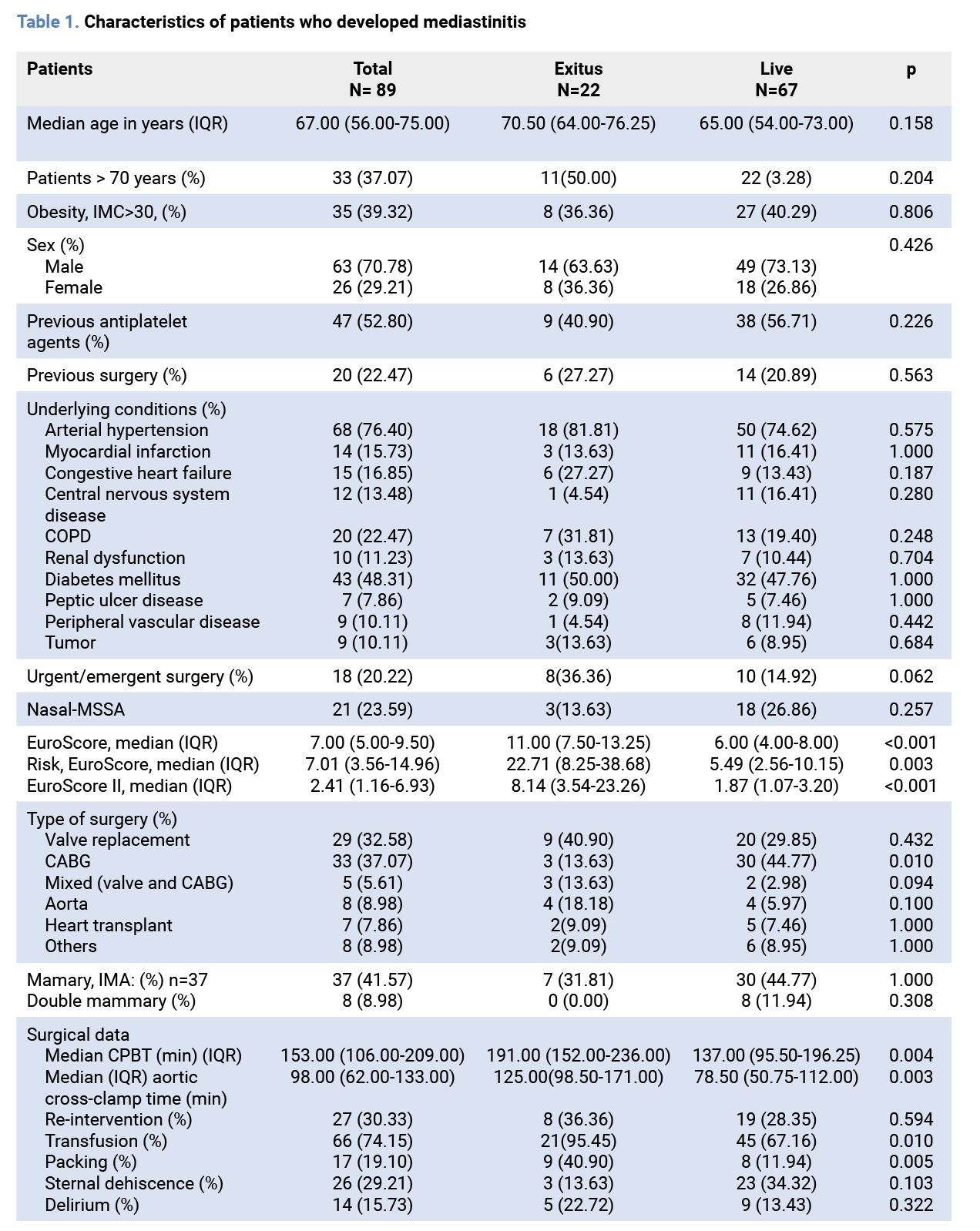
During the 12-year study period, a total of 5,584 patients underwent MHS at our institution, of them 89 (1.6%) patients developed 92 episodes of PSM. The incidence rate of PSM varied yearly between 1.16 and 2.34 episodes/100 surgical procedures with a stable trend (Figure 1).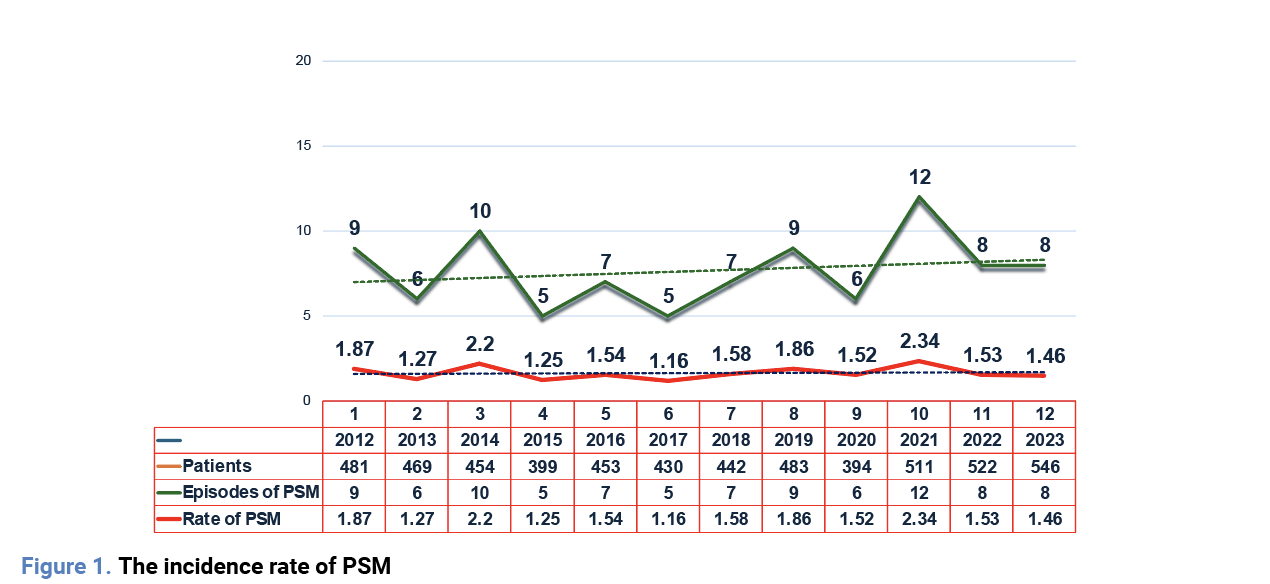 Patients who developed mediastinitis (89 patients) had a median age of 67 years (IQR 56-75) and 70.8% were males. Their main underlying conditions were high blood pressure (76%), diabetes mellitus (48%). Chronic obstructive pulmonary disease (22.5%), obesity (39,3%) and reintervention (30%). The median Euroscore in patients with PSM was 7 (IQR 5-9.5) and the type of heart surgery was: coronary artery bypass graft (CABG) in 37% and valve replacement (32.6%), aortic surgery (8.98%), valve and CABG (5.61 %) and others (16.8%).
One quarter of the patients (23.6%) were previously colonized by methicillin-susceptible Staphylococcus aureus (MSSA). During the postoperative period 74% of the patients required one or more blood transfusions.
Median time between surgery and PSM confirmation was 22 days (IQR 12.2-40.2). Median length of stay of patients with PSM in MHS unit and hospital were 10 (IQR 5-28) and 49 days (IQR 30-80), respectively.
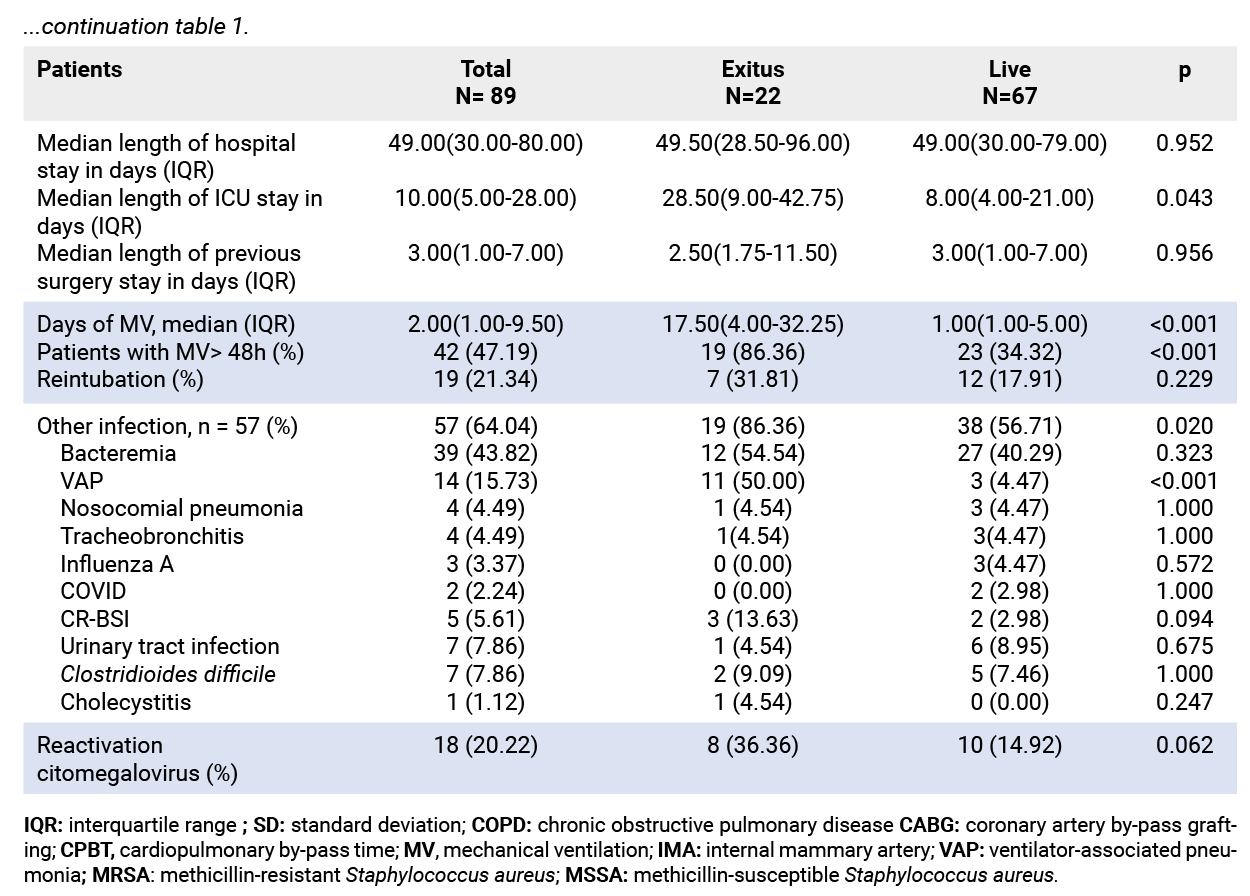
Overall, 57 patients (64%) had also one or more infections other than PSM and 18 (20.22%) had a reactivation of Cytomegalovirus. Of the 89 patients, 22 patients (24.7%) died during admission. Mortality risk factors in patients with PSM (Table 1), included high Euro-scores, reoperations, days on mechanical ventilation and number of transfusions.
 Microorganisms causing mediastinitis
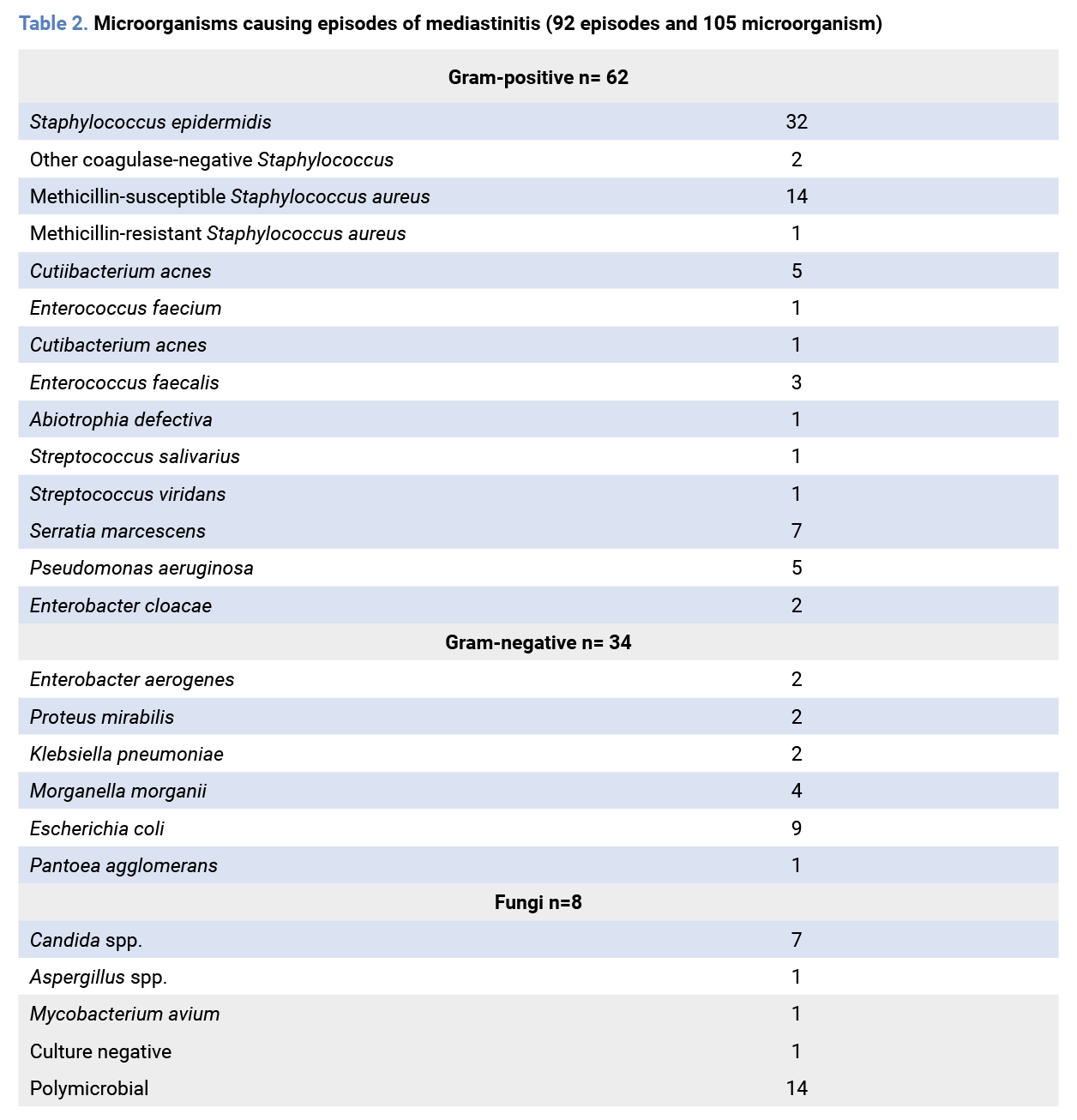
Overall, 105 different microorganisms were recovered in culture from mediastinal samples. Gram-positive bacteria were identified in 59% of the cases, mainly Staphylococcus epidermidis and S. aureus. Gram-negative bacteria were isolated in 34 of the episodes (32.4%) and fungi in 7.6% (Table 2). Overall, 40% of our episodes were not caused by classical Gram-positive bacteria.
Discusion
The incidence rate of mediastinitis seems to be very steady over the last 12 years, despite significant improvements in the prevention of post-surgical infection after MHS. Our work demonstrates stability in the incidence of PSM episodes. At the same time, the etiological agents seem to be changing with a progression of cases not caused by Gram positive bacteria that represent in recent years 40% of the cases in our series. The incidence of PSM has traditionally ranged between 1 to 8% % [1-4,11,12] . Our data suggest that these figures are maintained in recent years. In our opinion the data invite to a reflection and to the search for alternative interventions. The hypothesis that this stabilization can be explained by the type of population operated on in recent years may be “comfortable” but, in our opinion, has not been demonstrated properly [13,14]. We believe also that the paradigm of PSM caused mainly by Gram-positive bacteria is turning obsolete. Our data show that 40% of our episodes are no longer caused by classical Gram-positive bacteria (S. aureus, coagulase-negative staphylococci). This coincides with other series where Gram-negative bacteria were relatively common [7,8,15]. Of particular concern are fungal mediastinitis [5]. Mortality rates are also scaring and unacceptable [16,17] . Our overall mortality of 23.4% in patients with PSM confirms this pessimistic idea and we believe that they invite for the search of innovative solutions in this field. We believe that patients with PSM should be considered a therapeutic failure and be discussed and treated by a multidisciplinary team that must include at least, cardiac surgeons, anesthetists/intensivists, nurses, microbiologists, infectious diseases physicians, and plastic surgeons [18]. Other aspects probably require improving the preoperative conditions of some patients (obesity..), with presurgical preparation, and early diagnosis both by imaging and etiology. We believe that “zero” tolerance projects that have had a great success in catheter-related infections or pneumonia associated with mechanical ventilation, are possibly necessary to be imported to this field of the prevention of post-surgical infection in cardiac surgery. The main limitation of our study is that it is retrospective and only one center has participated. Further initiatives in the prevention of PSM have to be based on innovative approaches and ideas.Conclusions
The incidence of PSM has remained stable and below 2.5% in recent years in our institution, but it continues to be an entity associated with high morbidity and mortality, very long hospital stays, that require innovative approaches. Acknowledgments The authors gratefully acknowledge the valuable contributions of the Cardiovascular Infection Study Group. The members include: Begoña Quintana, Alejandro Garrido Sánchez, Mónica Barranco, Eduardo Sánchez Pérez, Francisco Moraga, Alba López, Patricia Bono, Ignacio Fernández López, Guillermo Rodríguez Bernal, Emma Novoa, Roberto Hugo Rodríguez Abella, Manolo Ruiz, Álvaro Pedraz, Diego Monzón Díaz, Ramón Fortuny, Javier Rodríguez Lega, María Yolanda Villa Gallardo, Laura Díaz Calvo, Sara Solís Gallego, Carmen García Meré, and Álvaro Álvarez Tomás. Funding Supported in part by CIBER Enfermedades Respiratorias-CIBERES (CB06/06/0058), Madrid, Spain and funded by Instituto de Salud Carlos III (ISCIII) through the project “PI18/01741” and “ICI19-00079” and co-funded by the European Union”. The funders had no role in the study design, data collection and analysis, decision to publish, or manuscript preparation. Conflicts of interest The authors declare no conflicts of interest. Authors contributions MJPG, EB and MV participated in the conception and design of the study, carried out the analysis, interpreted the data, and drafted the manuscript. PACS, JMB, MM, AE, GCC, JH, AGP, and PM collected the samples and data and participated in drafting the manuscript. All the authors read and approved the final version of the manuscript.References
- Lepelletier D, Perron S, Bizouarn P, Caillon J, Drugeon H, Michaud JL, et al. Surgical-site infection after cardiac surgery: incidence, microbiology, and risk factors. Infect Control Hosp Epidemiol. 2005;26(5):466-72.
- Abu-Omar Y, Kocher GJ, Bosco P, Barbero C, Waller D, Gudbjartsson T, et al. European Association for Cardio-Thoracic Surgery expert consensus statement on the prevention and management of mediastinitis. Eur J Cardiothorac Surg.2017;51(1):10-29.
- Bouza E, Munoz P, Alcala L, Perez MJ, Rincon C, Barrio JM, et al. Cultures of sternal wound and mediastinum taken at the end of heart surgery do not predict postsurgical mediastinitis. Diagn Microbiol Infect Dis. 2006;56(4):345-9.
- Pérez-Granda MJ, Barrio JM, Cuerpo G, Valerio M, Muñoz P, Hortal J, et al. Infectious complications following major heart surgery from the day of the surgery to hospital discharge. BMC Infect Dis. 2024;24(1):73.
- Hariri G, Genoud M, Bruckert V, Chosidow S, Guérot E, Kimmoun A, et al. Post-cardiac surgery fungal mediastinitis: clinical features, pathogens and outcome. Crit Care. 2023;27(1):6.
- Orlandi BMM, Mejia OAV, Trindade EM, Jatene FB. Financial Impact of Deep Sternal Wound Infections After Coronary Surgery: A Microcosting Analysis. Braz J Cardiovasc Surg. 2023;38(5):e20220261.
- Jiménez-González MDC, Mejía-Aguirre B, Ascencio-Montiel IJ. Microorganisms isolated in patients with post-cardiac surgery mediastinitis at a cardiology hospital of Mexico City. Gac Med Mex. 2023;159(1):17-23.
- Peghin M, Pompei E, Vendramin I, Tascini C. Gram-negative bacteria as a cause of mediastinitis after cardiac surgery. Curr Opin Infect Dis. 2021;34(6):710-7.
- Horan TC, Andrus M, Dudeck MA. CDC/NHSN surveillance definition of health care-associated infection and criteria for specific types of infections in the acute care setting. Am J Infect Control. 2008;36(5):309-32.
- Lazar HL, Salm TV, Engelman R, Orgill D, Gordon S. Prevention and management of sternal wound infections. J Thorac Cardiovasc Surg. 2016;152(4):962-72.
- Ali U, Bibo L, Pierre M, Bayfield N, Raichel L, Merry C, et al. Deep Sternal Wound Infections After Cardiac Surgery: A New Australian Tertiary Centre Experience. Heart Lung Circ. 2020;29(10):1571-8.
- Phoon PHY, Hwang NC. Deep Sternal Wound Infection: Diagnosis, Treatment and Prevention. J Cardiothorac Vasc Anesth. 2020;34(6):1602-13.
- Storey A, MacDonald B, Rahman MA. The association between preoperative length of hospital stay and deep sternal wound infection: A scoping review. Aust Crit Care. 2021;34(6):620-33.
- Downing M, Modrow M, Thompson-Brazill KA, Ledford JE, Harr CD, Williams JB. Eliminating sternal wound infections: Why every cardiac surgery program needs an I hate infections team. JTCVS Tech. 2023;19:93-103.
- Akyıldız Ö, Ulular Ö. Evaluation of post-operative development of mediastinitis in patients undergoing isolated coronary artery bypass grafting surgery: A single-center experience. Ulus Travma Acil Cerrahi Derg. 2022;28(2):180-6.
- Nieminen VJ, Jääskeläinen IH, Eklund AM, Murto ES, Mattila KJ, Juvonen TS, et al. The Characteristics of Postoperative Mediastinitis During the Changing Phases of Cardiac Surgery. Ann Thorac Surg. 2021;112(4):1250-6.
- Hämäläinen E, Laurikka J, Huhtala H, Järvinen O. Risk factors for 1-year mortality after postoperative deep sternal wound infection. Scand J Surg. 2023;112(1):41-7.
- Schiraldi L, Jabbour G, Centofanti P, Giordano S, Abdelnour E, Gonzalez M, et al. De Arch Plast Surg. ep sternal wound infections: Evidence for prevention, treatment, and reconstructive surgery. Arch Plast Surg. 2019;46(4):291-302.
Explore
Articles
Volumes
About the journal
Most read
Recomendaciones para la prevención y el tratamiento de las infecciones respiratorias en adultos mayores institucionalizados
Revista Española de Quimioterapia
Acute infectious gastroenteritis in childhood: the role of rapid multiplex molecular syndromic panels in diagnosis and clinical management
Revista Española de Quimioterapia
Características epidemiológicas de pacientes con aislamientos de Enterobacterales productores de carbapenemasas-NDM en un hospital de alta complejidad
Revista Española de Quimioterapia
Review on the management of intra-abdominal candidiasis
Revista Española de Quimioterapia
Neoscytalidium dimidiatum: a rare locally acquired deep cutaneous infection in a renal transplant recipient
Revista Española de Quimioterapia