Review
Volume 38; Suppl. 1
9 min
Highlights in HIV 2022-2024
María José Núñez Orantos1,*
1Servicio de Medicina Interna-Infecciosas. Hospital Clínico San Carlos, Madrid, Spain
https://doi.org/10.37201/req/s01.13.2025
Receipt Date:
07/09/2025
Acceptance Date:
06/09/2025
Publication Date:
23/10/2025
How to cite
Núñez Orantos M J. Highlights in HIV 2022-2024. Rev Esp Quimioter. 2025; 38(Suppl. 1): 87-91. Available from: https://doi.org/10.37201/req/s01.13.2025
Metrics
288
Views
56
Downloads
Share
Share
Abstract (EN)
Se presenta un resumen de aquellas publicaciones y presentaciones en congresos internacionales más relevantes sobre el manejo de la infección por VIH, correspondientes al período de 2022 a 2024. Se abordará la situación epidemiológica de la infección por VIH en España y se revisará el nivel de conocimiento del personal sanitario respecto a esta infección. Además, se expondrá el estudio REPRIEVE, que ha tenido un gran impacto clínico en el manejo de las personas que viven con VIH. Por ultimo, se presentarán los avances más recientes en el tratamiento antirretroviral y en la profilaxis preexposición, incluyendo los últimos datos sobre biterapia y terapia inyectable de acción prolongada.
Keywords (EN):
Lenacapavir
Tratamiento de larga duración.
VIH
profilaxis preexposición
Latest epidemological data of HIV infection in Spain
According to the Spanish Epidemiological Surveillance System for HIV/AIDS [1], in 2023 a total of 3,196 adults acquired HIV infection, with 86.1% men and 13.9% women, mainly between 30 and 39 years old. Nearly half of the new diagnoses (48.7%) were considered late presentations. After a peak of over 4,400 new HIV diagnoses in 2014, the number of reported cases in Spain initially declined. However, since 2021, a slight increase has been observed, primarily driven by enhanced diagnostic efforts rather than a true rise in incidence. National initiatives such as the “Deja tu huella” programme [2,3], along with broader testing strategies in hospital settings, have contributed to improved case detection. Spain remains close to achieving the UNAIDS 2025 targets, with 92.5% of people living with HIV (PLWH) aware of their status, 96.6% on treatment, and 90.6% achieving viral suppression.HIV stigma in the healthcare setting
The European Centre for Disease Prevention and Control (ECDC) and the European AIDS Clinical Society (EACS) recently collaborated to assess HIV-related stigma and discrimination among healthcare personnel in various settings across Europe and Central Asia. Between September 15 and December 5, 2023, a multidisciplinary stakeholder group administered a survey based on a previously validated questionnaire [4]. The instrument evaluated healthcare workers’ knowledge—both clinical and non-clinical—on three key areas: the “Undetectable = Untransmittable” (U=U) principle, pre-exposure prophylaxis (PrEP), and post-exposure prophylaxis (PEP). A total of 1,167 responses were received from Spain. Most respondents were women (69%) aged 45–54 years. Physicians accounted for 69% and nurses for 57%, with over 72% of all participants working in hospital settings. Key findings included the following: 1) persistent misconceptions about HIV transmission, including the use of unnecessary protective measures; 2) 7% of respondents expressed unwillingness to treat people who inject drugs; 3) only 33% had received specific training on HIV-related stigma; and 4) 49% were unaware of whether their workplace had guidelines to prevent discrimination against PLWH.Dual versus triple therapy
Since the introduction of dual therapy into antiretroviral treatment—specifically with the commercialization of DTG/3TC in Spain in 2020 (Figure 1)—numerous studies have demonstrated its non-inferiority across various clinical settings.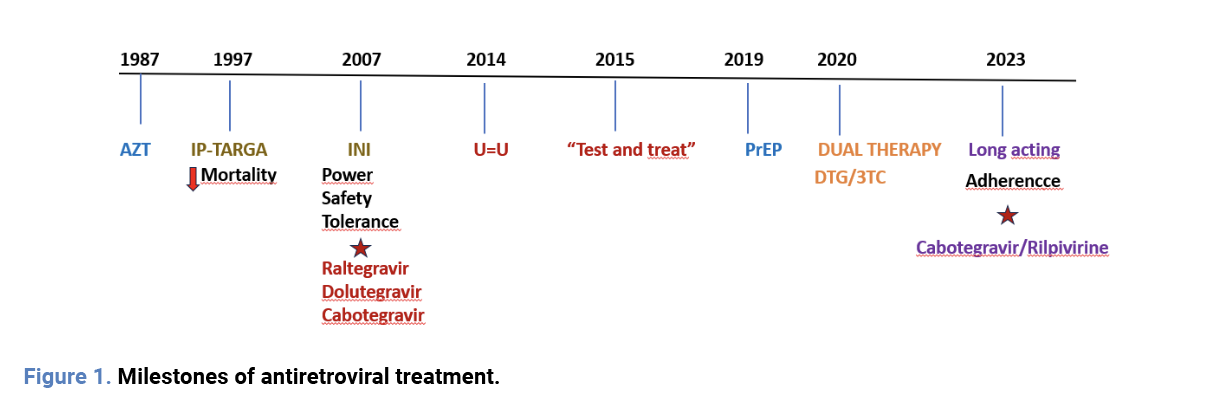 Notably, the PASODOBLE trial [5], presented at the 25th International AIDS Conference (AIDS 2024), is the largest head-to-head randomized clinical trial comparing DTG/3TC with BIC/FTC/TAF. This phase IV, open-label, multicentre study was conducted across 30 Spanish hospitals and enrolled 553 virologically suppressed PLWH without hepatitis B virus (HBV) coinfection. Participants were randomized to switch to either DTG/3TC (n=277) or BIC/FTC/TAF (n=276). The primary endpoint was the proportion of participants with plasma HIV-1 RNA ≥50 copies/mL at week 48 (FDA Snapshot, non-inferiority margin 4%). DTG/3TC was shown to be non-inferior to BIC/FTC/TAF, with proportions of 2.2% and 0.7%, respectively, and a 95% confidence interval (CI) of –0.5 to 3.4.
Another important 2024 study on dual therapy is the DOLCE trial [6], presented at the HIV Drug Therapy Glasgow 2024 Congress. This randomized, open-label, multicentre study evaluated the efficacy and safety of DTG/3TC in 230 ART-naïve, HBsAg-negative individuals with low CD4 counts (≤200 cells/μL). Participants were randomized 2:1 to receive either DTG/3TC (n=152) or DTG plus TDF/XTC (n=77). Both groups included severely immunosuppressed individuals: 32.6% were in CDC category C, 43.4% had CD4 ≤100 cells/μL, 61.3% had HIV RNA ≥100,000 copies/mL, and 23% had ≥500,000 copies/mL. At week 48, similar levels of efficacy were observed: 82% of participants in the DTG/3TC group and 80% in the three-drug regimen group achieved viral suppression (<50 copies/mL). A post-hoc analysis confirmed that DTG/3TC (Dovato®) was non-inferior to the three-drug regimen.
Long-acting treatment
PLWH face several challenges that may negatively impact adherence to treatment. These include HIV-related stigma—which can lead to concealing medications—as well as travel restrictions in certain regions. Additional concerns involve fear of missed doses and the psychological burden of daily reminders of their HIV status. Due to these social and psychological barriers, real-world adherence to daily oral antiretroviral therapy is often suboptimal. In this context, the development of long-acting therapeutic options represents a promising strategy to improve adherence and quality of life. Currently, long-acting injectable agents are the only available formulation for pre-exposure prophylaxis (PrEP), although some oral regimens are under investigation. Cabotegravir, an integrase strand transfer inhibitor (INSTI), blocks HIV-1 integrase, thereby preventing the integration of viral DNA into the host genome. It is the only long-acting drug approved by both the U.S. Food and Drug Administration (FDA) and the European Medicines Agency (EMA) for HIV pre-exposure prophylaxis. It is available as a 30 mg oral tablet and as a 600 mg intramuscular (IM) injection (administered every two months). In two randomized clinical trials, cabotegravir demonstrated superior efficacy to oral TDF/FTC in preventing HIV infection. Cabotegravir/rilpivirine (CAB/RPV) is the first complete long-acting injectable antiretroviral regimen for virologically suppressed adults with HIV-1. Administered intramuscularly every two months, this regimen has been supported by extensive clinical data and offers a safe, effective, and convenient alternative to daily oral therapy. It has been shown to improve adherence, reduce stigma, and enhance patient-reported quality of life. Lenacapavir is a potent HIV-1 capsid inhibitor approved for the treatment of multidrug-resistant HIV-1 infection in combination with other antiretrovirals. Due to its long half-life, it can be administered subcutaneously once every six months. The CARES trial [7], presented at the 31st Conference on Retroviruses and Opportunistic Infections (CROI), aimed to evaluate whether switching virologically suppressed adults to long-acting cabotegravir plus rilpivirine (CAB + RPV LA), administered every eight weeks, is non-inferior to standard daily oral antiretroviral therapy (ART). The study was conducted in Uganda, Kenya, and South Africa, enrolling 512 participants. Several implementation challenges were noted, including high HIV prevalence among Black women, the presence of diverse HIV-1 subtypes (predominantly A1), high rates of obesity, non-nucleoside reverse transcriptase inhibitor (NNRTI) resistance, and limitations in virological monitoring. The primary endpoint was the proportion of participants with plasma HIV-1 RNA <50 copies/mL at week 48, according to the FDA Snapshot algorithm. Despite the complex setting, the trial achieved a 99% retention rate. Virologic suppression was achieved in 96.9% of participants in the CAB/RPV group and 97.3% in the standard-of-care (SOC) group, confirming non-inferiority. One participant (0.4%) in the CAB/RPV arm experienced virologic failure, but subsequently achieved suppression on dolutegravir-based therapy. The long-acting regimen was generally well tolerated, with the most common adverse events being mild injection site reactions. Patient-reported treatment satisfaction increased more significantly in the CAB + RPV group than in the SOC group.Pre-exposure prophylaxis (PrEP)
Currently, the most widely approved regimen for pre-exposure prophylaxis (PrEP) consists of the daily oral administration of tenofovir disoproxil fumarate/emtricitabine (TDF/FTC), although in some countries tenofovir alafenamide/emtricitabine (TAF/FTC) is also approved. In addition, long-acting intramuscular cabotegravir administered every two months has been approved in several countries as an alternative PrEP strategy. In Spain, however, the only PrEP regimen currently approved is the daily oral intake of one tablet of TDF/FTC. The PURPOSE-1 trial [8] (Figure 2) was a multicentre, double-blind, active-controlled, randomized phase III trial conducted in South Africa and Uganda, designed to evaluate the efficacy of long-acting lenacapavir for HIV prevention in women.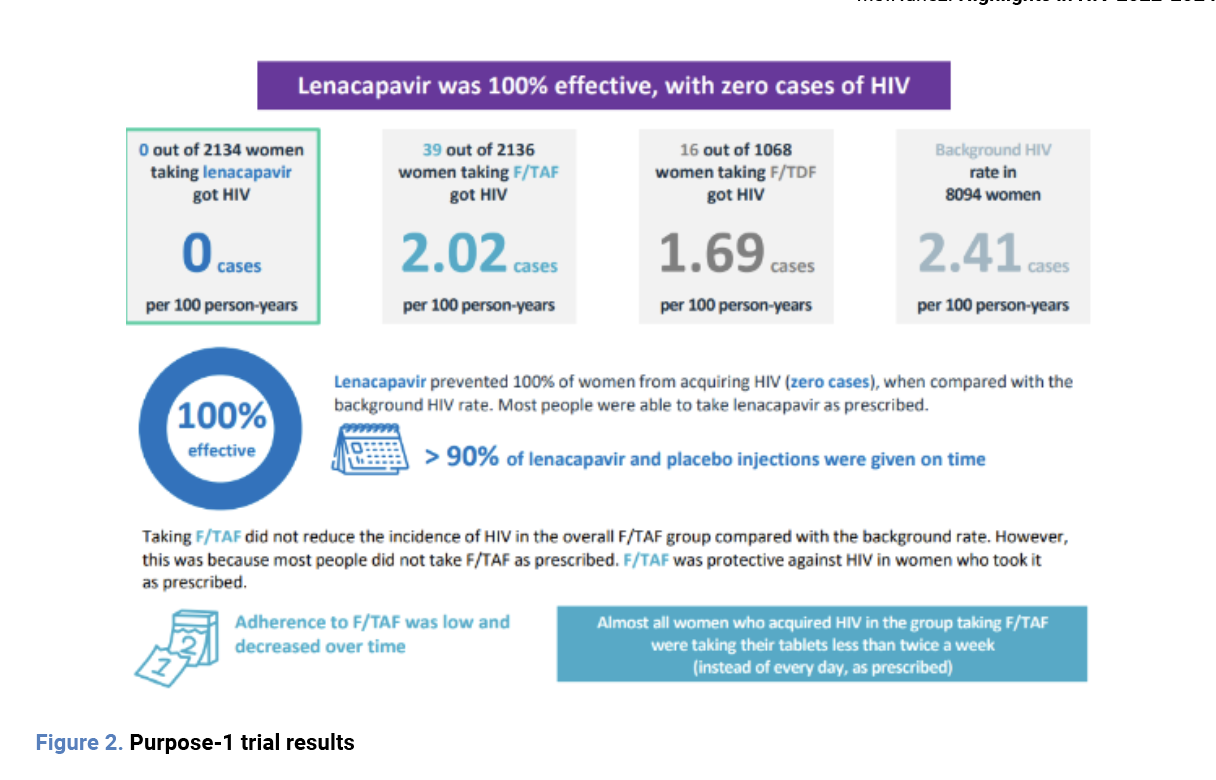 All participants were women aged 16 to 25 years; 99% were Black and over 80% had undergone prior HIV testing. A total of 8,094 women were screened for HIV, and those testing negative were randomized into three arms: Group 1 (n=2,134) received subcutaneous lenacapavir injections every six months; Group 2 (n=2,136) received oral FTC/TAF once daily; and Group 3 received oral FTC/TDF once daily.
The primary endpoint was HIV incidence during the screening and follow-up periods, compared with a background observational cohort (screened but not enrolled). Key secondary endpoints included HIV incidence compared to the FTC/TDF arm, adherence, and safety.
Lenacapavir showed 100% efficacy, with zero HIV infections recorded in the intervention group. In contrast, the HIV incidence was 2.02 cases per 100 person-years in the FTC/TAF group and 1.69 in the FTC/TDF group.
Notably, despite overall low adherence to oral PrEP in this population, over 90% of lenacapavir and placebo injections were administered on schedule. In contrast, most women in the FTC/TAF group reported taking fewer than two tablets per week, limiting its effectiveness. Lenacapavir was well tolerated, with few discontinuations due to adverse events.
Based on these groundbreaking results, Science magazine named lenacapavir the 2024 Breakthrough of the Year. Furthermore, at the 2024 World Economic Forum in Davos, UNAIDS underscored the potential of long-acting PrEP strategies like lenacapavir to end the HIV epidemic—provided global access is rapidly expanded, especially in low- and middle-income countries.
Funding
None to declare.
Conflict of Interest
The author declares no conflict of interest.
Author contributions
Writing—original draft preparation, M.J.N.O.; writing—review and editing, M.J.N.O
References
- Unidad de Vigilancia de VIH, ITS y Hepatitis. Vigilancia epidemiológica del VIH y sida en España 2023: Sistema de Información sobre Nuevos Diagnósticos de VIH y Registro Nacional de Casos de Sida. Centro Nacional de Epidemiología, Instituto de Salud Carlos III/División de Control de VIH, ITS, Hepatitis Virales y Tuberculosis. Ministerio de Sanidad. Madrid; 2024 Nov. Available from: https://www.sanidad.gob.es/ciudadanos/enfLesiones/enfTransmisibles/sida/vigilancia/docs/Informe_VIH_SIDA_2023_Nov_2024_def.pdf [Consulted: 4 May 2025]
- González del Castillo J, Llorens P, Trenc P, Piedrafita L, Cabrera N, Abellas C, et al. New recommendations of Spanish Society of Emergency Medicine (SEMES) for emergency department diagnosis of HIV infection based on results from Spain’s “Leave Your Mark” program. Emergencias. 2024;36:447-59
- Miró E, Miró O, Varón A, Marrón P, Canóniga C, Salgado P, et al. Impact of specialized training for emergency department nurses screening or undetected HIV infection: the “Urgències VIHgila” project experience. Emergencias. 2024;36:188-96
- European Centre for Disease Prevention and Control. HIV stigma in the healthcare setting. Monitoring implementation of the Dublin Declaration on partnership to fight HIV/AIDS in Europe and Central Asia. Stockholm: ECDC; 2024 Jul. ISBN: 978-92-9498-733-4. Available from: https://doi.org/10.2900/255834
- Ryan P, et al. Non-inferior efficacy and less weight gain when switching to DTG/3TC than when switching to BIC/FTC/TAF in virologically suppressed people with HIV (PWH): the PASODOBLE (GeSIDA 11720) randomised clinical trial. Presented at: 25th International AIDS Conference; 2024 Jul; Munich, Germany.
- Figueroa MI, Brites C, Cecchini D, Ramalho A, Francos JL, Lacerda M, et al. Efficacy and safety of dual therapy with dolutegravir/lamivudine in treatment-naive persons with CD4 counts <200/mm³: 48-week results of the DOLCE study. SSRN. 2024. Available from: https://ssrn.com/abstract=5151362 [Consulted: 18 Jul 2025]
- Kityo C, Mugerwa H, Walimbwa S, Nasuuna E, Owarwo NC, Were E, et al. Switch to long-acting cabotegravir and rilpivirine in virologically suppressed adults with HIV in Africa (CARES): week 48 results from a randomized, multicentre, open-label, non-inferiority trial. Lancet Infect Dis. 2024;24(10):1083–92. Available from: https://doi.org/10.1016/S1473-3099(24)00167-8
- Bekker LG, Das M, Abdool Karim Q, Ahmed K, Batting J, Brumskine W, et al.; PURPOSE 1 Study Team. Twice-Yearly Lenacapavir for HIV Prevention in Cisgender Women. N Engl J Med. 2024 Jul;391(13):1179–92. Available from: https://doi.org/10.1056/NEJMoa2407001
Explore
Articles
Volumes
About the journal
Most read
Recomendaciones para la prevención y el tratamiento de las infecciones respiratorias en adultos mayores institucionalizados
Revista Española de Quimioterapia
Acute infectious gastroenteritis in childhood: the role of rapid multiplex molecular syndromic panels in diagnosis and clinical management
Revista Española de Quimioterapia
Características epidemiológicas de pacientes con aislamientos de Enterobacterales productores de carbapenemasas-NDM en un hospital de alta complejidad
Revista Española de Quimioterapia
Review on the management of intra-abdominal candidiasis
Revista Española de Quimioterapia
Neoscytalidium dimidiatum: a rare locally acquired deep cutaneous infection in a renal transplant recipient
Revista Española de Quimioterapia