Review
Volume 38; Suppl. 1
9 min
Introduction to XIV updating course of antimicrobials and infectious diseases
Francisco Javier Candel1,* , Mayra Matesanz2
1Clinical Microbiology and Infectious Diseases. IdISSC & IML Health Research Institutes. Hospital Clínico San Carlos. Madrid.
2Hospital at Home Unit. Department of Internal Medicine. Hospital Clínico San Carlos. Madrid.
https://doi.org/10.37201/req/s01.00.2025
Receipt Date:
14/10/2025
Acceptance Date:
13/10/2025
Publication Date:
23/10/2025
How to cite
Candel FJ, Matesanz M. Introduction to XIV Updating Course of Antimicrobials and Infectious Disease. Rev Esp Quimioter. 2025; 38(Suppl. 1): 1-4. Available from: http://www.doi.org/10.37201/req/s01.00.2025
Metrics
272
Views
76
Downloads
Share
Share
Last February, the 14th Course on Antimicrobials and Infectious Diseases Update took place at the Hospital Clínico San Carlos in Madrid. This scientific activity was accredited by the Community of Madrid (Continuing Education Commission for Healthcare Professions of the Community of Madrid, file Exp.
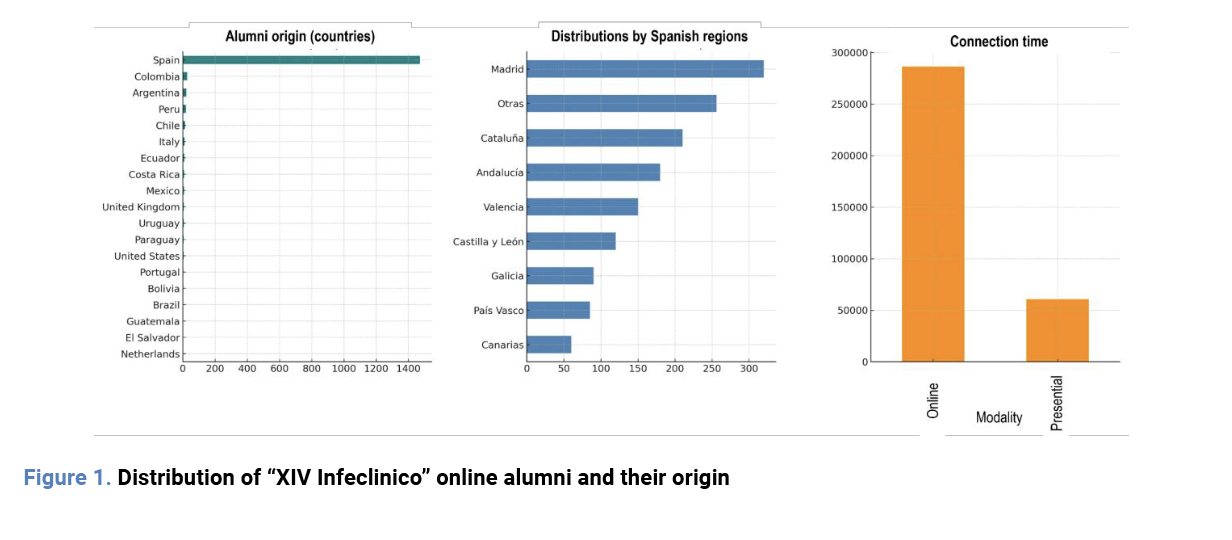
07-AFOC-07063.7/2024) and endorsed by the Spanish Society of Clinical Microbiology and Infectious Diseases (SEIMC), the Spanish Society of Chemotherapy (SEQ), and the Madrid Society of Clinical Microbiology (SMMC). In this edition, the course was held in a hybrid format—both in-person and online—achieving participation from 155 attendees and 786 continuous online connections from Spain and several European and American countries (Figure 1). The audience consisted of multidisciplinary professionals from all infection-related specialities, and the faculty provided an update on the most relevant aspects of bacteriology, mycology, and virology. This issue of the journal includes summaries of the lectures presented.
Diagnostic update
González del Castillo at al. analyzed the usefulness of the Monocyte Distribution Width (MDW) parameter as an early biomarker of infection in critically ill patients seen in emergency departments. This index, integrated into automated blood counts, showed a diagnostic performance comparable to or better than classical biomarkers, with a sensitivity of 73% and a specificity of 72%. Its immediate availability and low cost make it a promising tool for early detection of sepsis (particularly in elderly patients) supporting its integration into clinical algorithms for suspected infection [1-2]. Cercenado and Candel reviewed the main characteristics of the new β-lactamase inhibitors (enmetazobactam, avibactam, relebactam, durlobactam, zidebactam, nacubactam, vaborbactam, taniborbactam, and xeruborbactam), their spectrum of activity, and the available therapeutic combinations. They emphasized how these molecules expand coverage against class A, C, and D enzymes and restore the usefulness of classic β-lactams against Enterobacterales, Pseudomonas aeruginosa, and Acinetobacter baumannii. However, they also warn that emerging resistance during treatment (through KPC mutations, AmpC modifications, or porin loss) requires prudent, microbiologically guided use. Overall, the new BL-BLI combinations (ceftazidime-avibactam, meropenem-vaborbactam, imipenem-relebactam, aztreonam-avibactam, sulbactam-durlobactam, or meropenem-xeruborbactam) represent a crucial advance in managing infections caused by carbapenemase-producing microorganisms, always within an active surveillance framework [3-5]. Cantón and Halperín analyzed the importance of early diagnosis and diagnostic stewardship programs, highlighting the need for 24/7 active laboratories and the incorporation of rapid technologies such as MALDI-TOF or molecular panels. These tools reduce turnaround time, improve therapeutic adequacy, and strengthen collaboration between clinicians and microbiologists in the context of sepsis [6-7]. Sanz, Burillo, and García-Lechuz examined the role of syndromic platforms in the diagnosis of critically ill patients. The simultaneous detection of pathogens and resistance mechanisms through multiplex PCR or microarrays enables early treatment adjustment and reduces hospital stay, consolidating their use as an essential tool in antimicrobial stewardship programs [8-9]. Maldonado-Barrueco and colleagues updated advances in the diagnosis of invasive fungal infections, emphasizing the importance of galactomannan, β-D-glucan, and molecular techniques-together with mass spectrometry to improve early detection of pathogenic fungi and reduce mortality [10-12]. Muñoz-Echeverría and colleagues highlighted the importance of early clinical recognition and immunological and genetic characterization for the diagnosis and management of primary immunodeficiencies in adults, diseases that are often underdiagnosed [13-14].Therapeutic update
Pina-Sánchez and colleagues reviewed therapeutic optimization strategies against bacteria carrying metalloenzymes, emphasizing the relevance of combinations with new β-lactamase inhibitors and the application of pharmacokinetic and pharmacodynamic principles in clinical decision-making [15-17]. Maseda and Suárez de la Rica focused their analysis on the epidemiological and therapeutic evolution of nosocomial peritonitis, highlighting the increase in multidrug-resistant pathogens and emerging antimicrobial options (ceftazidime–avibactam, meropenem–vaborbactam, imipenem–relebactam, or eravacycline). They addressed the usefulness of rapid molecular techniques for early pathogen identification, the limited role of echinocandins in intra-abdominal candidiasis, and the need to shorten therapy duration through strategies guided by procalcitonin and fungal biomarkers. Their analysis synthesizes a rational, up-to-date approach to complicated intra-abdominal infection in the ICU [18-19]. Soriano-Cuesta and colleagues underlined the importance of empirical treatment adjusted to risk and early de-escalation according to microbiological results. The new antibiotics active against carbapenemases and Acinetobacter spp. represent a key tool for improving clinical outcomes [20-21]. Blanes-Hernández and colleagues challenged the classical dogmas of antibiotic therapy (monotherapy versus combination, treatment duration, or actual impact on resistance), promoting a more rational use based on scientific evidence [22-23]. From the viral infection perspective, Fortún analyzed recent advances in the prophylaxis, monitoring, and treatment of cytomegalovirus, especially in the transplant setting. He highlighted the introduction of next-generation antivirals and the importance of personalized strategies according to risk and resistance [24-25]. Finally, Núñez-Orantos reviewed the latest advances in HIV infection, including long-acting therapies, simplified regimens, and combined prevention strategies (PrEP and vaccination) [26-27].References
- Ciaccio AM, Agnello L, Sasso BL, Giglio RV, Iacona A, Gambino CM, et al. Monocyte distribution width (MDW) as a biomarker of sepsis: an evidenced-based laboratory medicine approach. Clin Chim Acta. 2023;540:117214. Available from: https://doi.org/10.1016/j.cca.2022.117214
- Encabo M, Hernández-Álvarez E, Oteo D, García-Álvarez A, Martínez-Novillo González M, et al. Monocyte distribution width (MDW) as an infection indicator in severe patients attending in the Emergency Department: a pilot study. Rev Esp Quimioter. 2023;36(3):267–74. Available from: https://doi.org/10.37201/req/108.2022
- European Centre for Disease Prevention and Control. Assessing the health burden of infections with antibiotic-resistant bacteria in the EU/EEA, 2016–2020. Available from: https://www.ecdc.europa.eu/en/publications-data/health-burden-infections-antibiotic-resistant-bacteria-2016-2020
- Peñalva G, Cantón R, Pérez-Rodríguez MT, González-López JJ, Rodríguez-Baño J, Barrio-Tofiño ED, et al. Burden of bacterial antimicrobial resistance among hospitalised patients in Spain: findings from three nationwide prospective studies. Lancet Reg Health Eur. 2025;51:101220. Available from: https://doi.org/10.1016/j.lanepe.2025.101220
- Bush K. Past and present perspectives on β-lactamases. Antimicrob Agents Chemother. 2018;62(10):e01076-18. Available from: https://doi.org/10.1128/AAC.01076-18
- Kumar A, Roberts D, Wood KE, Light B, Parrillo JE, Sharma S, et al. Duration of hypotension before initiation of effective antimicrobial therapy is the critical determinant of survival in human septic shock. Crit Care Med. 2006;34(6):1589–96. Available from: https://doi.org/10.1097/01.CCM.0000217961.75225.E9
- Peri AM, Chatfield MD, Ling W, Furuya-Kanamori L, Harris PNA, Paterson DL. Rapid diagnostic tests and antimicrobial stewardship programs for the management of bloodstream infection: what is their relative contribution to improving clinical outcomes? a systematic review and network meta-analysis. Clin Infect Dis. 2024;79(2): 502–15. Available from: https://doi.org/10.1093/cid/ciae234
- Khare R, Kothari T, Castagnaro J, Hemmings B, Tso M, Juretschko S. Active monitoring and feedback to improve blood culture fill volumes and positivity across a large integrated health system. Clin Infect Dis. 2020;70(2):262–8. Available from: https://doi.org/10.1093/cid/ciz198
- Candel FJ, Salavert M, Cantón R, Del Pozo JL, Galán-Sánchez F, Navarro D, et al. The role of rapid multiplex molecular syndromic panels in the clinical management of infections in critically ill patients: an experts-opinion document. Crit Care. 2024;28(1):440. Available from: https://doi.org/10.1186/s13054-024-05224-3
- Boch T, Reinwald M, Spiess B, Liebregts T, Schellongowski P, Meybohm P, et al. Detection of invasive pulmonary aspergillosis in critically ill patients by combined use of conventional culture, galactomannan, 1-3-beta-D-glucan and Aspergillus-specific nested polymerase chain reaction in a prospective pilot study. J Crit Care. 2018;47:198–203. Available from: https://doi.org/10.1016/j.jcrc.2018.07.001
- Leeflang MM, Debets-Ossenkopp YJ, Wang J, Visser CE, Scholten RJ, Hooft L, et al. Galactomannan detection for invasive aspergillosis in immunocompromised patients. Cochrane Database Syst Rev. 2015;2015(12):CD007394. Available from: https://doi.org/10.1002/14651858.CD007394.pub2
- Wu Z, Wang L, Tan L, Wu J, Chen Z, Hu M. Diagnostic value of galactomannan in serum and bronchoalveolar lavage fluid for invasive pulmonary aspergillosis in non-neutropenic patients. Diagn Microbiol Infect Dis. 2021;99:115274. Available from: https://doi.org/10.1016/j.diagmicrobio.2020.115274
- Sullivan KE, Orange JS, editors. Inborn errors of immunity (primary immunodeficiencies): classification. UpToDate. Last updated Apr 15, 2024 [Accessed Feb 5, 2025]. Available from: https://www.uptodate.com
- Tangye SG, Al-Herz W, Bousfiha A, Cunningham-Rundles C, Franco JL, Holland SM, et al. Human inborn errors of immunity: 2022 update on classification. J Clin Immunol. 2022;42:1473–507. Available from: https://doi.org/10.1007/s10875-022-01289-3
- Boattini M, Gaibani P, Comini S, Costa C, Cavallo R, Broccolo F, et al. In vitro activity and resistance mechanisms of novel antimicrobial agents against metallo-β-lactamase producers. Eur J Clin Microbiol Infect Dis. 2025;44:1041–68. Available from: https://doi.org/10.1007/s10096-025-05080-1
- Grabein B, Arhin FF, Daikos GL, Moore LSP, Balaji V, Baillon-Plot N. Navigating the current treatment landscape of metallo-β-lactamase-producing Gram-negative infections: what are the limitations? Infect Dis Ther. 2024;13:2423–47. Available from: https://doi.org/10.1007/s40121-024-01044-8
- Hidalgo-Tenorio C, Bou G, Oliver A, Rodríguez-Aguirregabiria M, Salavert M, Martínez-Martínez L. The challenge of treating infections caused by metallo-β-lactamase–producing Gram-negative bacteria: a narrative review. Drugs. 2024;84:1519–39. Available from: https://doi.org/10.1007/s40265-024-02102-8
- Blot S, Antonelli M, Arvaniti K, Blot K, Creagh-Brown B, de Lange D, et al; Abdominal Sepsis Study (AbSeS) group on behalf of the Trials Group of the European Society of Intensive Care Medicine. Epidemiology of intra-abdominal infection and sepsis in critically ill patients: “AbSeS”, a multinational observational cohort study and ESICM Trials Group project. Intensive Care Med. 2019;45(12):1703–17. Available from: https://doi.org/10.1007/s00134-019-05819-3
- De Pascale G, Antonelli M, Deschepper M, Arvaniti K, Blot K, Brown C, et al; Abdominal Sepsis Study (AbSeS) group and the Trials Group of the European Society of Intensive Care Medicine. Poor timing and failure of source control are risk factors for mortality in critically ill patients with secondary peritonitis. Intensive Care Med. 2022;48(11):1593–606. Available from: https://doi.org/10.1007/s00134-022-06883-y
- Tamma PD, Heil EL, Justo JA, Mathers AJ, Satlin MJ, Bonomo RA. Infectious Diseases Society of America 2024 guidance on the treatment of antimicrobial-resistant Gram-negative infections. Clin Infect Dis. 2024;ciae403. Available from: https://doi.org/10.1093/cid/ciae403
- Timsit JF, Bassetti M, Cremer O, Daikos G, de Waele J, Kallil A, et al. Rationalizing antimicrobial therapy in the ICU: a narrative review. Intensive Care Med. 2019;45(2):172–89. Available from: https://doi.org/10.1007/s00134-019-05520-5
- Lam JC, Bourassa-Blanchette S. Ten common misconceptions about antibiotic use in the hospital. J Hosp Med. 2023;18(12):1123–9. Available from: https://doi.org/10.1002/jhm.13220
- McCreary EK, Johnson MD, Jones TM, Spires SS, Davis AE, Dyer AP, et al. Antibiotic myths for the infectious diseases clinician. Clin Infect Dis. 2023;77(8):1120–5. Available from: https://doi.org/10.1093/cid/ciad357
- Ruiz-Arabi E, Torre-Cisneros J, Aguilera V, Alonso R, Berenguer M, Bestard O, et al. Management of cytomegalovirus in adult solid organ transplant patients: GESITRA-IC-SEIMC, CIBERINFEC, and SET recommendations update. Transplant Rev (Orlando). 2024;38(4):100875. Available from: https://doi.org/10.1016/j.trre.2024.100875
- Piñana JL, Giménez E, Vázquez L, Marcos MÁ, Guerreiro M, Duarte R, et al. Update on cytomegalovirus infection management in allogeneic hematopoietic stem cell transplant recipients: a consensus document of the Spanish Group for Hematopoietic Transplantation and Cell Therapy (GETH-TC). Mediterr J Hematol Infect Dis. 2024;16(1):e2024065. Available from: https://doi.org/10.4084/MJHID.2024.065
- Kityo C, Mugerwa H, Walimbwa S, Nasuuna E, Owarwo NC, Were E, et al. Switch to long-acting cabotegravir and rilpivirine in virologically suppressed adults with HIV in Africa (CARES): week 48 results from a randomized, multicentre, open-label, non-inferiority trial. Lancet Infect Dis. 2024;24(10):1083–92. Available from: https://doi.org/10.1016/S1473-3099(24)00167-8
- Bekker LG, Das M, Abdool Karim Q, Ahmed K, Batting J, Brumskine W, et al; PURPOSE 1 Study Team. Twice yearly lenacapavir for HIV prevention in cisgender women. N Engl J Med. 2024;391(13):1179–92. Available from: https://doi.org/10.1056/NEJMoa2407001
Explore
Articles
Volumes
About the journal
Most read
Recomendaciones para la prevención y el tratamiento de las infecciones respiratorias en adultos mayores institucionalizados
Revista Española de Quimioterapia
Acute infectious gastroenteritis in childhood: the role of rapid multiplex molecular syndromic panels in diagnosis and clinical management
Revista Española de Quimioterapia
Características epidemiológicas de pacientes con aislamientos de Enterobacterales productores de carbapenemasas-NDM en un hospital de alta complejidad
Revista Española de Quimioterapia
Review on the management of intra-abdominal candidiasis
Revista Española de Quimioterapia
Neoscytalidium dimidiatum: a rare locally acquired deep cutaneous infection in a renal transplant recipient
Revista Española de Quimioterapia