Letter
February 2026, Volume 39, nº 1
6 min
Lung abscess in a migrant
Carlos Ruiz-de-Alegría-Puig1*, Francisco Arnaiz-Las-Revillas1, Daniela Andia-Torrico1, Ana María De-Malet Pintos-Fonseca2
1Hospital Universitario Marqués de Valdecilla, Santander, España
2Hospital do Meixoeiro, Vigo, España
http://www.doi.org/10.37201/req/100.2025
Receipt Date:
24/09/2025
Acceptance Date:
30/10/2025
Publication Date:
12/01/2026
How to cite
Ruiz-de-Alegría-Puig C, Arnaiz-Las-Revillas F, Andia-Torrico D, De-Malet Pintos-Fonseca AM. Lung abscess in a migrant. Rev Esp Quimioter 2026; 39(1):73-75. Available from: http://www.doi.org/10.37201/req/100.2025
Metrics
334
Views
34
Downloads
Share
Share
Sir,
Echinococcosis, or hydatidosis, is a parasitic disease caused by infestation by larvae of several species of a cestode parasite or gastrointestinal worm (tapeworm, genus Echinococcus) of importance to livestock production and public health [1].
Hydatid cysts can develop in virtually every organ, most commonly in the liver and lungs [2]. The most common complication is cyst rupture and infection. The purpose of this case report is to highlight some important features of this type of Echinococcus granulosus infection.
In April 2022, a 20-year-old male presented to the emergency department with chest pain. The patient had been complaining for two months of a pressing central chest pain, always at rest, usually when lying down, with no gastroesophageal reflux, nausea, dyspnoea or palpitations. The pain radiated into both arms, causing weakness, and disappeared within 20 minutes. The patient came from a rural area of Morocco, was a pack-a-day smoker, and his father owned a farm. Blood analysis showed no leukocytosis, neutrophilia, or eosinophilia, and no elevated liver enzymes. An anteroposterior chest radiograph and an abdominal thoracic CT scan with contrast (Figure 1) revealed a 9.5 × 8.2 cm thin-walled cystic lesion in the axial plane and an 11.5 cm long craniocaudal thin-walled cystic lesion in the right hemithorax.
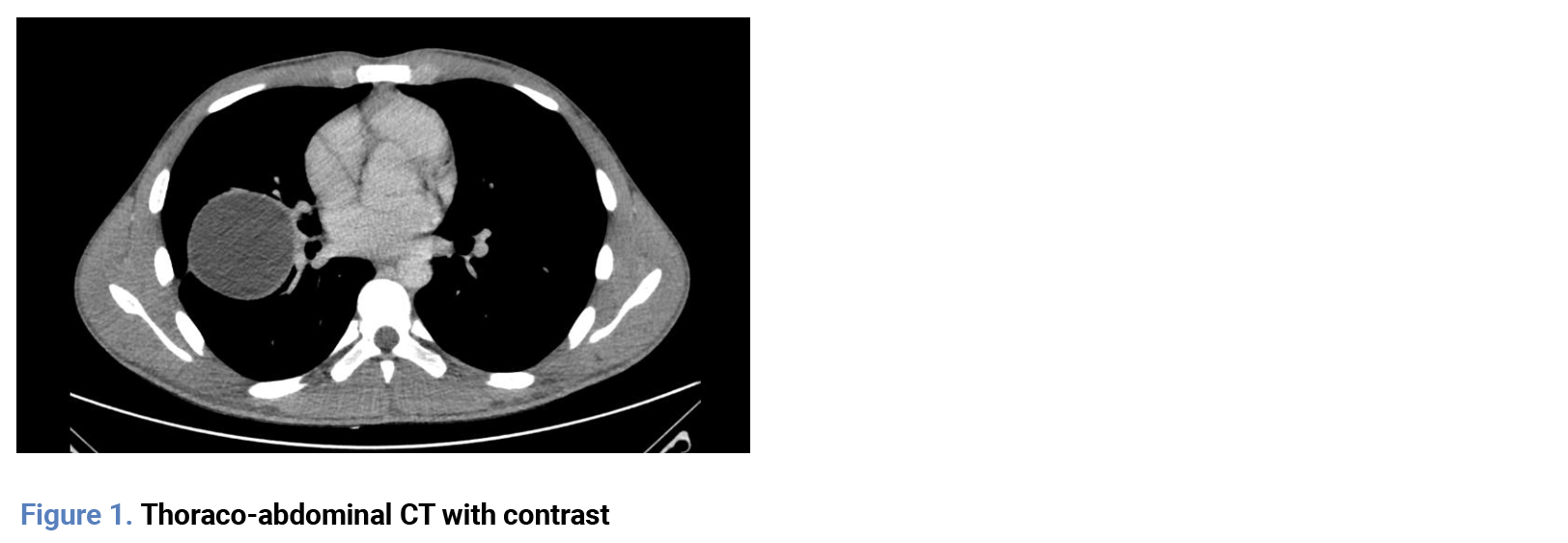 The liver, pancreas, spleen, adrenal glands, and both kidneys were unremarkable. Surgery to remove the cyst was recommended, but the patient refused. He subsequently returned for surgery in May 2024, at which time an immunoglobulin G serology test for hydatidosis was performed using a commercially available indirect haemagglutination assay (IHA) (Echinococcosis Fumouze; Laboratoires Fumouze, Levallois-Perret, France), with a negative result. An apparent hydatid cyst was removed and confirmed in the microbiology laboratory (Figure 2).
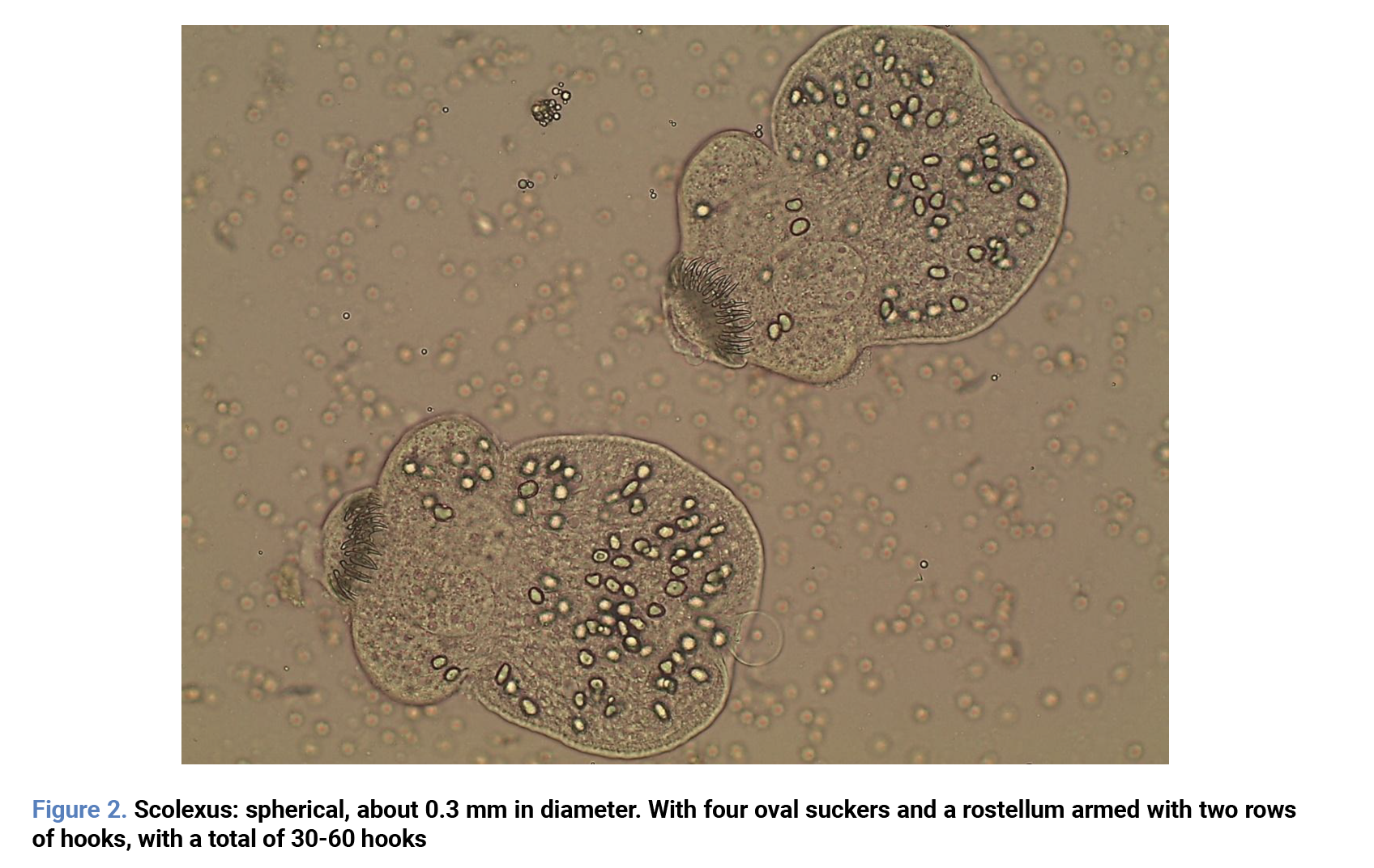 Treatment with albendazole (400 mg) was started, completing 28 days after surgery with good clinical evolution, remaining asymptomatic months after surgery with normal thoracic radiography.
Medical history remains a fundamental tool for suspecting rare diseases in our environment. This parasite is endemic in Morocco, as well as in other countries in Central and South America, Central and Southern Europe, some sub-Saharan countries, Russia, and China.
Of patients with cystic echinococcosis, 85–90% show single organ involvement, and more than 70% harbor a solitary cyst. The liver is the most common site of cyst formation, followed by the lungs in 10–30% of cases and other organs in 10% of cases. In children and young adults, the lungs may be the most common site of cyst formation and are giant because of their greater lung elasticity. Pulmonary hydatid cysts are mainly located in the lower lobes (55-70% of cases) and can sometimes be multiple (30%) and bilateral (20%). Among patients with pulmonary cysts, 20-40% also have liver cysts [3]. Most patients with pulmonary hydatid disease do not show liver involvement, which suggests that either the liver filter has not worked properly or has been bypassed, but it does not exclude the possibility of a simultaneous intrahepatic transplantation. The lungs also facilitate cyst growth due to the negative pressure and compressibility of the lungs, which may explain the high prevalence of the disease in the lungs and the easy growth of cysts in children.
The negative serology for fully established hydatidosis is also striking in this case. Immunodiagnostic tests for serum antibodies or circulating antigens provide evidence to confirm pulmonary echinococcosis. The commercial indirect haemagglutination test used has a sensitivity of 88% and a specificity of 98.4% at the manufacturer’s recommended cut-off of 320. However, an enzyme-linked immunosorbent assay or indirect haemagglutination test is found positive in only around half of patients with pulmonary cysts and over 90% of patients with liver cysts [4].
Hydatid fluid is the main source of antigens used both for primary immunodiagnosis and for monitoring patients after surgical or pharmacological treatment. However, problems have been encountered in standardizing its use, as well as in terms of its sensitivity and specificity [5,6]. For example, a high percentage of patients with clinically or surgically confirmed hydatidosis are seronegative, while cross-reactivity issues are common with sera from individuals infected with other helminths, mainly E. multilocularis and Taenia solium [7]. The use of molecular biology techniques has also led to the availability of a considerable range of recombinant proteins and synthetic peptides, the use of which, individually or in combination, has greatly improved the diagnostic performance of available techniques [8]. However, despite all these advances, there is currently no standardised technique that combines high diagnostic sensitivity and specificity [9].
Although surgery is effective in treating pulmonary hydatidosis in patients with both complicated and uncomplicated cysts, it is essential that surgery be performed before the cysts rupture [10].
Funding
None to declare.
Author contributions
Conceptualization, C.R.A.P., and A.D.M.P.F.; writing and original draft preparation, C.R.A.P.; review and editing, C.R.A.P., F.A.L.R., D.A.T., and A.D.M.P.F.; supervision, C.R.A.P., F.A.L.R., D.A.T., and A.D.M.P.F. All authors have read and agreed to the published version of the manuscript.
Conflicts of interest
The authors declare that they have no conflicts of interest.
AI statement
No artificial intelligence tools were used in the writing, analysis, interpretation, or review of this article.
[h2]
[/h2]
The liver, pancreas, spleen, adrenal glands, and both kidneys were unremarkable. Surgery to remove the cyst was recommended, but the patient refused. He subsequently returned for surgery in May 2024, at which time an immunoglobulin G serology test for hydatidosis was performed using a commercially available indirect haemagglutination assay (IHA) (Echinococcosis Fumouze; Laboratoires Fumouze, Levallois-Perret, France), with a negative result. An apparent hydatid cyst was removed and confirmed in the microbiology laboratory (Figure 2).
Treatment with albendazole (400 mg) was started, completing 28 days after surgery with good clinical evolution, remaining asymptomatic months after surgery with normal thoracic radiography.
Medical history remains a fundamental tool for suspecting rare diseases in our environment. This parasite is endemic in Morocco, as well as in other countries in Central and South America, Central and Southern Europe, some sub-Saharan countries, Russia, and China.
Of patients with cystic echinococcosis, 85–90% show single organ involvement, and more than 70% harbor a solitary cyst. The liver is the most common site of cyst formation, followed by the lungs in 10–30% of cases and other organs in 10% of cases. In children and young adults, the lungs may be the most common site of cyst formation and are giant because of their greater lung elasticity. Pulmonary hydatid cysts are mainly located in the lower lobes (55-70% of cases) and can sometimes be multiple (30%) and bilateral (20%). Among patients with pulmonary cysts, 20-40% also have liver cysts [3]. Most patients with pulmonary hydatid disease do not show liver involvement, which suggests that either the liver filter has not worked properly or has been bypassed, but it does not exclude the possibility of a simultaneous intrahepatic transplantation. The lungs also facilitate cyst growth due to the negative pressure and compressibility of the lungs, which may explain the high prevalence of the disease in the lungs and the easy growth of cysts in children.
The negative serology for fully established hydatidosis is also striking in this case. Immunodiagnostic tests for serum antibodies or circulating antigens provide evidence to confirm pulmonary echinococcosis. The commercial indirect haemagglutination test used has a sensitivity of 88% and a specificity of 98.4% at the manufacturer’s recommended cut-off of 320. However, an enzyme-linked immunosorbent assay or indirect haemagglutination test is found positive in only around half of patients with pulmonary cysts and over 90% of patients with liver cysts [4].
Hydatid fluid is the main source of antigens used both for primary immunodiagnosis and for monitoring patients after surgical or pharmacological treatment. However, problems have been encountered in standardizing its use, as well as in terms of its sensitivity and specificity [5,6]. For example, a high percentage of patients with clinically or surgically confirmed hydatidosis are seronegative, while cross-reactivity issues are common with sera from individuals infected with other helminths, mainly E. multilocularis and Taenia solium [7]. The use of molecular biology techniques has also led to the availability of a considerable range of recombinant proteins and synthetic peptides, the use of which, individually or in combination, has greatly improved the diagnostic performance of available techniques [8]. However, despite all these advances, there is currently no standardised technique that combines high diagnostic sensitivity and specificity [9].
Although surgery is effective in treating pulmonary hydatidosis in patients with both complicated and uncomplicated cysts, it is essential that surgery be performed before the cysts rupture [10].
Funding
None to declare.
Author contributions
Conceptualization, C.R.A.P., and A.D.M.P.F.; writing and original draft preparation, C.R.A.P.; review and editing, C.R.A.P., F.A.L.R., D.A.T., and A.D.M.P.F.; supervision, C.R.A.P., F.A.L.R., D.A.T., and A.D.M.P.F. All authors have read and agreed to the published version of the manuscript.
Conflicts of interest
The authors declare that they have no conflicts of interest.
AI statement
No artificial intelligence tools were used in the writing, analysis, interpretation, or review of this article.
[h2]
[/h2]
References
- Majbar AM, Aalala M, Elalaoui M, Sabbah F, Raiss M, Hrora A, et al. Asymptomatic Intra-Peritoneal Rupture of Hydatid Cyst of the Liver: Case Report. BMC Research Notes, 2014;7:114. Available from: https://doi.org/10.1186/1756-0500-7-114
- Iqbal N, Hussain M, Idress R, Irfan M. Disseminated hydatid cyst of liver and lung. BMJ Case Rep. 2017;2017:bcr2017222808. Available from: https://doi.org/10.1136/bcr-2017-222808
- Onal O, Demir OF. The relation between the location and the perforation rate of lung hydatid cysts in children. Asian J Surg. 2018;41(5):422-426. Available from: https://doi.org/10.1016/j.asjsur.2017.04.001
- Gottstein B, Reichen J. Hydatid lung disease (echinococcosis/hydatidosis). Clin Chest Med. 2002;23(2):397-408. Available from: https://doi.org/10.1016/s0272-5231(02)00007-2
- Irabuena O, Nieto A, Ferreira A, Battistoni J, Ferragut G. Characterization and optimization of bovine Echinococcus granulosus cyst fluid to be used in immunodiagnosis of hydatid disease by ELISA. Rev Inst Med Trop S Paulo, 2000;42(5):255-262. Available from: https://doi.org/10.1590/s0036-46652000000500004
- Liance M, Janin V, Bresson-Hadni S, Vuitton DA, Houin R, Piarroux R. Immunodiagnosis of Echinococcus infections: confirmatory testing and species differentiation by new commercial Western blot. J Clin Microbiol, 2000;38(10):3718-3721. Available from: https://doi.org/10.1128/JCM.38.10.3718-3721.2000
- Hajjafari A, Sadr S, Santucciu C, Masala G, Bayat M, Lotfalizadeh N, et al. Advances in Detecting Cystic Echinococcosis in Intermediate Hosts and New Diagnostic Tools: A Literature Review. Vet Sci. 2024;11(6):227. Available from: https://doi.org/10.3390/vetsci11060227
- Zhang W, Li J, McManus DP. Concepts in immunology and diagnosis of hydatid disease. Clin Microbiol Rev. 2003;16(1):18-36. Available from: https://doi.org/10.1128/CMR.16.1.18-36.2003
- Li J, Zhang W-B, Wilson M, Ito A, McManus DP. A novel recombinant antigen for immunodiagnosis of human cystic echinococcosis. J Infect Dis. 2003;188(12):1951-1960. Available from: https://doi.org/10.1086/379976
- Kuzucu A, Soysal O, Ozgel M, Yologlu S. Complicated hydatid cysts of the lung: clinical and therapeutic issues. Ann Thorac Surg. 2004;77(4):1200-1204. Available from: https://doi.org/10.1016/j.athoracsur.2003.09.046
Explore
Articles
Volumes
About the journal
Most read
Recomendaciones para la prevención y el tratamiento de las infecciones respiratorias en adultos mayores institucionalizados
Revista Española de Quimioterapia
Acute infectious gastroenteritis in childhood: the role of rapid multiplex molecular syndromic panels in diagnosis and clinical management
Revista Española de Quimioterapia
Características epidemiológicas de pacientes con aislamientos de Enterobacterales productores de carbapenemasas-NDM en un hospital de alta complejidad
Revista Española de Quimioterapia
Review on the management of intra-abdominal candidiasis
Revista Española de Quimioterapia
Neoscytalidium dimidiatum: a rare locally acquired deep cutaneous infection in a renal transplant recipient
Revista Española de Quimioterapia