Letter
December 2025, Volume 38, nº 6
6 min
Neoscytalidium dimidiatum: a rare locally acquired deep cutaneous infection in a renal transplant recipient
Laudy Rivero-Rodríguez1* , Daniel Adrados-Ruiz1, Andrea San-José-Rodríguez1, Julio Orlando Rodríguez-López1
1Complejo Hospitalario Universitario Insular Materno Infantil, Las Palmas de Gran Canaria, Spain
http://www.doi.org/10.37201/req/064.2025
Receipt Date:
14/07/2025
Acceptance Date:
17/11/2025
Publication Date:
02/12/2025
How to cite
Rivero-Rodríguez L, Adrados-Ruiz D, San-José-Rodríguez A, Rodríguez-López JO. Neoscytalidium dimidiatum: a rare locally acquired deep cutaneous infection in a renal transplant recipient. Rev Esp Quimioter 2025; 38(6): 535-538. Available from: http://www.doi.org/10.37201/req/064.2025
Metrics
1394
Views
58
Downloads
Share
Share
Sir,
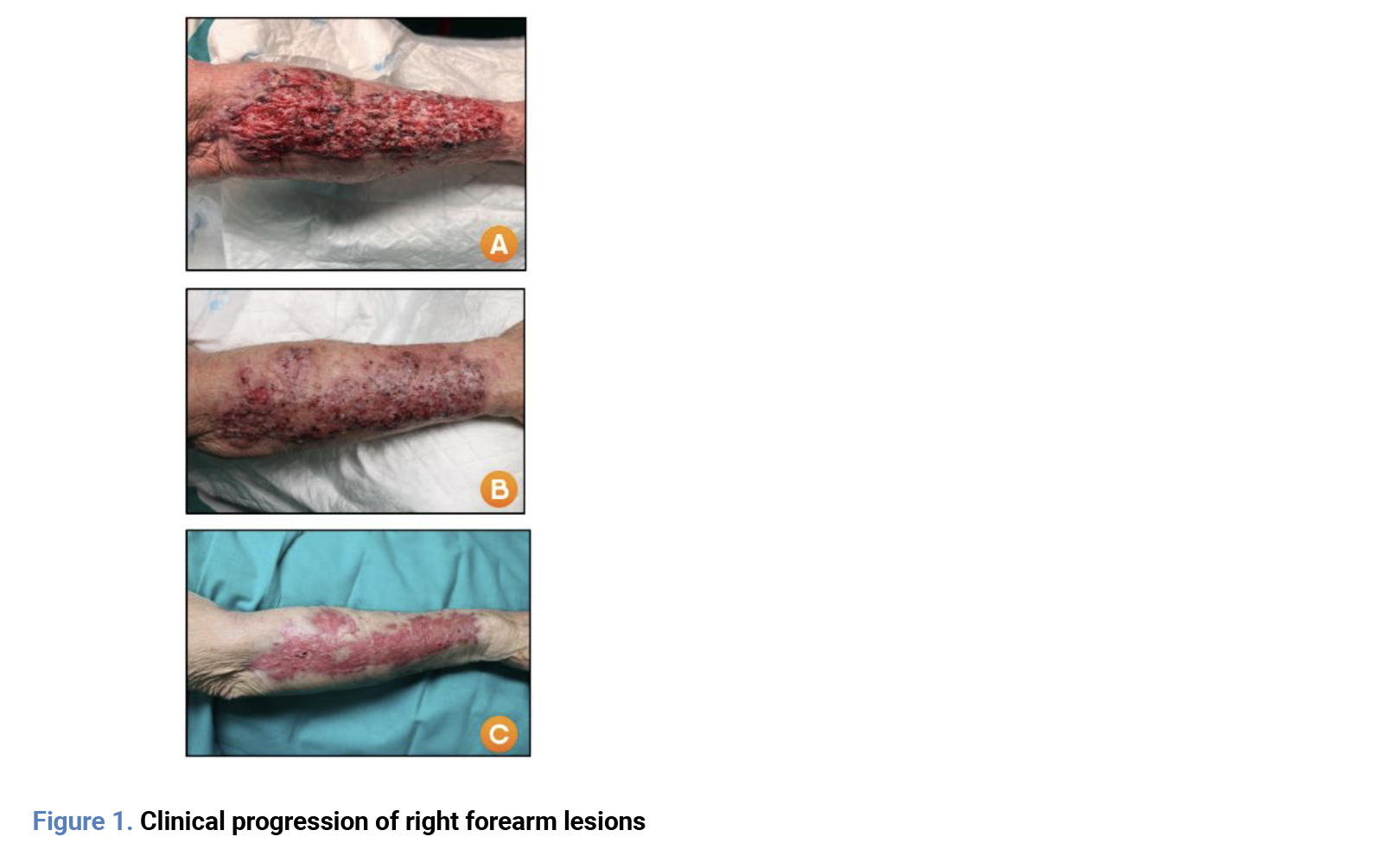
A 76-year-old man from Gran Canaria underwent renal transplantation in May 2022 for chronic renal insufficiency and was maintained on tacrolimus, mycophenolate mofetil, and prednisone. In November 2024, he developed painful, progressive ulcerative and suppurative lesions on his right forearm with edema and blackish crusts after what the patient himself described as a ‘mild trauma caused by a rose bush at his home,’ which resulted in a superficial erosion on the distal forearm. No significant bleeding or systemic symptoms were reported at that time (Figure 1A).
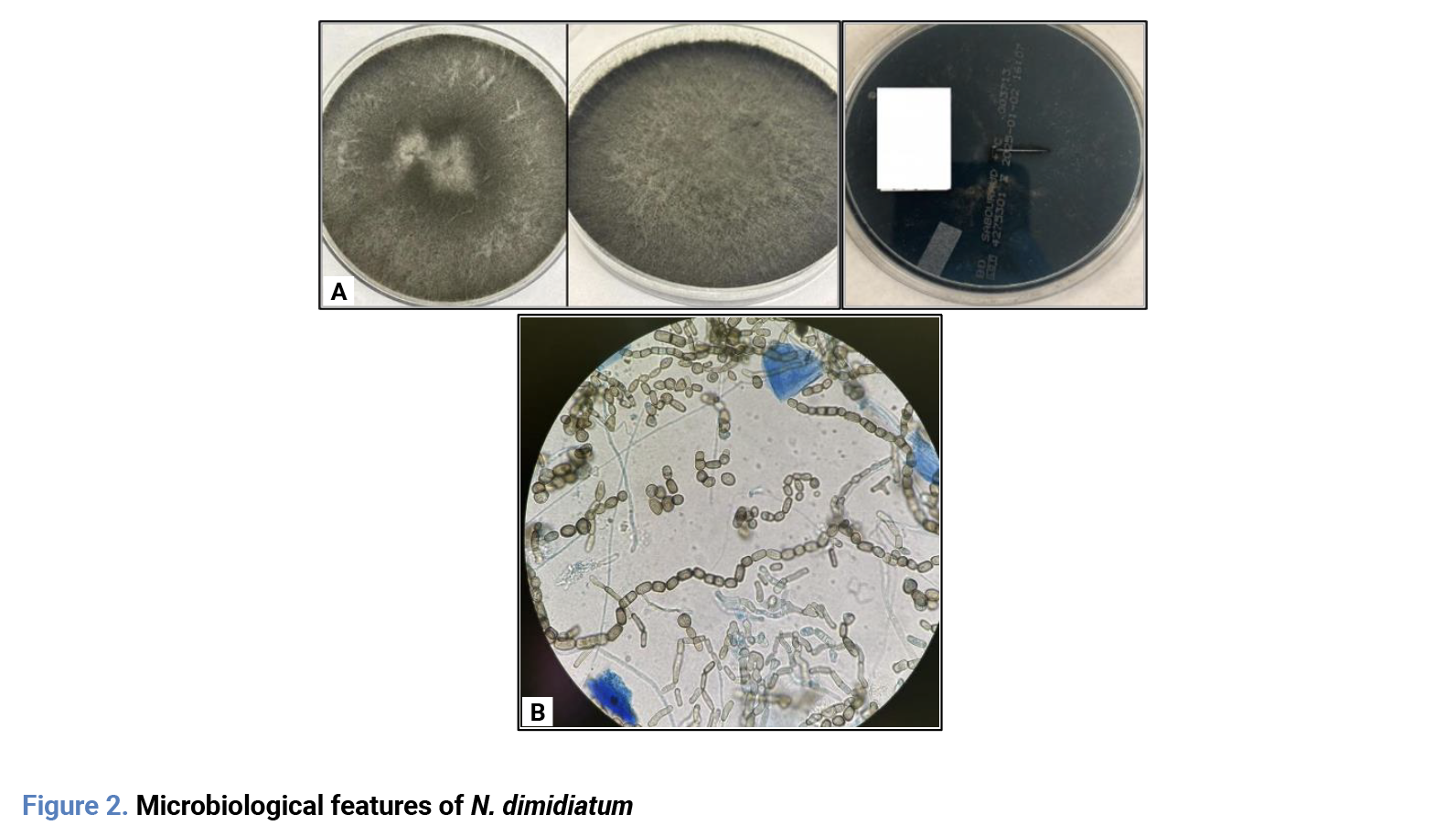
 He reported no international travel. Histological diagnosis of deep soft-tissue invasion was performed through visualization of septate hyphae extending down to the hypodermis using PAS and Grocott-Gomori stains. Cultures on Sabouraud Dextrose Agar with chloramphenicol at 28°C and 37°C yielded Neoscytalidium dimidiatum after 4 days, identified by macroscopic (dark, woolly colonies) and microscopic (arthroconidia and hyphae in lactophenol cotton blue; Figure 2) features, confirmed by MALDI-TOF MS (Bruker Daltonics™) and validated at the National Mycology Reference Center (ISCIII, Madrid).
 Antifungal susceptibility testing (EUCAST v10.0) revealed minimum inhibitory concentration (MIC) values of liposomal amphotericin B 0.03 mg/L, terbinafine 0.5 mg/L, voriconazole 2 mg/L, itraconazole >8 mg/L, and caspofungin 4 mg/L [1].
Empirical treatment was initiated in December 2024 with oral terbinafine (250 mg every 48 hours, adjusted for renal function: creatinine 2.14 mg/dL, GFR 29 mL/min), followed by a switch to oral caspofungin (70 mg loading dose, then 50 mg/day) and discontinuation of mycophenolate mofetil due to lack of clinical response. The lesions showed mild improvement (Figure 1B); however, therapy was subsequently changed to liposomal amphotericin B (300 mg/day) after obtaining the antifungal susceptibility results, which showed greater sensitivity of the isolate to amphotericin B, and the treatment was therefore adjusted, switching to amphotericin B in order to optimize therapeutic efficacy [2].
By February 2025, voriconazole (200 mg every 12 hours) was initiated for maintenance, with tacrolimus monitoring for interactions, resulting in near-complete resolution with minimal hyperpigmentation (Figure 1C) and culture-negative follow-up biopsies.
Although multiple surgical debridements of necrotic areas were performed, extensive surgical excision was not pursued due to the large surface involved, affecting the entire dorsal aspect of the forearm. In the absence of fever, systemic symptoms, or elevated acute-phase reactants in blood tests, a multidisciplinary team (nephrology, dermatology, and infectious diseases units) decided not to conduct staging studies at the initial timepoint. This case, adhering to CARE guidelines with ethical approval (CHUIMI-2024-112, October 15, 2024) and informed consent, highlights N. dimidiatum as an opportunistic pathogen in transplant recipients.
A 2025 systematic review identified only seven deep cutaneous and seven invasive cases globally over 25 years, mostly in tropical settings [3]. European reports of invasive infections are limited, such as a French series of five invasive cutaneous cases in renal transplant recipients (2001–2011), all linked to tropical origins and travel [4]. Published superficial infections in Europe are often imported [5], including four cases in Spain (onychomycosis and tinea pedis linked to South America) [6], 18 dermatomycoses in Switzerland (2009–2018, associated with migrant origins from Africa and Asia) [5], and superficial mycoses in French Guiana (2006–2009, with N. dimidiatum in onychomycoses) [7].
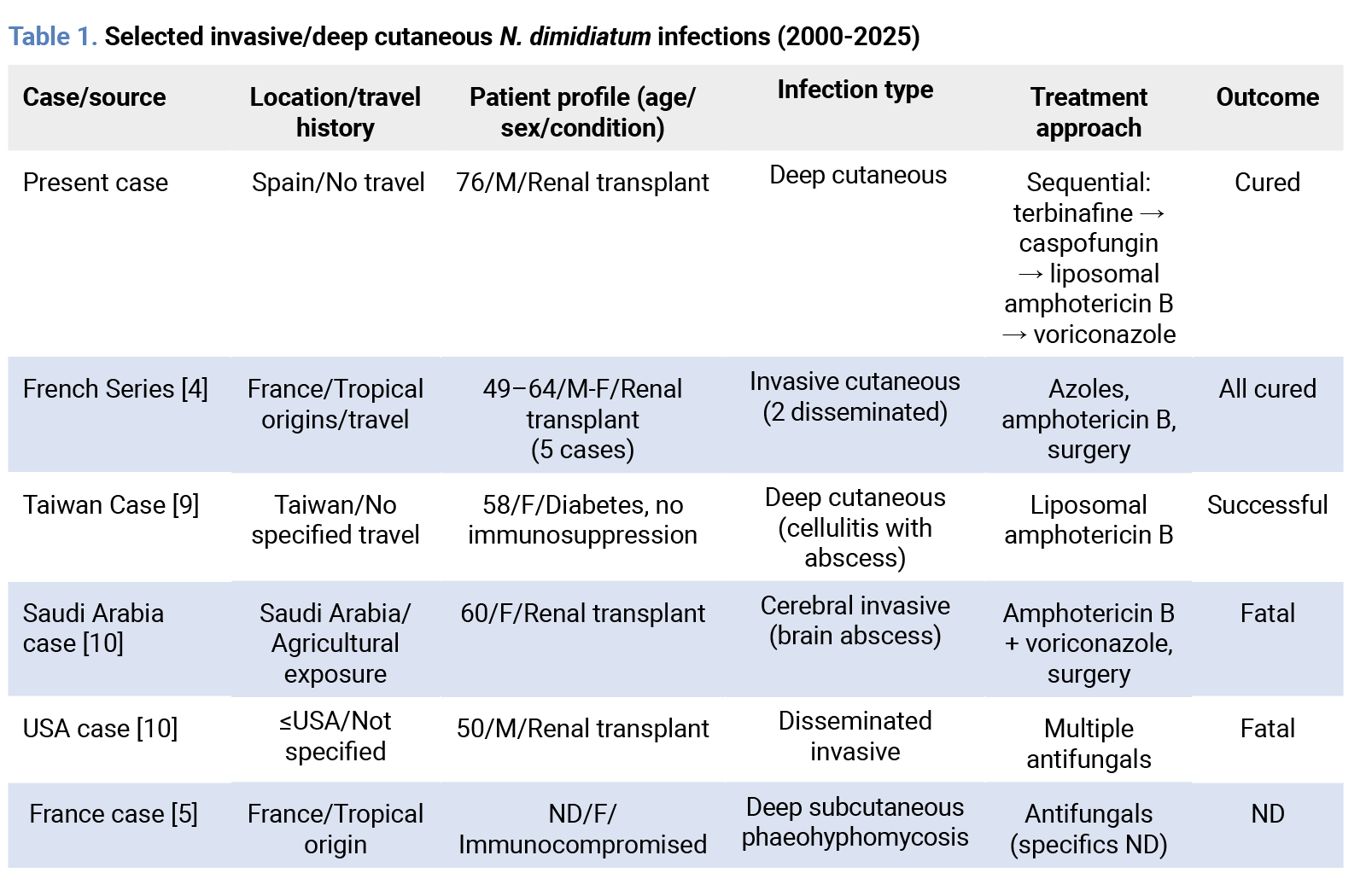 The absence of travel in this case suggests local acquisition, possibly influenced by Gran Canaria’s subtropical climate and ongoing warming trends facilitating fungal adaptation [8]. Diagnosis relied on culture, microscopy, and susceptibility testing, which helps explain initial terbinafine failure due to poor deep penetration and caspofungin’s suboptimal MIC, while amphotericin B and voriconazole aligned with reported efficacy [9]. Reduction of immunosuppression was key, mirroring successes in the French series [4] without the dissemination seen in some fatal cases [10].
Strengths include comprehensive diagnostics and multidisciplinary management; limitations are the single-case nature, lack of standardized breakpoints, and unconfirmed environmental source.
This report emphasizes the need for heightened suspicion of N. dimidiatum in non-endemic Europe, even without travel, and calls for susceptibility-guided therapy, immunosuppression modulation, and studies on climate-related fungal shifts to inform clinical practice.
Acknowledgments
The authors would like to express their sincere gratitude to Dr. Ana Alastruei (CNM–ISCIII) for performing the confirmation and antifungal susceptibility testing of the isolate, whose expertise greatly contributed to the accuracy and quality of this work.
Funding
None to declare.
Author contributions
Conceptualization, L.R.R., A.S.R., D.A.R., and O.R.L.; methodology, L.R.R., and D.A.R.; validation, L.R.R., A.S.R., D.A.R., and O.R.L.; formal analysis, L.R.R., and D.A.R.; investigation, L.R.R., and A.S.R.; resources, L.R.R., and D.A.R.; data curation, L.R.R., and D.A.R.; writing—original draft preparation, L.R.R., and A.S.R.; writing—review and editing, D.A.R., and O.R.L.; visualization, L.R.R.; supervision, D.A.R., A.S.R., and O.R.L.; project administration, L.R.R., and A.S.R.; microbiological analysis and strain typing, D.A.R. and L.R.R. All authors have read and agreed to the published version of the manuscript.
Conflict of interests
The authors declare no conflicts of interest.
He reported no international travel. Histological diagnosis of deep soft-tissue invasion was performed through visualization of septate hyphae extending down to the hypodermis using PAS and Grocott-Gomori stains. Cultures on Sabouraud Dextrose Agar with chloramphenicol at 28°C and 37°C yielded Neoscytalidium dimidiatum after 4 days, identified by macroscopic (dark, woolly colonies) and microscopic (arthroconidia and hyphae in lactophenol cotton blue; Figure 2) features, confirmed by MALDI-TOF MS (Bruker Daltonics™) and validated at the National Mycology Reference Center (ISCIII, Madrid).
Antifungal susceptibility testing (EUCAST v10.0) revealed minimum inhibitory concentration (MIC) values of liposomal amphotericin B 0.03 mg/L, terbinafine 0.5 mg/L, voriconazole 2 mg/L, itraconazole >8 mg/L, and caspofungin 4 mg/L [1].
Empirical treatment was initiated in December 2024 with oral terbinafine (250 mg every 48 hours, adjusted for renal function: creatinine 2.14 mg/dL, GFR 29 mL/min), followed by a switch to oral caspofungin (70 mg loading dose, then 50 mg/day) and discontinuation of mycophenolate mofetil due to lack of clinical response. The lesions showed mild improvement (Figure 1B); however, therapy was subsequently changed to liposomal amphotericin B (300 mg/day) after obtaining the antifungal susceptibility results, which showed greater sensitivity of the isolate to amphotericin B, and the treatment was therefore adjusted, switching to amphotericin B in order to optimize therapeutic efficacy [2].
By February 2025, voriconazole (200 mg every 12 hours) was initiated for maintenance, with tacrolimus monitoring for interactions, resulting in near-complete resolution with minimal hyperpigmentation (Figure 1C) and culture-negative follow-up biopsies.
Although multiple surgical debridements of necrotic areas were performed, extensive surgical excision was not pursued due to the large surface involved, affecting the entire dorsal aspect of the forearm. In the absence of fever, systemic symptoms, or elevated acute-phase reactants in blood tests, a multidisciplinary team (nephrology, dermatology, and infectious diseases units) decided not to conduct staging studies at the initial timepoint. This case, adhering to CARE guidelines with ethical approval (CHUIMI-2024-112, October 15, 2024) and informed consent, highlights N. dimidiatum as an opportunistic pathogen in transplant recipients.
A 2025 systematic review identified only seven deep cutaneous and seven invasive cases globally over 25 years, mostly in tropical settings [3]. European reports of invasive infections are limited, such as a French series of five invasive cutaneous cases in renal transplant recipients (2001–2011), all linked to tropical origins and travel [4]. Published superficial infections in Europe are often imported [5], including four cases in Spain (onychomycosis and tinea pedis linked to South America) [6], 18 dermatomycoses in Switzerland (2009–2018, associated with migrant origins from Africa and Asia) [5], and superficial mycoses in French Guiana (2006–2009, with N. dimidiatum in onychomycoses) [7].
The absence of travel in this case suggests local acquisition, possibly influenced by Gran Canaria’s subtropical climate and ongoing warming trends facilitating fungal adaptation [8]. Diagnosis relied on culture, microscopy, and susceptibility testing, which helps explain initial terbinafine failure due to poor deep penetration and caspofungin’s suboptimal MIC, while amphotericin B and voriconazole aligned with reported efficacy [9]. Reduction of immunosuppression was key, mirroring successes in the French series [4] without the dissemination seen in some fatal cases [10].
Strengths include comprehensive diagnostics and multidisciplinary management; limitations are the single-case nature, lack of standardized breakpoints, and unconfirmed environmental source.
This report emphasizes the need for heightened suspicion of N. dimidiatum in non-endemic Europe, even without travel, and calls for susceptibility-guided therapy, immunosuppression modulation, and studies on climate-related fungal shifts to inform clinical practice.
Acknowledgments
The authors would like to express their sincere gratitude to Dr. Ana Alastruei (CNM–ISCIII) for performing the confirmation and antifungal susceptibility testing of the isolate, whose expertise greatly contributed to the accuracy and quality of this work.
Funding
None to declare.
Author contributions
Conceptualization, L.R.R., A.S.R., D.A.R., and O.R.L.; methodology, L.R.R., and D.A.R.; validation, L.R.R., A.S.R., D.A.R., and O.R.L.; formal analysis, L.R.R., and D.A.R.; investigation, L.R.R., and A.S.R.; resources, L.R.R., and D.A.R.; data curation, L.R.R., and D.A.R.; writing—original draft preparation, L.R.R., and A.S.R.; writing—review and editing, D.A.R., and O.R.L.; visualization, L.R.R.; supervision, D.A.R., A.S.R., and O.R.L.; project administration, L.R.R., and A.S.R.; microbiological analysis and strain typing, D.A.R. and L.R.R. All authors have read and agreed to the published version of the manuscript.
Conflict of interests
The authors declare no conflicts of interest.
References
- European Committee on Antimicrobial Susceptibility Testing. Breakpoint tables for antifungal agents. Version 11.0, 2024. Available from: https://www.eucast.org/fileadmin/eucast/pdf/AFST/clinical_breakpoints/AFST_BP_v12.0_non-protected_Final_26_Jun_MaCA.pdf
- Machouart M, Menir P, Helenon R, Quist D, Desbois N. Scytalidium and scytalidiosis: what’s new in 2012? J Mycol Med. 2013;23(1):40-6. Available from: https://doi.org/10.1016/j.mycmed.2013.01.002
- Enriquez-Mendez JJ, Gonzalez A. A systematic review on the emerging fungal pathogen Neoscytalidium causing infections worldwide. Mycopathologia. 2025;190(4):61. Available from: https://doi.org/10.1007/s11046-025-00964-4
- Garinet S, Tourret J, Barete S, Arzouk N, Meyer I, Frances C, et al. Invasive cutaneous Neoscytalidium infections in renal transplant recipients: a series of five cases. BMC Infect Dis. 2015;15:535. Available from: https://doi.org/10.1186/s12879-015-1241-0
- Leuthard D, Walther M, Galliker N, Bosshard PP. Epidemiological and clinical aspects of patients with Neoscytalidium spp. dermatomycoses in Switzerland. J Eur Acad Dermatol Venereol. 2020;34(1):e4-e5. Available from: https://doi.org/10.1111/jdv.15836
- Fernández-Rivas G. Cutaneous lesions caused by Scytalidium hyalinum resembling dermatophycosis. Clin Microbiol Newsl. 2012;34:4. Available from: https://doi.org/10.1016/j.clinmicnews.2012.01.004
- Simonnet C, Berger F, Gantier JC. Epidemiology of superficial fungal diseases in French Guiana: a three-year retrospective analysis. Med Mycol. 2011;49:608-11. Available from: https://doi.org/10.3109/13693786.2011.558929
- Williams SL, Toda M, Chiller T, Brunkard JM, Litvintseva AP. Effects of climate change on fungal infections. PLoS Pathog. 2024;20(5):e1012219. Available from: https://doi.org/10.1371/journal.ppat.1012219
- Yang SJ, Ng CY, Wu TS, Huang PY, Wu YM, Sun PL. Deep cutaneous Neoscytalidium dimidiatum infection: successful outcome with amphotericin B therapy. Mycopathologia. 2019;184:169-76. Available from: https://doi.org/10.1007/s11046-018-0308-z
- Heidari S, Gheisari M, Abastabar M, Pourabdollah M, Sadat M, Basharzad N,et al. Genotyping and in vitro antifungal susceptibility profile of Neoscytalidium species isolates from respiratory tract. Mycopathologia. 2021;186:833-45. Available from: https://doi.org/10.1007/s11046-021-00545-1
Explore
Articles
Volumes
About the journal
Most read
Recomendaciones para la prevención y el tratamiento de las infecciones respiratorias en adultos mayores institucionalizados
Revista Española de Quimioterapia
Acute infectious gastroenteritis in childhood: the role of rapid multiplex molecular syndromic panels in diagnosis and clinical management
Revista Española de Quimioterapia
Características epidemiológicas de pacientes con aislamientos de Enterobacterales productores de carbapenemasas-NDM en un hospital de alta complejidad
Revista Española de Quimioterapia
Review on the management of intra-abdominal candidiasis
Revista Española de Quimioterapia
Neoscytalidium dimidiatum: a rare locally acquired deep cutaneous infection in a renal transplant recipient
Revista Española de Quimioterapia