Original
August 2025, Volume 38, nº4
14 min
Pneumococcal vaccination coverage: Residential Care Unit of the Community of Madrid
Diego Martín-Caro Álvarez1,* , Javier García-Iglesias1 , Carmen Rojas-Chicote2, Ana María Ruiz-Tornero2 , María Rosa Mozo-Martín1, Virginia Barrios-Escudero1, Ricardo Rodríguez-Barrientos3,4,5, on behalf of the working group of the Residential Care Unit of the Community of Madrid (Addenda)
1Unidad de Atención a Residencias, Gerencia de Atención Primaria, SERMAS, Madrid, Spain.
2Servicio de Medicina Preventiva, Hospital Universitario Gregorio Marañon, Madrid, Spain.
3Unidad de Investigación, Gerencia de Atención Primaria, SERMAS, Madrid, Spain
4Red de Investigación en Cronicidad, Atención Primaria y Promoción de la Salud (RICAPPS), Madrid, Spain.
5Instituto Investigación Sanitaria Gregorio Marañón IiSGM, Madrid, Spain
http://www.doi.org/10.37201/req/033.2025
Receipt:
24/03/2025
Acceptance:
21/04/2025
Publication:
08/05/2025
How to cite
Martín-Caro Álvarez D, García-Iglesias J, Rojas-Chicote C, Ruiz-Tornero AM, Mozo-Martín MR, Barrios-Escudero V, Rodríguez-Barrientos R. Pneumococcal vaccination coverage: Residential Care Unit of the Community of Madrid. Rev Esp Quimioter 2025; 38(4): 345-351. Disponible en: http://www.doi.org/10.37201/req/033.2025
Metrics
543
Views
87
Downloads
Share
Share
Abstract (EN)
Introduction: Invasive pneumococcal disease is the most severe form of pneumococcal disease, with a high incidence rate that is associated with age and the existence of risk factors. The Residential Care Units (RCU) of the Community of Madrid have been designed with the primary objective of improving the quality and safety of care for institutionalised patients. The aim of the study was to describe pneumococcal vaccination coverage and administration periods in institutionalised patients, as well as to analyse the possible association of different variables with vaccination status.
Materials and methods: A retrospective observational study was conducted on institutionalised patients with an indicated vaccination who were in active status in their electronic health records as of May 2024. The study variables were age, sex, type of centre, Barthel Index, comorbidities, number of pneumococcal vaccine doses, and date of vaccination. A logistic regression model was used to assess the association of the variables age, sex, and Barthel Index with vaccination status.
Results: The total number of patients in the study population was 40,660. A total of 32,436 doses of pneumococcal vaccine were administered. Pneumococcal vaccination coverage was found to be 81.10% in centres for the elderly and 71.36% in centres for the disabled. Sex-adjusted variables associated with vaccination were age (OR:1.30; 95% CI: 1.12-1.50) in patients with older age and Barthel Index (OR: 1.87; 95% CI: 1.68-2.08) in patients with total dependency.
Conclusions: The establishment of the RCUs has improved vaccination coverage. Moreover, adequate vaccination is associated with older age and a higher level of dependency. Strategies must be implemented to increase vaccination rates among both institutionalised patients and adults in the general population.
Keywords (EN):
Vaccination coverage
Nursing homes
Pneumococcal vaccine
Immunisation programmes
Elderly
Introduction
Invasive pneumococcal disease (IPD) is the most severe form of pneumococcal disease and is defined as the presence of pneumococcus in blood, cerebrospinal fluid or other normally sterile fluid [1]. Pneumonia shows a high incidence rate in hospitalised patients and older outpatients. In addition, there are several risk factors for pneumonia, including smoking, diabetes mellitus (DM), heart failure, lung cancer, chronic renal failure (CRF) and chronic obstructive pulmonary disease (COPD) [1]. IPD constitutes a serious health problem among adults with certain underlying conditions and pathologies, which render them more vulnerable to infection and result in more severe and unfavourable outcomes [2]. IPD has a higher incidence at the extremes of life. In 2023 in the Community of Madrid, the cumulative incidence was 9.04 cases per 100,000 inhabitants, while in 2022 the incidence was 6.36 cases according to the epidemiological bulletin of the Instituto de Salud Carlos III [3]. The most prevalent clinical presentation was bacteraemic pneumonia (48.1%), followed by sepsis (17.3%). Overall case fatality was 10.9%, being higher in those over 60 years of age (17.0%) and in the clinical form of sepsis (27.3%) [4]. Streptococcus pneumoniae is one of the main causative agents of community-acquired pneumonia. It is also a major cause of high mortality and morbidity in infants, the elderly and immunocompromised persons [5]. There are currently three pneumococcal vaccines available for adults in the Community of Madrid vaccination schedule: The 23-valent pneumococcal polysaccharide vaccine (PPV23), Pneumovax 23®, was included in the adult vaccination schedule of the Community of Madrid in 2005 [6]. The 13-valent pneumococcal conjugate vaccine (PCV13), Prevenar 13®, has been available in Spain since June 2010. Immunisation in adults consists of the administration of a single intramuscular dose [7]. The 20-valent pneumococcal conjugate vaccine (PCV20), Prevenar 20®, like the previous ones, consists of the administration of a single intramuscular dose [8]. It was included in the Community of Madrid in April 2023, following the evaluation of the epidemiological situation of pneumococcal disease, to improve protection against additional serotypes previously included only in PPV23, with the advantages of a conjugate vaccine [9]. The recommendations for vaccination against pneumococcal disease in adults aged 18 years and older established by the Community of Madrid are: persons aged 60 years and over with or without risk factors, as well as persons with chronic pathology, including DM, cardiovascular disease (CVD), chronic respiratory disease (CRD), and institutionalised persons, among others. Furthermore, persons aged 18-59 years with pathologies at risk for pneumococcal disease who have not received any previous pneumococcal vaccination will receive a dose of PCV20 [9]. Despite vaccination being one of the main strategies to prevent pneumococcal disease, according to the 2023 evaluation report of the Primary Care Services Portfolio of the Community of Madrid, pneumococcal vaccination coverage in adults was 50.3% [10]. It has also been documented that other communities across Spain have reported pneumococcal vaccination coverage in individuals age 65 years and over, reaching 40.46% in Castilla y León in 2024 [11]. Additionally, in February 2025, Andalusia published data concerning pneumococcal vaccination rates among subjects aged between 60 and 76 years, ranging from 34.7% in those born in 1963 to 78.9% in those born in 1952 [12]. During the pandemic, the Community of Madrid established specific teams to provide on-site care in nursing homes, known as the Residential Care Unit (RCU). These units are specialised care units within Primary Care in the Community of Madrid, aimed at optimising care for the institutionalised elderly, avoiding or minimising health problems. The general objective of these units is to improve the quality and safety of care in socio-health centres, the state of health, autonomy and functionality of their users [13]. Given the relevance of this topic and the innovative role of the RCU, we sought to determine the pneumococcal vaccination status of institutionalised patients in order to optimise vaccination strategies. The aim of the study was to describe pneumococcal vaccination coverage and administration periods in institutionalised patients according to the adult vaccination schedule of the Community of Madrid, assigned to the RCU. In addition, the study population was described using the Barthel Index and comorbidities (DM, COPD, CVD, and CRF). Finally, the possible association of the type of centre and the Barthel Index with vaccination status was analysed.Materials and methods
Study design and setting Retrospective observational study using electronic health record (EHR) data as of May 2024. The setting was all nursing homes of the Community of Madrid attended by the RCU. Participants and selection criteria All institutionalised patients belonging to the centres affiliated to the RCU and in an active situation in their EHR were selected for inclusion. Displaced patients and/or patients who were not beneficiaries of the National Health System were excluded. Variables Demographics: gender, age and type of centre. Clinical: dependency test using Barthel index, existence of episodes confirmed by EHR of the next comorbidities: DM, COPD, CVD and CRF. Vaccination-related: number of pneumococcal doses received and date of vaccination. Data collection Sociodemographic and clinical data were obtained from the Primary Care EHR. The data were requested from the Technical Directorate for Information Systems (TDIS) of the Primary Care Management. The database obtained was anonymised by the TDIS and provided to the researchers with password protection. Ethics The study protocol was approved by the Ethics Committee of the Puerta de Hierro Hospital with exemption from informed consent (code PI 122/24) and of the Central Research Commission of the Primary Care Management. The study was conducted in accordance with the Declaration of Helsinki [14] and the current Spanish legislation (Law 14/2007) on biomedical research. Furthermore, the Organic Law 3/2018 of December 5, on Personal Data Protection and Guarantee of Digital Rights has been complied with. Statistical analysis A descriptive analysis of the variables under study was performed. Qualitative variables were described using frequencies and percentages, while quantitative variables were described as mean and standard deviation (SD) when they followed a normal distribution, and as median and interquartile range otherwise. Confidence intervals at 95% (CI 95%) were estimated for overall vaccination coverage. A logistic regression model was performed to evaluate the association of the variables Barthel Index and type of centre with vaccination status, adjusting for sex and age. The magnitude of the association was presented as an odds ratio (OR) and its CI 95%. P values less than 0.05 were considered statistically significant. All statistical analyses were performed with the STATA® v.14.0 statistical software package.Results
The total number of patients in our study population registered in the Primary Care database was 40,660. A total of 32,436 doses of pneumococcal vaccine were administered, of which 9,725 corresponded to the PCV20 and 22,711 were PCV13. Table 1 describes the characteristics of the population. The mean age was 82.4 years, with a standard deviation of 14.7 years. The minimum age was 19 years and the maximum was 104 years. The majority of patients were women (69.3%).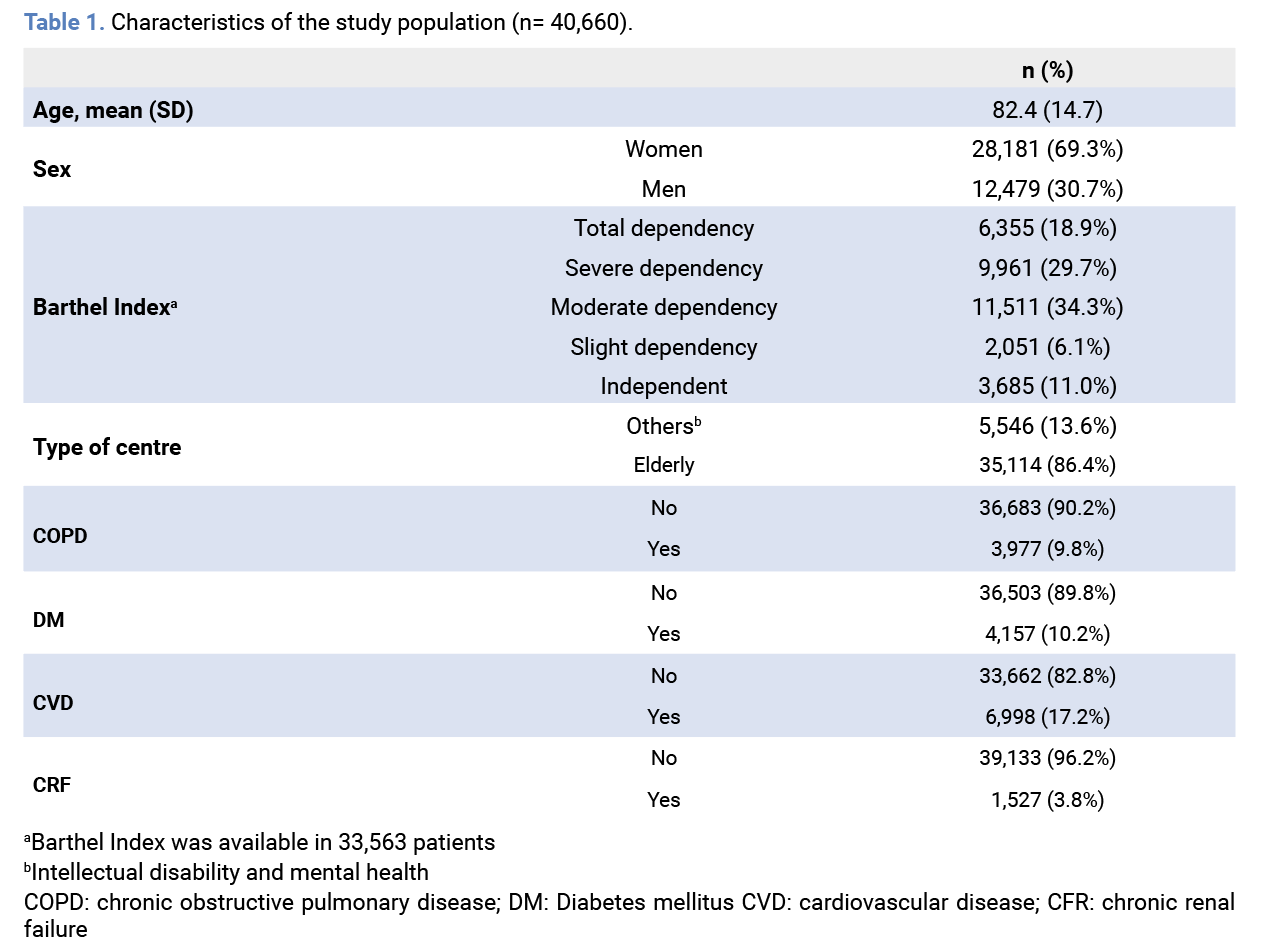 Regarding the Barthel Index, 18.9% of the population was categorised as 'total dependency', 29.7% as 'severe dependency', 34.3% as 'moderate dependency', 6.1% as 'slightly dependent', and 11% as 'independent'. Of the study population, 86.4% resided in a nursing home for the elderly, compared with 13.6% who resided in a disability centre.
With regard to comorbidities, 9.8% of the patients had a diagnosis of COPD, 10.2% had DM, 17.2% had CVD and 3.8% had CRF.
Vaccination coverage with at least one dose of PCV13 or PCV20 was 79.77%. The remaining 20.23% had not received any doses or had received only one dose of PPV23, as shown in Table 2.
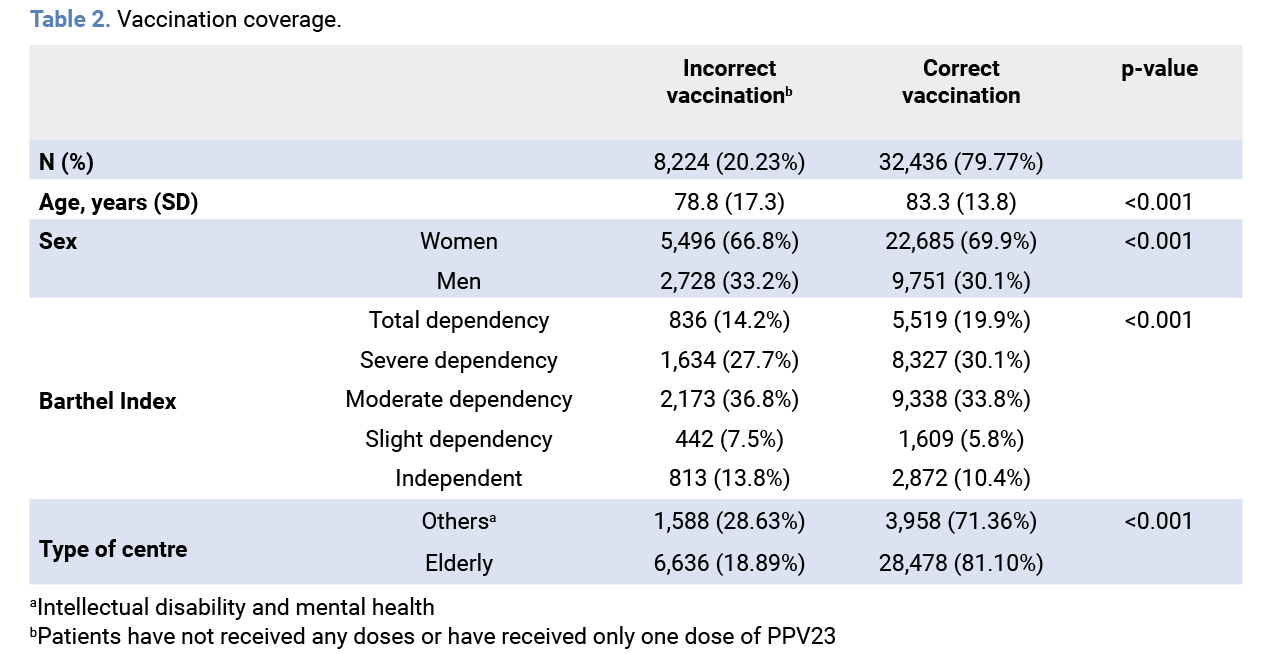 Regarding the type of centre, it can be observed that a vaccination coverage reached 81.10% in centres for the elderly, whereas in disability or mental‑health centres the final vaccination coverage was 71.36%.
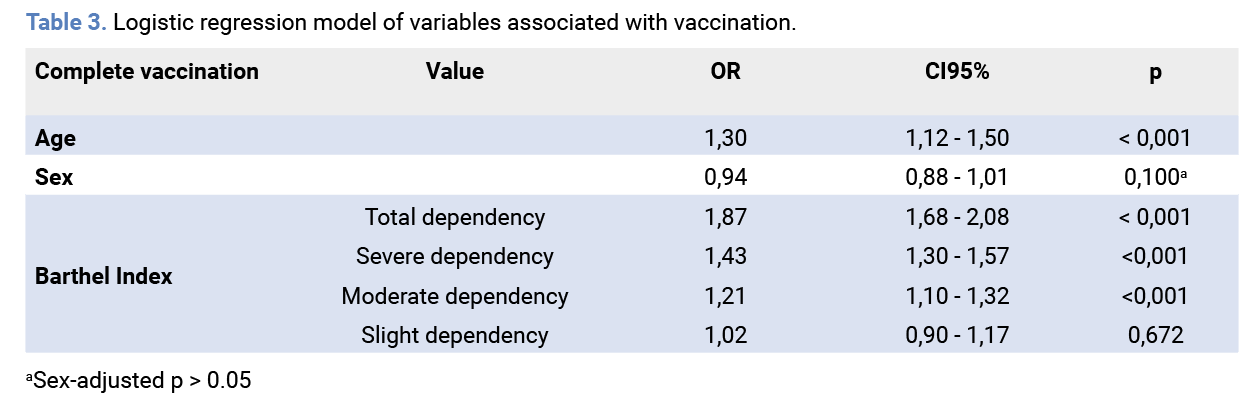
Table 3 shows the results of the model analysing the association between the variables studied and complete vaccination. Vaccination (p < 0.05) is associated with older age and a higher level of dependency, and no association was found between the type of centre and being vaccinated.
Discussion
S. pneumoniae is an important cause of disease, especially in the elderly and in people with underlying diseases [2]. During the study period, vaccination coverage increased significantly in institutionalised patients in the centres of the Community of Madrid assigned to the RCU, achieving coverage of 79.77%. National data on adult pneumococcal vaccination coverage are not available, but there are coverage data published by some Autonomous Communities. On 20 February 2025, Andalusia published data on pneumococcal vaccination coverage with PCV13 or PCV20 in persons aged 60-76 years, ranging from 34.7% in those born in 1963 to 78.9% in those born in 1952 [12]. On the other hand, Castilla y León published data on 17 March 2025 with a pneumococcal vaccination coverage of 40.46% in people aged 65 years and older [11], while the Barcelona Public Health Agency provides coverage data for 2023 in people aged 66 years and older with rates of 33.9% in women and 35.7% in men [15]. In addition, data on adult pneumococcal vaccination coverage of 50.3% were published in the most recent evaluation report of the Madrid Community Standardised Service Portfolio for 2023 [10]. The vaccination rates in our study are 29.47% higher than the data published by the Community of Madrid for adults. In addition, our vaccination coverage is also higher than the vaccination rates published by the different Autonomous Communities described above. In order to provide a more precise contextualisation of the results obtained in the specific population of institutionalised patients, a comparison with studies addressing the same population is necessary. A published study on vaccination coverage in geriatric centres provides data on high coverage rates for influenza (93.9%), while the vaccines included in the vaccination schedule show coverage rates of 61.2% for tetanus-diphtheria and low vaccination coverage for PCV13 [16]. A further US study on vaccination coverage in nursing homes demonstrates vaccination rates in 2023 of 33.1%, 72.0% and 9.8% for COVID-19, influenza and respiratory syncytial virus (RSV), respectively. An update of the study publishes data in November 2024 with vaccination coverage of 29.7% against COVID-19, 58.4% against influenza and 17.9% against RSV [17,18]. Although these studies were conducted in a variety of settings, they all agree on the variability of vaccination rates in institutionalised populations. In contrast to the figures observed in these studies, our unit achieved a vaccination coverage of 81.1% against pneumococcus in centres for elderly. This result demonstrates the potential for achieving high vaccination rates in this setting, although it underlines the need to refine and adapt specific vaccination strategies to improve coverage. Despite the absence of specific data on pneumonia and mortality in our study, it is relevant to consider the findings of previous research. Thus, a study published in Castilla y León in July 2019, with a population of 61,922 patients over 65 years of age and a vaccination coverage (VNC13) against pneumococcus of 60%, yielded data on 147 cases of pneumococcal pneumonia and 13 deaths prevented, respectively, thanks to the vaccination strategy adopted [19]. The present study reveals that adequate vaccination is associated with a higher level of dependency and older age. This association may be due to the awareness of family members and staff in the centres, as well as the involvement of professionals who provide greater care to the most fragile and vulnerable people. The establishment of the RCU with a specific focus on institutionalised patients facilitates the increase in coverage, thus improving immunisation in these patients. Finally, the study has a limitation. The EHR use as a data source has the potential to result in an underestimation of vaccination coverage, particularly in cases where patients have been vaccinated at different levels of care, within other autonomous communities, or in private medical facilities. In conclusion, the present study shows an increase in vaccination coverage thanks to the creation of the RCU and the strategies adopted by them. These findings may help to design measures to improve vaccination coverage in institutionalised patients and the general population. Acknowledgements The authors would like to thank the research unit and the Technical Directorate for Information Systems of the Primary Care Management as well as to Margarita Barba Calderón and María José del Olmo Rubio, as coordinators of the RCU, for their valuable collaboration in the project. ADDENDA: Working group of the Residential Care Unit of the Community of Madrid. Verónica Buitrago Barrasa, Teresa Cabezas Indiano, Aida Choclan Hermosilla, Alicia Crespo Plaza, Pilar Espigares López, Cristina Ángeles Gallego Pérez, Judit Gómez Benito, Alfonso González Blanco, Alba María Hidalgo Cabello, María Mercedes Ibáñez González, Beatriz Lardón Segovia, Sonia López Mirete, Alejandra Quero Pérez, Sandra Romero Llorente, Marta Soriano Fraile, María Vega Cribeiro, María Fontana-Campos, and Ivonne Andrea Torres Jiménez. Funding None to declare. Conflict of interest The authors declare no conflicts of interest. Authors contributions Conceptualization, D.M-C.A. and J.G.I.; methodology, D.M-C.A., R.R.B., A.R.T., and C.R.D.; software, J.G.I., V.B.E., and M.M.M; validation, D.M-C.A., J.G.I., and R.R.B.; formal analysis, D.M-C.A., R.R.B., A.R.T, and C.R.C.; investigation, D.M-C.A. and J.G.I.; resources, Working group; data curation, D.M-C.A. and J.G.I.; writing—original draft preparation, D.M-C.A., J.G.I., R.R.B., A.R.T, and C.R.C; writing—review and editing, D.M-C.A., J.G.I., R.R.B., and V.B.E.; visualization, M.M.M., J.G.I., and V.B.E.; supervision, D.M-C.A., J.G.I., and R.R.B.; project administration, D.M-C.A. and M.M.M. All authors have read and agreed to the published version of the manuscript.References
- Payeras A, Villoslada A, Garau M, Borras M, Pareja A, Beingolea D, et al. Pneumococcal pneumonia in the era of heptavalent pneumococcal conjugate vaccine. Enferm Infecc Microbiol Clin. 2011;29:250-6. Available from: http://dx.doi.org/10.1016/j.eimc.2010.09.014
- Jackson ML, Neuzil KM, Thompson WW, Shay DK, Yu O, Hanson CA, et al. The burden of community-acquired pneumonia in seniors: results of a population-based study. Clin Infect Dis. 2004 Dec 1;39(11):1642-50. Available from: https://doi.org/10.1086/425615
- Soler Soneira M, Del-Águila-Mejía J, Acosta-Gutiérrez M, Sastre-García M, Amillategui- Dos-Santos R, et al. Enfermedad Neumocócica Invasiva en España en 2023. Boletín Epidemiológico Semanal. 2024; 32(2):74–93. Available from: https://doi.org/10.4321/s2173-92772024000200003
- Comunidad de Madrid, Dirección General de Salud Pública.Boletín Epidemiológico de la Comunidad de Madrid. Madrid: Consejería de Sanidad; 2025 feb; 30(2). Available from: https://www.comunidad.madrid/publicacion/ref/51490
- Kim G-L, Seon S-H, Rhee D-K. Pneumonia and Streptococcus pneumoniae vaccine. Arch Pharm Res. 2017;40(8):885–93. Available from: http://dx.doi.org/10.1007/s12272-017-0933-y
- Comunidad de Madrid, Dirección General de Salud Pública. Nota informativa sobre vacunación frente a Neumococo en el adulto. Madrid: Consejería de Sanidad; 2018. [Cited: 2024 abr 17]. Available from: https://neumoexpertos.org/wp-content/uploads/2018/03/actualizacion-neumococo-madrid.pdf
- Agencia Española de Medicamentos y Productos Sanitarios. Ficha técnica Prevenar 13. Madrid: AEMPS; [s.f.] Available from: https://cima.aemps.es/cima/pdfs/es/ft/09590002/FT_09590002.html.pdf
- Agencia Española de Medicamentos y Productos Sanitarios. Ficha técnica vacuna Prevenar 20. Madrid: AEMPS; [s.f.]Available from: https://cima.aemps.es/cima/dochtml/ft/1211612002/FT_1211612002.html
- Comunidad de Madrid, Dirección General de Salud Pública. Calendario de vacunación para toda la vida 2024. Madrid: Consejería de Sanidad; 2024 Available from: https://www.comunidad.madrid/sites/default/files/doc/sanidad/prev/doc_tecnico_calendario_vacunacion_toda_la_vida_2024_web.pdf
- Servicio Madrileño de Salud, Gerencia Asistencial de Atención Primaria. Informe de evaluación de Cartera de servicios estandarizados, año 2023. Madrid: Servicio Madrileño de Salud; 2024. Available from: https://www.madrid.org/bvirtual/BVCM050454.pdf
- Junta de Castilla y León, Consejería de Sanidad. Cobertura de vacunaciones 2024 Castilla y León. Valladolid: Consejería de Sanidad; 2025. Available from: https://www.saludcastillayleon.es/profesionales/es/vacunaciones/coberturas-vacunacion.ficheros/2971792-COBERTURAS%202024%20CyL_datos%20provisonales_17032025.pdf
- Junta de Andalucía, Dirección General de Salud Pública y Ordenación Farmacéutica. Calendario de Vacunaciones e Inmunizaciones Andalucía 2025, Instrucción 1/2025. Sevilla: Consejería de Salud; 2025. Available from: https://www.andavac.es/wp-content/uploads/instrucciones/Instruccion_Calendario_Vacunacion_Andalucia.pdf
- Servicio madrileño de salud, Gerencia de Atención Primaria. Plan de desarrollo de las unidades de atención a residencias socio sanitarias (UAR) en atención primaria. Madrid: Servicio Madrileño de Salud; 2022. Available from: https://www.comunidad.madrid/hospital/atencionprimaria/ciudadanos/unidades-atencion-residencias-atencion-primaria
- Asociación Médica Mundial. Declaración de Helsinki - Principios éticos para las investigaciones médicas en seres humanos. Ferney‑Voltaire: AMM; 2013. Available from: https://www.um.es/documents/7232477/7272232/declaracion_de_helsinki.pdf/643a79f0-980d-4a95-a442-5fb1dee81548
- Roel E, Valmayor S, Salobral R, Pérez C. La vacunació a Barcelona 2023. Barcelona: Agència de Salut Pública de Barcelona; 2024. Available from: https://www.aspb.cat/wp-content/uploads/2023/12/vacunacio-barcelona-2023_240925.pdf
- Berlanga-Fernández S, González-López N, Carreriro-Alonso MÁ, Casas-Thomsem A, Amorós-Molina Á, Sarret-Vilà S, et al. Coberturas vacunales de residentes en centros geriátricos. Gerokomos. 2018 ;29(3):117–22.
- Reses HE, Dubendris H, Haas L, Barbre K, Ananth S, Rowe T, et al. Coverage with influenza, respiratory syncytial virus, and updated COVID-19 vaccines among nursing home residents - national healthcare safety network, United States, December 2023. MMWR Morb Mortal Wkly Rep. 2023;72(51):1371–6. Available from: http://dx.doi.org/10.15585/mmwr.mm7251a3
- Reses HE, Segovia G, Dubendris H, Barbre K, Ananth S, Lape-Newman B, et al. Coverage with influenza, respiratory syncytial virus, and COVID-19 vaccines among nursing home residents - national healthcare safety network, United States, November 2024. MMWR Morb Mortal Wkly Rep. 2024;73(46):1052–7. Available from: http://dx.doi.org/10.15585/mmwr.mm7346a2
- López-Gobernado M, Pérez-Rubio A, López-García E, Mayo Iscar A, Cabezas Pascual C, Eiros JM. Economic evaluation of pneumococcal vaccination in adults aged over 65 years in Castilla y León (SPAIN). Rev Esp Geriatr Gerontol. 2019;54(6):309–14. Available from: http://dx.doi.org/10.1016/j.regg.2019.05.004
Explore
Articles
Volumes
About the journal
Most read
Recomendaciones para la prevención y el tratamiento de las infecciones respiratorias en adultos mayores institucionalizados
Revista Española de Quimioterapia
Características epidemiológicas de pacientes con aislamientos de Enterobacterales productores de carbapenemasas-NDM en un hospital de alta complejidad
Revista Española de Quimioterapia
Acute infectious gastroenteritis in childhood: the role of rapid multiplex molecular syndromic panels in diagnosis and clinical management
Revista Española de Quimioterapia
Review on the management of intra-abdominal candidiasis
Revista Española de Quimioterapia
Eravacycline: From broad-spectrum coverage to novel clinical applications
Revista Española de Quimioterapia