Original
February 2026, Volume 39, nº 1
18 min
Predictive performance of weekly rectal surveillance cultures and extra-rectal colonization for carbapenem-resistant Enterobacterales infections in a resource-limited ICU with KPC and NDM co-circulation
Patricio Favier 1* , Pedro Suárez-Urquiza2, Carla Raffo3, Diego Torres3, Liliana Kumar4, Johanna Pérez5, Ivana Primost6, María Inés Gallino6, Fidel Pinilla-Huayta3, Claudia Muñoz-Soto3, Matías Ravelli 3, Enrique Serio3, Javier Pemán-García7, Amparo Valentín-Martín2, Eva María González-Barberá2
1Hospital de Trauma y Emergencias Dr. Federico Abete, Malvinas Argentinas County, Province of Buenos Aires, Argentina
2Department of Medical Microbiology, Hospital Universitari i Politècnic La Fe, València, Spain
3Department of Infectious Diseases, Hospital de Trauma y Emergencias Dr. Federico Abete, Malvinas Argentinas County, Buenos Aires Province, Argentina
4Intensive Care Unit, Hospital de Trauma y Emergencias Dr. Federico Abete, Malvinas Argentinas County, Buenos Aires Province, Argentina
5Department of Microbiology, Hospital de Trauma y Emergencias Dr. Federico Abete, Malvinas Argentinas County, Buenos Aires Province, Argentina
6Department of Genetics and Molecular Biology, Hospital de Trauma y Emergencias Dr. Federico Abete, Malvinas Argentinas County, Buenos Aires Province, Argentina
7Severe Infection Research Group, Health Research Institute La Fe, València, Spain
http://www.doi.org/10.37201/req/113.2025
Receipt Date:
23/10/2025
Acceptance Date:
09/01/2026
Publication Date:
01/02/2026
How to cite
Favier P, Suárez-Urquiza P, Raffo C, Torres D, Kumar L, Pérez J, et al. Predictive performance of weekly rectal surveillance cultures and extra-rectal colonization for carbapenem-resistant Enterobacterales infections in a resource-limited ICU with KPC and NDM co-circulation. Rev Esp Quimioter 2026; 39(1): 49-60. Available from: http://www.doi.org/10.37201/req/113.2025
Supplementary material
Supplementary material
Metrics
293
Views
46
Downloads
Share
Share
Abstract (EN)
Background: Carbapenem-resistant Enterobacterales (CRE) cause hard-to-treat infections. Rectal surveillance is widely used to detect carriers, but its predictive value where different carbapenemases co-circulate is unclear. We assessed whether CRE rectal and extra-rectal colonization predicts subsequent infection in an intensive care unit with concurrent KPC and NDM circulation.
Methods: We performed a retrospective observational study in a 60-bed adult intensive care unit in Buenos Aires, Argentina, from July 2016 to September 2019. All patients underwent weekly rectal surveillance, and extra rectal samples were taken when clinically indicated. Following up lasted 90 days from the first positive culture or from admission for non-carriers. Outcomes were any CRE infection and bacteremia. We estimated predictive values and fitted multivariable logistic regression models.
Results: We included 495 patients, median age 66 years, 58% male. Of them, 66% had rectal colonization and 8% had extrarectal colonization. CRE rectal carriage showed low PPV for any infection, about 10%, with high NPV near 94%, and it was not independently associated with infection (aOR 1.9 [0.9–4.4], p=0.1). CRE extra-rectal colonization was an independent predictor of any CRE infection (aOR 3.4 [1.4–7.9] p<0.01) and bacteremia (aOR 3.3 [1.3–8.9] p<0.05), with specificity >93% but sensitivity ≈ 20%.
Conclusions: In this mixed KPC and NDM CRE setting, weekly rectal surveillance was not a predictor of later infection, while extra rectal colonization retained independent predictive value for overall infection and for bacteremia.
Keywords (EN):
Carbapenem-resistant enterobacterales
Enterobacterales infections
Carrier state
Intensive care units
Introduction
The global increase of carbapenem-resistant Enterobacterales (CRE), particularly carbapenemase-producing Klebsiella pneumoniae (KPC) and New Delhi metallo-β-lactamase (NDM), highlights the need for reliable predictive tools to optimize empiric antimicrobial therapy [1-4]. Although newer β-lactam/β-lactamase inhibitor combinations such as ceftazidime–avibactam, meropenem-vaborbactam, and imipenem/cilastatin-relebactam are effective against CRE-KPC, their widespread use has contributed to shifts in epidemiology, favoring the emergence of CRE harboring other carbapenemases, particularly class B enzymes such as NDM, VIM, and IMP) [1,2,5-7]. Rectal surveillance cultures are widely used to identify CRE colonization, supporting infection control measures and semi-targeted empiric therapy. Their predictive value for subsequent CRE infection has been demonstrated in settings dominated by a single resistance mechanism (e.g., OXA-48, KPC, or class B enzymes) [5,8-10], but evidence remains limited in environments with mixed carbapenemase circulation, such as concurrent KPC and NDM [11]. Accurate risk prediction is essential, as inadequate empiric therapy among colonized patients is common due to delayed microbiological confirmation and is associated with worse outcomes, particularly in resource-limited settings [4,12,13]. Therefore, this study aimed to evaluate the predictive value of rectal and extra-rectal colonization for subsequent CRE infection, including bacteremic and non-bacteremic episodes, in a resource-limited hospital with co-circulation of CRE-KPC and CRE-NDM.Material and methods
Study design and population Rectal and extra-rectal CRE colonization were assessed in a retrospective observational cohort of adult patients (≥18 years) admitted to a 60-bed emergency and trauma ICU in Buenos Aires Province, Argentina. The study was conducted between July 2016 and September 2019, during an outbreak of Providencia stuartii-NDM (Pst-NDM) and the endemic circulation of Klebsiella pneumoniae-KPC strains (Kpn-KPC) [14]. The ICU was an open-bay unit with partitioned beds, and contact precautions were implemented according to institutional protocols and feasibility. Rectal CRE colonization was systematically assessed through weekly surveillance cultures in all ICU admissions, transfers from other healthcare facilities, and patients sharing care areas with known CRE-colonized individuals. Extra-rectal samples were obtained from clinically indicated non-rectal sites at the discretion of the treating physicians and included skin and soft-tissue or surgical wound swabs, respiratory samples (tracheal aspirates or oropharyngeal swabs), urine samples, and isolated catheter cultures obtained without clinical criteria of catheter-related infection, including venous, abdominal, urinary, and neurosurgical drainage catheters. Patients receiving intestinal decontamination with oral non-absorbable antibiotics were excluded. Patients with rectal and/or extra-rectal CRE colonization were followed from the date of the first positive surveillance culture until the development of a CRE infection, death, or hospital discharge. Patients without rectal colonization served as the control group and underwent weekly rectal surveillance until discharge or death. Data collection and definitions Patient comorbidities were recorded using the Charlson comorbidity index. Risk factors were evaluated from the date of colonization detection for colonized patients or from hospital admission for non-colonized controls until either the onset of CRE infection or hospital discharge. Exposure to surgical and procedural interventions associated with increased infection risk was recorded. Invasive hepatobiliary procedures included hepatic surgery, liver transplantation, endoscopic retrograde cholangiopancreatography, percutaneous biliary drainage, and biliary stent placement. Invasive abdominal procedures comprised open or laparoscopic abdominal surgery and percutaneous abdominal drainage. Other clinically relevant invasive procedures outside these categories were also documented. Corticosteroid therapy was defined as a prednisone-equivalent dose ≥16 mg/day for ≥15 consecutive days. Chemotherapy or radiotherapy was defined as the receipt of cytotoxic agents or therapeutic ionizing radiation for malignancy. Neutropenia was defined as an absolute neutrophil count of 500 cells/mm³ or lower lasting ≥7 days. Rectal colonization was defined as the detection of CRE on rectal surveillance cultures in the absence of clinical signs of infection, while extra-rectal colonization was defined as isolation of CRE from non-rectal, non-blood clinical specimens without evidence of active infection. Clinical CRE infections included: (i) CRE bacteremia, defined as recovery of CRE from ≥1 blood culture bottles, and (ii) non-bacteremic CRE infections, as infections at a primary anatomical site fulfilling clinical and microbiological criteria, with negative blood cultures within 48 hours before or after diagnosis and no CRE bacteremia in the preceding 7 days. These included catheter-associated urinary tract infections, healthcare-associated pneumonia including ventilator-associated pneumonia, intra-abdominal infections, surgical site infections, neurosurgical-related infections, and skin and soft tissue infections. In all cases, the primary focus had to be anatomically distinct from any site of extra-rectal colonization [15-19]. Microbiological studies and molecular biology Clinical samples were immediately transported to the microbiology laboratory. Rectal surveillance swabs were directly inoculated onto MacConkey agar plates (Britania™, Argentina) with ertapenem (10 μg) disks (Britania™, Argentina) to select CRE isolates. After incubation at 37°C for 24 hours, Gram-negative bacilli were identified using automated biochemical tests (Phoenix™, Becton DickinsonTM, USA) [20,21]. Non-rectal clinical samples were processed using conventional culture media, and isolates were identified by the same system. Antimicrobial susceptibility was tested by using the disk-diffusion method following Clinical and Laboratory Standards Institute (CLSI) 2017 guidelines [22]. Additionally, real-time PCR (rt-PCR) was performed on all suspected isolates to detect carbapenemase genes blaKPC, blaNDM, and blaOXA-48-like [21]. Statistical analysis Primary analysis compared the incidence of clinical CRE infection between patients with rectal colonization and those without rectal colonization. Statistical comparisons were performed using χ² or Fisher’s exact tests for categorical variables and Student’s t-test or Mann–Whitney U test for continuous variables, as appropriate. Sensitivity, specificity, positive predictive value (PPV), and negative predictive value (NPV) of rectal and extra-rectal colonization status for predicting clinical CRE infections were calculated separately. Statistical analyses were conducted using R Statistics version 4.3.3, with significance set at a p-value <0.05.Results
Population characteristics A total of 495 patients were included in the cohort, of whom 287 (58%) were male. The median age was 66 years (IQR 22). Overall, 302 patients (61%) were admitted directly to the ICU without first staying in another ward. Rectal CRE colonization was identified in 336 patients (68%). Among these, 162 patients (32.7%) were colonized with CRE-KPC, all of whom were Kpn-KPC; 108 patients (21.8%) were colonized with CRE-NDM, exclusively Pst-NDM; and 66 patients (13.3%) exhibited co-colonization. No additional carbapenemases were detected. Extra-rectal colonization was observed in 40 patients (8.1%), 37 of whom also had concomitant rectal colonization. Of these, 19 (3.8%) had extra-rectal colonization with Kpn-KPC, 18 (3.6%) with Pst-NDM, and 3 (0.6%) with both. During hospitalization, Kpn–KPC caused bacteremia in 16 patients (3.2%) and non-bacteremic infection in 10 (2.0%; 5 ventilator-associated pneumonias—VAP, 3 surgical-site infections—SSI, and 2 catheter-associated urinary tract infections-CAUTI-). Pst–NDM caused bacteremia in 12 patients (2.4%) and non-bacteremic infection in 3 (0.6; 3 VAP and 1 CAUTI). In addition, 4 patients (0.8%) had infections involving both Kpn-KPC and Pst-NDM (2 VAP, 1 skin and soft-tissue infection, and 1 CAUTI). Overall, 258 patients (52.1%) were discharged, and 237 (47.9%) died in hospital (Table 1).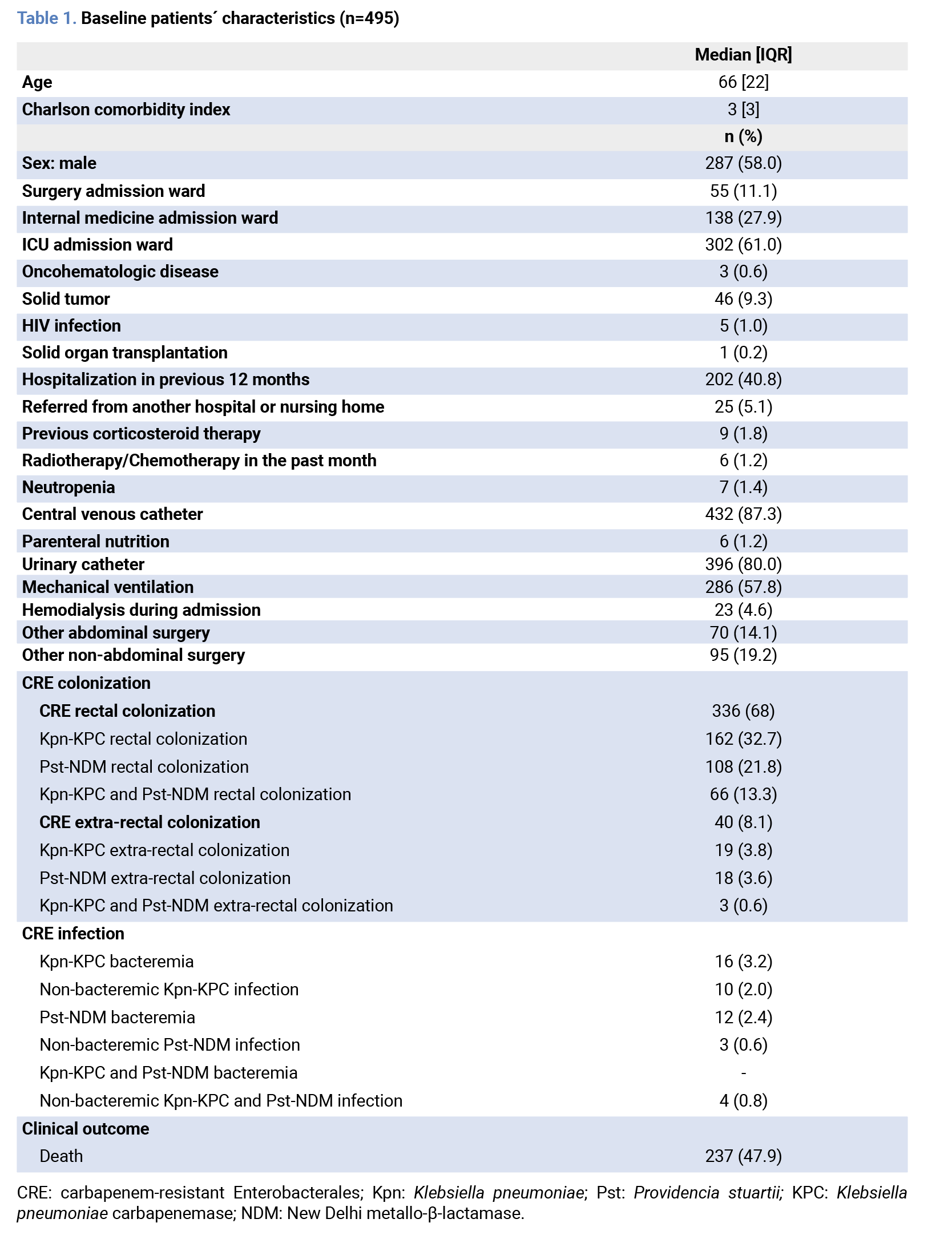 Rectal surveillance cultures as predictors of infection and bacteriemia
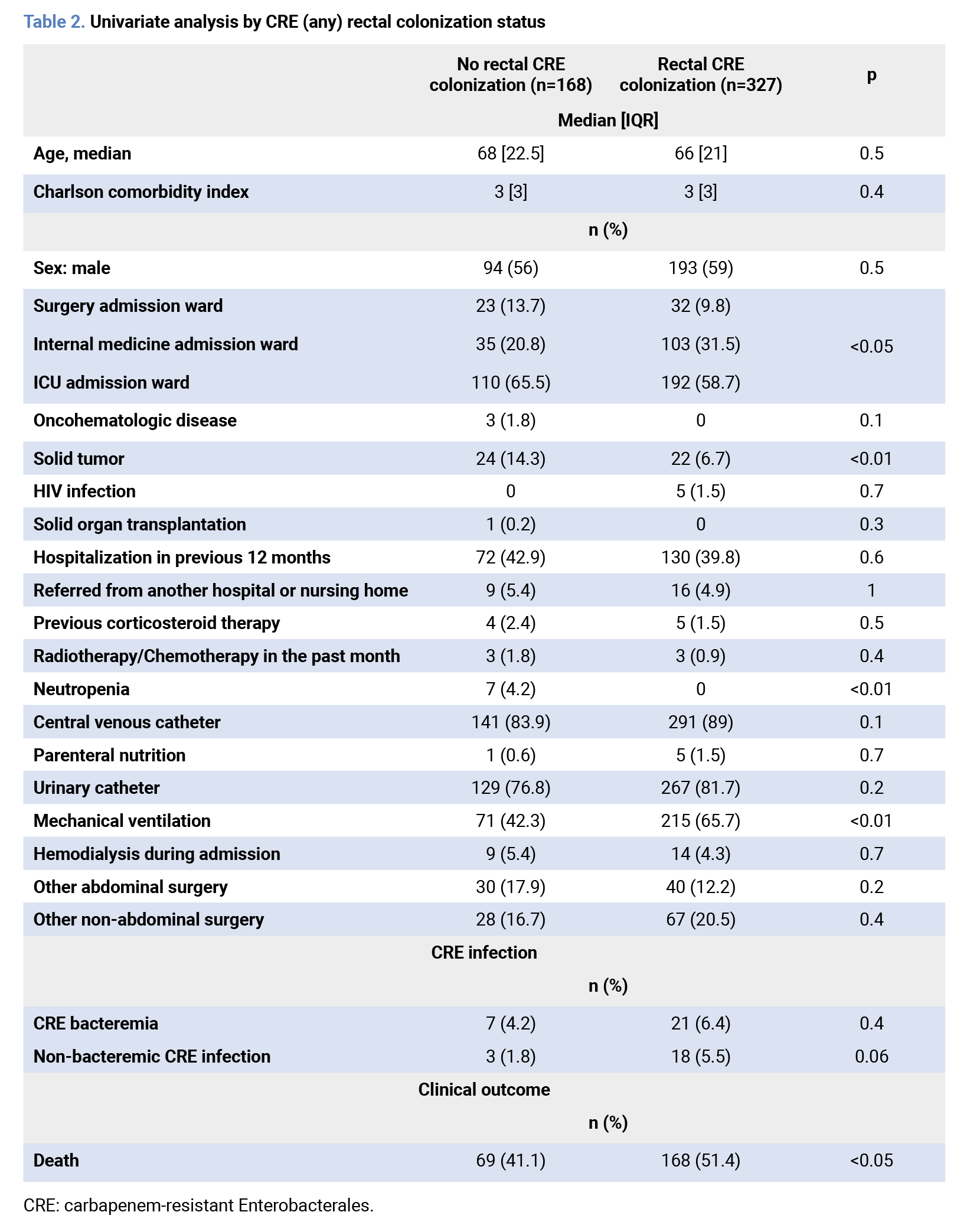
Rectal colonization by any CRE was not associated with a higher likelihood of subsequent infection. Rates were 1.8% vs. 5.5% for non-bacteremic infection (p=0.06) and 7.0% vs. 6.4% for bacteremia (p=0.4) in CRE rectal colonized versus non-colonized patients, respectively. However, CRE colonization was linked to an initial admission to internal medicine wards (31.5% vs. 20.8%, p<0.05), neutropenia (4.2% vs. 0%, p<0.01), and use of mechanical ventilation (65.7% vs. 42.3%, p<0.01). In-hospital mortality was also significantly higher among colonized patients (51.4% vs. 41.1%, p<0.05). No significant differences were found in age, sex, comorbidity burden, or the use of central venous catheters, hemodialysis, or surgical procedures (Table 2).
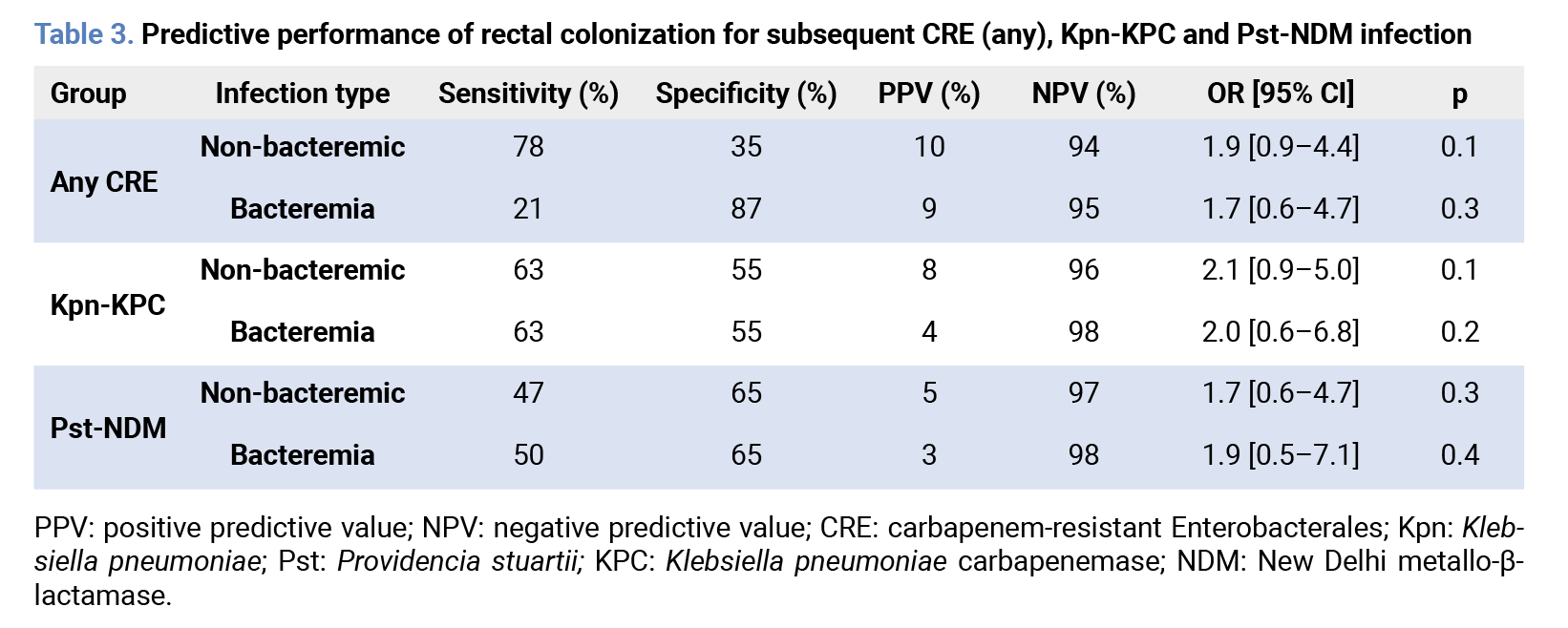
 In the overall CRE group, rectal colonization predicted subsequent infection with a sensitivity of 78%, specificity of 35%, PPV of 10%, and NPV of 94% (OR 1.9 [0.9–4.4], p=0.1). For CRE bacteremia, sensitivity was 21%, specificity 87%, PPV 9%, and NPV 95% (OR 1.7 [0.6–4.7], p=0.3) (Table 3).
 When stratified by carbapenemase type, rectal colonization by either Kpn-KPC or Pst-NDM was not associated with subsequent infection. Among Kpn-KPC colonized patients, non-bacteremic infection occurred in 1.4% vs. 3.1% in non-colonized individuals (p=0.7), and bacteremia in 2.9% vs. 3.3%, respectively (p=1.0). Patients colonized by Kpn-KPC were more frequently mechanically ventilated (64.9% vs. 51.7%, p<0.01); however, no demographic parameters differed significantly between both groups (Supplementary Table 1).
The predictive performance of rectal colonization for subsequent Kpn-KPC non-bacteremic infection showed a sensitivity of 63%, specificity of 55%, PPV of 8%, and NPV of 96% (OR 2.1 [0.9–5.0], p=0.1). For bacteriemia, sensitivity, specificity, PPV, and NPV were 63%, 55%, 4% and 98%, respectively (OR 2.0 [0.6–6.8], p=0.2) (Table 3).
Regarding Pst-NDM, non-bacteremic infection occurred in 1.4% of colonized patients vs. 0.3% of non-colonized patients (p=0.2), and bacteremia in 3.4% vs. 1.9%, respectively (p=0.1). Among those colonized with Pst-NDM, patients were more frequently male (65.5% vs. 53.9%, p<0.01), older (median age 68 vs. 65 years, p<0.05), neutropenic (4.0% vs. 0%, p<0.01), mechanically ventilated (64.4% vs. 54.2%, p<0.05), and had undergone non-abdominal surgery more frequently (24.7% vs. 16.2%, p<0.05) (Supplementary Table 2). The diagnostic performance of Pst-NDM rectal colonization for predicting infection yielded a sensitivity of 47%, specificity of 65%, PPV of 5%, and NPV of 97% (OR 1.7 [0.6–4.7], p=0.3), and for bacteremia sensitivity was 50%, specificity 65%, PPV 3%, and NPV 98% (OR 1.9 [0.5–7.1], p=0.4) (Table 3).
Extra-rectal cultures as predictors of infection and bacteriemia
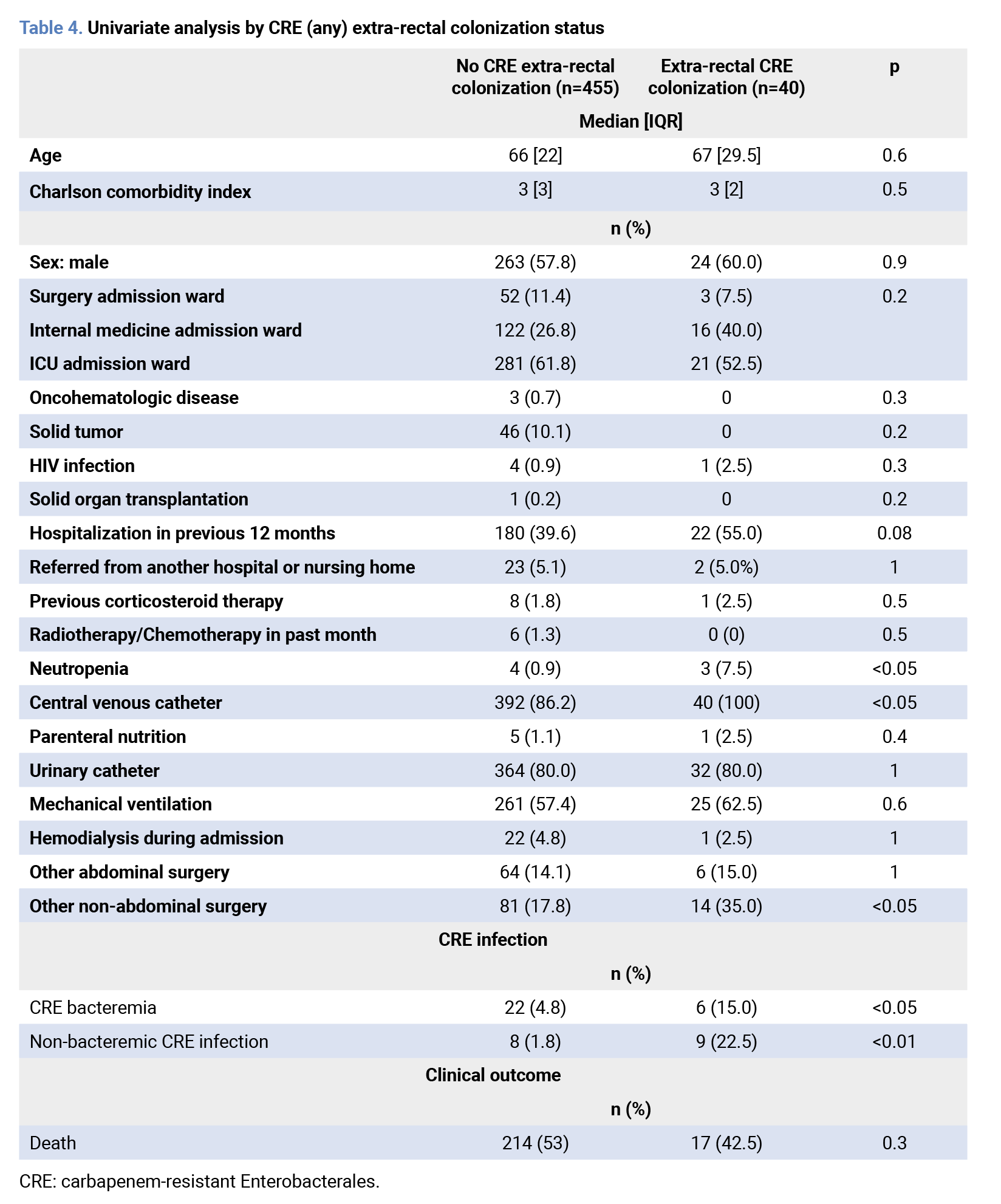
Extra-rectal colonization by any CRE was significantly associated with subsequent infection: non-bacteremic infection occurred in 22.5% of colonized patients vs. 1.8% of non-colonized patients (p<0.01), and bacteremia in 15.0% vs. 4.8%, respectively (p<0.05). In the univariate analysis, underlying Table 4, colonized patients more often presented neutropenia (7.5% vs. 0.9%, p<0.05), central venous catheter (100% vs. 86.2%, p<0.05), and prior non-abdominal surgery (35.0% vs. 17.8%, p<0.05).
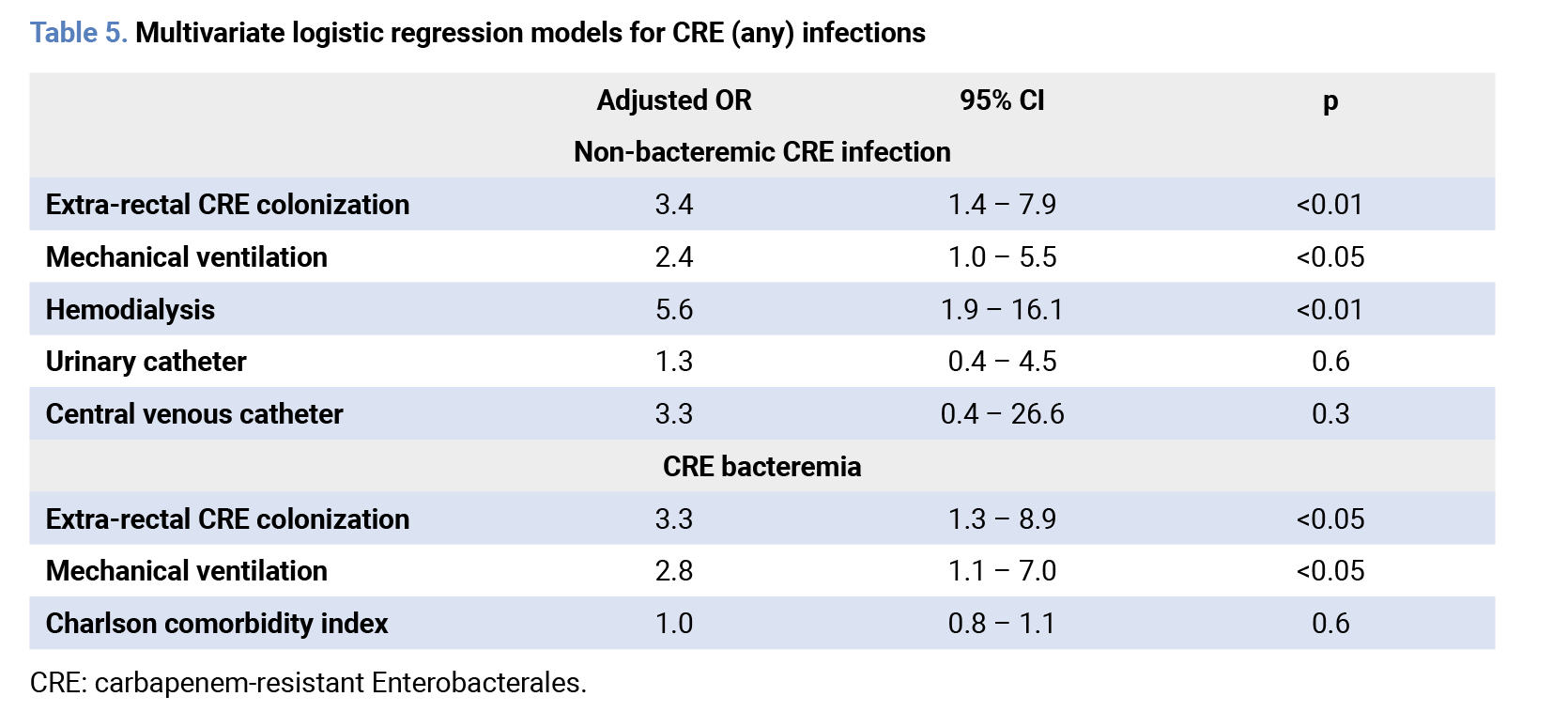
 In the multivariable model, extra-rectal colonization remained independently associated with any CRE infection (aOR 3.4 [1.4–7.9], p<0.01), alongside hemodialysis (aOR 5.6 [1.9–16.1], p<0.01) and mechanical ventilation (aOR 2.4 [1.0–5.5], p<0.05); for CRE bacteremia, extra-rectal colonization also retained an independent association (aOR 3.3 [1.3–8.9], p<0.05), together with mechanical ventilation (aOR 2.8 [1.1–7.0], p<0.05) (Table 5).
 The predictive performance was as follows: sensitivity 20%, specificity 93%, PPV 23%, and NPV 92% (OR 3.4 [1.3–8.0], p<0.01) for non-bacteremic infection; sensitivity 21%, specificity 93%, PPV 15%, and NPV 95% (OR 3.5 [1.1–9.6], p<0.05) for bacteremia (Table 6).
We found no significant association between extra-rectal Kpn-KPC colonization and subsequent Kpn-KPC infection: non-bacteremic infection occurred in 4.5% of colonized vs. 1.9% of non-colonized patients (p=0.5), and bacteremia in 9.1% vs. 3.0% (p=0.2) (Supplementary Table 3). Rectal Kpn-KPC colonization had limited predictive value: for non-bacteremic infection, sensitivity was 10% and specificity 96% (PPV 14%, NPV 94%; OR 2.6 [0.5–9.7], p=0.1), and for bacteremia, sensitivity and specificity were 13% and 96% respectively (PPV 9%, NPV 97%; OR 3.3 [0.3–15.8], p=0.2) (Table 6).
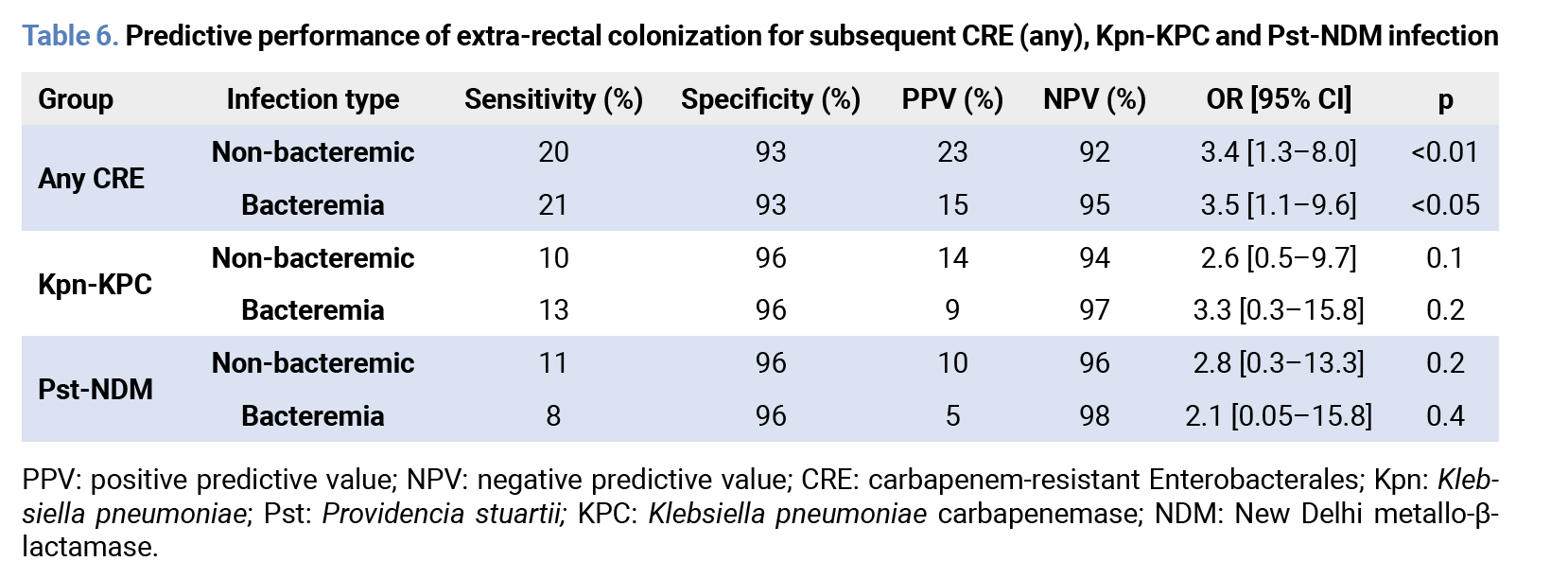 Similarly, Pst-NDM extra-rectal colonization was not associated with subsequent Pst-NDM infection: rates of non-bacteremic infection were 4.8% in colonized vs. 1.3% in non-colonized patients (p=0.3), and bacteremia was 4.8% vs. 2.3% (p=0.4) (Supplementary Table 4). Predictive performance was low for both non-bacteremic infection and bacteremia: for non-bacteremic infection, sensitivity was 11% and specificity 96% (PPV 10%, NPV 96%; OR 2.8 [0.3–13.3], p=0.2), and for bacteremia, sensitivity was 8% and specificity 96% (PPV 5%, NPV 98%; OR 2.1 [0.05–15.8], p=0.4) (Table 6).
Discussion
In our ICU cohort, rectal surveillance cultures did not reliably predict subsequent CRE infection according to specific carbapenemase type. In contrast, extra-rectal colonization showed an independent association with later CRE infection in adjusted analyses. A distinctive feature of our local epidemiology was the prominence of Pst-NDM [14], rather than the more frequently reported carbapenemases (such as blaKPC or blaOXA-48) or bacterial species like K. pneumoniae or E. coli that dominate much of the predictive surveillance literature. This unique microbiological context may partly explain the limited performance of rectal swabs in our setting. Within this ecological landscape, selective pressure from individual carbapenemase types appeared comparable, suggesting that a high overall CRE burden, reflected by extra-rectal colonization, may be a stronger predictor of infection than rectal carriage alone, without distinguishing between specific CRE-KPC or CRE-NDM. Evidence from more homogeneous or clonally dominated settings, however, often reveals different patterns. Studies focusing on specific clonal lineages have shown that carbapenemase class and clone structure can substantially modify the predictive value of rectal surveillance. In the CHIMERA cohort, Falcone et al. reported higher bloodstream infection (BSI) rates among Kpn-NDM carriers than among Kpn-KPC carriers, largely driven by the predominance of a single clone (ST147). In that setting, rectal carriage of Kpn-NDM was independently associated with BSI, despite prior circulation of the high-risk KPC ST512 clone [5]. These findings illustrate how local molecular epidemiology can strongly influence both the diagnostic yield and clinical interpretation of rectal screening. In high-risk populations, such as patients in hematology units or those undergoing hematopoietic stem cell transplantation, rectal screening for CRE and other multidrug-resistant Gram-negative bacteria has also shown a closer correlation with subsequent infection risk [9,23]. In these contexts, rectal screening often provides a strong negative predictive value, identifying patients at low risk of bloodstream infection, while still contributing to risk stratification among carriers. Conversely, other cohorts demonstrate that a high prevalence of colonization does not necessarily translate into invasive disease without additional host or pathogen-related factors. Wang et al. developed a predictive model among intestinal CRE carriers from ICU and hematology departments that required integration of both clinical and microbiological variables, including gastrointestinal injury, recent tigecycline exposure, and resistance profiles of colonizing strains, to accurately predict bloodstream infection [11]. Similarly, earlier ICU studies in high CRE-endemicity settings showed that clinical factors such as prolonged ICU stay, central venous catheter use, antibiotic exposure, and comorbidities were critical determinants of progression from colonization to infection [24]. These findings reinforce that colonization status must be interpreted within the broader clinical context rather than as an isolated predictor. Classic CRE-KPC dominant experiences, such as those reported by Schechner et al., similarly emphasized the role of clinical stratification among rectal carriers [10]. Methodological heterogeneity across studies also contributes to variability in predictive performance. While some investigations rely on molecular detection of carbapenemases and frequent re-swabbing [5,8], others adopt pragmatic, resource-adapted approaches [11,23,24]. Clonal homogeneity within a healthcare setting may strengthen the link between carriage and infection [5], whereas polyclonal environments with multiple circulating species and carbapenemase types may attenuate the predictive value of rectal surveillance [11]. In such settings, extra-rectal cultures, even when obtained based on clinical judgment rather than standardized surveillance, may retain a stronger association with subsequent infection. Our findings align with external validations of the Giannella Risk Score in Spain and Ecuador, where extra-rectal colonization consistently emerged as a high-weight predictor of CRE infection among rectal carriers [25-29]. Notably, in these studies and in ours, extra-rectal isolates were derived from incidental clinical cultures rather than systematic surveillance, potentially underestimating their true predictive value. Our study was conducted in a lower-resource setting and shares limitations common to similar environments, including operational constraints that limited detailed stratification by carbapenemase type, bacterial species, and molecular clonality. As molecular typing was not performed, the influence of dominant clones on the observed epidemiological patterns cannot be excluded, potentially limiting generalizability. Nevertheless, these conditions are representative of many hospitals with open-bay ICUs, mixed CRE ecology, and resource-adapted screening strategies [9,11,26]. Moreover, the expanding global use of newer beta-lactam/beta-lactamase inhibitor combinations (such as ceftazidime-avibactam, imipenem/cilastatin-relebactam, or meropenem-vaborbactam) has contributed to the emergence of settings with concurrent circulation of multiple carbapenemase types, increasingly resembling our epidemiological context [1,2,5-7]. Future research should prioritize multicenter studies across diverse ecological settings, with stratification by carbapenemase type, bacterial species, and clonal lineages. Comparative evaluations of molecular and phenotypic screening strategies are needed, as well as integrated clinical-microbiological risk models that account for co-colonization and ecological complexity. Finally, prospective and standardized extra-rectal surveillance protocols should be rigorously evaluated to define their true predictive value and potential incorporation into updated risk scores.Conclusions
In this ICU cohort from a resource-limited hospital with concurrent CRE (Kpn)-KPC and CRE (Pst)-NDM circulation, rectal surveillance cultures do not reliably predict subsequent clinical infection, regardless of carbapenemase type. In contrast, extra-rectal colonization was independently associated with both bacteremic and non-bacteremic CRE infections in adjusted analyses. These findings indicate that, in mixed-carbapenemase epidemiological settings, the overall CRE burden reflected by extra-rectal colonization may serve as a more robust predictor of systemic infection than rectal carriage alone. Acknowledgements We thank Fernando Pasterán from the ANLIS Dr. Carlos G. Malbrán Institute (Buenos Aires, Argentina) for his microbiological support and generous, disinterested guidance. Funding No funding was received for the research, authorship, and/or publication of this article. Author contributions PF: Conceptualization, Methodology, Formal analysis, Data curation, Writing–Original draft, Project administration. PSU: Formal analysis, data interpretation. CR, DT, FPH, CMS, MR, ES: Data curation, clinical data collection. JP: Investigation (microbiological cultures). LK: Investigation (sample collection). IP, MIG: Methodology, Investigation (PCR and molecular biology assays). JPG, AVM, EMGB: Conceptualization, Supervision, Data interpretation, Writing–Review & Editing. Conflict of interests PF has received financial compensation for consulting and speaking engagements from bioMérieux Argentina. JPG has received financial compensation for consulting, speaking, and research activities from Pfizer, Gilead, and MSD. DT has received financial compensation for consulting and speaking engagements from MSD, Pfizer, Knight, GSK, and Gilead. AVM has received financial compensation for speaking engagements from Werfen. All other authors declare no conflicts of interest, financial or non-financial, relevant to this work. If there are other authors, they declare that they have no known competing financial interests or personal relationships that could have appeared to influence the work reported in this paper. AI statement In the process of drafting the manuscript, generative artificial intelligence was used as a support tool. The final content was fully reviewed, supervised, and validated by the authors, who assume full responsibility for it. Supplementary material The supplementary material is available for consultation on the website of the Revista Española de Quimioterapia.References
- Papadimitriou-Olivgeris M, Bartzavali C, Karachalias E, Spiliopoulou A, Tsiata E, Siakallis G, et al. A Seven-Year Microbiological and Molecular Study of Bacteremias Due to Carbapenemase-Producing Klebsiella Pneumoniae: An Interrupted Time-Series Analysis of Changes in the Carbapenemase Gene’s Distribution after Introduction of Ceftazidime/Avibactam. Antibiotics 2022;11:1414. Available from: https://doi.org/10.3390/antibiotics11101414
- Papadimitriou-Olivgeris M, Bartzavali C, Lambropoulou A, Solomou A, Tsiata E, Anastassiou ED, et al. Reversal of carbapenemase-producing Klebsiella pneumoniae epidemiology from blaKPC -to blaVIM-harbouring isolates in a Greek ICU after introduction of ceftazidime/avibactam. J Antimicrob Chemother 2019;74:2051–4. Available from: https://doi.org/10.1093/jac/dkz125
- Paul M, Carrara E, Retamar P, Tängdén T, Bitterman R, Bonomo RA, et al. European Society of Clinical Microbiology and Infectious Diseases (ESCMID) guidelines for the treatment of infections caused by multidrug-resistant Gram-negative bacilli (endorsed by European Society of Intensive Care Medicine). Clin Microbiol Infect 2022;28:521–47. Available from: https://doi.org/10.1016/j.cmi.2021.11.025
- Nguyen M, Eschenauer GA, Bryan M, O’Neil K, Furuya EY, Della-Latta P, et al. Carbapenem-resistant Klebsiella pneumoniae bacteremia: factors correlated with clinical and microbiologic outcomes. Diagn Microbiol Infect Dis 2010;67:180–4. Available from: https://doi.org/10.1016/j.diagmicrobio.2010.02.001
- Falcone M, Tiseo G, Galfo V, Giordano C, Leonildi A, Marciano E, et al. Bloodstream infections in patients with rectal colonization by Klebsiella pneumoniae producing different types of carbapenemases: a prospective cohort study (CHIMERA study). Clin Microbiol Infect 2022;28:298.e1-298.e7. Available from: https://doi.org/10.1016/j.cmi.2021.06.031
- Favier P, Abusamra L, Moncalero S, Errecalde L, Montibello S, Rodríguez O, et al. Change in Klebsiella pneumoniae susceptibility profile after the arrival of ceftazidime-avibactam in an Argentinean intensive care unit: a new ecological landscape. Rev Esp Quimioter 2024;37:415–21. Available from: https://doi.org/10.37201/req/042.2024
- García-Betancur JC, Appel TM, Esparza G, Gales AC, Levy-Hara G, Cornistein W, et al. Update on the epidemiology of carbapenemases in Latin America and the Caribbean. Expert Rev Anti Infect Ther 2021;19:197–213. Available from: https://doi.org/10.1080/14787210.2020.1813023
- Cao W, Zhang J, Bian Z, Li L, Zhang S, Qin Y, et al. Active Screening of Intestinal Colonization of Carbapenem-Resistant Enterobacteriaceae for Subsequent Bloodstream Infection in Allogeneic Hematopoietic Stem Cell Transplantation. Infect Drug Resist 2022;15:5993–6006. Available from: https://doi.org/10.2147/IDR.S387615
- Gallardo-Pizarro A, Lopera C, Peyrony O, Monzo-Gallo P, Aiello TF, Martinez-Urrea A, et al. Rectal colonization by multidrug-resistant Gram-negative bacteria and subsequent bacteraemia in haematological patients. Clin Microbiol Infect 2025. Available from: https://doi.org/10.1016/j.cmi.2025.05.033
- Schechner V, Kotlovsky T, Kazma M, Mishali H, Schwartz D, Navon-Venezia S, et al. Asymptomatic rectal carriage of blaKPC producing carbapenem-resistant Enterobacteriaceae: Who is prone to become clinically infected? Clin Microbiol Infect 2013; 19:451–6. Available from: https://doi.org/10.1111/j.1469-0691.2012.03888.x
- Wang Y, Lin Q, Chen Z, Hou H, Shen N, Wang Z, et al. Construction of a risk prediction model for subsequent bloodstream infection in intestinal carriers of carbapenem-resistant Enterobacteriaceae: A retrospective study in hematology department and intensive care unit. Infect Drug Resist 2021;14:815–24. Available from: https://doi.org/10.2147/IDR.S286401
- La Via L, Sangiorgio G, Stefani S, Marino A, Nunnari G, Cocuzza S, et al. The Global Burden of Sepsis and Septic Shock. Epidemiologia 2024;5:456–78. Available from: https://doi.org/10.3390/epidemiologia5030032
- Machuca I, Gutiérrez-Gutiérrez B, Gracia-Ahufinger I, Rivera Espinar F, Cano Á, Guzmán-Puche J, et al. Mortality Associated with Bacteremia Due to Colistin-Resistant Klebsiella pneumoniae with High-Level Meropenem Resistance: Importance of combination therapy without colistin and carbapenems. Antimicrob Agents Chemother 2017;61. Available from: https://doi.org/10.1128/AAC.00406-17
- Macchi A, Harispe ME, Pasterán F, Corso A. The post-antibiotic era has arrived: interventions to contain an outbreak of pan-drug-resistant (PDR) NDM-1 and OXA-48-like dual-producer Providencia stuartii in an acute care hospital in Argentina. Poster presented at: 27th European Congress of Clinical Microbiology and Infectious Diseases (ECCMID); 2017 Apr 22–25; Vienna, Austria.
- Cunto ER, Colque AM, Herrera MP, Chediack V, Staneloni MI, Saúl PA. Infecciones graves de piel y partes blandas. Medicina (B. Aires). 2020;80(5):531-540.
- Clara L, Rodríguez VM, Saúl P, Domínguez C, Esteban M. Infecciones intraabdominales. Puesta al día y recomendaciones de la Sociedad Argentina de Infectología. Medicina (B. Aires). 2018;78(6):417–426.
- Cornistein W, Colque AM, Staneloni MI, Lloria MM, Lares M, González AL, et al. Neumonía asociada a ventilación mecánica: actualización y recomendaciones intersociedades, Sociedad Argentina de Infectología–Sociedad Argentina de Terapia Intensiva. Medicina (B. Aires). 2018;78(2):99–106.
- Farina J, Cornistein W, Balasini C, Chuluyan J, Blanco M. Infecciones asociadas a catéteres venosos centrales. Actualización y recomendaciones intersociedades. Medicina (B. Aires). 2019;79(1):53–60.
- Nemirovsky C, López Furst MJ, Pryluka D, De Vedia L, Scapellato P, Colque A, et al. Consenso argentino intersociedades de infección urinaria 2018-2019. Medicina (B. Aires). 2020;80(3):229–240.
- Servicio de Antimicrobianos, INEI-ANLIS “Dr. Carlos G. Malbrán”. Criterios para sospecha de carbapenemasas en enterobacterias [Internet]. Buenos Aires: INEI-ANLIS; 2019. Available from: https://antimicrobianos.com.ar/atb/wp-content/uploads/2019/10/criterios-para-sospecha-de-carbapenemasas-en-enterobacterias-2019.pdf
- Servicio de Antimicrobianos, INEI-ANLIS “Dr. Carlos G. Malbrán”. Protocolo de real-time PCR multiplex para la detección de genes kpc, oxa-48, ndm, imp y vim [Internet]. Buenos Aires: INEI-ANLIS; 2016. Available from: https://antimicrobianos.com.ar/wp-content/uploads/2016/06/Deteccion-Carbapenemasas-Multiplex-qPCR.v2.pdf
- Clinical and Laboratory Standards Institute (CLSI). Performance Standards for Antimicrobial Susceptibility Testing. 27th ed. CLSI supplement M100. Wayne, PA: CLSI; 2017. Available from: http://clsi.org n.d
- Yan L, Sun J, Xu X, Huang S. Epidemiology and risk factors of rectal colonization of carbapenemase-producing Enterobacteriaceae among high-risk patients from ICU and HSCT wards in a university hospital. Antimicrob Resist Infect Control 2020;9. Available from: https://doi.org/10.1186/s13756-020-00816-4
- McConville TH, Sullivan SB, Gomez-Simmonds A, Whittier S, Uhlemann AC. Carbapenem-resistant Enterobacteriaceae colonization (CRE) and subsequent risk of infection and 90-day mortality in critically ill patients, an observational study. PLoS One 2017;12. Available from: https://doi.org/10.1371/journal.pone.0186195
- Cano A, Gutiérrez-Gutiérrez B, Machuca I, Gracia-Ahufinger I, Pérez-Nadales E, Causse M, et al. Risks of Infection and Mortality Among Patients Colonized With Klebsiella pneumoniae Carbapenemase–Producing K. pneumoniae: Validation of Scores and Proposal for Management. Clin Infect Dis 2018;66:1204–10. Available from: https://doi.org/10.1093/cid/cix991
- Salazar Alvarado AI, Plaza Plaza GA. Evaluación del Gianella Risk Score en pacientes adultos con colonización rectal por Klebsiella pneumoniae productora de carbapenemasas en el Hospital General del Norte de Guayaquil Los Ceibos, durante el periodo de enero 2018 a junio 2019. Ecuador J Med 2021;3:30–45. Available from: https://doi.org/10.46721/tejom-vol3iss1-2021-30-45
- Giannella M, Trecarichi EM, De Rosa FG, Del Bono V, Bassetti M, Lewis RE, et al. Risk factors for carbapenem-resistant Klebsiella pneumoniae bloodstream infection among rectal carriers: a prospective observational multicentre study. Clin Microbiol Infect 2014;20:1357–62. Available from: https://doi.org/10.1111/1469-0691.12747
- Gutiérrez-Gutiérrez B, Salamanca E, de Cueto M, Hsueh P-R, Viale P, Paño-Pardo JR, et al. Effect of appropriate combination therapy on mortality of patients with bloodstream infections due to carbapenemase-producing Enterobacteriaceae (INCREMENT): a retrospective cohort study. Lancet Infect Dis 2017;17:726–34. Available from: https://doi.org/10.1016/S1473-3099(17)30228-1
- Tumbarello M, Trecarichi EM, Tumietto F, Del Bono V, De Rosa FG, Bassetti M, et al. Predictive Models for Identification of Hospitalized Patients Harboring KPC-Producing Klebsiella pneumoniae. Antimicrob Agents Chemother 2014; 58:3514–20. Available from: https://doi.org/10.1128/AAC.02373-13
Explore
Articles
Volumes
About the journal
Most read
Recomendaciones para la prevención y el tratamiento de las infecciones respiratorias en adultos mayores institucionalizados
Revista Española de Quimioterapia
Acute infectious gastroenteritis in childhood: the role of rapid multiplex molecular syndromic panels in diagnosis and clinical management
Revista Española de Quimioterapia
Características epidemiológicas de pacientes con aislamientos de Enterobacterales productores de carbapenemasas-NDM en un hospital de alta complejidad
Revista Española de Quimioterapia
Review on the management of intra-abdominal candidiasis
Revista Española de Quimioterapia
Neoscytalidium dimidiatum: a rare locally acquired deep cutaneous infection in a renal transplant recipient
Revista Española de Quimioterapia