Letter
April 2026, Volume 39, nº 2
7 min
Rezafungin for the treatment of invasive candidiasis secondary to esophagogastric anastomotic leak: clinical success in a complex situation
Agustín Estévez1* , Daniel Lalinde2, Rafael Ramos3, Patricia Piñeiro3, Patricia Muñoz4,5
1Servicio de Microbiología Clínica y Enfermedades Infecciosas, Hospital General Universitario Gregorio Marañón, Departamento de Medicina, Universidad Complutense de Madrid (UCM), Instituto de Investigación Sanitaria Gregorio Marañón (IiSGM), Madrid, Spain
2 Servicio de Microbiología Clínica y Enfermedades Infecciosas, Hospital General Universitario Gregorio Marañón, Instituto de Investigación Sanitaria Gregorio Marañón (IiSGM), Madrid, Spain
3 Servicio de Anestesia y Reanimación, Hospital General Universitario Gregorio Marañón, Instituto de Investigación Sanitaria Gregorio Marañón (IiSGM), Madrid, Spain
4 Servicio de Microbiología Clínica y Enfermedades Infecciosas, Hospital General Universitario Gregorio Marañón. Departamento de Medicina, Universidad Complutense de Madrid (UCM). Instituto de Investigación Sanitaria Gregorio Marañón (IiSGM), Madrid, Spain
5 CIBER Enfermedades Respiratorias-CIBERES, Madrid, Spain
*Correspondence:
Agustín Estévez: agustin.estevez.prieto@gmail.com
Receipt Date:
25/12/2025
Acceptance Date:
18/02/2026
Publication Date:
08/03/2026
How to cite
Estévez A, Lalinde D, Ramos R, Piñeiro P, Muñoz P. Rezafungin for the treatment of invasive candidiasis secondary to esophagogastric anastomotic leak: clinical success in a complex situation. Rev Esp Quimioter 2026; 39(2):166-168. Available from: http://www.doi.org/10.37201/req/140.2025
Metrics
933
Views
64
Downloads
Share
Share
Sir,
Invasive fungal infections (IFIs) represent an increasing cause of morbidity and mortality among critically ill patients, particularly among those undergoing recent surgical interventions, those with immunosuppression, or those with prolonged stays in intensive care units (ICUs). Among these, postoperative intra-abdominal candidiasis and fungal mediastinitis are especially severe entities, associated with high mortality rates, diagnostic challenges, and significant therapeutic limitations. These infections typically occur in complex clinical settings, such as after organ transplantation, major abdominal surgery, or cardiac procedures, where the balance between effective antifungal therapy and drug tolerability is particularly delicate.
In this context, the effectiveness of conventional antifungal agents is often limited by emerging resistance, nephrotoxicity or hepatotoxicity, drug–drug interactions, and the need for therapeutic drug monitoring. Moreover, achieving adequate antifungal concentrations in anatomically challenging sites such as the peritoneal cavity or mediastinum remains a critical concern, potentially compromising both empirical and targeted therapy.
Rezafungin is a novel, next-generation echinocandin recently approved for the treatment of Candida spp. infections in adults [1-3]. Its main innovation lies in its extended half-life, allowing for once-weekly intravenous administration while maintaining sustained serum and tissue concentrations [4,5]. Additionally, it displays a broad spectrum of activity against Candida spp., and offers a favorable safety profile. These characteristics make it a promising therapeutic option, particularly in critically ill patients with invasive fungal infections, where pharmacokinetic stability, safety, and ease of administration are crucial for clinical success.
In this report, we present the clinical case of a patient with invasive candidiasis due to C. glabrata, secondary to dehiscence of an esophagogastric anastomosis with fistulization into the pleural cavity in the form of an empyema, successfully treated with rezafungin as rescue therapy.
We present the case of a 64-year-old male with a medical history of smoking, hypertension, dyslipidemia, and diabetes mellitus with target organ involvement, including peripheral vasculopathy and diabetic nephropathy with chronic kidney disease. He also had atrial fibrillation requiring anticoagulation and ischemic heart disease. His oncological history included adrenal carcinoma and bladder urothelial carcinoma, both currently in remission. Recently, he was diagnosed with esophageal adenocarcinoma and underwent four cycles of neoadjuvant chemotherapy with the FLOT regimen (fluorouracil, leucovorin, oxaliplatin, and docetaxel). As part of his treatment, he was admitted electively for open esophagectomy with esophagogastric anastomosis and jejunostomy.
Early complications after surgery included an anastomotic dehiscence on postoperative day (POD) +6, managed with endoluminal vacuum therapy (Eso-SPONGE®), bilateral pleural drainage, and broad-spectrum antibiotic and antifungal therapy (anidulafungin) for 14 days, with negative blood cultures. This resulted in resolution of infectious symptoms, and the complication was considered resolved.
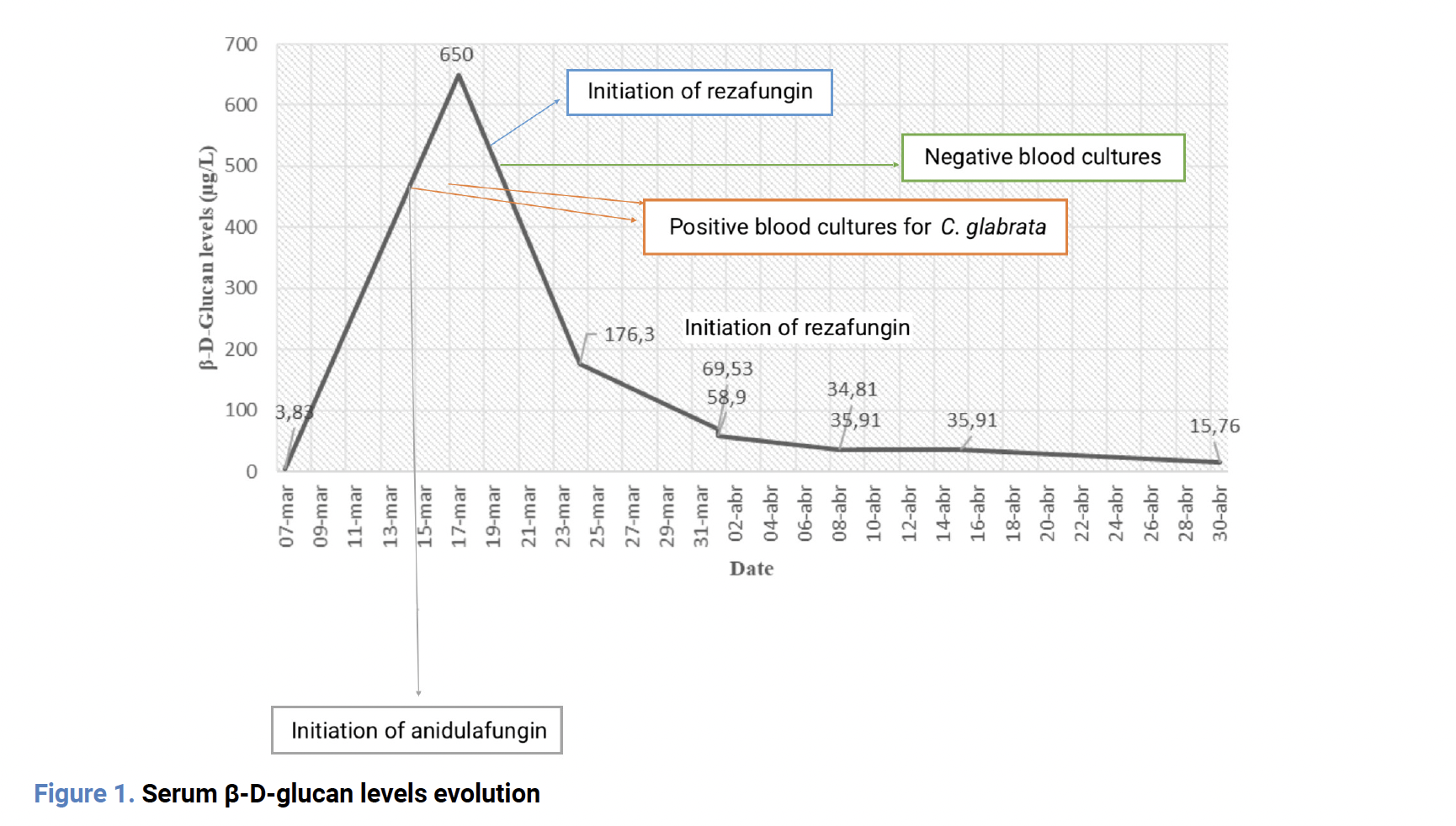
However, 72 hours later (POD +23), the patient developed a new episode of systemic clinical deterioration with fever and multiorgan dysfunction, requiring orotracheal intubation, invasive mechanical ventilation, and vasopressor support (noradrenaline). Broad-spectrum antibiotics (meropenem + vancomycin) and antifungal therapy (anidulafungin) were reinitiated. On POD +24, blood cultures were positive for Candida glabrata in two separate sets (PODs +24 and +25), along with isolation of C. glabrata from pleural fluid (indicating empyema) and markedly elevated serum β-D-glucan levels (650 pg/mL). Given the persistence of severe clinical status (refractory septic shock), inability to control the infectious source, and persistent candidemia, anidulafungin was discontinued and rezafungin was initiated on POD +27 (400 mg loading dose, followed by 200 mg weekly).
Following the initiation of rezafungin, the patient showed early clearance of blood cultures (POD +28) and a marked decrease in serum β-D-glucan levels on serial testing (Figure 1).
Clinically, the patient improved progressively, allowing for extubation, discontinuation of vasopressors, and cessation of antibiotic therapy. After nearly six weeks of antifungal treatment (5 doses of rezafungin plus 4 prior days of anidulafungin), rezafungin was discontinued, and the patient was transferred to the general ward on POD +68, with no evidence of fungal infection recurrence at the time of hospital discharge (POD +93).
Rezafungin exhibits potent, broad-spectrum in vitro antifungal activity against a wide range of Candida species, including those with reduced susceptibility or resistance to azoles. It demonstrates low minimum inhibitory concentrations (MICs) against different species such as C. albicans, C. tropicalis, C. krusei, C. glabrata, and C. parapsilosis. Notably, rezafungin also exhibits promising in vitro activity against emerging multidrug-resistant species, most notably C. auris [6].
This case illustrates the potential of rezafungin in the treatment of deep-seated severe infections caused by C. glabrata, where adequate tissue penetration of antifungal therapy is essential due to the high fungal burden and the difficulty in achieving source control. In this regard, several studies using murine models have demonstrated high deep-tissue penetration and concentration of rezafungin, with areas under the curve in tissues significantly exceeding those observed in plasma. Furthermore, drug levels consistently remain above the mutant prevention concentration. These pharmacological attributes are particularly relevant to the type of deep-seated infection presented by our patient, where achieving high drug concentrations is essential, especially when source control is clinically challenging [5,7].
Regarding the duration of antifungal therapy in our patient, the clinical evolution and the longitudinal monitoring of β-D-glucan levels served as the primary clinical guides. In this case, weekly β-D-glucan determinations proved instrumental in assessing the response to antifungal treatment. At the time of rezafungin discontinuation, β-D-glucan levels had decreased by more than 90% relative to the baseline value.
This case highlights both the favorable microbiological response (early clearance of blood cultures and marked decrease in serum β-D-glucan levels) and the positive clinical outcome observed in this patient. Furthermore, this case provides insight into the use of rezafungin in patients with septic shock admitted to an intensive care unit.
Funding
No funding was received for the research, authorship, and/or publication of this article.
Author contributions
Conceptualization, writing, and original draft preparation: A.E. and D.L. Review, editing, and supervision: R.R., P.P, and P.M. All authors have read and agreed to the published version of the manuscript.
Conflicts of interest
No commercial, financial, or personal conflicts of interest were identified in relation to the research, authorship, and/or publication of this article.
AI statement
No artificial intelligence tools were used in the writing, analysis, interpretation, or review of this article.
References
- Chandramohan D, Aguilar S, Gawrys G, Wiederhold NP, Traugott K, Patterson TF. A case of recurrent Candida glabrata fungemia and successful treatment with rezafungin. IDCases. 2025;40(e02233):e02233. Available from: https://doi.org/10.1016/j.idcr.2025.e02233
- Mori G, Gottardi M, Guffanti M, Castagna A, Lanzafame M. Treatment of Candida glabrata native valve endocarditis with rezafungin: a case report. JAC Antimicrob Resist. 2024;6(2):dlae042 Available from: https://doi.org/10.1093/jacamr/dlae042
- Thompson GR 3rd, Soriano A, Cornely OA, Kullberg BJ, Kollef M, Vazquez J, et al. Rezafungin versus caspofungin for treatment of candidaemia and invasive candidiasis (ReSTORE): a multicentre, double-blind, double-dummy, randomised phase 3 trial. Lancet. 2023;401(10370):49-59. Available from: https://doi.org/10.1016/S0140-6736(22)02324-8
- Andes D, Brüggemann RJ, Flanagan S, Lepak AJ, Lewis RE, Ong V, et al. The distinctive pharmacokinetic profile of rezafungin, a long-acting echinocandin developed in the era of modern pharmacometrics. J Antimicrob Chemother. 2025;80(1):18-28. Available from: https://doi.org/10.1093/jac/dkae415
- Zhao Y, Prideaux B, Nagasaki Y, Lee MH, Chen PY, Blanc L, et al. Unraveling Drug Penetration of Echinocandin Antifungals at the Site of Infection in an Intra-abdominal Abscess Model. Antimicrob Agents Chemother. 2017;61(10):e01009-17. Available from: https://doi.org/10.1128/AAC.01009-17
- Tóth Z, Forgács L, Locke JB, Kardos G, Nagy F, Kovács R, et al. In vitro activity of rezafungin against common and rare Candida species and Saccharomyces cerevisiae. J Antimicrob Chemother. 2019;74(12):3505-3510. Available from: https://doi.org/10.1093/jac/dkz390
- Lakota EA, Bader JC, Ong V, Bartizal K, Miesel L, Andes DR, et al. Pharmacological Basis of CD101 Efficacy: Exposure Shape Matters. Antimicrob Agents Chemother. 2017;61(11):e00758-17. Available from: https://doi.org/10.1128/AAC.00758-17
Explore
Articles
Volumes
About the journal
Most read
Recomendaciones para la prevención y el tratamiento de las infecciones respiratorias en adultos mayores institucionalizados
Revista Española de Quimioterapia
Acute infectious gastroenteritis in childhood: the role of rapid multiplex molecular syndromic panels in diagnosis and clinical management
Revista Española de Quimioterapia
Características epidemiológicas de pacientes con aislamientos de Enterobacterales productores de carbapenemasas-NDM en un hospital de alta complejidad
Revista Española de Quimioterapia
Review on the management of intra-abdominal candidiasis
Revista Española de Quimioterapia
Neoscytalidium dimidiatum: a rare locally acquired deep cutaneous infection in a renal transplant recipient
Revista Española de Quimioterapia