Letter
August 2025, Volume 38, nº4
6 min
Successful rezafungin treatment of an azole-resistant Candida parapsilosis vascular graft infection
Adela Benítez-Cano*, Lorena Rivera, Isabel Ramos, Jesús Carazo, Eliana Carrillo-Villamizar , Sonia Luque, Ramón Adalia, Luisa Sorlí
Hospital del mar, Barcelona, España
http://www.doi.org/10.37201/req/028.2025
Receipt Date:
05/03/2025
Acceptance Date:
09/04/2025
Publication Date:
15/04/2025
How to cite
Benítez-Cano A, Rivera L, Ramos I, Carazo J, Carrillo-Villamizar E, Luque S, Adalia R, Sorlí L. Successful rezafungin treatment of an azole-resistant Candida parapsilosis vascular graft infection. Rev Esp Quimioter 2025; 38(4): 358-360. Available from: http://www.doi.org/10.37201/req/028.2025
Metrics
573
Views
88
Downloads
Share
Share
Sir,
Rezafungin (CD101) is a novel semisynthetic echinocandin approved for the treatment of candidemia and invasive candidiasis. Rezafungin has an extended half-life allowing for weekly administration, which offers potential advantages over other echinocandins, especially in device-associated infections requiring long-term antifungal treatment [1-2].
We present the case of a 64‐year‐old male smoker with a history of arterial hypertension, dyslipidemia, and ischemic heart disease with preserved ejection fraction. He underwent an aorto-aortic bypass and right aorto-femoral bypass surgery in March 2022 for an abdominal aortic aneurysm. Two years later, he developed an aortic graft infection that required bypass removal and the placement of an axillo-bifemoral bypass. The postoperative course was complicated by the need for intensive care unit (ICU) admission due to the onset of leukocytoclastic vasculitis with ocular, cutaneous, and renal involvement, requiring hemodialysis and immunosuppressive treatment with immunoglobulins and rituximab.
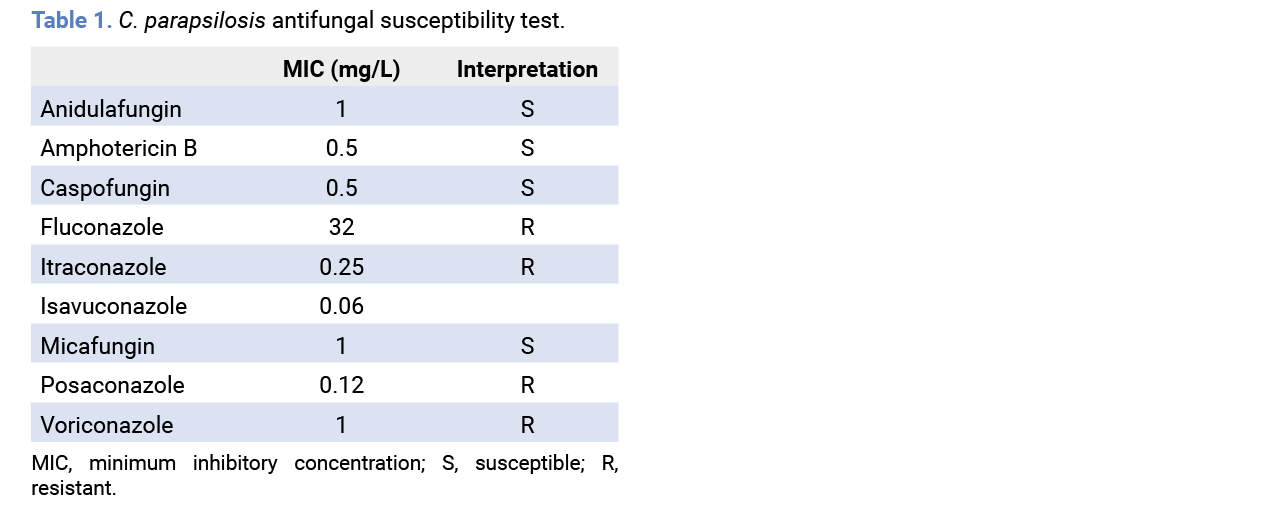
On the 15th postoperative day, the patient presented with a low-grade fever and elevated acute-phase reactants and was diagnosed with candidemia due to azole-resistant Candida parapsilosis associated with the jugular hemodialysis catheter. The antifungal susceptibility profile of C. parapsilosis is shown in Table 1.
 Targeted therapy with anidulafungin was initiated. However, persistent breakthrough candidemia was noted, suggesting secondary candidemia due to vascular graft infection (VGI). As the patient was not considered a candidate for surgical source control, combination antifungal therapy with anidulafungin and oral isavuconazole was initiated. Ten days later, a PET-CT was performed, revealing distal hyperuptake in the right bypass, confirming the suspicion of VGI (Figure 1).
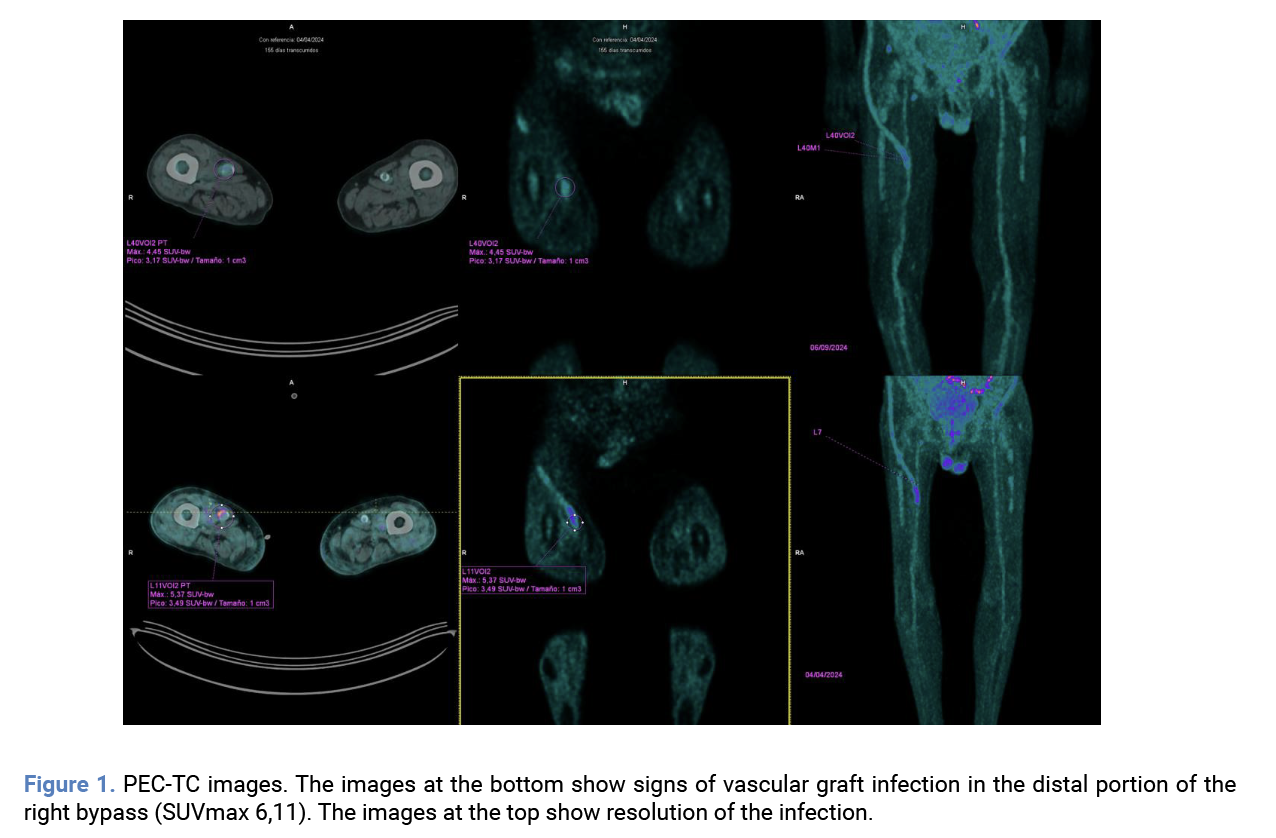 After 18 days of dual antifungal therapy with negative blood cultures, the patient was discharged from the ICU. This combination therapy was maintained upon discharge for two months, after which it was switched to rezafungin (Rezzayo®, Mundipharma GmbH, Germany). Although clinical evolution was favourable, the decision to change the antifungal treatment was based on the need for long-term outpatient therapy. The clinical evolution was favourable, and the patient was discharged from the hospital 35 days after the initiation of rezafungin treatment. Throughout the treatment, no significant adverse effects were observed. Following hospital discharge, treatment was maintained for four months until PET/CT imaging showed resolution of infection signs (Figure 1). During this period, the patient was monitored by the Infectious Diseases Unit with weekly hospital visits, without the need for long-term venous access, thereby reducing the risk of secondary infections.
VGI is a serious complication of vascular surgery, leading to increased morbidity and mortality [3]. Depending on the graft location, VGI can have devastating consequences, including gastrointestinal or bronchial bleeding, limb amputation, or death.
Successful VGI treatment often requires partial or complete removal of the infected graft and secondary vascular reconstruction in addition to antimicrobial or antifungal therapies. However, in patients for whom surgery is not an option due to their general condition, lifelong treatment should be considered [4].
On the other hand, invasive fungal infections are associated with high mortality rates, particularly among immunocompromised and critically ill patients [5]. In these populations, adverse effects and drug interactions related to many antifungal agents are common. Moreover, in recent years, there has been an increase in the incidence of azole-resistant Candida spp., which limits available therapeutic options, highlighting the need to expand the antifungal armamentarium [6].
Rezafungin is a semisynthetic echinocandin approved for the treatment of invasive candidiasis in adults [1-2]. It has demonstrated clinical efficacy against Candida spp., including strains resistant to other antifungal agents. The in vitro activity of rezafungin is comparable to that of anidulafungin, yet it exhibits an improved safety profile [7-8] and potent antibiofilm activity [9]. The absence of pharmacological interactions represents a significant advantage over other antifungal agents in the treatment of invasive candidiasis in immunocompromised patients. Furthermore, its pharmacokinetic properties—marked by stability and a long half-life (133 hours)—allow for weekly administration, thereby improving treatment adherence compared with other antifungal therapies [2,10].
Rezafungin represents a promising alternative for the treatment of invasive candidiasis, particularly in immunocompromised patients or those with infections that are difficult to treat due to resistance to other antifungal agents. Further studies are needed to establish its role in clinical therapy and evaluate its efficacy in specific populations.
Funding
None to declare.
Conflict of Interest
The authors declare no conflict of interest.
Authors contributions
Conceptualization, A.B-C. L.R. and L.S.; methodology, A.B-C., L.R. and L.S; software, A.B-C. and L.S; validation, A.B-C., L.R., I.S., J.C., C-L. E., S.L., R.A. and L.S.; formal analysis, A.B-C, L.S.; investigation, A.B-C. L.R. and L.S; resources, A.B-C. L.R., R.A. and L.S.; data curation, A.B-C., L.R., I.S., J.C., C-L. E., S.L., R.A. and L.S; writing—original draft preparation, A.B-C. L.R. and L.S.; writing—review and editing, A.B-C., R.A. and L.S; visualization, A.B-C., L.R., I.S., J.C., C-L. E., S.L., R.A; supervision, R.A., S.L and L.S.; project administration, A.B-C.; funding acquisition, A.B-C. All authors have read and agreed to the published version of the manuscript.
Targeted therapy with anidulafungin was initiated. However, persistent breakthrough candidemia was noted, suggesting secondary candidemia due to vascular graft infection (VGI). As the patient was not considered a candidate for surgical source control, combination antifungal therapy with anidulafungin and oral isavuconazole was initiated. Ten days later, a PET-CT was performed, revealing distal hyperuptake in the right bypass, confirming the suspicion of VGI (Figure 1).
After 18 days of dual antifungal therapy with negative blood cultures, the patient was discharged from the ICU. This combination therapy was maintained upon discharge for two months, after which it was switched to rezafungin (Rezzayo®, Mundipharma GmbH, Germany). Although clinical evolution was favourable, the decision to change the antifungal treatment was based on the need for long-term outpatient therapy. The clinical evolution was favourable, and the patient was discharged from the hospital 35 days after the initiation of rezafungin treatment. Throughout the treatment, no significant adverse effects were observed. Following hospital discharge, treatment was maintained for four months until PET/CT imaging showed resolution of infection signs (Figure 1). During this period, the patient was monitored by the Infectious Diseases Unit with weekly hospital visits, without the need for long-term venous access, thereby reducing the risk of secondary infections.
VGI is a serious complication of vascular surgery, leading to increased morbidity and mortality [3]. Depending on the graft location, VGI can have devastating consequences, including gastrointestinal or bronchial bleeding, limb amputation, or death.
Successful VGI treatment often requires partial or complete removal of the infected graft and secondary vascular reconstruction in addition to antimicrobial or antifungal therapies. However, in patients for whom surgery is not an option due to their general condition, lifelong treatment should be considered [4].
On the other hand, invasive fungal infections are associated with high mortality rates, particularly among immunocompromised and critically ill patients [5]. In these populations, adverse effects and drug interactions related to many antifungal agents are common. Moreover, in recent years, there has been an increase in the incidence of azole-resistant Candida spp., which limits available therapeutic options, highlighting the need to expand the antifungal armamentarium [6].
Rezafungin is a semisynthetic echinocandin approved for the treatment of invasive candidiasis in adults [1-2]. It has demonstrated clinical efficacy against Candida spp., including strains resistant to other antifungal agents. The in vitro activity of rezafungin is comparable to that of anidulafungin, yet it exhibits an improved safety profile [7-8] and potent antibiofilm activity [9]. The absence of pharmacological interactions represents a significant advantage over other antifungal agents in the treatment of invasive candidiasis in immunocompromised patients. Furthermore, its pharmacokinetic properties—marked by stability and a long half-life (133 hours)—allow for weekly administration, thereby improving treatment adherence compared with other antifungal therapies [2,10].
Rezafungin represents a promising alternative for the treatment of invasive candidiasis, particularly in immunocompromised patients or those with infections that are difficult to treat due to resistance to other antifungal agents. Further studies are needed to establish its role in clinical therapy and evaluate its efficacy in specific populations.
Funding
None to declare.
Conflict of Interest
The authors declare no conflict of interest.
Authors contributions
Conceptualization, A.B-C. L.R. and L.S.; methodology, A.B-C., L.R. and L.S; software, A.B-C. and L.S; validation, A.B-C., L.R., I.S., J.C., C-L. E., S.L., R.A. and L.S.; formal analysis, A.B-C, L.S.; investigation, A.B-C. L.R. and L.S; resources, A.B-C. L.R., R.A. and L.S.; data curation, A.B-C., L.R., I.S., J.C., C-L. E., S.L., R.A. and L.S; writing—original draft preparation, A.B-C. L.R. and L.S.; writing—review and editing, A.B-C., R.A. and L.S; visualization, A.B-C., L.R., I.S., J.C., C-L. E., S.L., R.A; supervision, R.A., S.L and L.S.; project administration, A.B-C.; funding acquisition, A.B-C. All authors have read and agreed to the published version of the manuscript.
References
- Ham YY, Lewis JS 2nd, Thompson GR 3rd. Rezafungin: a novel antifungal for the treatment of invasive candidiasis. Future Microbiol. 2021; 16:27-36. doi: 10.2217/fmb-2020-0217.
- Sandison T, Ong V, Lee J, Thye D. Safety and Pharmacokinetics of CD101 IV, a Novel Echinocandin, in Healthy Adults. Antimicrob Agents Chemother. 2017; 61:e01627-16. doi: 10.1128/AAC.01627-16.
- Wilson WR, Bower TC, Creager MA, Amin-Hanjani S, O’Gara PT, Lockhart PB, et al. Vascular Graft Infections, Mycotic Aneurysms, and Endovascular Infections: A Scientific Statement From the American Heart Association. Circulation. 2016; 134:e412-e460. doi: 10.1161/CIR.0000000000000457.
- Kahlberg A, Melissano G, Mascia D, Loschi D, Grandi A, Chiesa R. How to best treat infectious complications of open and endovascular thoracic aortic repairs. Semin Vasc Surg. 2017; 30:95-102. doi: 10.1053/j.semvascsurg.2017.11.002.
- Mazi PB, Olsen MA, Stwalley D, Rauseo AM, Ayres C, Powderly WG, et al. Attributable Mortality of Candida Bloodstream Infections in the Modern Era: A Propensity Score Analysis. Clin Infect Dis. 2022; 75:1031-6. doi: 10.1093/cid/ciac004.
- Pappas PG, Lionakis MS, Arendrup MC, Ostrosky-Zeichner L, Kullberg BJ. Invasive candidiasis. Nat Rev Dis Primers. 2018; 4:18026. doi: 10.1038/nrdp.2018.26.
- Thompson GR, Soriano A, Skoutelis A, Vazquez JA, Honore PM, Horcajada JP, et al. Rezafungin Versus Caspofungin in a Phase 2, Randomized, Double-blind Study for the Treatment of Candidemia and Invasive Candidiasis: The STRIVE Trial. Clin Infect Dis. 2021; 73:e3647-e3655. doi: 10.1093/cid/ciaa1380. Erratum in: Clin Infect Dis. 2021; 73:561-2. doi: 10.1093/cid/ciab402.
- Thompson GR 3rd, Soriano A, Cornely OA, Kullberg BJ, Kollef M, Vazquez J, et al. Rezafungin versus caspofungin for treatment of candidaemia and invasive candidiasis (ReSTORE): a multicentre, double-blind, double-dummy, randomised phase 3 trial. Lancet. 2023; 401:49-59. doi: 10.1016/S0140-6736(22)02324-8.
- Chandra J, Ghannoum MA. CD101, a Novel Echinocandin, Possesses Potent Antibiofilm Activity against Early and Mature Candida albicans Biofilms. Antimicrob Agents Chemother. 2018; 62:e01750-17. doi: 10.1128/AAC.01750-17.
- Lakota EA, Bader JC, Ong V, Bartizal K, Miesel L, Andes DR, et al. Pharmacological Basis of CD101 Efficacy: Exposure Shape Matters. Antimicrob Agents Chemother. 2017; 61:e00758-17. doi: 10.1128/AAC.00758-17.
Explore
Articles
Volumes
About the journal
Most read
Recomendaciones para la prevención y el tratamiento de las infecciones respiratorias en adultos mayores institucionalizados
Revista Española de Quimioterapia
Acute infectious gastroenteritis in childhood: the role of rapid multiplex molecular syndromic panels in diagnosis and clinical management
Revista Española de Quimioterapia
Características epidemiológicas de pacientes con aislamientos de Enterobacterales productores de carbapenemasas-NDM en un hospital de alta complejidad
Revista Española de Quimioterapia
Review on the management of intra-abdominal candidiasis
Revista Española de Quimioterapia
Neoscytalidium dimidiatum: a rare locally acquired deep cutaneous infection in a renal transplant recipient
Revista Española de Quimioterapia