Review
Volume 38; Suppl. 1
15 min
Therapeutic approach in the critically ill patient with suspected multidrug resistance
María Cruz Soriano-Cuesta1,* , Marina López-Olivencia1 , Francisco Javier Candel2 , Susana García-Plaza1
1Intensive Care Medicine Department, Hospital Universitario Ramón y Cajal, Madrid. Spain
2Clinical Microbiology and Infectious Diseases. Hospital Clínico Universitario San Carlos, Madrid, Spain
https://doi.org/10.37201/req/s01.10.2025
Receipt Date:
04/09/2025
Acceptance Date:
03/09/2025
Publication Date:
23/10/2025
How to cite
Soriano-Cuesta C, López-Olivencia M, Candel FJ, García-Plaza S. Therapeutic approach in the critically ill patient with suspected multidrug resistance. Rev Esp Quimioter. 2025; 38(Suppl. 1): 63-69. Available from: https://doi.org/10.37201/req/s01.10.2025
Metrics
576
Views
196
Downloads
Share
Share
Abstract (EN)
The treatment of infections caused by multidrug-resistant microorganisms (MDROs) in critically ill patients remains a major clinical challenge due to the high mortality associated with therapeutic failure. Delays in administering effective antibiotics is a determining factor, especially in patients with sepsis. The presence of MDROs is one of the main causes of failure of empirical treatment. Identifying patients at risk of MDRO infection is essential, although complex. Factors such as prior use of antibiotics disrupt the intestinal microbiome balance and promote colonization by MDROs. Immunosuppression, disruption of physical barrier, systemic or organ-specific frailty, and the length of hospital stay increase the risk of colonization and infection by MDROs. In patients with sepsis and a high risk of MDRO infection, empirical therapy should be broad-spectrum and administered early. Traditionally, combination therapy has been recommended, preferably including a classical β-lactam together with aminoglycosides or colistin—drugs that may be suboptimal in certain infection sites and are associated with significant toxicity risks. The new broad-spectrum β-lactams, already validated as first-line targeted treatment, are emerging as a promising empirical option in selected patients. Their early use, guided by colonization status, can optimize initial coverage in terms of spectrum and pharmacokinetic/pharmacodynamic, and reduces delays in the initiation of effective treatment. This strategy should be integrated into antimicrobial stewardship programs and be followed by de-
escalation once microbiological results are available.
Keywords (EN):
Empirical Therapy
Sepsis
Antimicrobial Stewardship
De-escalation
Multidrug-Resistant Bacteria
Critically Ill Patients
Introduction
In critically ill patients, selecting empirical antimicrobial therapy is an urgent and crucial decision. Delays in the administration of effective antibiotics are consistently associated with increased mortality in cases of sepsis and septic shock [1]. However, choosing the appropriate empirical treatment is not always straightforward, and the risk of therapeutic failure rises significantly when the causative pathogen is a multidrug-resistant microorganism (MDRO). This risk has led many clinical guidelines to recommend an initial empirical dual therapy strategy in patients at high risk of infection by multidrug-resistant Gram-negative bacilli (MDR-GNB), combining a classical broad-spectrum β-lactam with a second agent such as colistin or an aminoglycoside [2]. However, in clinical practice, this approach presents significant limitations: adequate coverage with the initial β-lactam is not always achieved [3], which implies that during the first hours—the most critical phase of the septic process—the patient may be receiving effective monotherapy with agents that have suboptimal pharmacokinetic/pharmacodynamic (PK/PD) profiles in certain sites of infection (such as the lungs or soft tissues), and that carry a high risk of toxicity, especially nephrotoxicity [4]. In this context, the new broad-spectrum β-lactams gain relevance, as they are already positioned as first-line targeted therapy against documented MDRO infections [5]. Due to their spectrum, improved pharmacodynamic profiles, and lower toxicity, they are considered promising candidates for empirical use in selected patients with severe infections and a high risk of MDRO. This article reviews the potential role of these new antimicrobials in the empirical treatment of severe infections in patients at high risk of MDRO infection, with the aim of assessing whether sufficient rationale exists to position them as a first-line option.Clinical context: impact of delayed effective empirical treatment
Early administration of effective antibiotics is essential to improve outcomes in patients with sepsis or septic shock, particularly in the context of infections caused by MDROs. The evidence is clear: each hour of delay decreases survival probability. Kumar et al. demonstrated that every minute counts in septic shock [1], and Mensa et al. introduced the concept of a “point of no return” beyond which antimicrobial efficacy is lost [6]. The presence of MDROs is one of the main factors associated with failure of empirical treatment in severe infections. In a multicenter study conducted by Kadri et al. [7], which included more than 21,000 episodes of bloodstream infection, it was observed that one in five patients received inadequate empirical therapy, with resistant pathogens being the main predictor of this failure (aOR 9.09; 95% CI 7.68–10.76). Furthermore, inadequate therapy was associated with increased hospital mortality (aOR 1.46; 95% CI 1.28–1.66). In patients with KPC-producing Klebsiella pneumoniae bacteremia, starting active treatment within the first 24 hours significantly reduced 30-day mortality, whereas each day of delay increased the risk of death [4]. In infections caused by carbapenem-resistant Gram-negative bacilli, the impact also extends to prolonged hospital stay and increased costs [8].Risk factors for MDRO infection
Identifying patients at risk for MDRO infection is essential but complex. Among individual risk factors, those that alter the microbiome stand out, as they promote the emergence of the intestinal resistome and colonization by MDROs. One of the most extensively studied risk factors is prior antibiotic use, especially agents with anaerobicidal activity and/or biliary excretion, due to their ability to induce dysbiosis [9]. Cumulative exposure to antipseudomonal β-lactams, such as piperacillin/tazobactam or meropenem, increases the risk of selection and subsequent infection by multidrug-resistant pathogens such as Pseudomonas aeruginosa [10] (Figure 1). Other factors that may facilitate acquisition or infection by MDROs—by altering the microbiome, increasing exposure, or disrupting natural barriers—include prolonged hospital stay, immunosuppression, patient frailty, mechanical ventilation, or the presence of central venous catheters. Most of these factors, taken individually, have a low positive predictive value; assessing them in isolation may lead to unnecessary antibiotic pressure, with both individual and global consequences in terms of resistance development [11] (Figure 1).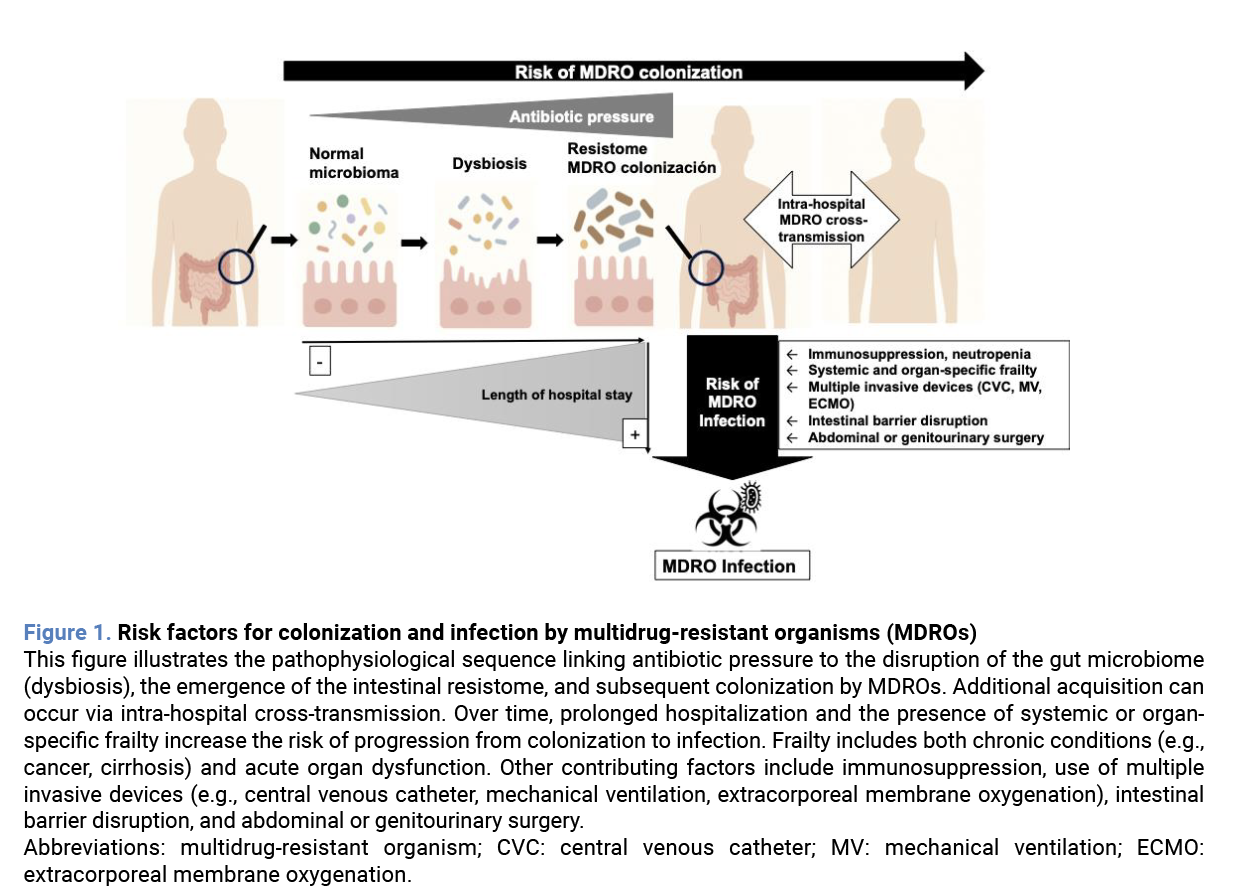 Intestinal colonization by carbapenemase-producing Enterobacterales or multidrug-resistant Pseudomonas is one of the factors most strongly associated with MDRO infection and has a high negative predictive value [12]. In endemic or outbreak settings, local epidemiology may override the absence of individual risk factors and explain cases of
colonization or infection in patients without apparent risk [13].
The selection of empirical antibiotic therapy must consider both the patient’s history of colonization or infection with MDROs and the local epidemiological situation—whether endemic or outbreak-related. In the context of a severe infection, empirical treatment should include agents active against the identified or suspected MDROs.
Empirical antibiotic strategy
In critically ill patients with sepsis or septic shock and a high risk of infection by MDR-GNB, the empirical antibiotic therapy should be broad-spectrum and initiated early [2]. It is recommended to ensure from the outset a broad-spectrum β-lactam with specific activity against these pathogens. Traditionally, the standard recommendation has been dual therapy targeting MDR-GNB, combining a classical anti-Pseudomonas β-lactam (piperacillin-tazobactam, cefepime, ceftazidime, imipenem, meropenem, or aztreonam) with a non-β-lactam agent (aminoglycoside, colistin, or fluoroquinolone), aiming to broaden initial empirical coverage. This approach is followed by de-escalation to targeted monotherapy once the microorganism is identified and its susceptibility profile is available, to minimize adverse effects associated with antimicrobial use, such as direct toxicity, Clostridioides difficile infection, and the selection of antimicrobial resistance [2]. The main goal of combination therapy is to maximize initial empirical coverage—especially by combining agents active against GNB —to broaden the antimicrobial spectrum, although its clinical benefit remains limited and controversial. It was considered particularly useful in situations where more effective therapeutic alternatives were not available. However, in real-world clinical practice, optimal empirical coverage is not always achieved. A study in hematologic patients with P. aeruginosa bacteremia showed that, despite therapeutic efforts, a relevant proportion received inadequate treatment—especially regarding the initial β-lactam—which was associated with increased mortality. This underscores that therapeutic failures are even more frequent if defined as failure to choose the correct β-lactam [3]. According to these classical schemes, when an active β-lactam is not available due to resistance, this implies monotherapy with aminoglycosides or colistin during the period of greatest clinical instability and highest bacterial load. It is important to note that definitive results from cultures and susceptibility testing may take several days [14], meaning that suboptimal treatment is being administered during this time, potentially delaying effective infection control. Although aminoglycosides and colistin demonstrate broad in vitro activity against MDR-GNB and generally favorable minimum inhibitory concentrations (MICs), they have suboptimal PK/PD profiles—particularly in infection sites like the lungs—where tissue penetration and distribution are poor. As a result, clinical response may be insufficient. Moreover, both drug classes carry a high risk of nephrotoxicity, making them less suitable for empirical use in critically ill patients, especially those with impaired renal function [5]. This issue opens the door for the new broad-spectrum β-lactams to play a role in empirical treatment in selected patients.New β-lactams and their role in empirical treatment
New broad-spectrum β-lactams such as ceftolozane- tazobactam, ceftazidime-avibactam, cefiderocol, meropenem-vaborbactam, imipenem-relebactam, aztreonam-avibactam, and cefepime-enmetazobactam have been consolidated in clinical guidelines as first-line agents for targeted treatment of infections caused by MDROs, due to their high efficacy, improved PK/PD profiles, and lower toxicity compared to traditional combinations such as colistin or aminoglycosides [5]. Several studies evaluating novel β-lactam antibiotics have found that early initiation is associated with improved clinical outcomes [14–16]. Riccobene et al. [14] analyzed the impact of inadequate empirical therapy in patients with infections caused by Enterobacterales (n = 229,320) and P. aeruginosa (n = 36,027), including patients treated with agents such as ceftazidime-avibactam, ceftolozane- tazobactam, cefiderocol, meropenem-vaborbactam, eravacycline, and imipenem-relebactam. Their results showed that delays in initiating these antibiotics were significantly associated with increased mortality and longer hospital stays, underscoring the importance of early administration in patients at risk for MDRO infections. In addition, the mean time to initial susceptibility results was longer for resistant strains than for susceptible ones—64 hours vs. 48 hours for Enterobacterales, and 67 hours vs. 60 hours for P. aeruginosa— highlighting the real-world difficulty in adjusting treatment promptly when the use of last- generation agents is not anticipated. On the other hand, available evidence supports the use of these antibiotics as monotherapy when documented in vitro susceptibility exists, as no clinical benefit or resistance prevention has been demonstrated with systematic combination [5]. In the PERSEUS study, for example, cefiderocol monotherapy was effective in severe MDRO infections, reinforcing its role as a rescue therapeutic option. A recent meta-analysis concluded that combining ceftazidime-avibactam with other agents does not provide significant advantages over monotherapy in terms of mortality or clinical cure rates [17]. In critically ill patients, the empirical use of these novel broad-spectrum β-lactams should be particularly considered when the risk of inadequate coverage is unacceptable, such as in patients with severe infection and known colonization or prior infection by MDROs. The concept of colonization-guided empirical treatment is based on integrating results from rectal screenings, recent clinical cultures, or a history of MDRO infection, in order to select from the outset the antibiotic most likely to be effective. This strategy allows anticipation of microbiological results and optimization of initial coverage, reducing delays in active treatment administration and improving clinical outcomes (Figure 2).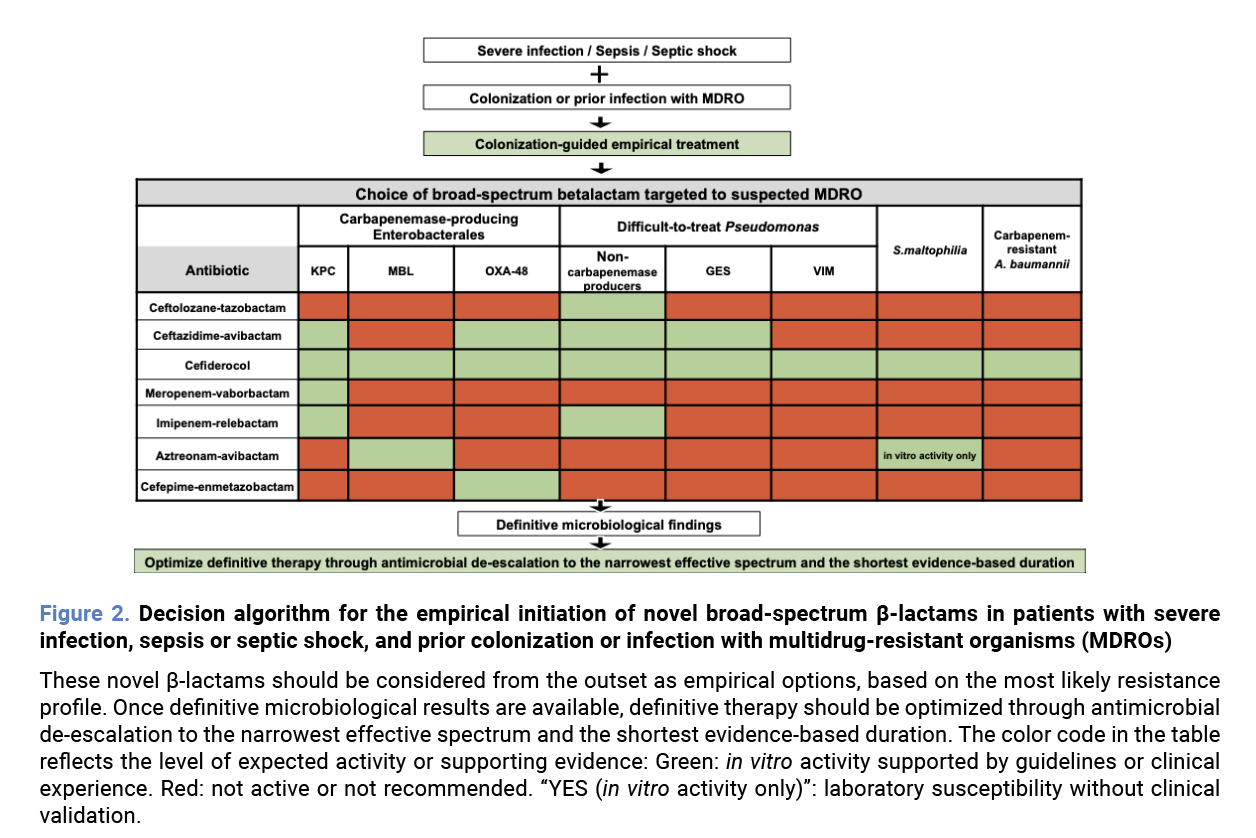 Nevertheless, the empirical use of these broad-spectrum antibiotics must be accompanied by a de-escalation strategy once microbiological results are available. This practice is safe and has been associated with lower mortality in patients with sepsis and septic shock [18]. It also helps minimize toxicity, reduce selective pressure, and avoid unnecessary treatment with broad-spectrum agents [19].
In the context of severe infection, particularly in critically ill patients, it is essential to optimize the pharmacokinetics of β-lactam antibiotics through strategies such as loading doses and prolonged or continuous infusion. These interventions, recommended for time-dependent β-lactams, have been shown to improve clinical efficacy in scenarios with increased volume of distribution, hypoalbuminemia, high bacterial load, or elevated MICs [20]. Although this strategy has traditionally been applied to classical β-lactams, its rationale also extends to the new agents, whose efficacy may similarly depend on appropriate PK/PD optimization.
New diagnostic tools bring empirical treatment closer to targeted therapy
Rapid molecular techniques, such as the FilmArray® syndromic panel, allow identification of both the pathogen and certain resistance mechanisms within a few hours [21]. This diagnostic approach can be particularly useful in patients with suspected infection by MDROs, as it enables earlier and more tailored therapeutic decisions, reducing the time between empirical and targeted therapy. In clinically stable patients, having the results before initiating treatment allows for a more rational approach from the outset, aimed at a targeted or semi-targeted therapy. However, in critically ill patients with hemodynamic instability or other severe conditions, the early selection of broad-spectrum empirical treatment remains an essential clinical practice and a guarantee of good medical conduct. In such cases, these techniques do not replace but rather complement the initial decisions, enabling a potentially earlier and safer de-escalation.Rational use of antimicrobials in the ICU: compatibility with early empirical treatment
Antimicrobial stewardship program in the intensive care unit (ICU-ASP), led by intensivists specialized in infectious diseases and sepsis, aims primarily to ensure the rational use of antibiotics by promoting the selection of effective, safe treatments with appropriate exposure based on pharmacokinetic and pharmacodynamic principles. This approach includes strategies to reduce overall antimicrobial consumption, such as limiting treatment duration, discontinuing ineffective antibiotics, diversifying selective pressure, and de-escalating therapy when feasible [22]. This model is compatible with the early empirical administration of broad-spectrum β-lactams in patients at high risk of MDRO infection. Therefore, integrating this individual decision into a broader review and de-escalation strategy is an essential component of a well-structured ASP, which seeks to balance individual patient safety with the control of antimicrobial resistance.Conclusions
The treatment of infections caused by MDROs in critically ill patients remains a major challenge. Delays in the administration of appropriate antibiotics significantly increases mortality. Currently, new broad-spectrum β-lactams are emerging as an effective and safe option for the empirical treatment of infections at risk of MDRO in patients with severe infection. Early use of these antibiotics, guided by colonization status, is crucial when the risk of inadequate coverage is high and the clinical condition does not allow delays in optimal therapy. The empirical use of these agents must be accompanied by a de-escalation strategy once microbiological results become available, in order to minimize toxicity and control selective pressure. Funding None to declare. Conflict of interest M.C.S.-C. reports having received financial support for congress attendance from Pfizer, MSD, Shionogi, Viatris, Mundipharma, and Gilead. She has also received speaker honoraria and/or participated in advisory boards funded by Pfizer, MSD, Shionogi, Viatris, Mundipharma, Gilead, and Advance. M.L.-O. reports having received financial support for attending medical courses and conferences from Pfizer and Gilead, and speaker honoraria from Pfizer and Shionogi. F.J.C. reports having received financial support for congress attendance from Pfizer, MSD, Shionogi, Viatris, Mundipharma, and Gilead. He has also received speaker honoraria and/or participated in advisory boards funded by Pfizer, MSD, Shionogi, Viatris, Mundipharma, Gilead, and Advance. S.G.-P. declares no conflicts of interest. Author contributions M.C.S.-C.; writing—original draft preparation, M.L.-O.; writing—original draft preparation, S.G.-P.; writing—review and editing, F.J.C.; writing—review and editing. All authors have read and agreed to the published version of the manuscript.References
- Kumar A, Roberts D, Wood KE, Light B, Parrillo JE, Sharma S, et al. Duration of hypotension before initiation of effective antimicrobial therapy is the critical determinant of survival in human septic shock. Crit Care Med. 2006 Jun;34(6):1589-96. Available from: https://doi.org/10.1097/01.CCM.0000217961.75225.E9
- Evans L, Rhodes A, Alhazzani W, Antonelli M, Coopersmith CM, French C, et al. Surviving sepsis campaign: international guidelines for management of sepsis and septic shock 2021. Intensive Care Med. 2021 Nov;47(11):1181-1247. Available from: https://doi.org/10.1007/s00134-021-06506-y
- Chumbita M, Puerta-Alcalde P, Yáñez L, Angeles Cuesta M, Chinea A, Español-Morales I, et al. High rate of inappropriate antibiotics in patients with hematologic malignancies and Pseudomonas aeruginosa bacteremia following international guideline recommendations. Microbiol Spectr. 2023 Aug 17;11(4):e0067423. Available from: https://doi.org/10.1128/spectrum.00674-23
- Falcone M, Bassetti M, Tiseo G, Giordano C, Nencini E, Russo A, et al. Time to appropriate antibiotic therapy is a predictor of outcome in patients with bloodstream infection caused by KPC-producing Klebsiella pneumoniae. Crit Care. 2020 Jan 30;24(1):29. Available from: https://doi.org/10.1186/s13054-020-2742-9
- Tamma PD, Heil EL, Justo JA, Mathers AJ, Satlin MJ, Bonomo RA. Infectious Diseases Society of America 2024 guidance on the treatment of antimicrobial-resistant Gram-negative infections. Clin Infect Dis. 2024 Aug 7;ciae403. Available from: https://doi.org/10.1093/cid/ciae403
- Mensa J, Barberán J, Ferrer R, Borges M, Rascado P, Maseda E, et al. Recommendations for antibiotic selection for severe nosocomial infections. Rev Esp Quimioter. 2021 Oct;34(5):511-24. Available from: https://doi.org/10.37201/req/126.2021
- Kadri SS, Lai YL, Warner S, Strich JR, Babiker A, Ricotta EE, et al. Inappropriate empirical antibiotic therapy for bloodstream infections based on discordant in-vitro susceptibilities: a retrospective cohort analysis of prevalence, predictors, and mortality risk in US hospitals. Lancet Infect Dis. 2021 Feb;21(2):241-51. Available from: https://doi.org/10.1016/S1473-3099(20)30477-1
- Garnacho-Montero J, Aguado JM, Alemparte E, Horcajada JP, López-Medrano F, Ramírez P, et al. Healthcare resource utilization and costs associated with inadequate initial antibiotic treatment of bacteraemia produced by carbapenem-resistant Gram-negative bacilli (CRGNB): a descriptive, observational study in Spanish hospitals. Rev Esp Quimioter. 2025 May;38(3):197-207. Available from: https://doi.org/10.37201/req/121.2024
- Woerther P-L, Lepeule R, Burdet C, Decousser J-W, Ruppé É, Barbier F, et al. Carbapenems and alternative β-lactams for the treatment of infections due to extended-spectrum β-lactamase-producing Enterobacteriaceae: what impact on intestinal colonisation resistance? Int J Antimicrob Agents. 2018;52(6):762-70. Available from: https://doi.org/10.1016/j.ijantimicag.2018.08.026
- Teshome BF, Vouri SM, Hampton N, Kollef MH, Micek ST, et al. Duration of exposure to antipseudomonal β-lactam antibiotics in the critically ill and development of new resistance. Pharmacotherapy. 2019 Mar;39(3):261-70. Available from: https://doi.org/10.1002/phar.2201
- Timsit JF, Bassetti M, Cremer O, Daikos G, de Waele J, Kallil A, et al. Rationalizing antimicrobial therapy in the ICU: a narrative review. Intensive Care Med. 2019 Feb;45(2):172-89. Available from: https://doi.org/10.1007/s00134-019-05520-5
- Gallardo-Pizarro A, Lopera C, Peyrony O, Monzo-Gallo P, Aiello TF, Martinez-Urrea A, et al. Rectal colonization by multidrug-resistant Gram-negative bacteria and subsequent bacteraemia in haematological patients. Clin Microbiol Infect. 2025;S1198-743X(25)00282-4.
- Aracil-Gisbert S, Fernández-De-Bobadilla MD, Guerra-Pinto N, Serrano-Calleja S, Pérez-Cobas AE, Soriano C, et al. The ICU environment contributes to the endemicity of the Serratia marcescens complex in the hospital setting. mBio. 2024 May;15(5):e0305423. Available from: https://doi.org/10.1128/mbio.03054-23
- Riccobene T, Ye G, Lock J, Yu KC, Ai C, Gregory S, et al. Outcomes of inadequate empiric therapy and timing of newer antibacterial therapy in hospitalized adults with culture-positive Enterobacterales and Pseudomonas aeruginosa: a multicenter analysis. BMC Infect Dis. 2024 Aug;24(1):810. Available from: https://doi.org/10.1186/s12879-024-09700-7
- Torre-Cisneros J, Almirante B, De La Fuente Martos C, Rascado P, Salavert Lletí M, Sánchez-García M, et al. Effectiveness and safety of cefiderocol treatment in patients with Gram-negative bacterial infections in Spain in the early access programme: results of the PERSEUS study. Eur J Clin Microbiol Infect Dis. 2025. Available from: https://doi.org/10.1007/s10096-025-05108-6
- Ackley R, Roshdy D, Shafiq M, et al. Race against time: unraveling the impact of early ceftazidime-avibactam administration [poster]. Presented at: 33rd ECCMID (European Congress of Clinical Microbiology and Infectious Diseases); 2023 Apr 15–18; Copenhagen, Denmark.
- Hsu W, Chuang MH, Tsai WW, Lai CC, Lai HY, Tang HJ. Ceftazidime-avibactam combination therapy versus monotherapy for treating carbapenem-resistant Gram-negative infection: a systematic review and meta-analysis. Infection. 2024;52(4):2029-42. Available from: https://doi.org/10.1007/s15010-024-02277-y
- Garnacho-Montero J, Gutiérrez-Pizarraya A, Escoresca-Ortega A, Corcio-Palomo Y, Fernández-Delgado E, Herrera- Melero I, et al. De-escalation of empirical therapy is associated with lower mortality in patients with severe sepsis and septic shock. Intensive Care Med. 2014 Jan;40(1):32-40. Available from: https://doi.org/10.1007/s00134-013-3077-7
- Matuszak SS, Kolodziej L, Micek S, Kollef MH. Antibiotic de-escalation in the intensive care unit: rationale and potential strategies. Antibiotics (Basel). 2025;14(5):467. Available from: https://doi.org/10.3390/antibiotics14050467
- Roberts JA, Abdul-Aziz MH, Davis JS, Dulhunty JM, Cotta MO, Myburgh J, et al. Continuous versus intermittent β-lactam infusion in severe sepsis: a meta-analysis of individual patient data from randomized trials. Am J Respir Crit Care Med. 2016 Sep;194(6):681-91. Available from: https://doi.org/10.1164/rccm.201601-0024OC
- Candel FJ, Salavert M, Cantón R, Del Pozo JL, Galán-Sánchez F, Navarro D, et al. The role of rapid multiplex molecular syndromic panels in the clinical management of infections in critically ill patients: an expert-opinion document. Crit Care. 2024 Dec;28(1):440. Available from: https://doi.org/10.1186/s13054-024-05224-3
- Ruiz-Ramos J, Ramírez Galleymore P. Programas de optimización de antibióticos en la unidad de cuidados intensivos en caso de infecciones por bacilos Gram-negativos multirresistentes. Med Intensiva. 2023;47(Suppl 3):99-107. Available from: https://doi.org/10.1016/j.medin.2022.07.007
Explore
Articles
Volumes
About the journal
Most read
Recomendaciones para la prevención y el tratamiento de las infecciones respiratorias en adultos mayores institucionalizados
Revista Española de Quimioterapia
Acute infectious gastroenteritis in childhood: the role of rapid multiplex molecular syndromic panels in diagnosis and clinical management
Revista Española de Quimioterapia
Características epidemiológicas de pacientes con aislamientos de Enterobacterales productores de carbapenemasas-NDM en un hospital de alta complejidad
Revista Española de Quimioterapia
Review on the management of intra-abdominal candidiasis
Revista Española de Quimioterapia
Neoscytalidium dimidiatum: a rare locally acquired deep cutaneous infection in a renal transplant recipient
Revista Española de Quimioterapia