Review
Volume 38; Suppl. 1
9 min
Usefulness of monocyte distribution width (MDW) in enhancing diagnostic accuracy of infection among severely ill patients presenting to the emergency department
Juan González del Castillo1 , Enrique del Toro2, Marcos Fragiel2 , David Oteo2, Ana García-Álvarez3
1Emergency Department, IdISSC, Clínico San Carlos Hospital, Complutense University, Madrid, Spain
2Emergency Department, Clínico San Carlos Hospital, Madrid, Spain
3Department of Medical Laboratory, Laboratory Medicine Institute, Clínico San Carlos Hospital, Madrid, Spain.
https://doi.org/10.37201/req/s01.01.2025
Receipt Date:
01/09/2025
Acceptance Date:
31/08/2025
Publication Date:
23/10/2025
How to cite
González del Castillo J, del Toro E, Fragiel M, Oteo D, García-Álvarez A. Usefulness of monocyte distribution width (MDW) in enhancing diagnostic accuracy of infection among severely ill patients presenting to the emergency department. Rev Esp Quimioter. 2025; 38(Suppl. 1): 5-10 Available from: http://www.doi.org/10.37201/req/s01.01.2025
Metrics
407
Views
84
Downloads
Share
Share
Abstract (EN)
Sepsis remains a major cause of morbidity and mortality and continues to pose substantial diagnostic challenges in its early stages. Monocyte Distribution Width (MDW), a parameter automatically integrated into complete blood counts by next-generation haematology analysers, has emerged as a promising biomarker. This study evaluates the diagnostic performance of MDW compared with traditional markers (C-reactive protein and leukocyte count) and clinical scoring systems (SOFA and NEWS) in a cohort of critically ill patients presenting to a hospital emergency department, with the aim of distinguishing those with infection from those whose severity was attributable to other causes.
Keywords (EN):
Biomarkers
Monocyte distribution width (MDW)
Sepsis
Introduction
Sepsis is a life-threatening condition caused by a dysregulated host response to infection, in which early recognition significantly improves prognosis [1]. However, diagnosis at an early stage remains a major clinical challenge, particularly in immunocompromised patients, the elderly, or those with comorbidities, where clinical manifestations may be atypical [2]. It should also be noted that clinical scoring systems used in sepsis definition, such as sequential organ failure assessment (SOFA) and national early warning score (NEWS), may be altered in clinical conditions apart from sepsis. Several recent studies have addressed the importance of early diagnosis, prognostic stratification [3], appropriate blood culture sampling [4], and early antibiotic administration [5], as well as the impact of compliance with sepsis care bundles on clinical outcomes [6,7]. In parallel, the development of biomarkers applicable to emergency settings has gained increasing relevance. Classical biomarkers such as C-reactive protein (CRP) and procalcitonin have been complemented by more recent ones, such as midregional proadrenomedullin (MR-proADM) and soluble urokinase plasminogen activator receptor (suPAR), as well as predictive models such as MPB-INFURG-SEMES [8–11]. Nevertheless, elevated biomarker levels do not provide 100% specificity for identifying sepsis, as they may also increase in other clinical conditions. In this context, Monocyte Distribution Width (MDW), derived from advanced haematology analysers, has emerged as a promising biomarker with the advantage of being obtained automatically without the need for additional testing. MDW is an automated index based on morpho-volumetric analysis of monocytes and has been proposed as a rapid, accessible, and cost-effective tool to improve diagnostic accuracy in suspected severe infections. Recent studies have shown promising performance of MDW compared with traditional biomarkers [12]. The aim of this study was to assess the diagnostic value of MDW for detecting infection in patients presenting to the emergency department with clinical severity criteria, and to compare its performance with other routinely available biomarkers and clinical scores.Methods
This was a retrospective observational study conducted in the Emergency Department of Hospital Clínico San Carlos (Madrid, Spain) between 1 January and 30 June 2024. Adult patients (≥18 years) were included if they met at least one of the following severity criteria: NEWS ≥5 points, increase in SOFA score ≥2 points from baseline, lactate ≥4 mmol/L, or lactate ≥3 mmol/L with systolic blood pressure <100 mmHg. Our institution is a high-complexity university hospital with more than 700 beds, where approximately 165,000 patients are attended annually in the Emergency Department. Clinical, demographic, and analytical variables at admission were collected through automated download of pseudo-anonymised data from the electronic health records of the Emergency Department. These included age, sex, comorbidities, leukocyte count, CRP, and MDW values, final diagnosis of infection at hospital discharge, and in-hospital mortality. NEWS scores and changes from baseline SOFA scores were also calculated. The final hospital discharge diagnosis was used as the reference standard to determine whether or not the patient had an infectious process. Receiver operating characteristic (ROC) curves were generated for each biomarker and clinical score, with estimation of the area under the curve (AUC), sensitivity, and specificity. The optimal cut-off for MDW was determined using the Youden index. Diagnostic performance was assessed both in the overall study population and in the subgroup of patients aged ≥65 years. The prognostic value of MDW for identifying in-hospital mortality was also analysed. The study protocol was approved by the Ethics Committee of Clínico San Carlos Hospital (Madrid, Spain), reference number HCSC/25/532-E. The Ethics Committee waived the requirement for informed consent due to the characteristics of the study.Results
A total of 3,942 patients meeting severity criteria were included out of 79,708 attended in the Emergency Department (4.9%). The mean age was 70.8 years (SD 20.3); 53.6% were male, and 68% were aged ≥65 years. Infection was diagnosed in 43.4% of patients, 4.3% of whom were of viral origin. In-hospital mortality was 9.2%. Figure 1 shows the AUC values for the biomarkers analysed, with MDW reaching 0.788 (95% CI 0.773–0.802). Figure 2 depicts results in patients aged ≥65 years, highlighting the loss of accuracy observed for CRP.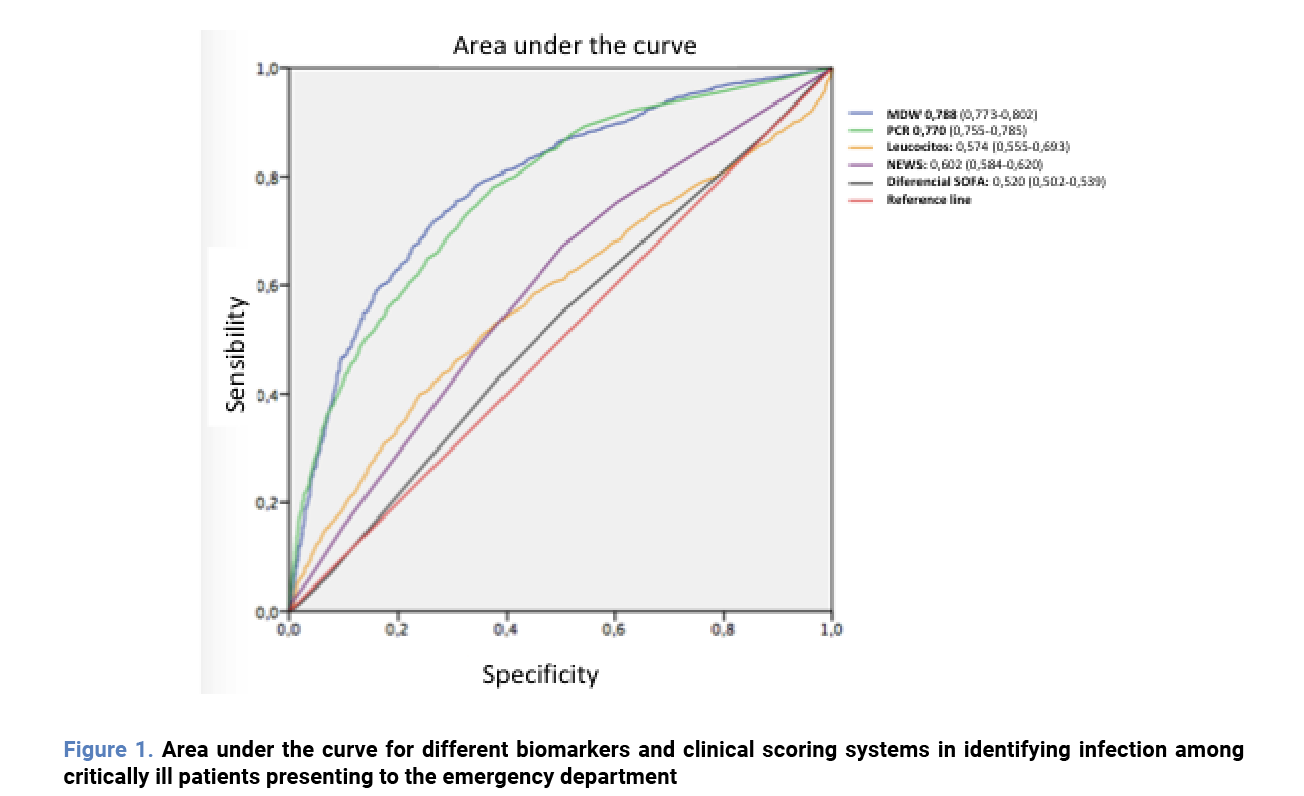
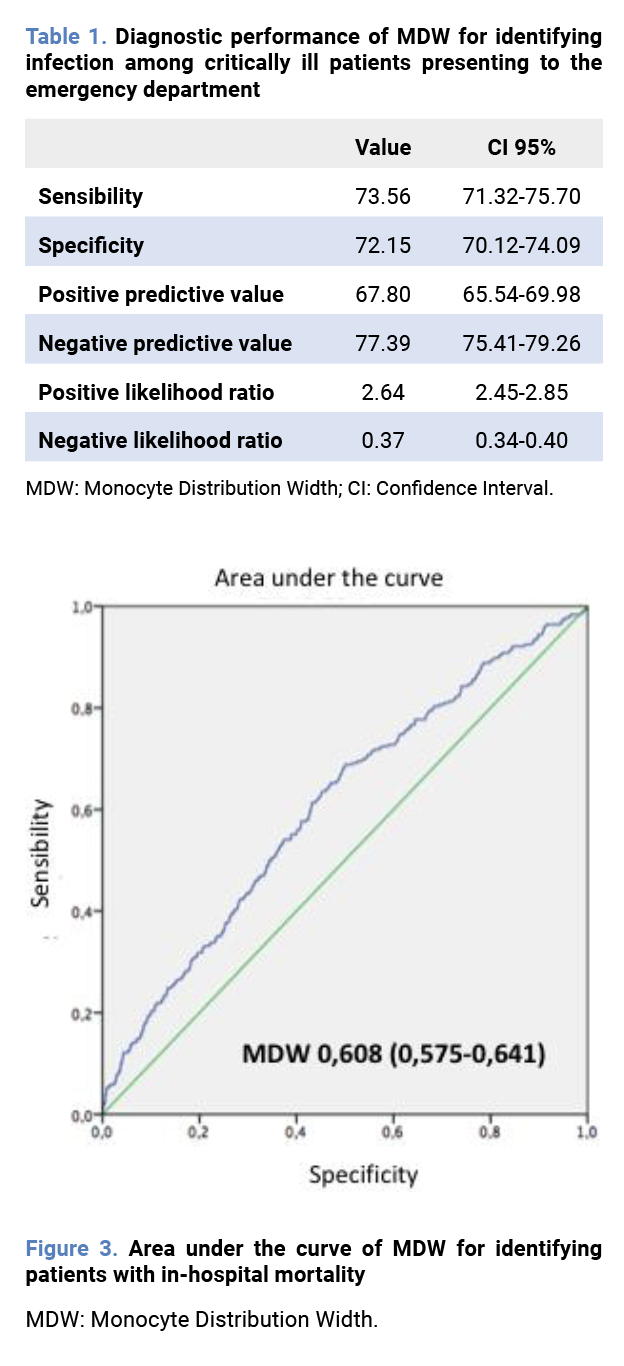
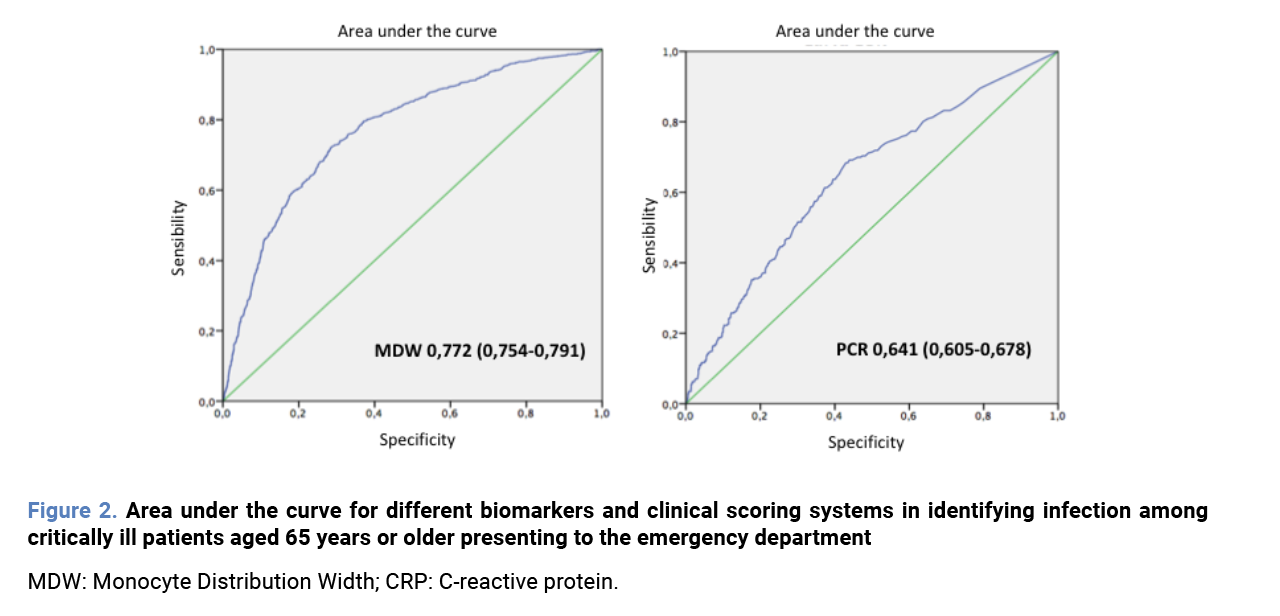 Table 1 displays the diagnostic accuracy of MDW for identifying infection among the study population. The optimal cut-off value for MDW was 20.115, yielding a sensitivity of 73% (95% CI 71.32–75.70) and a specificity of 72.15% (95% CI 70.12–74.09). The positive likelihood ratio was 2.64 (95% CI 2.45–2.85).
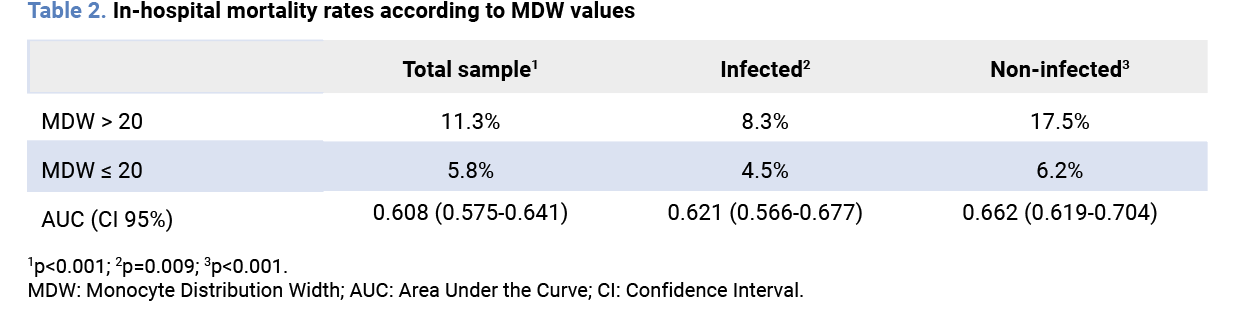
 Regarding the ability to predict in-hospital mortality, MDW yielded a poor AUC of 0.608 (95% CI 0.575–0.641), as shown in Figure 3. However, higher MDW values were associated with greater mortality, both in infected and non-infected patients (Table 2).
Discussion
MDW demonstrated good diagnostic performance, superior to leukocyte count and comparable to CRP for the diagnosis of infection in patients with severity criteria presenting to the emergency department. Its performance remained high even in older subgroups, where CRP loses discriminative capacity, as previously reported [2]. This finding has important clinical implications given the increasing proportion of elderly patients in emergency departments and their higher risk of atypical infection presentations. Leukocyte count showed poor AUC values both in the overall population and in patients aged ≥65 years. Our findings support the emerging role of MDW as a useful biomarker for the early diagnosis of infection in patients with severity criteria in the emergency setting. Advantages of MDW include its automatic availability as part of the complete blood count, without the need for specific requests or additional cost, which facilitates its integration into routine clinical practice in emergency departments. Unlike other biomarkers, MDW does not require additional samples, and its measurement is independent of the clinical context or the requesting physician’s judgment, thereby reducing potential biases in its application. In recent years, several authors have explored novel tools to improve diagnosis and risk stratification of sepsis in the emergency setting, including biomarkers such as MR-proADM or suPAR [11,13], as well as predictive models based on algorithms or artificial intelligence [14]. Compared with these approaches, MDW offers the advantage of being integrated into the complete blood count, available in real time, and at no additional cost, thus enhancing its clinical applicability. Taken together, our results suggest that MDW could be routinely incorporated into algorithms for the suspicion and initial management of sepsis in the emergency department, alongside other measures recommended in sepsis care bundles [6,7]. Its role as a first-line marker, complementary to clinical scoring systems and other biomarkers, deserves validation in multicenter interventional studies. This approach complements current pragmatic recommendations for the initial management of sepsis in the emergency setting, as reported in various national publications [7], and allows progress towards personalised diagnosis according to clinical profiles, as explored in predictive models [8]. Such potential integration is consistent with the growing interest of the Spanish emergency medicine community in biomarkers as real-time clinical tools, as reflected in several recent publications [9–11]. The limitations of this study include its retrospective, observational, single-centre design, which restricts the generalizability of the findings. Although a large cohort was analysed, the absence of systematic microbiological confirmation in all patients may have affected diagnostic classification. However, this reflects usual clinical practice, as hospital discharge diagnosis rather than the initial emergency department impression was used as the reference standard. Furthermore, the study did not assess the impact of MDW on therapeutic decision-making or clinical outcomes, such as time to antibiotic administration or length of hospital stay. Despite these limitations, our findings reinforce the usefulness of MDW as an accessible tool with high added value for the early diagnosis of infection in patients with severity criteria in the emergency department. The consistency with previous studies regarding optimal cut-off values and diagnostic performance suggests clinical robustness that justifies its validation in multicenter cohorts [15].Conclusions
The MDW biomarker is a useful diagnostic tool for the early detection of infection in patients presenting with severity criteria in the emergency department. Its immediate availability, low cost, and performance comparable to or exceeding that of classical biomarkers position it as a relevant candidate for routine incorporation into sepsis suspicion algorithms, particularly in older populations. Multicenter prospective studies are needed to confirm its clinical applicability. Funding None to declare. Conflict of interest The author declares that they have no conflicts of interest. Author contributions GC was the lead clinical investigator and provided statistical advice. ET, MF and DO were involved in manuscript writing. ADA critically reviewed and approved the manuscript. All authors have read and agreed to the published version of the manuscript.References
- Singer M, Deutschman CS, Seymour CW, Shankar-Hari M, Annane D, Bauer M, et al. The Third International Consensus Definitions for Sepsis and Septic Shock (Sepsis-3). JAMA. 2016;315(8):801-10. Available from: https://doi.org/10.1001/jama.2016.0287
- Yañez Palma MC, Roman F, Llopis-Roca F, Fragiel M, Julián Jiménez A, et al. Utility of the medial region of pro-adrenomodulin for the detection of true bacteremia in elderly patients treated in the emergency department for suspected infection. Rev Esp Quimioter. 2024; 37(1):78-87. Available from: https://doi.org/10.37201/req/110.2023
- López Izquierdo R, Del Pozo Vegas C, Del Rey Vieria A, García Rupérez I, Sanz García A, Martín Rodríguez F. Utilidad de la escala mSOFA para la valoración pronóstica de los pacientes diagnosticados de sepsis en un servicio de urgencias hospitalario. Emergencias. 2025; 37:235. Available from: http://doi.org/10.55633/s3me/040.2025
- Gamazo del Río JJ, López Izquierdo R, Delgado Cárdenas G, Estella A, García DE, Julián-Jiménez A. Extracción de hemocultivos a pacientes adultos atendidos en el servicio de urgencias con sospecha de infección grave o sepsis. Emergencias. 2025; 37:131-40.
- Rodríguez MR, Llopis Roca F, Rubio Díaz R, García DE, Julián-Jiménez A. Administración precoz de la antibioterapia empírica en los pacientes atendidos con sospecha de sepsis en el servicio de urgencias: revisión sistemática. Emergencias. 2025; 37:44-55.
- Carbó Díez M, Osorio Quispe G, Fresco Quindós L, Miota Hernández N, Perea Gainza M, Ortega Romero MM. Cumplimiento del paquete de medidas en las primeras tres horas en urgencias y su relación con el pronóstico de los pacientes mayores de 65 años con sepsis. Emergencias. 2024; 36:179-87.
- Cancella de Abreu M, Freund Y. Conjunto de medidas para la sepsis y consideraciones pragmáticas desde el servicio de urgencias. Emergencias. 2024; 36:164-5.
- Melero Guijarro L, Martín-Rodríguez F, Álvarez Manzanares J, del Pozo Vegas C, Sanz García A, Castro Villamor MA, et al. Modelo de riesgo de mortalidad a largo plazo en pacientes con infección atendidos por servicios de emergencias prehospitalarios. Emergencias. 2024; 36:088-096.
- Torrella Esteban P, Rodríguez Rojas C, Wikström Fernández S, Murillo Herrera A, Garrido Orta P, Montoro Jorquera E, et al. Utilidad del biomarcador MR-proADM para la estratificación del riesgo en pacientes con tumores sólidos atendidos en urgencias por neutropenia febril secundaria a quimioterapia. Emergencias. 2024; 36:417-24
- Mòdol Deltell JM, Robert Boter N. Biomarcadores en urgencias: ¿una carrera sin fin?. Emergencias. 2024;36:4-6
- Herrero-Puente P, Eugen-Olsen J, Ferreras Amez JM, Gamazo del Río J, Prieto-García B, de las Heras-Vallelado A, et al. Capacidad del biomarcador suPAR para estratificar el pronóstico en pacientes atendidos en servicios de urgencias hospitalarios. Emergencias. 2024; 36:17-24
- Encabo M, Hernández-Álvarez E, Oteo D, García-Álvarez A, Martínez-Novillo González M, et al. Monocyte distribution width (MDW) as an infection indicator in severe patients attending in the Emergency Department: a pilot study. Rev Esp Quimioter. 2023; 36(3):267-274. Available from: https://doi.org/10.37201/req/108.2022
- de Rafael-González E, Cabañas-Morafraile J, Serrano-Martín L, Julián-Jiménez A, Torres-Fernández M, Chaves-Prieto E, et al.; Grupo URGEN-LABQMI, CHUT, Instituto de Investigación Sanitaria de Castilla La Mancha (IDISCAM). Ability of midregional proadrenomedullin (MR-proADM) to predict poor clinical outcome and stratify prognosis in adult patients seen for suspected infection in the Emergency Department. Rev Esp Quimioter. 2025:031.2025. Available from: https://doi.org/10.37201/req/031.2025
- Muelas González M, Torner Marchesi E, Peláez Díaz G, Ramos Aranguez M, Cabañas Morafraile J, López Forero W, et al. grupo INFURG-SEMES (grupo de estudio de infecciones de la Sociedad Española de Medicina de Urgencias y Emergencias). Usefulness of the MPB-INFURG-SEMES model to predict bacteremia in the patient with solid tumor in the Emergency Department. Rev Esp Quimioter. 2024; 37(3):257-265. Available from: https://doi.org/10.37201/req/004.2024
- Ciaccio AM, Agnello L, Sasso BL, Giglio RV, Iacona A, Gambino CM, et al. Monocyte Distribution Width (MDW) as a biomarker of sepsis: An evidenced-based laboratory medicine approach. Clin Chim Acta. 2023; 540:117214. Available from: https://doi.org/10.1016/j.cca.2022.117214.
Explore
Articles
Volumes
About the journal
Most read
Recomendaciones para la prevención y el tratamiento de las infecciones respiratorias en adultos mayores institucionalizados
Revista Española de Quimioterapia
Acute infectious gastroenteritis in childhood: the role of rapid multiplex molecular syndromic panels in diagnosis and clinical management
Revista Española de Quimioterapia
Características epidemiológicas de pacientes con aislamientos de Enterobacterales productores de carbapenemasas-NDM en un hospital de alta complejidad
Revista Española de Quimioterapia
Review on the management of intra-abdominal candidiasis
Revista Española de Quimioterapia
Neoscytalidium dimidiatum: a rare locally acquired deep cutaneous infection in a renal transplant recipient
Revista Española de Quimioterapia